
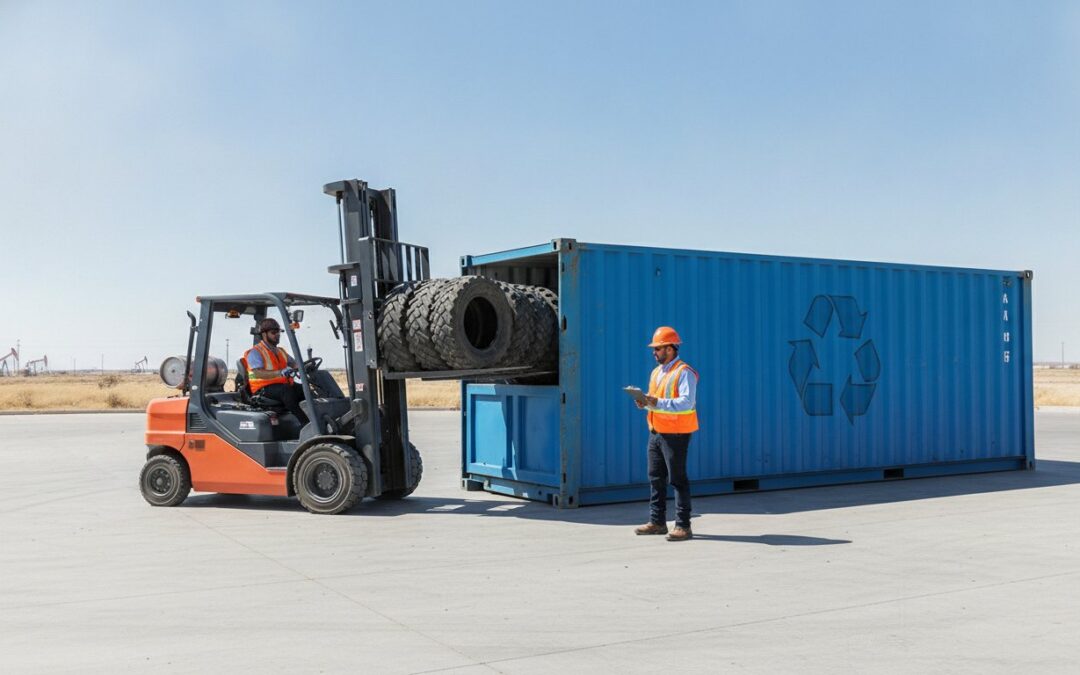
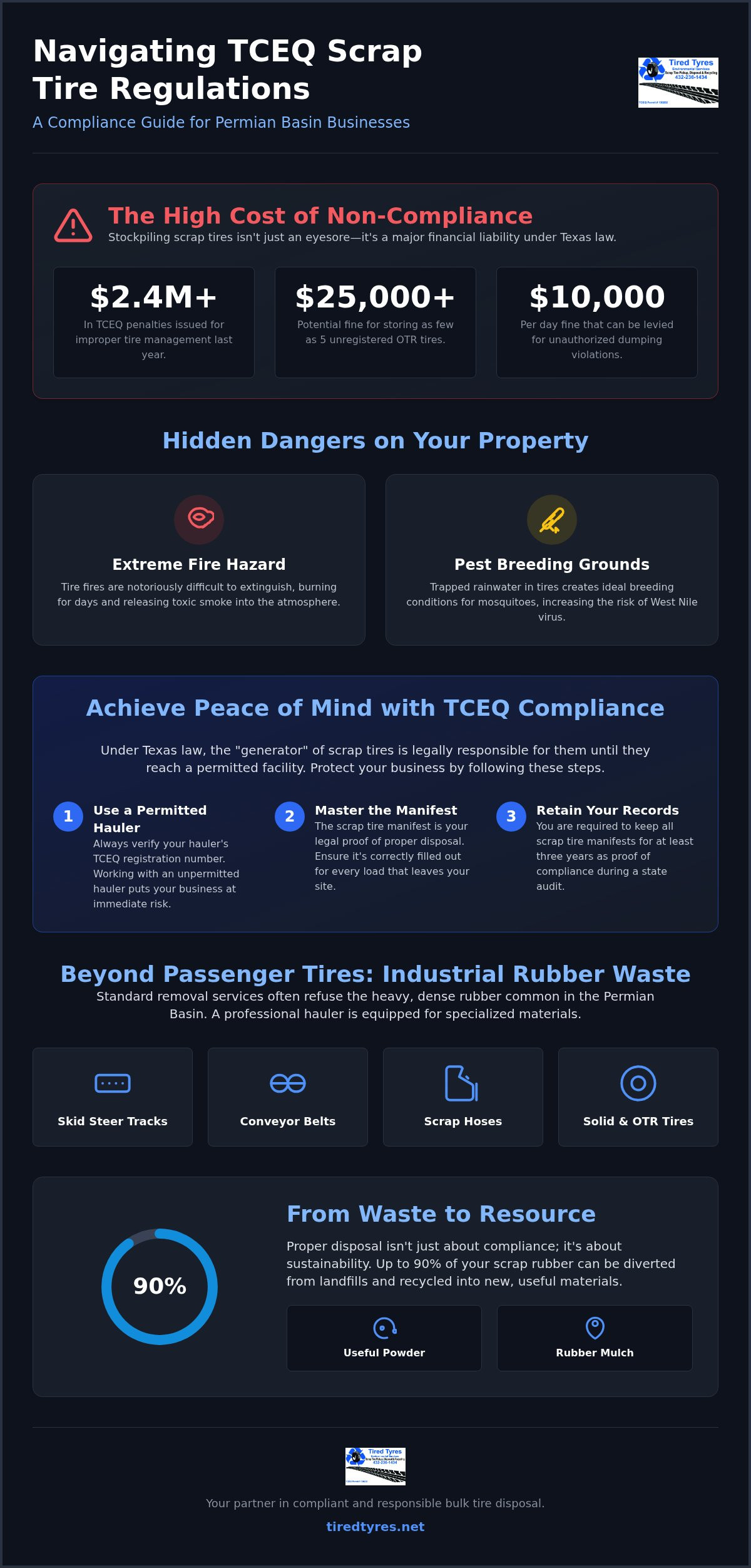
Did you know the TCEQ issued more than $2.4 million in penalties for improper scrap tire management just last year? For businesses in the Permian Basin, a growing stockpile isn’t just an eyesore; it’s a massive financial liability. If you’re managing a fleet or an industrial site, finding a reliable solution for bulk tire disposal Odessa becomes a top priority before the next inspection. Storing just five unregistered OTR tires can trigger fines exceeding $25,000, making “getting around to it” a risky strategy.
It’s frustrating to see valuable yard space wasted by rubber piles, especially when the threat of a $10,000 per day fine looms over your operations. This guide teaches you how to legally and efficiently manage large-scale scrap tire removal while staying compliant with Texas environmental laws. You’ll learn about the manifest system, the benefits of using a state-permitted hauler, and how 90% of your waste can be recycled into useful powder or mulch. We’ll break down the 2026 regulations so you can clear your property with total peace of mind.
Key Takeaways
- Identify the environmental and financial risks of scrap tire accumulation and why Odessa industries face unique disposal challenges.
- Master the TCEQ manifest system to ensure your business remains compliant and avoids liability for illegal dumping.
- Compare the limitations of local landfills against the efficiency of state-permitted professional collection for large-scale rubber waste.
- Follow a two-step site preparation plan to streamline your bulk tire disposal Odessa and ensure fast, safe pickups.
- Discover specialized removal solutions for industrial rubber waste like skid steer tracks and conveyor belts that standard services often refuse.
The Growing Challenge of Bulk Tire Disposal in Odessa
Odessa businesses face a unique set of logistical hurdles when it comes to waste management. In the heart of the Permian Basin, the sheer volume of rubber waste generated by oil field services and heavy agriculture is staggering. Unlike residential junk, industrial bulk waste consists of massive, heavy materials that don’t fit in a standard dumpster. Managing bulk tire disposal Odessa requires more than just a trailer and a spare afternoon; it requires a strategy that accounts for the constant wear and tear of 24/7 operations.
Ignoring a growing pile of rubber is a gamble with high stakes. Beyond the visual clutter, these stockpiles represent a significant fire hazard. Tire fires are notoriously difficult to extinguish, often burning for days and releasing toxic smoke. In the West Texas climate, even a small amount of trapped rainwater turns tires into ideal breeding grounds for mosquitoes, increasing the risk of West Nile virus. The hidden costs of these piles include potential TCEQ fines, increased insurance premiums, and the loss of usable operational space.
Tire Accumulation in the Permian Basin
The Permian Basin’s economy runs on heavy machinery. Semi-trucks hauling equipment and OTR (Off-the-Road) vehicles working the fields chew through rubber at an accelerated rate. Odessa’s intense summer heat bakes abandoned tires, making them brittle and harder to process over time. Many site managers don’t realize they’ve reached a legal “tipping point” until it’s too late. Under Texas law, storing as few as 50 scrap tires can trigger registration requirements. Once you cross that threshold, your property is no longer just a yard; it’s a regulated storage site subject to strict oversight.
Beyond Passenger Tires: Industrial Rubber Waste
Standard junk removal companies usually focus on furniture or residential debris. They lack the specialized equipment to handle the dense, steel-reinforced rubber found on industrial sites. This is a major gap for Odessa businesses dealing with more than just passenger tires. Specialized disposal is a necessity for items such as:
- Skid steer tracks: These are heavy, awkward, and nearly impossible to move without professional machinery.
- Conveyor belts: Often used in mining or material handling, these long, heavy strips of rubber are a major disposal headache.
- Scrap hoses and solid tires: Common in oil field maintenance, these materials require specific processing to be recycled.
Understanding modern Tire recycling processes helps illustrate why these materials can’t just be tossed into a standard bin. Most industrial rubber requires heavy-duty shredding or grinding before it can be repurposed. Because standard haulers often refuse these items, they end up sitting in “temporary” piles that quickly become permanent liabilities. Professional collection is the only way to ensure these specialized materials are handled correctly and kept out of local landfills.
Texas Scrap Tire Regulations: Staying TCEQ Compliant
In 2026, the Texas Commission on Environmental Quality (TCEQ) has intensified its focus on scrap tire management. A TCEQ-permitted hauler isn’t just someone with a truck; they’re a registered entity that follows strict transportation and reporting protocols. Working with an unpermitted hauler puts your business at immediate risk. The Texas scrap tire manifest is the legal proof of proper disposal required for all commercial entities. Without this document, your business has no defense if those tires are later found in an unauthorized dump site.
The financial consequences of non-compliance are severe. TCEQ issued over $2.4 million in penalties for improper tire management in 2025 alone. Unauthorized dump sites can trigger fines of up to $25,000 per day. These costs often exceed the price of professional bulk tire disposal Odessa by a wide margin. When you pay for a permitted service, you aren’t just paying for hauling; you’re paying for a legal shield that protects your company from state enforcement actions.
The Legal Responsibility of the Generator
Under Texas law, the business that “generates” the scrap tire remains legally responsible for that tire until it reaches a permitted processing facility. This means if a hauler dumps your tires in a West Texas canyon, the state can trace them back to you. You should always verify a hauler’s permit status by asking for their TCEQ registration number before any rubber leaves your property. In Ector County, you’re required to keep all scrap tire manifests for at least three years to prove your compliance during an audit.
State regulations mirror broader federal scrap tire cleanup initiatives designed to reduce environmental hazards. These rules ensure that tires don’t end up in landfills whole, which is illegal in Texas. By maintaining a clean paper trail, you demonstrate that your industrial operation is committed to the “Keep Texas Beautiful” mission while avoiding the attention of environmental inspectors.
Avoiding Illegal Dumping Fines in Odessa
A common mistake for Odessa auto shops and industrial sites is handing tires over to “pickers” who offer free or low-cost removal. These individuals often lack the required state permits and have no way to provide a legal manifest. They may strip the tires for resale and dump the leftovers in remote areas of the Permian Basin. This practice is a trap for the generator. Professional collection protects your bottom line by ensuring every tire is accounted for from pickup to the recycling plant.
Don’t assume that local landfills will accept your bulk loads without prior processing. Texas law requires tires to be split, quartered, or shredded before landfill disposal. If you’re looking for a hassle-free way to manage recurring pickups, consulting with a state-permitted hauler is the most efficient way to stay on the right side of the law.
Odessa Disposal Options: Landfills vs. Professional Collection
Odessa businesses often look for the most direct route to clear yard space. While the City of Odessa directs residents to the Republic Services Charter Waste Landfill on Murphy Street, commercial entities face a much steeper climb. Landfills aren’t designed to handle massive volumes of rubber at once. They often impose strict daily limits on tire counts for commercial users. If you have a stockpile of 200 tires, you might spend a week just getting them through the gate. This makes bulk tire disposal Odessa a complex logistical puzzle for any site manager trying to stay on schedule.
The true cost of self-hauling is often hidden in labor and equipment wear. Loading a flatbed with heavy semi-truck tires is a high-risk activity for your staff. Between the fuel costs, landfill tipping fees, and the hours spent waiting in line, the “DIY” approach rarely saves money. When you factor in the requirement to process tires before they even arrive, the scale tips heavily in favor of professional collection.
Municipal Landfill Limitations
Texas state law is clear: tires must be split, quartered, or shredded before they enter a landfill. Most Odessa businesses don’t own the heavy machinery required to process tires this way. Even if you do, the labor costs of processing and loading can quickly exceed the cost of professional service. Large OTR and agricultural tires are frequently rejected at municipal facilities because they’re too large for standard processing equipment. Self-hauling requires multiple trips and specialized trailers that many businesses simply don’t have on hand.
The Benefits of On-Site Bulk Collection
Professional collection shifts the entire burden of labor and compliance to the hauler. Instead of your team wrestling with heavy rubber waste, a specialized fleet handles the heavy lifting directly from your yard. This is especially vital for Odessa auto shops and industrial sites that generate waste on a recurring basis. Scheduled pickups keep your property clean without you having to lift a finger or pull staff away from their primary duties.
Choosing professional collection also supports the “Keep Texas Beautiful” mission. Unlike landfills that simply bury the problem, state-permitted haulers ensure tires go to a recycling facility. About 90% of the material collected is recycled into powder or mulch, giving new life to old rubber. If you’re ready to clear your property efficiently, scheduling a professional pickup is the most responsible way to handle large volumes of waste.
How to Prepare Your Site for a Bulk Tire Pickup
Preparing your facility for a bulk tire disposal Odessa pickup ensures the process is safe, fast, and cost-effective. A disorganized pile leads to delays and potential safety hazards for both your staff and the hauling crew. By following a clear staging protocol, you can minimize downtime and ensure your property is cleared without complications. Efficiency starts the moment you decide to clear the yard.
First, sort your inventory by type. Grouping passenger tires, semi-truck tires, and OTR rubber allows for a much smoother loading process. Second, verify site accessibility. Heavy haulers need wide turn radiuses and solid ground to maneuver safely. Third, remove excessive debris. While some dust is expected in West Texas, tires buried under mud or mixed with scrap metal are harder to process. Finally, estimate your total volume. Knowing the approximate count helps the hauler dispatch the correct equipment for the job.
Sorting and Organization for Faster Loading
Separating passenger tires from heavy OTR tires is a practical necessity. Because the recycling process for a standard car tire differs from a massive tractor tire, keeping them distinct simplifies the manifest documentation. If you have tires still mounted on rims, keep them in a separate stack. Most industrial collection services handle rims differently than loose rubber. Staging your tires in a central, open location allows a loader to clear the area in a single pass. This organization reduces the time the hauling crew spends on your site, allowing your operations to return to normal faster.
Site Access and Safety Requirements
Large-scale collection trucks and trailers require significant clearance. In oil field or agricultural environments, you must ensure the path to your tire pile is free of parked equipment, narrow gates, or debris. Safety is the top priority when handling heavy agricultural and industrial rubber. The pickup area should be level and firm to support the weight of a loaded trailer. Avoid staging tires under low-hanging power lines or on soft, sandy soil that could trap a heavy vehicle. If your site has specific safety protocols or gate codes, communicate these to the hauler well in advance. Clear communication prevents site bottlenecks and ensures a professional, incident-free removal. Ready to clear your yard? You can schedule your pickup today to get your industrial site back to peak efficiency.
Reliable Bulk Rubber and Tire Collection with Tired Tyres
Tired Tyres operates as a state-permitted hauler with a clear focus on the industrial demands of West Texas. Our specialized fleet is engineered to manage the logistics of bulk tire disposal Odessa, specifically targeting the heavy OTR and agricultural tires that standard junk removal services often leave behind. We understand that your property is for operations, not storage. By deploying specialized trailers and loading equipment, we ensure that even the largest rubber stockpiles are cleared efficiently and safely.
Our capabilities extend far beyond standard tire collections. We provide comprehensive removal for industrial rubber waste, including scrap skid steer tracks, conveyor belts, and industrial hoses. These materials are common in oil field maintenance but are notoriously difficult to dispose of through traditional channels. We handle the heavy lifting and the regulatory paperwork, providing you with the necessary manifests to prove your compliance with state law. Our team treats every site with the precision and professionalism your business expects.
Serving the Permian Basin Industrial Sector
Oil field service companies and heavy equipment yards require a partner who understands the pace of the Permian Basin. We offer tailored solutions that fit your specific workflow, whether you need a one-time site remediation or a scheduled route service. Odessa tire shops and dealerships benefit from our reliable pickup windows, ensuring that scrap inventory never reaches a point of legal liability. Our commitment to legal transparency means you receive accurate documentation for every load, protecting your business from the risks of unpermitted hauling.
If you’re dealing with a significant accumulation of rubber waste, you can request a custom quote for large-scale site remediation. We assess the volume and type of material to provide a clear, professional plan for removal that fits your budget and timeline.
From Scrap to Sustainability: The Recycling Process
Our “Keep Texas Beautiful” mission drives us to divert as much material as possible from landfills. Currently, 90% of the waste we collect is recycled into useful products like rubber mulch, asphalt additives, and industrial mats. This process significantly reduces the environmental footprint of Odessa’s industrial sector and keeps West Texas landscapes free of hazardous stockpiles. Our state-permitted process supports a circular economy for West Texas rubber waste by ensuring that every scrap tire finds a new purpose rather than a permanent home in the ground. By choosing a recycling-focused hauler, you ensure your business contributes to a more sustainable future for the local community while maintaining a clean, compliant facility.
Take Control of Your Property and Compliance
Managing a large-scale rubber stockpile in the Permian Basin doesn’t have to be a constant source of stress. By choosing a state-permitted hauler, you eliminate the risk of heavy TCEQ fines and ensure that your business stays on the right side of Texas environmental law. We’ve explored how professional collection simplifies the logistics of handling heavy OTR and agricultural tires while protecting your yard from fire hazards and mosquito breeding grounds.
Efficient bulk tire disposal Odessa is about more than just clearing space; it’s about industrial responsibility. Our specialized equipment handles everything from semi-truck tires to scrap conveyor belts, and our 90% recycling rate means your waste supports a cleaner West Texas. You don’t have to navigate complex manifest requirements or landfill daily limits on your own.
Get a Bulk Tire Pickup Quote for Your Odessa Site to clear your property and receive the legal documentation you need. It’s time to get your industrial yard back to peak efficiency with a partner you can trust.
Frequently Asked Questions
Is it illegal to store a large pile of tires on my property in Odessa?
Yes, storing more than 50 scrap tires on the ground without a TCEQ registration is a violation of state law. In Odessa, outdoor piles must not exceed 15 feet in height or 8,000 square feet. Storing just five unregistered OTR tires can lead to fines exceeding $25,000. These regulations prevent fire hazards and mosquito breeding, ensuring your industrial site remains safe and compliant with Texas environmental standards.
How much does it cost to dispose of tires in bulk in Ector County?
Bulk disposal costs vary based on the tire type, size, and total volume of the load. Passenger tires have different rates compared to heavy duty truck or industrial OTR tires. Agricultural tires are often calculated by weight rather than a flat per unit fee. To get an accurate figure for your specific site, it’s best to request a custom quote that accounts for the logistics of your bulk tire disposal Odessa project.
Do I need a special permit to transport my own scrap tires to a landfill?
You typically don’t need a hauler permit to transport your own tires, but you must still comply with landfill processing rules. Texas law requires that all tires be split, quartered, or shredded before they can be legally disposed of in a landfill. Most businesses find that the labor and equipment costs of processing tires themselves are far higher than hiring a state-permitted hauler who manages the entire transportation and documentation process.
What is a tire manifest and why does my business need one?
A tire manifest is a multi-part tracking document that serves as your legal proof of proper disposal. It records the number of tires, the generator’s information, the hauler’s permit number, and the destination facility. In Ector County, commercial entities are required to keep these records for at least three years. If an inspector audits your facility, the manifest is the only document that protects you from liability for illegal dumping.
Can you pick up heavy OTR and agricultural tires from a farm or oil field?
Yes, we utilize specialized industrial equipment specifically designed to handle massive OTR and agricultural tires directly from your site. Whether you’re managing a ranch or an oil field maintenance yard, our fleet can navigate Permian Basin terrain to reach your stockpile. We handle the heavy loading and transportation, so your team doesn’t have to risk injury or equipment damage moving these oversized and awkward scrap materials themselves.
What happens if I hire an unpermitted person to take my tires away?
Hiring an unpermitted hauler leaves your business legally vulnerable. Under Texas law, the generator remains responsible for the tires until they reach a permitted facility. If an unlicensed “picker” dumps your tires in a remote area, the state can trace them back to you, resulting in fines of up to $25,000 per day. You also lose the protection of a legal manifest, leaving you with no defense during a TCEQ audit.
Do you handle other rubber waste like skid steer tracks or conveyor belts?
Yes, we specialize in the collection of industrial rubber waste that standard junk removal services often refuse. This includes scrap skid steer tracks, conveyor belts, solid tires, and industrial hoses commonly found in Odessa’s oil field operations. We provide a comprehensive solution for all your rubber waste, ensuring these dense and difficult materials are recycled properly rather than taking up valuable space or creating hazards on your industrial property.
How do I schedule a bulk tire pickup for my Odessa business?
Scheduling a pickup is a direct and efficient process. You can contact us through our website to provide details about your tire inventory, including the types and approximate volume. We’ll provide a tailored plan for your bulk tire disposal Odessa needs, whether you require a one-time site cleanup or recurring scheduled route services. Once the plan is confirmed, our state-permitted team arrives with the right equipment to clear your yard and provide your manifest.