
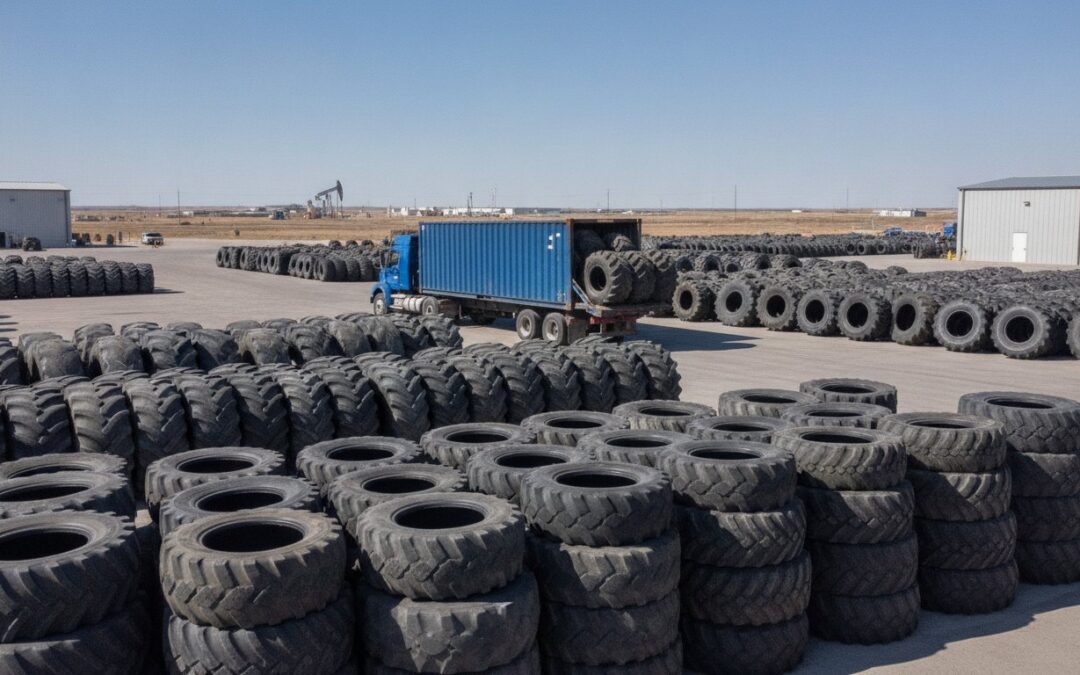
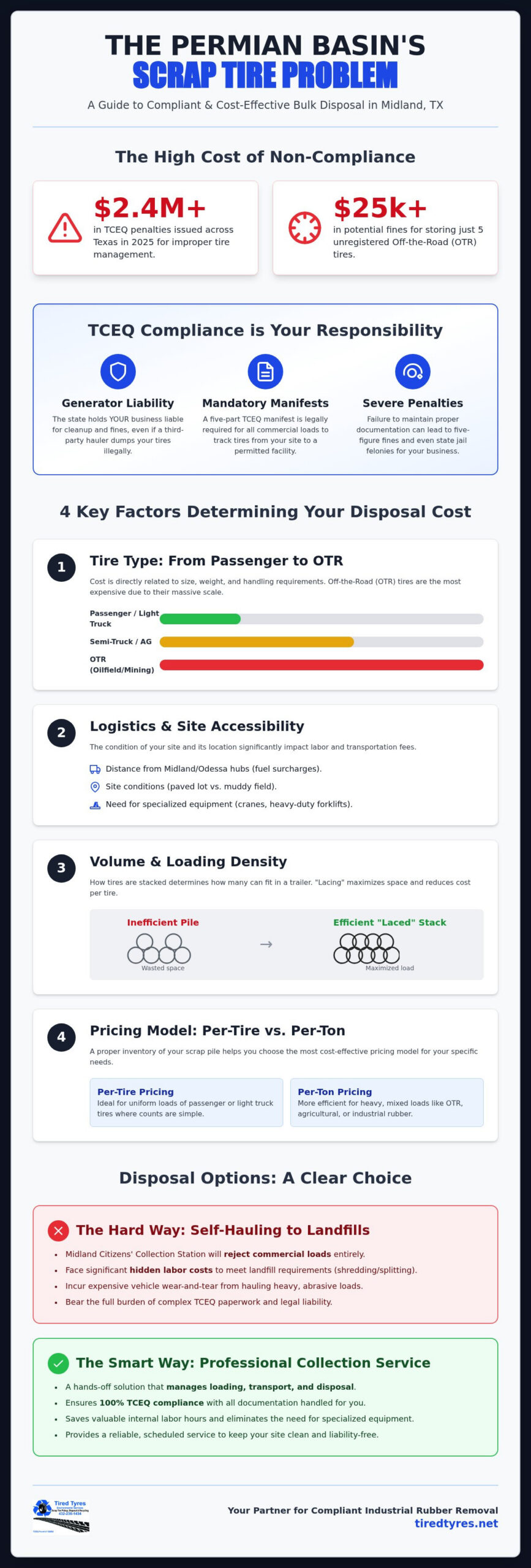
Did you know that improper scrap tire management led to over $2.4 million in TCEQ penalties across Texas in 2025? In the Permian Basin, storing just five unregistered OTR tires can trigger fines exceeding $25,000. For businesses in Midland, a growing pile of heavy-duty rubber isn’t just an eyesore; it’s a massive financial and legal liability. You already know that the local landfill won’t accept whole tires, and trying to manage OTR tire disposal Midland on your own often leads to hidden hauling costs and complex paperwork.
It’s frustrating to balance the need for a clean job site with the strict manifest requirements set by the state. We’ll help you understand the specific factors that drive bulk disposal costs in 2026, from tire classification to volume discounts. This guide provides a clear roadmap for budgeting for legal, TCEQ-compliant removal while ensuring you have the documentation needed to avoid state jail felonies. You’ll learn how to identify a reliable hauling partner and what to look for in a scheduled pickup service to keep your operations running smoothly.
Key Takeaways
- Learn how tire classification and loading density, such as “lacing” techniques, directly influence your total disposal costs.
- Understand the 2026 TCEQ manifest requirements to ensure your OTR tire disposal Midland remains fully legal and audit-ready.
- Compare City of Midland landfill gate fees against the hidden labor and vehicle wear costs of self-hauling heavy commercial loads.
- Discover how to perform a proper inventory of your scrap pile to choose between more efficient per-tire or per-ton pricing models.
- Identify why specialized industrial rubber removal is essential for businesses in the Permian Basin to avoid significant environmental penalties.
Understanding the Bulk Tire Disposal Landscape in Midland
Midland’s rapid expansion in the energy and agricultural sectors has created a logistical bottleneck for waste management. While residential tire disposal is often handled through municipal events, commercial entities face a different reality. In the context of 2026 Texas waste management, bulk disposal is defined as the regulated collection and transport of scrap tires exceeding 500 units or any volume of industrial rubber that necessitates formal TCEQ manifest tracking. This scale of waste is part of the global challenge of tire waste, where large-scale accumulation requires professional intervention to prevent environmental hazards like tire fires or pest breeding grounds.
Commercial vs. Residential Disposal Rules
The distinction between a homeowner and a business is strictly enforced in West Texas. The Citizens’ Collection Station in Midland is designed for residents and will reject commercial loads entirely. Municipal curbside pickups also have low volume limits, usually capping at only a few tires per household. For businesses, the Texas Commission on Environmental Quality (TCEQ) shifts the entire burden of responsibility onto the generator. You’re legally required to ensure your scrap ends up at a permitted facility. If a hauler dumps your tires illegally, the state holds your business liable for the cleanup and associated fines.
The Impact of the Permian Basin Economy on Waste
The heavy machinery powering the Permian Basin doesn’t use standard tires. Oilfield service trucks, tractors, and earthmovers generate massive OTR (Off-the-Road) scrap that municipal systems aren’t equipped to process. These tires require specialized equipment for loading and hauling due to their extreme weight and size. As landfill space in Midland and Odessa becomes more expensive and restrictive, businesses are finding that self-hauling is no longer cost-effective. Professional OTR tire disposal Midland requires a partner who understands the industrial scale of the local economy and possesses the right fleet to handle heavy-duty rubber.
Improperly storing or dumping tires carries severe penalties. Under Texas law, failing to maintain a five-part manifest for commercial loads is a violation that can lead to five-figure fines. Businesses typically choose between two main channels for removal:
- Municipal Landfills: These facilities often require tires to be shredded or split before acceptance. This adds significant labor costs for the business before the tires even leave the site.
- Permitted Haulers: Specialized services manage the loading, transportation, and TCEQ documentation. They offer a hands-off solution for high-volume sites, ensuring OTR tire disposal Midland stays within legal boundaries while saving on internal labor hours.
4 Key Factors That Determine Bulk Tire Disposal Cost
Budgeting for scrap rubber removal in West Texas requires more than a simple headcount of tires. Costs are driven by the logistical reality of moving heavy rubber across the Permian Basin. The national scrap tire management report highlights how processing requirements shift based on tire size and material composition. In Midland, four specific variables influence your final invoice.
Tire Type: From Passenger to OTR
Standard Passenger and Light Truck (PLT) tires are the baseline for pricing. They’re uniform and easy to stack. Semi-truck and agricultural tires carry higher premiums because they require more physical space and labor. However, OTR tire disposal Midland represents the highest cost tier. These massive tires, used in mining and oilfield operations, often require specialized cranes or heavy-duty forklifts just to move them onto a trailer. The sheer weight and specialized processing needed for these oversized units mean they’re never priced the same as standard commercial rubber.
Logistics and Site Accessibility
Distance is a major factor. If your site is far from the Midland or Odessa hubs, fuel surcharges and driver time will increase the total. Site conditions also matter. Loading a staged stack on a paved lot is much faster than excavating a scattered pile from a muddy field. For industrial sites, handling specialized items like scrap conveyor belts or solid tires requires specific equipment, which can add to the setup fee. If you need a consistent partner to keep your yard clear, you can schedule a professional tire collection to manage your inventory before it becomes a liability.
Volume and density change how much you pay per load. Interweaving tires in a laced pattern maximizes trailer space. This is especially important for OTR tire disposal Midland, where the scale of the rubber makes transport efficiency critical. A dense load reduces the number of trips required, which directly lowers your hauling costs.
Contamination levels also play a role. If your tires are still on rims, they require extra labor to separate before they can be recycled. Mud, debris, or standing water inside the tires increases the weight significantly. Since many disposal facilities charge by the ton, paying to haul West Texas dirt or rainwater can unnecessarily inflate your budget. Keeping your scrap pile covered and staged on a clean surface is the easiest way to control these hidden expenses.
Midland Landfill Fees vs. Professional Collection Services
Choosing between the City of Midland Landfill and a professional service often comes down to more than just the gate fee. While municipal facilities provide a necessary service, their rules for commercial loads are strict and labor-intensive. For example, the City of Midland landfill does not accept whole tires. Every unit in your load must be split, shredded, or quartered before you even arrive at the scale. This requirement forces businesses to invest in heavy-duty cutting equipment or spend dozens of man-hours preparing a single trailer load before transport.
The Reality of Hauling to the Landfill
Self-hauling involves significant “soft costs” that don’t appear on a receipt. Commercial vehicles at the landfill often face long wait times during peak hours, pulling your team away from productive work. There’s also the matter of vehicle wear; hauling tons of industrial rubber puts immense strain on transmissions and tires. Most importantly, the safety risks are substantial. Loading and unloading heavy OTR or semi tires manually increases the chance of workplace injuries and associated insurance claims. When you factor in fuel and the $25 access fee for non-permitted haulers, the DIY approach often costs more than a professional pickup.
Manifest Compliance: The Professional Advantage
Legal protection is the most critical benefit of professional OTR tire disposal Midland. The TCEQ requires a five-part manifest (Form TCEQ-10304) for every commercial tire transaction. This document tracks the waste from your site to the final disposal point, serving as your primary defense against illegal dumping allegations. If your tires are found in an unauthorized location, that manifest proves you followed the law and transferred the waste to a permitted hauler. This is a non-negotiable requirement for businesses that want to avoid state jail felonies and heavy environmental fines.
Managing this paperwork in-house is a logistical headache for many West Texas managers. Professional services take over the entire administrative burden, ensuring every load is documented and filed correctly. You can find more detail on these requirements in our guide to Texas Tire Disposal Regulations: A 2026 Guide for West Texas Businesses. By outsourcing OTR tire disposal Midland, you aren’t just paying for a truck; you’re investing in a reliable system that guarantees full environmental compliance and protects your business from third-party liability.
Estimating Your Budget for Bulk Tire Removal
Accurate budgeting starts with a precise inventory of your scrap pile. Commercial quotes in West Texas aren’t one-size-fits-all; they depend on the specific mix of rubber you’ve accumulated. While a residential user might think in terms of a few tires, a business must account for weight, volume, and the specialized equipment needed for loading. If you’re managing a site with mixed waste, separating your passenger tires from heavy-duty industrial rubber is the first step toward getting a realistic cost estimate.
Calculating Volume and Load Size
Estimating the number of tires in a large, unorganized pile can be difficult. You can approximate the count by measuring the square footage of the pile’s footprint and its average height. A standard 24-foot box truck can typically accommodate between 100 and 150 semi-truck tires depending on how tightly they are laced. To estimate the weight of a scrap tire pile for budgeting, multiply the total count of tires by their average category weight, such as 22 pounds for passenger tires or 110 pounds for standard semi-truck tires. For OTR tire disposal Midland, the weight is the primary cost driver since a single earthmover tire can weigh as much as 20 or 30 passenger tires combined.
Contractual vs. On-Call Pricing
The frequency of your service significantly impacts your long-term waste management budget. On-call pickups are ideal for property managers dealing with a one-time site remediation or an emergency cleanup. However, auto shops and industrial yards in the Midland-Odessa area usually find better value in scheduled monthly or quarterly pickups. Regular service prevents piles from growing into a TCEQ violation and allows for more efficient route planning, which can lower your per-trip fee.
Be aware of factors that lead to extra charges. Tires still mounted on rims require additional labor for separation. Piles that are difficult to access with a large trailer or those contaminated with heavy mud and debris will also increase the labor hours required for the job. Beyond tires, remember to budget for other industrial rubber waste. Items like scrap skid steer tracks, industrial hoses, and conveyor belts don’t fit standard “per tire” models and are typically billed by weight. To get a clear picture of your specific needs, you can request a bulk removal quote to see how a professional service fits into your 2026 operational budget.
Why Tired Tyres is Midland’s Choice for Bulk Disposal
General junk removal companies often struggle with the sheer scale of West Texas industrial waste. Most haulers lack the specialized trailers and heavy-lifting equipment required for OTR tire disposal Midland. We’ve built our operations specifically to serve the Permian Basin’s unique demands. We don’t just pick up trash; we manage a high-stakes waste stream that requires technical knowledge and a fleet capable of moving tons of industrial rubber in a single trip. Our team understands that for a Midland business, a reliable disposal partner is a critical part of maintaining a safe, compliant job site.
Our Permian Basin Service Area
We maintain dedicated routes through Midland, Odessa, and Lubbock to ensure consistent service for our commercial partners. This local focus allows us to respond quickly to site remediation needs and stay ahead of regional regulatory shifts. We’re deeply familiar with West Texas environmental standards and the specific logistical challenges of oilfield and agricultural sites. For a deeper look at the local landscape, see our article on Tire Disposal in Midland, TX: The Complete Guide to Legal Scrap Removal. Our presence in these hubs means we aren’t just passing through; we’re a permanent part of the local industrial infrastructure.
Industrial Rubber Experts
Our expertise extends far beyond standard passenger tires. We specialize in the difficult items that municipal landfills and generalists often reject. This includes:
- OTR Tire Collection: Handling the massive rubber used in mining and earthmoving.
- Industrial Components: Efficient removal of scrap conveyor belts and industrial hoses.
- Heavy Machinery Tracks: Specialized collection of scrap skid steer tracks and solid tires.
Choosing a specialized partner for OTR tire disposal Midland means you won’t have to worry about whether the equipment arriving at your site is up to the task. We use heavy-duty loaders and high-capacity trailers designed for the density of industrial rubber. You can find more information on our regional capabilities in our Commercial Tire Disposal in Midland, Odessa & Lubbock: The 2026 Guide. We take full responsibility for the TCEQ manifest process, providing the documentation you need to prove your business is meeting its environmental obligations. Our goal is to provide a direct, professional solution that removes the burden of waste management from your shoulders.
Secure Your Permian Basin Operations Today
Managing scrap rubber in the Permian Basin doesn’t have to be a legal or financial headache. By understanding how tire classification and volume density impact your budget, you can make informed decisions that keep your yard clear and your operations efficient. The true cost of disposal always includes the risk of non-compliance. Skipping a TCEQ manifest is a liability no business can afford in 2026, especially with state penalties reaching record highs.
Whether you’re dealing with standard passenger loads or complex OTR tire disposal Midland, the right equipment and local expertise make the difference. We provide the specialized trailers and documentation needed for heavy industrial rubber, serving clients across Midland, Odessa, and Lubbock with professional precision. Take the guesswork out of your waste management and ensure your site stays audit-ready and environmentally responsible. It’s about more than just moving rubber; it’s about protecting your business from unnecessary risk.
Get a Custom Bulk Tire Pickup Quote in Midland and let our team handle the heavy lifting and TCEQ manifest paperwork for you. We’re ready to help you clear your site today.
Frequently Asked Questions
How much does it cost to dispose of a tire at the Midland landfill?
The fee for self-hauling tires to the City of Midland landfill typically ranges from $3 to $7 per unit for standard passenger or light truck sizes. You must also pay a $25 access fee if you don’t have a Garbage Hauler’s Permit. It’s important to remember that the landfill requires tires to be split or shredded before they arrive; they won’t accept whole units at the gate.
Do I need a permit to haul my own scrap tires in Texas?
You don’t need a specific hauler registration if you’re transporting small quantities of your own waste for disposal. However, commercial entities hauling scrap tires for others must register with the TCEQ as a scrap tire transporter. If you’re a business generating large volumes, you’re responsible for ensuring your hauler is permitted. Most businesses find it’s safer to hire a registered professional to manage the required manifest paperwork.
What is the cheapest way to get rid of 100+ scrap tires?
The most cost-effective method for large volumes is usually a scheduled professional pickup rather than multiple self-haul trips. When you have over 100 tires, the labor hours, fuel, and landfill preparation costs of splitting tires yourself quickly exceed the price of a commercial service. Professional haulers offer volume-based efficiency, especially when dealing with heavy units like OTR tire disposal Midland, by using high-capacity trailers and mechanical loading equipment.
Will Tired Tyres pick up tires with the rims still on them?
Yes, we can collect scrap tires that are still mounted on rims. While tires on rims often involve extra processing steps for separation before recycling, our team is equipped to handle these loads. This service is particularly helpful for industrial sites or auto shops that don’t have the specialized equipment needed to dismount heavy commercial or agricultural tires before they are scheduled for disposal.
Can I dispose of OTR or tractor tires at a regular landfill?
Most regular municipal landfills are not equipped to handle oversized OTR or tractor tires. Even if they do, they almost always require them to be cut into quarters or shredded first. Because of their size and density, OTR tire disposal Midland usually requires a specialized industrial rubber partner. These large units often exceed the weight limits of standard residential collection points and require heavy-duty machinery for safe transport and loading.
What happens if I leave scrap tires on my commercial property?
Leaving tires on your property creates significant legal and environmental risks. Storing more than 500 tires without a TCEQ generator registration can lead to fines of up to $10,000 per violation. Beyond the financial penalties, scrap piles are a fire hazard and a breeding ground for pests. Local code enforcement in the Permian Basin actively monitors commercial sites to prevent illegal accumulation and potential groundwater contamination from aging rubber.
Do you provide disposal services for scrap conveyor belts in Midland?
We provide specialized collection services for scrap conveyor belts and other industrial rubber waste throughout the Midland area. These items are often rejected by standard waste haulers because of their weight and material composition. Our fleet is designed to handle the heavy-duty requirements of oilfield and industrial sites. We also collect scrap hoses and skid steer tracks, providing a single point of contact for all your industrial rubber disposal needs.
How does a scrap tire manifest protect my business?
A five-part scrap tire manifest acts as your legal receipt, proving that you transferred your waste to a permitted transporter. It tracks the tires from your site to a registered disposal or recycling facility. If those tires are ever dumped illegally by a third party, your copy of the manifest is your primary defense. It demonstrates full compliance with TCEQ regulations and protects your business from being held liable for cleanup costs.