
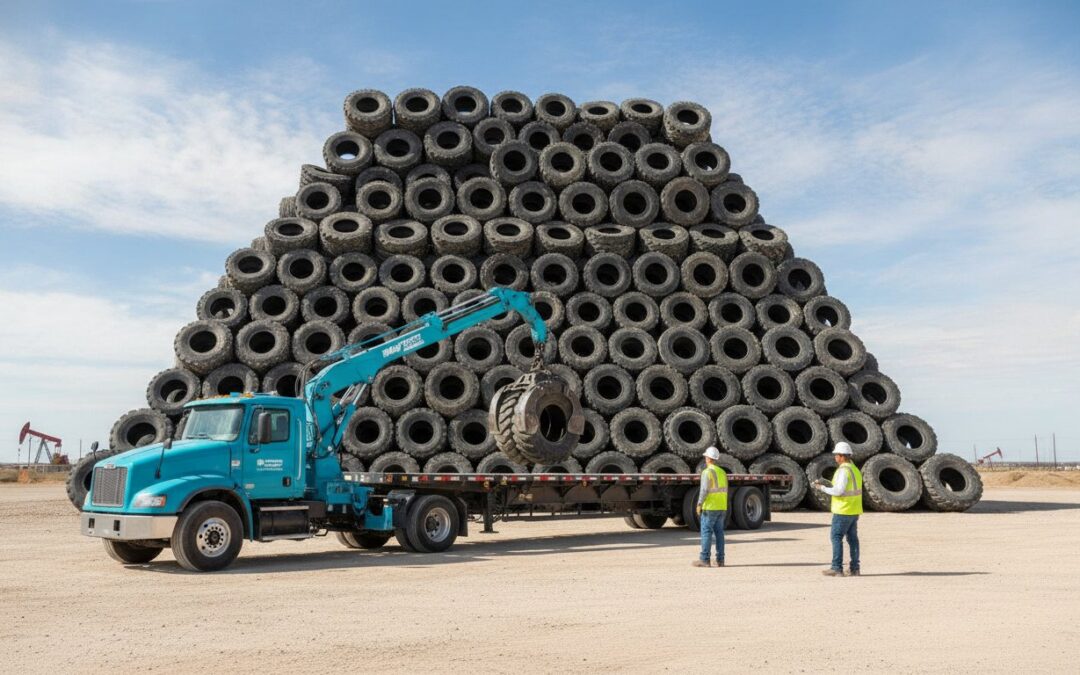
The TCEQ issued over $2.4 million in penalties for improper scrap tire management in 2025 alone. In Ector County, storing as few as five unregistered off-the-road tires can result in fines starting at $25,000, with daily penalties reaching much higher for larger stockpiles. For Permian Basin businesses, commercial tire disposal Odessa is no longer just a routine cleanup task; it’s a high-stakes liability management priority.
It’s easy to feel overwhelmed by rising disposal fees at local landfills and the technical burden of TCEQ manifest requirements. You need a way to clear your site without the constant worry of a regulatory audit or the difficulty of finding haulers for heavy OTR rubber and industrial hoses. This 2026 guide is designed to help you master the logistics and legalities of industrial rubber waste in Ector County. You’ll learn how to maintain full regulatory compliance, handle specialized materials like conveyor belts and skid steer tracks, and establish a predictable removal schedule that keeps your operations running smoothly.
Key Takeaways
- Understand the 2026 TCEQ manifest requirements to ensure your business remains legally protected from the moment rubber waste leaves your property.
- Identify the specific types of industrial waste, such as OTR tires and conveyor belts, that Odessa landfills often reject but professional collectors can handle.
- Learn how professional commercial tire disposal Odessa services provide a more efficient, compliant alternative to the restrictive intake policies of local municipal facilities.
- Use our site preparation checklist to streamline bulk pickups and maintain a safe, cleared environment for your fleet or construction yard.
- Avoid the significant financial risks of illegal stockpiling by staying within the current storage limits for commercial generators in the Permian Basin.
Navigating Commercial Tire Disposal in Odessa (2026)
In the Permian Basin, rubber waste isn’t just a byproduct; it’s a strictly regulated industrial material. Commercial tire disposal Odessa involves the systematic collection of large-volume scrap, ranging from semi-truck tires to heavy industrial conveyor belts. Unlike residential junk removal, this process requires professional documentation to meet Texas Commission on Environmental Quality (TCEQ) standards. In 2026, the Tire recycling process starts with ensuring that every casing is tracked from the job site to the final processing facility. Attempting to “self-haul” or mix industrial rubber with municipal waste is no longer a viable shortcut for local businesses due to increased enforcement and landfill restrictions.
Why Odessa Businesses Face Unique Disposal Risks
Odessa serves as the primary logistical hub for the Permian Basin. This concentration results in a high density of heavy fleet and oilfield equipment, which generates massive volumes of scrap rubber. In the West Texas environment, improper stockpiles quickly become significant fire hazards or breeding grounds for disease-carrying mosquitoes. These environmental risks have led to tighter local oversight. TCEQ compliance for Odessa businesses in 2026 requires maintaining valid manifests for all scrap rubber transported off-site, regardless of volume. Because of these rules, partnering with a permitted tire hauler has become a business necessity to ensure that logistics don’t turn into legal liabilities.
The True Cost of Improper Disposal in Ector County
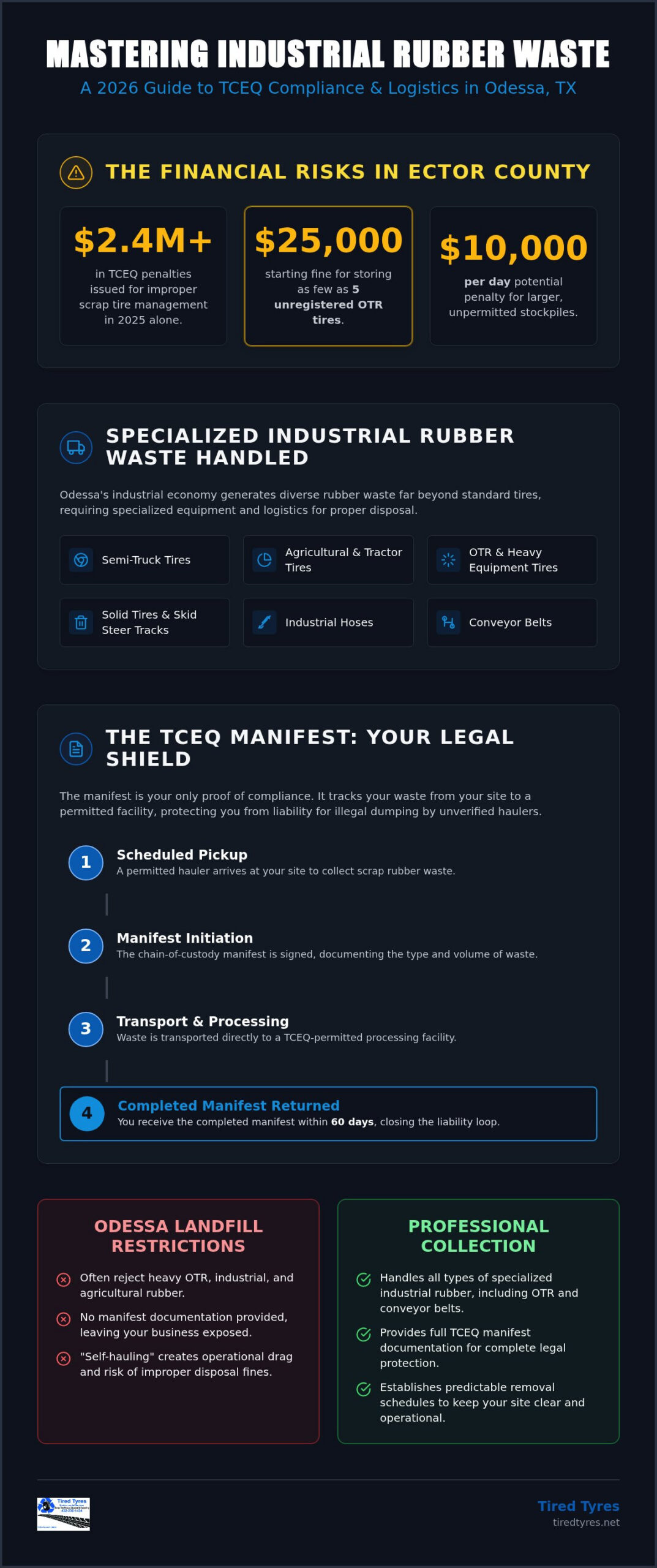
Mistakes in disposal carry heavy financial weight that can disrupt a company’s bottom line. The TCEQ issued over $2.4 million in penalties for improper scrap tire management in 2025 alone. Storing just five unregistered off-the-road (OTR) tires can trigger fines starting at $25,000. These penalties can escalate to $10,000 per day for larger, unpermitted stockpiles. Beyond direct fines, businesses face several hidden challenges:
- Operational Drag: Scrap piles occupy valuable yard space and interfere with equipment movement.
- Long-term Liability: You remain legally responsible for the tires until they reach a permitted destination.
- Legal Exposure: If an unverified hauler dumps your tires illegally, the manifest is your only proof of compliance.
Without a completed manifest returned within 60 days, your business is vulnerable to cleanup costs and legal action. Professional collection ensures that the chain of custody is never broken, protecting your reputation and your budget.
Specialized Handling for Semi, OTR, and Industrial Rubber
Odessa’s industrial landscape generates a diverse range of rubber waste that goes far beyond standard passenger tires. Managing this waste requires a deep understanding of the weight and volume constraints associated with heavy equipment. Efficient commercial tire disposal Odessa involves more than just a truck; it requires a logistical strategy for high-tonnage materials. Whether you’re managing a transport fleet or an oilfield service company, having a single point of contact for all rubber waste simplifies your operations and reduces yard clutter.
For local transport hubs, semi-truck tire collection is a constant requirement. These high-volume streams need predictable scheduling to prevent “tire graveyards” from forming behind warehouses. Agricultural operations in Ector County face similar challenges with large-diameter tractor tires. These units are heavy, awkward to move, and often rejected by municipal waste services. We provide the specialized transport needed to haul these agricultural units safely and legally, ensuring your farm or ranch stays clear of bulky debris.
OTR and Heavy Equipment Tire Logistics
Off-the-Road (OTR) tires from construction and mining sites are among the most difficult items to dispose of in West Texas. Standard junk haulers don’t have the heavy-duty trailers or lifting equipment necessary to manage these massive casings. When you schedule an OTR removal, it’s vital to ensure your site has a stabilized loading area that can support heavy transport vehicles. We specialize in the collection of these oversized units, as well as solid tires and scrap skid steer tracks. These dense materials require specific handling to ensure they’re transported without damaging equipment or violating road weight limits.
Beyond Tires: Industrial Hoses and Conveyor Belts
The Permian Basin oilfields produce unique waste streams like reinforced industrial hoses and worn-out conveyor belts. These items are often overlooked in traditional disposal guides, yet they present significant storage and compliance issues. Because they’re frequently reinforced with steel wire or high-tensile fabrics, they’re difficult to cut or process on-site. Tired Tyres integrates these difficult materials into a single, streamlined removal process. We provide comprehensive industrial rubber collection that covers everything from hydraulic hoses to heavy-duty belts, ensuring your site remains cleared and compliant with all local regulations. This approach eliminates the need to coordinate with multiple vendors for different types of rubber waste.
Odessa Landfill Restrictions vs. Professional Collection
Many Odessa businesses assume the local landfill is the simplest option for rubber waste. However, the City of Odessa’s solid waste services explicitly exclude tires from residential trash carts and neighborhood bulk drop-off events. For commercial entities, this means navigating the Republic Services Charter Waste Landfill on West Murphy Street. While this facility accepts tires, the logistical hurdles are significant. Texas regulations generally ban whole tires from landfills unless they have been shredded, split, or quartered. This requirement shifts the burden of pre-processing onto your business, often making “do-it-yourself” commercial tire disposal Odessa more expensive than it first appears.
Municipal sites also enforce strict volume limits that don’t align with industrial needs. A fleet manager attempting to drop off fifty semi-truck tires in a single morning will likely face rejection or steep surcharges. These facilities are designed for community maintenance, not the heavy-duty output of Permian Basin oilfield and transport operations. Professional commercial tire disposal Odessa services bypass these limitations by providing direct-to-site collection for any volume, ensuring your rubber waste is handled according to state law without the need for on-site shredding.
The ‘Landfill Headache’ for Odessa Fleet Managers
Managing disposal internally often results in hidden labor costs. Sending a technician or driver to wait in line at a landfill takes them away from revenue-generating work. In Ector County, wait times at commercial disposal sites can be unpredictable, especially during peak oilfield activity. Beyond the labor waste, there is a constant risk of being turned away. If your load contains OTR tires or reinforced agricultural casings, many landfills simply won’t accept them because they lack the equipment to process high-tonnage rubber. Free city cleanup events aren’t an option either; these are restricted to residential waste and strictly exclude commercial or industrial loads.
Benefits of a Dedicated Commercial Pickup Service
Choosing a collection model over a drop-off model allows your team to stay focused on their core responsibilities. Instead of coordinating multiple trips to a landfill, you can schedule a single bulk pickup that clears your entire site. We handle the heavy lifting, the manifest paperwork, and the transport of “difficult” items that municipal sites reject. This includes large OTR tires, solid tires, and scrap tracks. For a deeper look at managing these requirements across the Permian Basin, consult our comprehensive guide to commercial tire disposal. A professional service ensures that your site stays clean without the operational friction of self-hauling.
Compliance & Logistics: Manifests and Site Prep
Maintaining a cleared job site in Ector County requires more than just moving rubber; it requires a rigorous approach to documentation. In Texas, the chain of custody for scrap rubber is a legal obligation that remains with the business owner until the material is officially processed. Professional commercial tire disposal Odessa services prioritize this paper trail to protect your business from liability. Whether you manage a drilling site or a trucking fleet, understanding the administrative side of disposal is just as important as the physical removal.
Logistics generally fall into two categories: scheduled pickups and on-call services. High-volume transport hubs often benefit from scheduled monthly or bi-weekly collections to stay within TCEQ storage limits. For construction or oilfield projects with fluctuating waste levels, on-call services allow for flexibility as projects reach specific milestones. Regardless of the frequency, every load must be accompanied by a scrap tire manifest to ensure state compliance.
Mastering the Scrap Tire Manifest
The manifest is the primary tool used by the Texas Commission on Environmental Quality (TCEQ) to track scrap tires from the generator to a permitted facility. In 2026, a valid manifest must include your business’s registration information, the specific count of tires by category, and the destination facility’s permit number. You are legally required to receive a completed copy of this manifest from the disposal site within 60 days of the tires leaving your property. Odessa businesses must retain these records for a minimum of three years to prove legal disposal during routine state inspections. A registered transporter is responsible for verifying the tire count and ensuring the manifest is signed by the authorized disposal facility upon delivery.
Optimizing Your Site for Fast Collection
Preparing your yard for a bulk pickup minimizes downtime and ensures the safety of your crew and the collection team. Large-scale commercial tire disposal Odessa involves heavy-duty trailers that require stable ground and ample room to maneuver. Follow these best practices to prepare your site:
- Organize by Category: Separate semi-truck tires, agricultural units, and OTR tires into distinct piles to speed up the loading process.
- Ensure Clear Access: Provide at least 50 feet of clearance for collection trucks to back into the staging area without obstruction.
- Minimize Environmental Hazards: Keep tire piles on flat, dry ground and ensure they are free of standing water to prevent mosquito breeding.
- Remove Debris: Ensure that scrap rubber is not mixed with other industrial waste, such as metal or wood, which can delay processing.
Following these safety and organizational protocols helps prevent accidents and ensures that your collection is completed efficiently. If you are ready to clear your yard and secure your documentation, schedule your commercial tire collection with our Permian Basin team today.
Partnering with Tired Tyres for Odessa Scrap Removal
The Permian Basin operates on its own schedule and demands a level of logistical precision that national waste management firms often struggle to match. Tired Tyres provides a direct answer to the challenges of commercial tire disposal Odessa by combining local expertise with a comprehensive collection list. We understand that your yard space is valuable and that every day scrap rubber sits on your property, it represents a potential liability. Our service is designed to remove that burden quickly and professionally, ensuring your business stays focused on its core operations.
Our capabilities extend across the full spectrum of industrial rubber waste. We provide specialized collection for semi-truck fleets, agricultural operations, and heavy-duty OTR equipment. Beyond standard tires, we are one of the few providers in West Texas equipped to handle “difficult” materials like scrap conveyor belts, reinforced industrial hoses, and solid tires. We also manage scrap skid steer tracks and agricultural units that municipal landfills typically reject. Every load we haul is backed by a commitment to full TCEQ compliance, providing you with the necessary manifests to satisfy state inspectors and protect your business reputation.
Local Expertise in the Permian Basin
Supporting a West Texas business means working with operators who know the difference between a standard fleet yard and a remote drilling site. We have deep roots in the region, which allows us to navigate the unique logistical hurdles of Ector County with ease. National brands often lack the flexibility to handle the sudden volume spikes common in the oilfield, but our local team is built for this environment. We offer reliable tire disposal options that prioritize punctuality and regulatory safety. When you partner with us, you’re working with professionals who understand the local landscape and the specific environmental challenges of the South Plains.
Get Started with Your Disposal Plan Today
Setting up a professional removal plan is a straightforward process designed to minimize disruption to your workflow. We offer site assessments to help you determine the most efficient collection frequency for your volume. Some businesses prefer a one-time bulk pickup to clear years of accumulated scrap, while others require a recurring schedule to keep their transport hubs organized. We can accommodate both needs with the same level of professional rigor. Our team handles the loading, the transport, and the complex manifest paperwork from start to finish. If you’re ready to clear your site and secure your documentation, contact Tired Tyres for your Odessa commercial tire disposal quote. We will provide a clear, professional plan to keep your job site compliant and your operations moving forward.
Secure Your Compliance and Clear Your Site
Managing industrial rubber waste in Ector County is a matter of protecting your business from liability. Navigating the manifest process and landfill restrictions is essential for maintaining TCEQ compliance. Professional commercial tire disposal Odessa removes the logistical burden from your team, allowing you to focus on your primary operations without the risk of stockpiling fines. Whether you’re dealing with standard fleet tires or heavy duty OTR and conveyor belts, a specialized approach ensures every item is handled legally and efficiently.
Tired Tyres provides the specialized industrial rubber equipment and local Permian Basin expertise needed to handle even the most difficult materials. Our team of local operators is ready to help you establish a predictable removal schedule or manage a one-time bulk cleanup. Don’t let scrap rubber create a safety hazard or a legal headache on your property. It’s easier to manage your site when you have a partner who understands the specific demands of the West Texas oilfields and transport hubs.
Request a Commercial Tire Pickup Quote in Odessa today. It’s the simplest way to ensure your site stays cleared and your business remains fully protected.
Frequently Asked Questions
Is it illegal to dump tires in Odessa, TX?
Dumping tires in Odessa is illegal and carries severe penalties under Texas law. The Texas Commission on Environmental Quality (TCEQ) enforces strict regulations against unauthorized disposal to prevent fire hazards and mosquito breeding. In 2025, the state issued over $2.4 million in penalties for improper scrap tire management. To stay compliant, businesses must use a registered hauler to transport rubber waste to a permitted processing facility, ensuring a fully documented chain of custody.
What tires does the City of Odessa landfill accept from businesses?
Most municipal landfills in Ector County exclude commercial tire loads from their standard intake. Businesses are typically directed to the Republic Services Charter Waste Landfill on West Murphy Street. However, Texas law generally prohibits whole tires in landfills. This means you must shred, split, or quarter the rubber before they’ll accept it. Professional commercial tire disposal Odessa services avoid these restrictions by collecting whole tires directly from your yard for processing elsewhere.
Do I need a special permit to transport my own scrap tires in Ector County?
You don’t need a specific transporter permit to move your own business’s scrap tires, but you’re still bound by TCEQ manifest requirements. You must document the transfer and ensure the tires reach a permitted facility. For large volumes or heavy OTR tires, self-hauling is often impractical and risky. Most Odessa businesses hire a registered transporter to handle the logistics and ensure the manifest is completed correctly, which helps transfer the primary liability.
How does Tired Tyres handle large OTR and agricultural tires?
Tired Tyres uses specialized heavy-duty equipment to manage high-tonnage rubber that standard haulers can’t move. We provide direct collection for agricultural tires and massive OTR units used in oilfield or construction projects. Our team handles the loading and transport from your site in the Permian Basin. This service eliminates the need for you to rent specialized machinery or risk damaging your own fleet during a difficult disposal run.
What is a scrap tire manifest and why does my Odessa business need one?
A scrap tire manifest is a legal TCEQ document that tracks rubber waste from your site to its final destination. It serves as your primary proof of compliance with state environmental laws. Your Odessa business must receive a completed copy back from the disposal facility within 60 days of the pickup. You’re required to keep these records on file for at least three years to satisfy state inspections and prove legal disposal.
Can you pick up industrial rubber like conveyor belts and hoses in Odessa?
Yes, we provide comprehensive collection for industrial rubber waste beyond standard tires. This includes scrap conveyor belts, reinforced industrial hoses, and solid rubber tracks from skid steers. These materials are frequently rejected by municipal waste services because they’re difficult to process or contain steel reinforcement. We integrate these items into a single collection stream, helping you maintain a cleared and compliant job site without the need for multiple waste vendors.
How often should an Odessa auto shop schedule a scrap tire pickup?
The frequency depends on your service volume and storage capacity. TCEQ regulations limit registered commercial generators to a maximum of 500 scrap tires stored on the ground. To stay safely below this limit and maintain a clean shop, many Odessa auto centers schedule commercial tire disposal Odessa on a bi-weekly or monthly basis. Regular pickups prevent the buildup of fire hazards and ensure you never exceed state storage thresholds.
What happens to the tires after they are collected from my Odessa site?
After collection, the tires are transported to a permitted facility for official processing or recycling. This step is critical because it officially ends your liability as the waste generator. Once the tires reach a registered facility, the manifest is signed and returned to you, confirming that the rubber has been managed according to Texas law. This process ensures that the materials are diverted from landfills and handled in an environmentally responsible manner.