
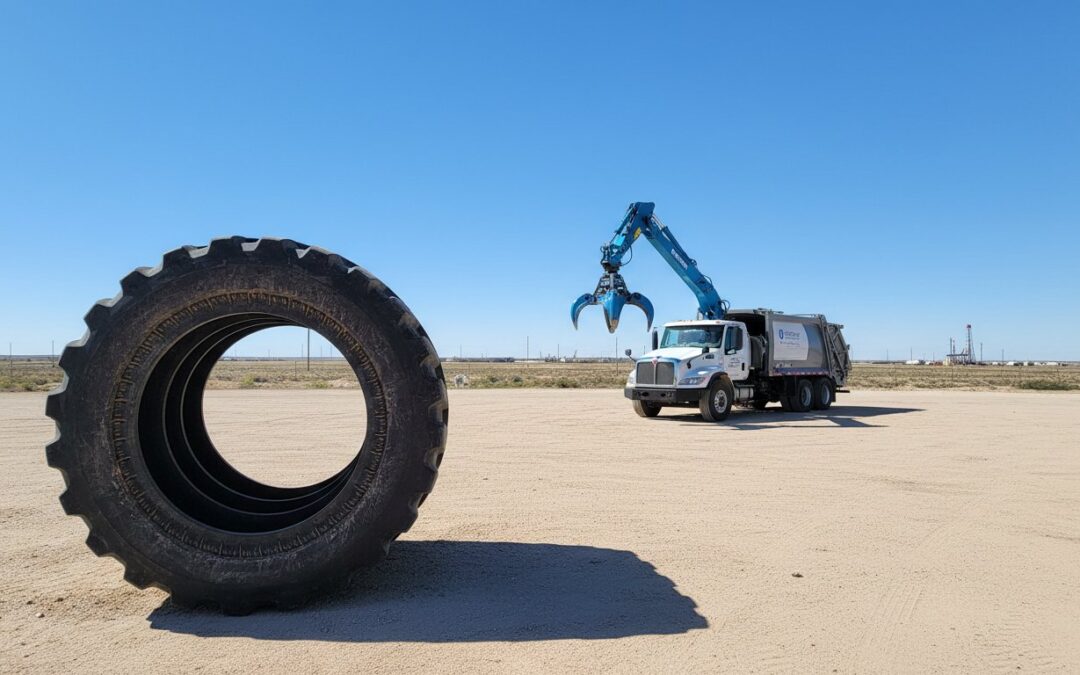
Your favorite Odessa metal recycler likely won’t touch your worn-out excavator tracks, and leaving them to rot on a lease site could cost you thousands in TCEQ penalties before 2026. Most local yards reject these components because the complex rubber-to-steel ratio makes processing too expensive for standard equipment. This makes finding a reliable solution for heavy equipment rubber track disposal Odessa a major priority for operators who want to avoid the 30-day stockpiling limits that trigger state inspections. You’ve likely felt the frustration of being stuck with 1,500-pound debris that no one seems to want, cluttering your site and creating a safety hazard.
We understand that you just want the mess gone so your crew can focus on the next project. This guide provides the definitive roadmap for managing your scrap tracks, ensuring you stay compliant with Texas environmental regulations while keeping your workspace clear. You’ll learn exactly how to bypass recycler rejections and secure a reliable pickup service that handles the heavy lifting for you. We’ll show you how to turn a disposal headache into a streamlined part of your site maintenance routine, protecting your business from fines and keeping your Permian Basin operations running smoothly.
Key Takeaways
- Understand why standard scrap yards reject steel-core tracks and how to avoid the common pitfalls of industrial waste management in West Texas.
- Stay compliant with the latest TCEQ scrap tire rules to protect your operations from heavy fines associated with improper rubber waste storage.
- Learn how to properly assess and prepare your site for heavy equipment rubber track disposal Odessa to ensure a fast and efficient collection process.
- Discover a full-service hauling and processing solution that removes the logistical burden of handling heavy-duty tracks from your team.
The Challenge of Heavy Equipment Rubber Track Disposal in Odessa
Managing decommissioned tracks in the Permian Basin has become a significant logistical hurdle for construction firms and oil field operators in 2026. These aren’t standard tires; they’re massive, reinforced components that Texas environmental guidelines classify as difficult-to-manage industrial waste. Leaving these tracks to rot on a lease or a job site creates more than just an eyesore. It poses a real risk of soil contamination and potential fines from regulatory bodies. Effective heavy equipment rubber track disposal Odessa requires a strategy that moves beyond simply hiding the problem in a back lot.
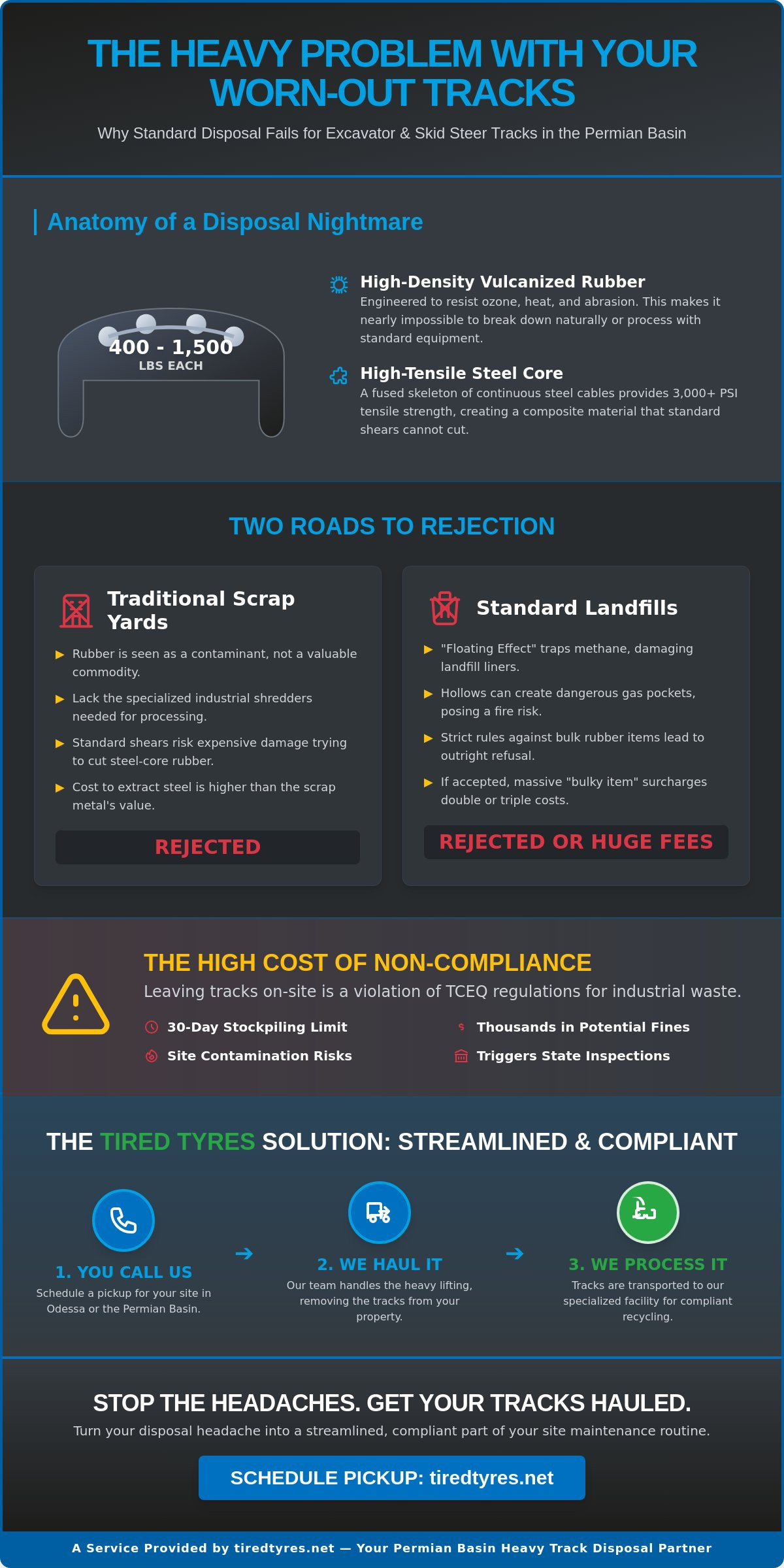
The core of the issue lies in the material composition. A standard excavator or skid steer track consists of high-density vulcanized rubber bonded to a heavy internal steel skeleton. This combination makes them nearly indestructible by design, which is great for the job site but a nightmare for disposal. Tired Tyres provides a specialized solution for Permian Basin businesses, ensuring these bulky items are handled with the professional precision the local industry demands.
Why Traditional Scrap Yards Say No
Most local scrap yards in Odessa focus on high-turnover, “clean” metals like copper, brass, or aluminum. When you bring them a rubber track, they see a contaminated product. The heavy equipment rubber track disposal Odessa process is stalled because separating the high-density rubber from the internal steel cords is labor-intensive and requires specialized machinery. Standard scrap shears often can’t bite through the reinforced rubber without sustaining damage or excessive wear.
Understanding the process of recycling reveals why local facilities hesitate. Most yards lack the industrial-grade shredders needed to process steel-core rubber. Without this equipment, the tracks are just dead weight that takes up valuable yard space. They won’t pay for the metal inside because the cost of extracting it exceeds the market value of the scrap steel.
The Problem with Standard Landfill Disposal
Attempting to drop tracks at the Ector County landfill or nearby municipal sites often results in immediate rejection or massive surcharges. Landfills have strict restrictions on bulk rubber items for several technical reasons:
- The Floating Effect: Large rubber items trap methane gas and have a natural buoyancy. Over time, they “float” to the surface, puncturing landfill liners and damaging the structural integrity of the site.
- Methane Traps: The hollow shape of certain tracks can create pockets where dangerous gases accumulate, posing a fire risk.
- Surcharge Costs: Industrial rubber items often trigger “bulky item” fees that can double or triple the standard tipping rate.
Relying on standard waste streams isn’t just expensive; it’s often impossible. Tired Tyres steps in to bridge this gap, offering a direct, professional path for disposal that keeps your operations compliant and your job sites clean.
Why Industrial Rubber Tracks Require Specialized Handling
Disposing of worn-out tracks from an ASV, skid steer, or mini-excavator involves more than just managing heavy weight. These components often weigh between 400 and 1,500 pounds each. Because they are built to survive the abrasive caliche and rock of the Permian Basin, their physical makeup is incredibly resilient. Standard landfill equipment isn’t designed to crush or shear these items, leading to “spring-back” issues where buried tracks eventually work their way back to the surface. Proper heavy equipment rubber track disposal Odessa requires a process that accounts for both the massive volume and the complex materials involved.
The Anatomy of a Rubber Track
Modern industrial tracks use a sophisticated blend of vulcanized rubber compounds. These layers are engineered to resist ozone cracking and thermal degradation, which makes them nearly impossible to break down naturally in a landfill. Inside this rubber shell sits a core of continuous, high-tensile steel cables. These cables provide the 3,000+ PSI tensile strength necessary to keep a 10,000-pound machine moving under load. The fusion of high-tensile steel and vulcanized rubber creates a bonded composite that standard shredders cannot process without specialized, heavy-duty equipment. This hybrid construction is why most local waste management sites in Ector County refuse them or charge exorbitant “hard-to-handle” fees.
Fire Risks and West Texas Heat
In Odessa, where summer temperatures regularly exceed 100 degrees Fahrenheit for 30 or more consecutive days, rubber stockpiles represent a massive fire hazard. Unlike brush fires, a rubber fire creates a self-sustaining heat reaction. These fires can reach internal temperatures of 2,000 degrees and burn for weeks, even underground. The thick, black smoke produced contains sulfur dioxide and cyanide compounds, posing an immediate health threat to residential areas near the I-20 corridor. Landowners who allow “temporary” stockpiles of old tracks face significant legal liability. Under Texas Commission on Environmental Quality (TCEQ) guidelines, improper storage of scrap tires and tracks can lead to daily fines and mandatory soil remediation costs if a fire occurs. Professional processing eliminates this risk by moving the material into a regulated recycling stream immediately.
Choosing a professional route for heavy equipment rubber track disposal Odessa ensures that the steel is recovered and the rubber is repurposed for tire-derived fuel or rubberized asphalt. This keeps your job site clean and protects your business from the long-term liability of environmental mismanagement. If you’re looking to clear out old inventory, you can find reliable disposal solutions that handle the heavy lifting for you. Professional handling is the only way to ensure these materials don’t end up as a permanent eyesore or a fire department emergency in the West Texas heat.
Navigating TCEQ Regulations for Industrial Rubber Waste
In Odessa, heavy equipment rubber track disposal Odessa requires a clear understanding of the Texas Commission on Environmental Quality (TCEQ) scrap tire management rules. Under 30 TAC Chapter 328, the state classifies rubber tracks as scrap tires rather than general industrial waste. This classification exists because tracks share the same physical properties and environmental risks as Off-The-Road (OTR) tires. They are bulky, non-biodegradable, and can become breeding grounds for pests if stored incorrectly. Following these rules isn’t optional for businesses in Ector County. It is a legal requirement to ensure that every pound of rubber is tracked from the moment it leaves your machine until it reaches a permitted processing facility. For a broader look at how these rules impact your operations, read our Texas Tire Disposal Regulations guide.
Understanding the Scrap Tire Manifest
A scrap tire manifest is the most critical document in your disposal process. It acts as a formal chain of custody, linking your business to a registered transporter and a final disposal site. When you schedule a pickup for heavy equipment rubber track disposal Odessa, the transporter must provide a manifest that includes their TCEQ registration number. You shouldn’t let a single track leave your yard without a signed copy of this form.
Texas law mandates that businesses keep these manifest records for at least 3 years. During a TCEQ audit or a local environmental inspection, you’ll need to produce these documents to prove your waste was handled legally. If you hire an unpermitted hauler, your business remains legally liable for where that rubber ends up. If they dump those tracks in the Permian Basin scrubland, the state can trace the serial numbers or purchase records back to you, leading to severe administrative penalties.
Avoiding Illegal Dumping Fines in Ector County
The Texas Health and Safety Code Chapter 365 defines illegal dumping as disposing of litter or other solid waste at a place that is not an approved solid waste site. In Ector County, the stakes are high for commercial entities. Disposing of more than 200 pounds of rubber waste, which is less than the weight of a single mini-excavator track, can escalate from a misdemeanor to a state jail felony for repeat or large-scale violations. Fines for commercial disposal violations often reach $10,000 per day per violation.
To protect your business, follow this verification checklist before handing over any industrial rubber:
- Verify Registration: Ask the transporter for their current TCEQ registration certificate.
- Check the Database: Use the TCEQ Central Registry to confirm the hauler’s status is “active.”
- Inspect the Vehicle: Registered haulers must display their TCEQ sign or registration number on the side of their vehicle.
- Confirm the Destination: Ensure the manifest lists a permitted scrap tire facility, not a standard municipal landfill that may not be equipped to handle heavy rubber.
By staying diligent with your paperwork and choosing permitted partners, you eliminate the risk of surprise inspections and protect the West Texas environment from industrial blight.
How to Prepare Your Tracks for Collection in Odessa
Efficient heavy equipment rubber track disposal Odessa requires more than just a phone call. Proper site preparation ensures that collection crews can move in and out without disrupting your operations. Start by calculating the total weight of your scrap. A single track for a CAT 299D3 can weigh approximately 530 lbs. If you have a dozen tracks from a fleet of compact track loaders, you’re looking at over 6,000 lbs of rubber. Haulers need this data to bring the right trailer capacity to the site.
Clear a dedicated staging area near the entrance of your yard or job site. A standard 53-foot flatbed truck requires a significant turning radius to navigate safely. Remove any smaller equipment or debris that might block the path. We recommend scheduling your pickup to avoid peak oil field traffic. In Ector County, traffic on Highway 191 and Loop 338 usually peaks between 6:30 AM and 8:30 AM. Aim for a mid-morning or early afternoon window to keep the process moving quickly.
- Group by size: Keep mini-excavator tracks separate from large CTL tracks to speed up the loading process.
- Clear the path: Ensure at least 15 feet of overhead clearance if a crane is needed for loading.
- Verify counts: Double-check the number of units before the driver arrives to avoid the need for multiple trips.
Site Logistics for Oil Fields and Construction
Odessa job sites often deal with soft sand or deep mud. For a successful pickup, place your tracks on a flat, hard-packed surface. This allows forklifts or cranes to stabilize properly during the lift. If your tracks are covered in thick Permian Basin mud, scrape them down before the truck arrives. Excessive debris adds unnecessary weight and can create safety hazards during transport. Access is everything when managing heavy equipment rubber track disposal Odessa, so ensure the gates are unlocked and a site contact is ready.
Inventory and Quoting
To get a precise quote, provide the exact dimensions of your tracks. Measure the width in millimeters or inches and count the total number of drive links. Identifying the machine model is also helpful. Whether you’re disposing of tracks from a Bobcat T770, a John Deere 333G, or a CAT 259D, knowing the model helps the hauler prepare the load plan. For more information on handling larger volumes of rubber waste, see our resource on Commercial Tire Disposal.
Ready to clear out your yard and get back to work? Contact Tired Tyres for a professional disposal quote today.
Tired Tyres: Specialized Heavy Track Collection in the Permian Basin
Tired Tyres handles the heavy lifting for industrial sites across Ector and Midland counties. Since January 2024, we’ve refined the process of removing high-density rubber waste from active job sites. We don’t just pick up standard tires. We manage the complex logistics of heavy equipment rubber track disposal Odessa operations demand. Our full-service model means we arrive with the right equipment, load the material ourselves, and transport it to licensed processing facilities. You stay focused on your project. We handle the liability and the labor.
Our Heavy Equipment Capabilities
We specialize in the removal of reinforced rubber tracks that standard waste services often refuse. Our specialized fleet is designed specifically for the Permian Basin’s unique terrain. We use heavy-duty trailers and loading equipment that can handle tracks weighing over 1,500 pounds each. Our “no-hassle” loading process for bulk industrial waste includes:
- Skid steer tracks: All sizes and tread patterns, including those with heavy steel imbeds.
- Excavator tracks: Mini-excavator and full-size crawler tracks from major brands like CAT, Komatsu, and John Deere.
- Crawler carrier tracks: Large-scale rubber tracks used in pipeline and oilfield transport.
We’ve optimized our routes to serve Odessa and Midland daily. This efficiency allows us to offer pickup windows in under 48 hours for most requests. Whether you have a single pair of tracks or a yard full of bulk waste, we have the capacity to clear your site quickly. Our team handles the heavy lifting so your crew doesn’t have to risk injury moving awkward, heavy rubber components.
Why Permian Basin Businesses Trust Us
Local expertise matters in West Texas. We understand the specific regulatory environment of the Odessa, Midland, and Lubbock triangle. Every pickup includes full manifest documentation. This paperwork proves your business follows TCEQ guidelines for scrap tire and rubber disposal. We provide transparent, flat-rate quotes based on volume and location. You won’t find hidden fuel surcharges or surprise fees on your final invoice.
Our team brings 15 years of combined experience in industrial rubber management. We’ve built our reputation on being the most reliable partner for heavy equipment rubber track disposal Odessa contractors can find. We treat every site with the same level of professional care, whether it’s a small repair shop or a massive fleet yard. We’re committed to keeping the Permian Basin clean and compliant while providing the most efficient service in the region.
Simplify Your Permian Basin Waste Logistics
Managing heavy equipment rubber track disposal Odessa requires more than just a standard hauling service. With TCEQ regulations setting strict standards for 2026, staying compliant means partnering with professionals who understand the industrial landscape of West Texas. We’ve refined our process to handle the heavy, steel-corded rubber tracks that typical waste providers often refuse. Our team uses specialized industrial rubber equipment to ensure every pickup is efficient and safe. As a TCEQ Permitted Hauler, we take the legal burden off your shoulders while serving the entire Permian Basin region. You don’t have to worry about the logistics of moving tons of industrial rubber on your own. We provide a reliable, transparent solution that keeps your yard clean and your operations running without interruption. It’s time to clear out the old and make room for the new. Let’s get those “tired” tracks out of your way so you can focus on the job at hand.
Get a Quote for Heavy Equipment Track Disposal
We’re ready to help you tackle your biggest disposal challenges with professional ease.
Frequently Asked Questions
Can I throw rubber tracks in a standard construction dumpster in Odessa?
No, you can’t dispose of rubber tracks in standard roll-off dumpsters because of their weight and material composition. Most Odessa waste haulers follow City of Odessa Solid Waste guidelines that prohibit dense, heavy rubber items in residential or commercial bins. While those bins are ideal for general construction debris—and you can discover Book Your Dumpster USA for those needs—a single 18 inch excavator track often weighs over 500 pounds. This weight can damage hydraulic lift systems on standard trucks or lead to rejected loads at the landfill entrance.
What is the difference between rubber track disposal and standard tire recycling?
The main difference is the heavy steel cable reinforcement found inside industrial tracks. While passenger tires have thin wire beads, tracks contain thick, continuous steel cores that require high torque industrial shredders. This complexity is why heavy equipment rubber track disposal Odessa services utilize specialized machinery. Standard tire recycling facilities often lack the equipment needed to process these dense, metal heavy components without damaging their blades.
Does Tired Tyres provide a manifest for every heavy equipment track pickup?
Yes, Tired Tyres issues a formal disposal manifest for every pickup to ensure your business remains compliant with Texas Commission on Environmental Quality records. This document tracks the chain of custody from your job site to the processing facility. It’s a critical piece of paperwork for your 2026 environmental audits. It proves that the rubber didn’t end up in an unauthorized dump or a restricted local landfill.
How much does it cost to dispose of excavator tracks in West Texas?
Disposal costs depend on the total tonnage and current market rates for scrap steel and rubber processing. While we don’t provide fixed pricing here, industry data from 2024 shows that specialized rubber disposal fees fluctuate based on logistics and fuel surcharges in the Permian Basin. You should contact us directly for a specific quote. We’ll base the estimate on your specific inventory of excavator or skid steer tracks.
Do you pick up scrap rubber tracks from remote oil field locations?
We offer dedicated pickup services for remote oil field sites throughout the Permian Basin, including locations 60 miles or more outside Odessa city limits. Our fleet is equipped to handle the rugged terrain of active lease sites. We’ve optimized our scheduling to ensure that heavy equipment rubber track disposal Odessa remains accessible for crews operating in isolated sectors of Ector, Midland, and Ward counties.
Can rubber tracks be recycled into other products after disposal?
Recycled tracks are frequently processed into rubber mulch, asphalt additives, or industrial mats. Once the internal steel cables are extracted, the remaining rubber is granulated. According to reports from the Rubber Manufacturers Association, nearly 80 percent of scrap rubber finds a second life in civil engineering projects. This includes being used for blast mats in demolition or as a durable base layer for high traffic industrial flooring.
What happens if I bury old tracks on my property in Ector County?
Burying rubber tracks is illegal under Texas state law and can lead to heavy fines from the TCEQ. These tracks don’t decompose; they can trap methane gas and eventually rise to the surface, causing soil instability. If a property inspection reveals buried industrial waste, the owner faces remediation costs. These cleanup expenses often exceed the original price of professional disposal by 400 percent or more based on recent environmental enforcement cases.