
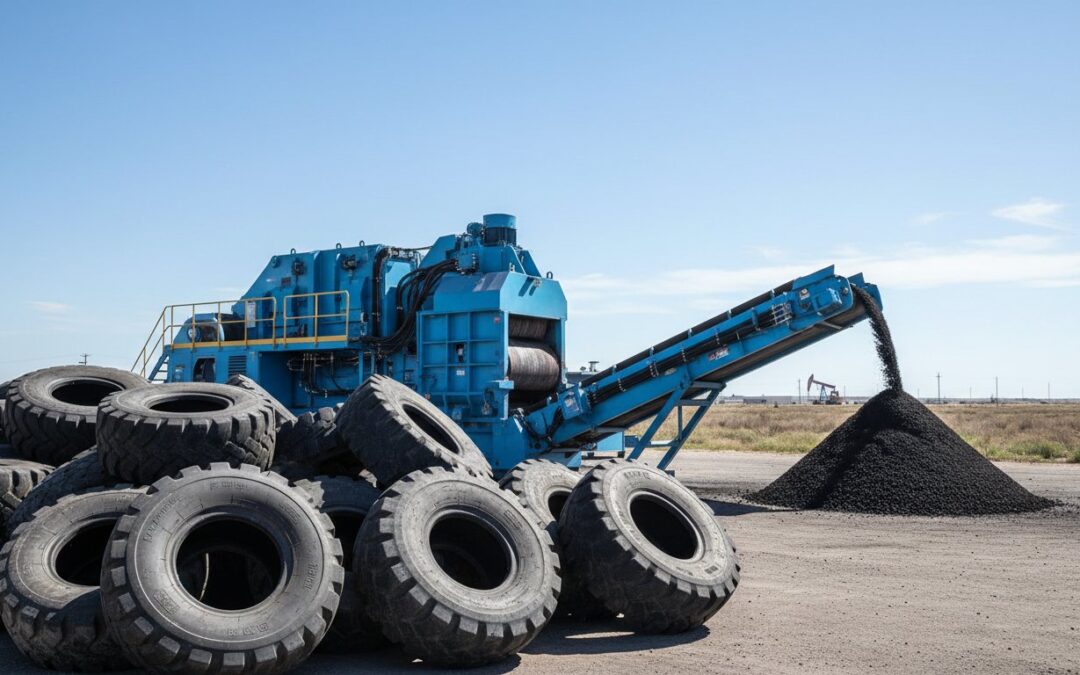
Storing more than 500 scrap tires on the ground in the Permian Basin isn’t just a space issue; it’s a direct invitation for a TCEQ inspection and potential fines. For many West Texas businesses, the solid rubber tire recycling process feels like a logistical mystery that ends in high disposal fees or rejected loads from standard haulers. We understand that managing non-pneumatic industrial waste is a heavy burden that requires more than just a dumpster. You need a solution that’s as rugged as the equipment you run.
In this guide, you’ll learn how these dense materials are transformed into valuable resources for Texas infrastructure. We’ll outline the exact steps of the recycling chain and provide the latest 2026 data you need to stay compliant. From the $0.20 per pound local rate for industrial rubber to the impact of the Waste Energy Corp facility opening in Midland on May 15, 2026, we’ve gathered the facts to help you choose a reliable partner. It’s time to turn your tire graveyard into a streamlined, legal, and professional part of your operation.
Key Takeaways
- Understand the technical differences between high-density industrial rubber and standard tires to avoid equipment damage and disposal delays.
- Master the five critical steps of the solid rubber tire recycling process, from local consolidation in the Permian Basin to primary size reduction.
- Compare ambient and cryogenic recycling methods to determine which industrial output quality aligns with your project goals.
- Learn how to navigate TCEQ regulations and the mandatory “Scrap Tire Manifest” system to ensure your business remains fully compliant.
- Identify reliable collection partners in Midland, Odessa, and Lubbock who specialize in heavy-duty and OTR rubber waste.
Understanding the Challenge of Solid Rubber vs. Pneumatic Tires
Solid rubber tires are the heavy-duty workhorses of the Permian Basin. Unlike the standard pneumatic tires found on your personal truck, these components are completely non-pneumatic. They consist of high-density rubber molded directly onto a steel base or core. This design is essential for the extreme weight and puncture risks of West Texas industrial sites, but it makes the solid rubber tire recycling process a specialized task. Standard equipment designed for air-filled tires simply can’t handle the sheer mass of these industrial blocks.
When we look at the broader tire recycling process, density is the primary hurdle. Standard passenger tire shredders rely on the hollow, flexible nature of a tire to gain purchase. Solid rubber is too tough for these machines. It causes blades to overheat, dull, or snap within minutes. In the 100-degree heat of a Midland summer, stockpiled solid rubber also becomes a significant liability. These piles don’t just take up valuable yard space; they trap heat and create fire hazards that are notoriously difficult for local fire departments to extinguish once they ignite.
Why Solid Rubber Requires Specialized Equipment
The core issue is the rubber-to-steel ratio. Solid tires contain a much higher percentage of dense rubber than pneumatic versions. This creates immense resistance during the primary shredding stage. Most standard shredders in West Texas are calibrated for 25-pound passenger tires, not 400-pound solid forklift tires. The weight alone can crush standard conveyor systems used in smaller facilities.
Landfills in Odessa and Ector County often reject bulk solid rubber waste because it doesn’t compress. It stays in the ground as a permanent, high-density mass that can interfere with landfill liners and management systems. Without specialized hydraulic shears for primary size reduction, these tires remain an expensive, permanent problem for local businesses. You need a partner with the right industrial-grade tools to break this material down effectively.
Common Industrial Rubber Waste in Midland and Lubbock
The industrial landscape of West Texas generates specific types of rubber waste that require professional handling. In Midland and Lubbock, we most frequently see these materials piling up in equipment yards:
- Solid forklift tires and press-on bands from warehouse operations.
- Heavy-duty rubber tracks from skid steers and mini-excavators used in oilfield construction.
- Industrial lay-flat hoses and conveyor belts from local service companies.
As of April 2026, managing these materials properly is vital for avoiding TCEQ fines. Industrial rubber waste, currently priced at $0.20 per pound for disposal at Tired Tyres, requires a documented chain of custody. You can’t just leave a stack of skid steer tracks behind a warehouse and hope for the best. Proper disposal ensures your business stays compliant while keeping the Permian Basin clean.
The 5-Step Solid Rubber Tire Recycling Process
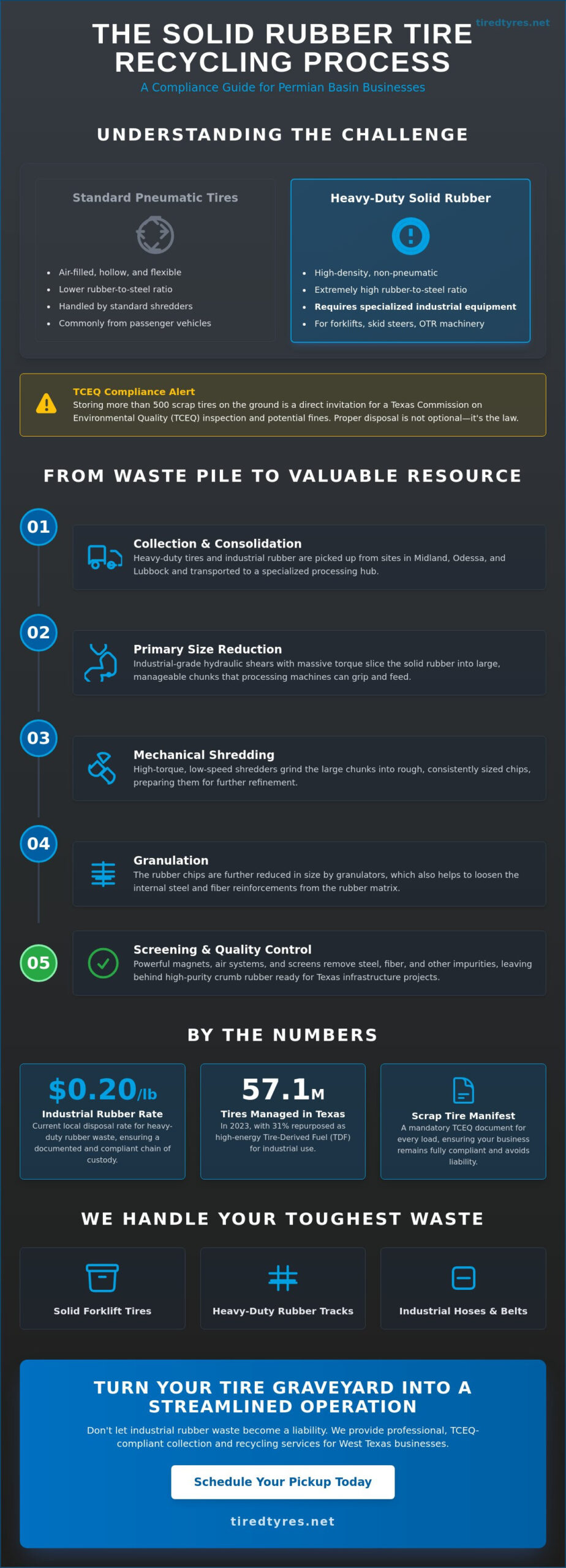
Converting a 400-pound solid tire into a usable material requires a linear, high-power workflow. The solid rubber tire recycling process moves from the equipment yard to the final product through five distinct phases. Unlike pneumatic tires that can be debeaded, solid industrial tires are processed as total units of high-density material. In 2023, approximately 57.1 million used and scrap tires were managed in Texas, with 31% repurposed as tire-derived fuel (TDF). If you have a stockpile accumulating, our industrial rubber collection services can help you start this chain of custody properly.
- Step 1: Collection and Consolidation: Heavy-duty tires are picked up from Midland or Odessa sites and consolidated at a specialized processing hub.
- Step 2: Primary Size Reduction: Industrial-grade hydraulic shears slice the solid rubber into large, manageable chunks that machines can grip.
- Step 3: Mechanical Shredding: High-torque machines grind these chunks into rough chips.
- Step 4: Granulation: The rubber is further reduced while internal steel and fiber reinforcements are loosened from the rubber matrix.
- Step 5: Screening and Quality Control: Magnets and air systems remove impurities, leaving behind high-purity crumb rubber for infrastructure projects.
Primary Shredding: Breaking Down the Bulk
Standard shredders often fail when faced with the 200+ lb weight of a solid industrial tire. These machines usually rely on high-speed rotation, but solid rubber requires massive torque to overcome its density. High-torque, low-speed shredders are essential here to prevent mechanical failure and ensure a consistent bite. Primary shredding is the initial mechanical reduction of bulk rubber into manageable 2-6 inch pieces.
Steel and Fiber Separation
Even solid tires aren’t 100% rubber. Solid forklift tires often have internal wire reinforcement or steel press-on bands that must be removed. We use powerful cross-belt magnets to extract this metal, which is then recycled as scrap steel. Air classifiers then blow away lighter textile fibers. This rigorous separation process is how we produce the high-purity rubber mulch used in West Texas landscaping and playground projects. In 2023, crumb rubber production accounted for 33% of all scrap tire end-uses in Texas. According to the U.S. Tire Manufacturers Association, these recovered materials are vital for sustainable manufacturing across the country.
Recycling Methods: Ambient vs. Cryogenic Processing
Once the initial size reduction is complete, the solid rubber tire recycling process moves into the refinement stage. Choosing between ambient and cryogenic processing depends on the intended end-use of the material and the budget of the operation. While both methods successfully reduce industrial rubber into granules, they produce very different physical results. In the Permian Basin, where efficiency and cost-effectiveness are priorities, understanding these differences helps businesses verify that their waste is being handled appropriately.
As of April 2026, we are also seeing the rise of chemical recycling alongside these mechanical methods. The new Waste Energy Corp facility in Midland is scheduled to commission on May 15, 2026. This facility will use pyrolysis, a thermal conversion process that breaks down solid rubber into tire-derived oil and recovered carbon black. This adds a third, more advanced tier to the local recycling landscape, providing an alternative to traditional grinding methods.
Ambient Grinding: The Workhorse of Industry
Ambient grinding is the most common method for processing solid industrial tires in West Texas. This process occurs at room temperature using high-powered granulators and secondary shredders. It’s a purely mechanical approach that relies on high-torque blades to tear the rubber apart. Because it doesn’t require expensive cooling agents, it remains the most cost-effective method for solid tire disposal.
The resulting crumb rubber has a rough, irregular texture with a high surface area. This “fuzzy” consistency is actually a technical advantage for many infrastructure projects. It creates a superior bond when mixed into rubberized asphalt for Texas highways or used as infill for athletic turf. For most Permian Basin businesses, ambient grinding provides the best balance of legal compliance and manageable disposal costs.
Cryogenic Processing: For High-Purity Applications
Cryogenic processing takes a more high-tech approach by using liquid nitrogen to freeze the rubber until it’s extremely brittle. Once frozen, the rubber is shattered into a fine powder. This method is exceptionally effective at liberating steel and fiber from the rubber matrix, resulting in a very high-purity final product. The particles are smooth and consistent, which is a requirement for high-end manufacturing like new tire production or specialized molded parts.
While cryogenic plants produce a premium material, they are rarer in Texas due to the high energy costs associated with liquid nitrogen. Most local industrial waste, like forklift tires and skid steer tracks, doesn’t require this level of precision. However, as the market for recovered materials grows in 2026, more specialized facilities are beginning to adopt this method to meet the needs of the manufacturing sector.
Texas Regulations: Legal Disposal for Midland-Odessa Businesses
Operating in the Permian Basin means staying ahead of strict environmental oversight. In Texas, the Texas Commission on Environmental Quality (TCEQ) sets the standard for how scrap tires are stored and transported. As of March 20, 2026, you must register with the TCEQ if your site stores more than 500 scrap tires on the ground or more than 2,000 in enclosed, lockable containers. For businesses managing the solid rubber tire recycling process, these thresholds are reached quickly due to the weight and volume of industrial equipment tracks and forklift tires.
The core of compliance is the “Scrap Tire Manifest.” This document tracks the movement of every tire from your yard to the final processing facility. It’s not just a suggestion; it’s your legal defense. If an inspector visits your Midland or Odessa facility, they’ll ask to see these records to prove that your industrial waste hasn’t been illegally dumped. Illegal dumping in Ector or Midland counties carries heavy penalties, including thousands of dollars in fines and potential criminal charges for business owners.
TCEQ Compliance and Record Keeping
Properly documenting the transfer of solid rubber waste is a non-negotiable part of your operations. Every time a hauler picks up a load, both parties must sign the manifest. You’re required to retain these disposal records for at least three years to remain in good standing. For a deeper dive into these requirements, check our guide on Texas Tire Disposal Regulations. Keeping a clean paper trail ensures that when you pay for the solid rubber tire recycling process, you’re also buying peace of mind.
Avoiding Liability in the Permian Basin
Texas law operates on a “cradle-to-grave” responsibility model. This means your business is responsible for those tires until they’re fully processed or recycled. Hiring an unpermitted “cheap” hauler might save a few dollars upfront, but if that hauler dumps your tires in a West Texas ravine or an abandoned lot, the TCEQ will trace them back to you. The resulting environmental fines often dwarf the original disposal cost. It’s simply not worth the risk to your company’s reputation or bottom line.
Local landfill restrictions in Odessa also complicate matters. Most municipal landfills won’t accept bulk industrial rubber because it doesn’t compact and creates “floating” issues within the waste cells. This is why you must use a permitted tire hauler who has direct access to specialized shredding facilities. To ensure your company stays on the right side of the law, you can schedule a compliant industrial pickup with our team today. We provide the necessary documentation to keep your business safe and your yard clear.
Tired Tyres: Professional Industrial Rubber Collection in West Texas
Many haulers in the Permian Basin shy away from heavy-duty industrial waste because they lack the equipment to move it. At Tired Tyres, we specialize in the “first mile” of the solid rubber tire recycling process. We bridge the gap between your active job site and the high-capacity shredders that handle dense materials. Whether you’re managing a warehouse fleet in Lubbock or an oilfield service company in Midland, we ensure your waste moves from your yard to a legal processing facility without a hitch. Our team handles the heavy lifting, so you don’t have to worry about the logistics of moving non-pneumatic rubber.
Most local services focus on passenger tires. They don’t have the lift capacity for OTR (Off-the-Road) tires or the specialized trailers needed for bulk solid rubber. We’ve built our reputation on being the reliable partner for the heavy stuff. We understand that a stack of “fáradt” (tired) industrial tracks isn’t just an eyesore; it’s a liability waiting to happen. Our commitment to legal, TCEQ-compliant disposal for every client means your business is protected from the cradle-to-grave liability risks inherent in industrial waste management.
Our Collection Fleet and Capability
Our fleet is designed for the high-density reality of West Texas industry. We don’t just pick up loose tires; we handle bulk loads of solid tires, heavy-duty tracks, and industrial hoses that standard waste management companies refuse. We offer scheduled pickups for auto shops and industrial yards in Odessa, ensuring your storage sites never exceed the 500-tire TCEQ threshold. This proactive approach prevents the risk of fines and keeps your operational space clear for productive work.
Our process is built on precision and transparency. We handle the manifest paperwork correctly at the point of pickup, providing you with the documentation needed for environmental audits. For more details on our specific service areas and logistics, read our Commercial Tire Disposal in Midland, Odessa & Lubbock guide. We make sure every load is tracked and processed at a permitted facility.
Get a Custom Quote for Your Industrial Waste
We believe in straightforward, honest communication. Our pricing is transparent and based on volume and material type, such as the $0.20 per pound rate for industrial rubber confirmed in April 2026. This clarity helps you budget for disposal without worrying about hidden fees or surprise surcharges. By choosing a professional collection partner, you’re directly supporting the local West Texas environment. Responsible recycling prevents illegal dumping and keeps the Permian Basin’s soil and water safe for the next generation.
Ready to clear your yard and stay compliant? Contact Tired Tyres for a Solid Rubber Collection Quote and experience a problem-free disposal process. We’ll take the weight off your shoulders and ensure your contribution to the solid rubber tire recycling process is fully documented and legally sound.
Secure Your Industrial Compliance in West Texas
Managing non-pneumatic waste doesn’t have to be a source of stress for your operations. By understanding the solid rubber tire recycling process, you’ve taken the first step toward protecting your business from TCEQ fines and environmental liability. Whether you’re dealing with high-density forklift tires or heavy-duty skid steer tracks, the right disposal path ensures these materials are repurposed into Texas infrastructure rather than sitting as a fire hazard in your yard.
As a TCEQ Permitted Hauler specializing in industrial and OTR rubber, Tired Tyres is here to take the logistics off your plate. We proudly serve Midland, Odessa, and Lubbock with reliable, documented collection services that keep your business running smoothly. Don’t let a stockpile of industrial rubber compromise your site safety or legal standing. We’ll handle the heavy lifting and provide the manifests you need for total peace of mind and professional record keeping.
Get a Professional Quote for Solid Rubber Collection in West Texas and let our team provide the reliable, expert solution your business deserves.
Frequently Asked Questions
How are solid rubber tires different to recycle than car tires?
Solid rubber tires differ because they are non-pneumatic and have a much higher density than air-filled car tires. Standard shredders designed for passenger vehicles often fail or overheat when processing these heavy industrial blocks. The solid rubber tire recycling process requires specialized high-torque, low-speed equipment to break down the material without damaging the machinery or causing mechanical delays.
Can I legally take solid industrial tires to a city landfill in Midland?
No, you cannot typically dispose of bulk solid industrial tires at city landfills in Midland or Odessa. These facilities often reject non-pneumatic rubber because it doesn’t compress and can interfere with landfill management systems. You must use a permitted hauler to transport these materials to a specialized recycling center equipped to handle high-density industrial waste.
What is the most common use for recycled solid rubber in Texas?
Crumb rubber production for asphalt and athletic turf is the most frequent use, accounting for 33% of managed scrap tires in Texas in 2023. Another 31% was utilized for tire-derived fuel. With the opening of the Waste Energy Corp facility in Midland on May 15, 2026, we’re seeing more rubber converted into oil and carbon black through advanced thermal conversion.
Do I need a special manifest to dispose of skid steer tracks in Odessa?
Yes, every industrial load of skid steer tracks or forklift tires in Odessa requires a signed Scrap Tire Manifest. This document tracks the waste from your yard to the final recycler to ensure legal disposal. TCEQ regulations require you to keep these signed records for at least three years to prove your business followed the law during an inspection.
How much does it cost to recycle solid rubber tires?
As of April 2026, Tired Tyres charges $0.20 per pound for industrial rubber items like hoses and conveyor belts. Skid steer rubber tracks are priced at $75.00 each. These rates provide a clear, volume-based cost for businesses to budget their disposal needs while ensuring they remain compliant with Texas environmental standards and avoid the risk of improper storage fines.
What happens if a business is caught illegally dumping tires in Lubbock?
Businesses caught dumping tires face thousands of dollars in TCEQ fines and potential criminal prosecution. Because Texas uses a “cradle-to-grave” liability model, you’re responsible for your tires even if a cheap, unpermitted hauler dumps them illegally. The cost of a legal pickup is always significantly lower than the legal fees and environmental fines associated with a violation.
How does Tired Tyres ensure my business stays TCEQ compliant?
We maintain our status as a TCEQ-permitted hauler and manage all required manifest documentation for your records at the point of pickup. Our team ensures that every load of industrial rubber is delivered only to authorized processing facilities. By handling the paperwork and logistics, we remove the risk of accidental non-compliance and record-keeping errors from your daily operations.
Is tire-derived fuel (TDF) still used in 2026?
Tire-derived fuel (TDF) remains a primary end-use in 2026, representing 31% of the 57.1 million scrap tires managed in Texas in 2023. While newer technologies like pyrolysis are growing in the Permian Basin, TDF continues to provide a reliable way to repurpose rubber that isn’t suitable for high-purity crumb rubber. It’s a stable and legal part of the Texas recycling economy.