
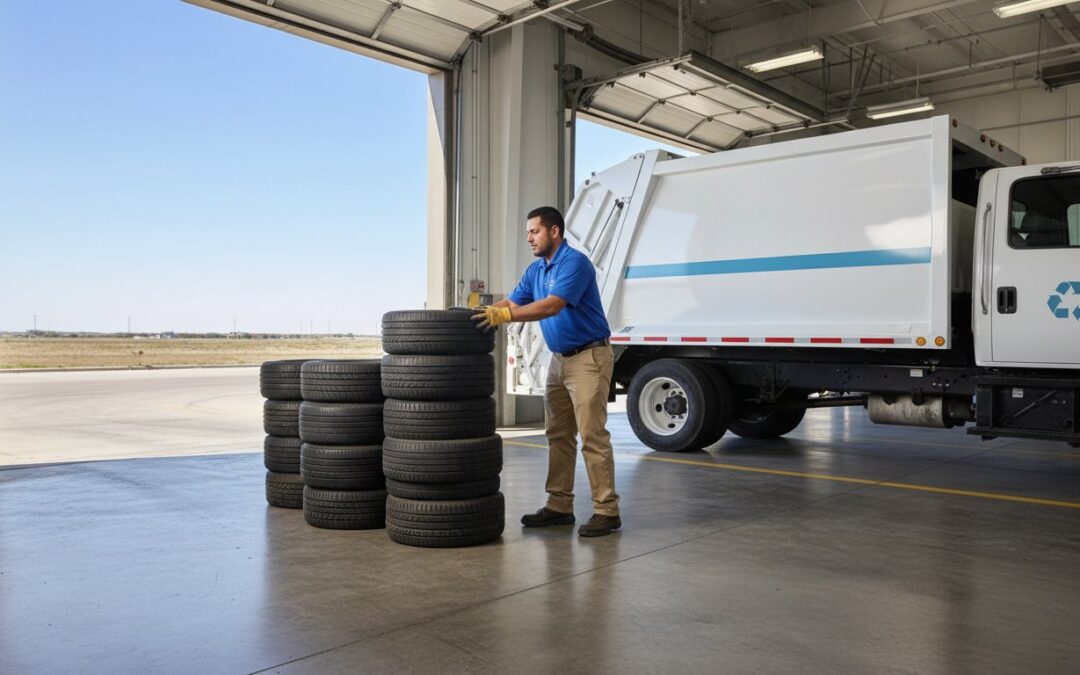
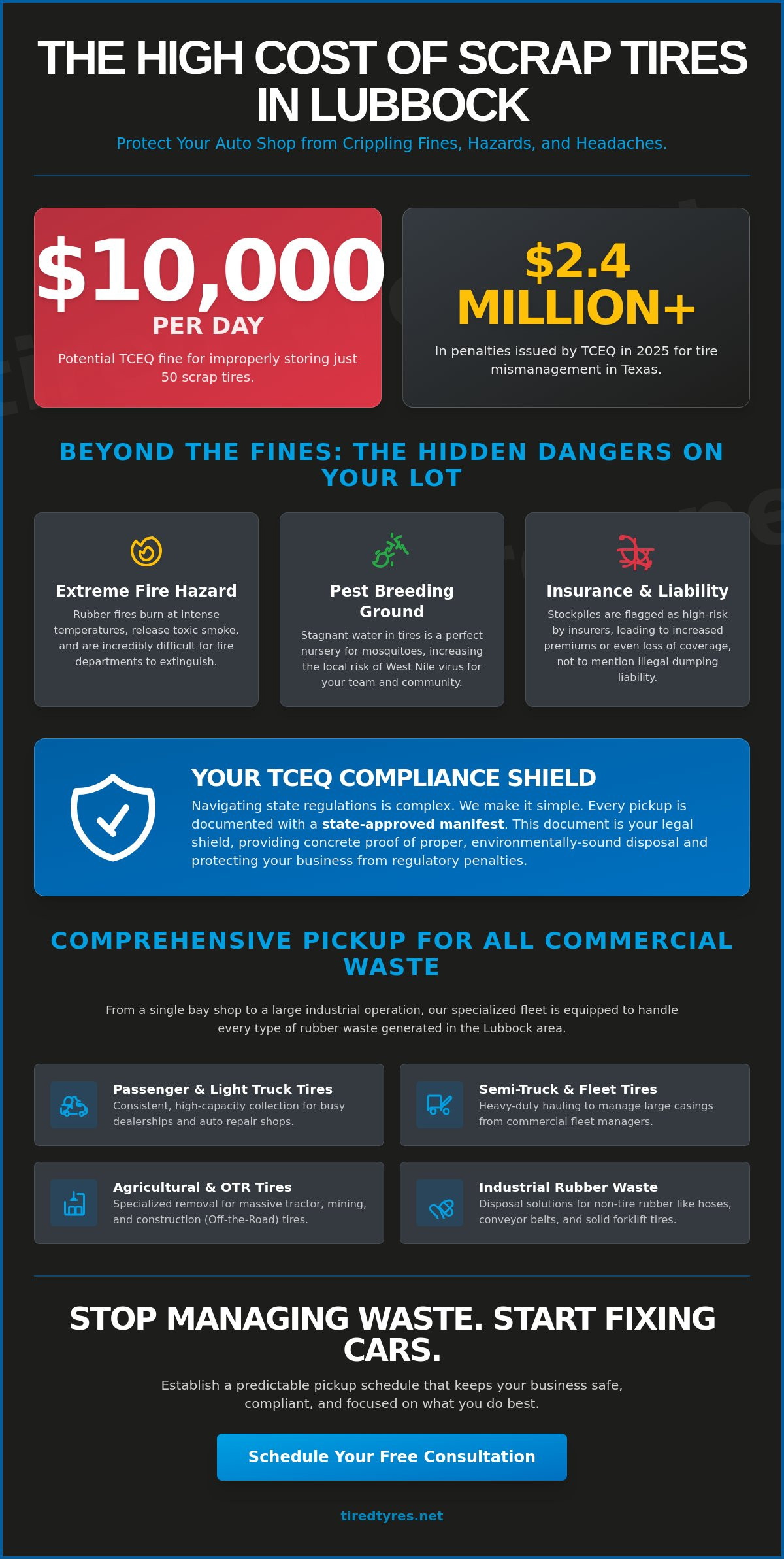
Did you know that storing just 50 scrap tires improperly could trigger a TCEQ fine of $10,000 per day? In 2025, the Texas Commission on Environmental Quality issued over $2.4 million in penalties for mismanagement, proving that enforcement is tighter than ever. For local business owners, securing a reliable auto shop scrap tire pickup Lubbock service is no longer just about cleaning up the yard. It’s a vital safeguard against crippling financial risks, fire hazards, and the pests that thrive in stagnant water.
You likely started your shop to fix vehicles, not to manage a growing mountain of rubber that attracts mosquitoes and inspectors. Dealing with the logistics of scrap disposal is a constant headache that pulls you away from your actual work. This guide shows you how to streamline your waste management with professional, TCEQ-compliant solutions. You’ll learn how to maintain a clean shop floor, manage required state-approved manifests, and establish a predictable pickup schedule that keeps your business safe and fully legal in 2026.
Key Takeaways
- Understand why Lubbock’s high traffic volumes require a strategic approach to scrap tire storage and removal.
- Secure your business by arranging a professional auto shop scrap tire pickup Lubbock service that covers passenger, semi-truck, and OTR tires.
- Master TCEQ compliance by using state-approved manifests as your legal shield against significant regulatory penalties.
- Optimize your daily operations by conducting volume audits and setting up dedicated loading zones for a faster, safer shop floor.
- Learn how a local, specialized fleet can handle diverse rubber waste like hoses and conveyor belts alongside standard tire collections.
Managing Scrap Tire Accumulation in Lubbock Auto Shops
Professional scrap tire pickup is a specialized B2B service designed to remove bulk rubber waste from commercial locations. For businesses in Lubbock, this service is a necessity rather than a luxury. As the “Hub City” of West Texas, Lubbock acts as a central repair point for a massive regional fleet. High traffic volume means local shops generate a significant amount of waste rubber every week. If you don’t have a plan for this volume, your shop floor can quickly become a storage yard.
Stockpiling tires leads to hidden costs that many owners overlook. Insurance companies often flag large tire piles as high-risk liabilities. This can result in increased premiums or even the loss of coverage. Moving from reactive “emergency” calls to a proactive waste management plan keeps your operations smooth. A scheduled auto shop scrap tire pickup Lubbock service ensures that your workspace stays clear and your overhead remains predictable. It’s about maintaining a professional environment where your team can focus on repairs, not waste management.
Safety Risks of On-Site Tire Piles
Large tire piles are a magnet for serious safety issues. Rubber fires are notoriously difficult for the Lubbock Fire Department to extinguish because they burn at extreme temperatures and create their own fuel source. Beyond the fire risk, tires are a major pest concern. Stagnant water trapped inside casings creates the perfect breeding ground for mosquitoes. This increases the local risk of West Nile virus, which is a serious concern in the South Plains. Clearing these piles doesn’t just satisfy inspectors; it protects your technicians and improves overall shop floor efficiency by reclaiming valuable workspace.
The Environmental Impact in the South Plains
Protecting the South Plains environment starts with responsible disposal. When rubber degrades under the intense West Texas sun, it can leach chemicals into the soil. This poses a potential threat to our local groundwater. Professional haulers ensure that your waste rubber enters the Tire recycling process, where it can be transformed into new products. For Lubbock business owners, illegal dumping is a high-stakes gamble that never pays off. If tires from your shop are found in a ditch, the TCEQ can hold you liable. Using a reliable auto shop scrap tire pickup Lubbock partner is the safest way to support the regional circular economy while protecting your legal interests.
Comprehensive Pickup Services for All Commercial Tire Types
Lubbock auto shops deal with more than just standard sedans. Our regional economy is powered by a mix of light-duty commuting, long-haul trucking, and heavy-duty agricultural work; all of which require different waste management strategies. A generic recycling center might take a few car tires, but they often lack the equipment to handle the diverse inventory found in a professional shop. We provide a specialized auto shop scrap tire pickup Lubbock service that scales to meet these specific commercial needs.
High-volume dealerships typically generate a constant stream of passenger and light truck (PLT) tires. These require consistent, high-capacity collection to keep service bays clear and productive. For commercial fleet managers, we offer heavy-duty solutions for semi-truck tire disposal. These larger casings take up significant space and require specialized hauling to ensure they don’t become a safety bottleneck. Beyond the city limits, our agricultural tire pickup serves the farming communities surrounding Lubbock, handling everything from tractor tires to specialized ranch machinery rubber.
Specialized OTR (Off-the-Road) Tire Removal
Mining and construction operations in West Texas use massive OTR tires that present unique logistical challenges. Standard waste haulers often refuse these items because they don’t fit in conventional trailers and require specialized loading equipment. Safely transporting these oversized loads across Lubbock County roads requires experience and the right fleet. We have the heavy-duty machinery necessary to lift and haul these massive units, ensuring your site stays compliant and clear of obstructions. If you are dealing with oversized inventory, you can schedule a specialized consultation to see how we handle these heavy loads.
Industrial Rubber Waste Solutions
It’s a common mistake to think that only round tires need professional disposal. Local manufacturing plants and warehouses often accumulate other forms of rubber waste that are just as difficult to manage. This includes scrap hoses, worn-out conveyor belts, and solid tires from forklift fleets. These materials are incredibly dense and don’t belong in a standard dumpster. By combining your tire and industrial rubber waste pickups, you can streamline your operations and reduce overall service visits. This integrated approach ensures that every piece of scrap rubber, from a skid steer track to a heavy-duty hydraulic hose, is removed efficiently and handled according to environmental standards.
Understanding TCEQ Compliance and Manifest Requirements
The Texas Commission on Environmental Quality (TCEQ) sets the standard for waste management across the state. For local business owners, staying on the right side of these regulations is a financial necessity. In 2025, the TCEQ issued over $2.4 million in penalties for improper scrap tire management. This oversight ensures that rubber waste doesn’t end up in unauthorized landfills or abandoned lots. If your shop stores more than 500 scrap tires on the ground or 2,000 in enclosed containers, you must have a formal TCEQ registration. This registration remains valid for 60 months, but your daily compliance depends on the paperwork you generate during every auto shop scrap tire pickup Lubbock service.
The scrap tire manifest is the most important document in your files. It acts as your legal proof of proper disposal. This tracking system follows the tires from the moment they leave your shop until they arrive at a permitted processor. Without a completed manifest, you have no way to prove to an inspector that those tires were handled legally. Best practices for record-keeping include:
- Retaining copies of all signed manifests for at least three years.
- Verifying that the hauler, the generator, and the processor have all signed the document.
- Matching your internal tire disposal logs with the official manifest counts.
- Reviewing your annual TCEQ reports to ensure they reflect your actual waste activity.
In the event of a surprise environmental audit, having a clear paper trail can save your business from massive administrative headaches. It’s not just about getting rid of the tires; it’s about proving you did it the right way.
Avoiding Illegal Dumping Fines in Lubbock
Under Texas law, your business is classified as a “scrap tire generator.” This title carries a significant burden of responsibility. Many shop owners mistakenly believe their liability ends the moment the tires are loaded onto a truck. In reality, you’re responsible for those tires until they reach a permitted processing site. If an unlicensed hauler dumps your inventory in a West Texas canyon, the TCEQ can trace those tires back to your shop. You can find detailed information on these requirements in our guide to Texas Tire Disposal Regulations. It’s a high-stakes gamble to ignore these rules when storing as few as five unregistered off-the-road tires can lead to fines exceeding $25,000.
The Importance of Permitted Haulers
Verifying your hauler’s credentials is the first step in protecting your business. Always ask for an active TCEQ registration number before signing any service contract. Unlicensed haulers often offer lower rates because they skip the costs of legal disposal, but the risk falls entirely on you. These “fly-by-night” operations frequently dump rubber waste in remote areas or local playa lakes, leaving the original generator to face the legal fallout. We maintain full regulatory compliance, ensuring every auto shop scrap tire pickup Lubbock is tracked from your shop floor to the shredder. This professional approach provides the peace of mind that your waste is handled ethically and legally every time.
Streamlining Your Shop Operations with Scheduled Pickups
Managing a high volume service center requires more than just mechanical skill. It requires logistical precision. Efficiency in a busy shop depends on clear floor space, and a pile of tires is a bottleneck for your technicians. To resolve this, you need a structured approach to waste management. Establishing a routine auto shop scrap tire pickup Lubbock service allows your team to focus on billable hours instead of moving rubber out of the way.
Follow these five steps to optimize your shop’s waste flow:
- Step 1: Conduct a volume audit. Track how many tires you generate over a 30 day period. This data helps you decide if you need weekly, bi-weekly, or monthly service.
- Step 2: Designate a loading zone. Create a clear, accessible area for the pickup truck and trailer. This zone should be away from customer parking but easy for your staff to reach.
- Step 3: Establish a recurring schedule. Consistency prevents pile-ups before they start. Automated schedules remove the need for last-minute “emergency” calls.
- Step 4: Train your staff. Ensure your service writers or shop foremen know how to verify load counts and sign TCEQ manifests correctly.
- Step 5: Review disposal reports. Use the provided manifests to track your environmental impact and maintain records for potential tax or certification purposes.
Flexible Scheduling for High-Volume Shops
Every shop has a different rhythm. Some dealerships experience heavy seasonality during “pothole season” or regional harvest times. Choosing between an on-call model and a recurring schedule depends on your storage capacity. If you have limited space, a recurring schedule is the safest bet to avoid TCEQ storage threshold violations. We offer flexible timing to minimize disruption, often scheduling pickups during off-peak hours so our trucks don’t block your service bays. For a deeper look at regional logistics, see our guide on Commercial Tire Disposal in Lubbock.
Maximizing Efficiency in Tire Storage
How you store your tires directly impacts how quickly they can be loaded. We recommend “lacing” tires, also known as the herringbone method. This technique stacks tires in an interlocking pattern, which maximizes your square footage and allows our drivers to load the trailer faster. It’s also vital to separate metal rims from the rubber. Most processors charge extra for tires on rims because they require additional labor. Finally, keep your scrap piles dry. TCEQ haulers prefer tires without mud or stagnant water because it reduces weight inaccuracies and keeps the transport environment cleaner. If you’re ready to optimize your workspace, contact us to set up your custom schedule.
Why Tired Tyres is Lubbock’s Trusted Partner for Scrap Removal
Choosing a waste management partner is about more than just finding a truck to haul away debris. It’s about finding a team that understands the specific pressures of the West Texas automotive industry. Unlike generic recycling centers or local junk yards that only focus on salvageable car parts, we provide a specialized service dedicated to the complete removal of scrap rubber. Our focus is on providing a professional, reliable auto shop scrap tire pickup Lubbock that keeps your shop floor clear and your business fully compliant with state law. We’ve built our reputation on being the reliable partner that shop owners can call when they need a problem solved quickly and correctly.
Our capability starts with our dedicated fleet. We don’t rely on third-party contractors who might lack the right equipment for heavy-duty loads. Our team has invested in specialized trailers and lifting machinery that can handle everything from standard passenger tires to massive OTR units and agricultural casings. This equipment also allows us to collect industrial rubber waste like scrap conveyor belts, solid forklift tires, and heavy-duty hoses. By managing these diverse materials in a single visit, we help you reduce service fees and simplify your vendor list. You get a single point of contact for all your rubber disposal needs, backed by a team that takes professional accountability for every manifest signed.
Our South Plains Service Area
We take pride in serving the entire South Plains region. Our service routes cover Lubbock, Slaton, Wolfforth, and the surrounding farming communities. This local expertise is vital. We understand the unique logistical challenges of West Texas, from navigating commercial zoning rules to coordinating with regional landfills. Our deep knowledge of local ordinances ensures that every load is handled correctly from start to finish. We’re part of this community, and we’re committed to keeping our local environment clean. For more details on how we support the region, read our article on Reliable Tire Disposal in West Texas.
Get a Custom Quote for Your Shop
Every auto shop has unique needs based on their service volume and the types of vehicles they handle. We offer no-obligation volume assessments for new commercial clients to help you establish a predictable, cost-effective pickup schedule. Whether you need a one-time clear-out of semi-truck tires or a recurring weekly auto shop scrap tire pickup Lubbock for a high-volume dealership, we provide transparent pricing without hidden fees. Our goal is to provide a sustainable solution that protects your shop’s safety and professional reputation. Contact us today to secure your compliance and get that scrap rubber off your lot for good.
Secure Your Shop’s Compliance and Future Efficiency
Managing a successful automotive business in West Texas means staying ahead of regulatory risks and operational bottlenecks. You’ve seen how professional tire removal protects you from significant penalties and fire hazards while reclaiming valuable floor space. By moving away from reactive disposal and toward a scheduled auto shop scrap tire pickup Lubbock service, you ensure your technicians stay productive and your lot remains clean.
As a TCEQ permitted hauler servicing Lubbock, Midland, and Odessa, we have the specialized OTR and agricultural equipment needed to handle any load size. Whether you’re managing a high-volume dealership or a heavy equipment repair shop, we provide the transparent manifests and reliable timing you need to stay compliant. Don’t let rubber waste become a liability for your business. Get a Professional Tire Pickup Quote for Your Lubbock Shop Today. We’re here to take the weight of waste management off your shoulders so you can focus on what you do best.
Frequently Asked Questions
How often should an auto shop in Lubbock schedule tire pickups?
You should schedule pickups based on your monthly service volume and storage capacity. High-volume dealerships in the Hub City often require weekly visits, while smaller local shops might find a monthly schedule sufficient. The primary goal is to ensure you never exceed the TCEQ storage threshold of 500 tires on the ground. Maintaining a consistent schedule prevents safety hazards and keeps your shop floor clear for billable work.
Does Tired Tyres provide the required TCEQ manifest for every pickup?
Yes, we provide a state-approved manifest for every auto shop scrap tire pickup Lubbock service we perform. This document is your legal proof of proper disposal and is required by the Texas Commission on Environmental Quality. It tracks your waste from the shop floor to the final processing site. You must keep these records for at least three years to stay protected during a surprise environmental audit.
Can you pick up tires that are still on the rims?
We can collect tires that are still on the rims, but it is often more efficient to separate them beforehand. Tires on rims are heavier and require additional processing at the recycling facility, which can impact your service fees. If you have a large volume of tires on rims, let us know during your initial assessment. We’ll bring the right equipment to ensure a safe and fast loading process for your team.
What happens to the scrap tires after they are picked up from my Lubbock shop?
Most scrap tires collected from your shop are sent to permitted processing facilities for recycling. Research indicates that over 90% of the waste we collect is repurposed into new materials. This includes tire-derived fuel, rubberized asphalt, or playground mulch. By choosing a professional hauler, you ensure your waste contributes to the regional circular economy instead of ending up in a West Texas canyon or a local landfill.
Are there specific fines for illegal tire dumping in Lubbock County?
Fines for illegal dumping are severe and can bankrupt a small business. Storing as few as 50 tires improperly can lead to a TCEQ fine of $10,000 per day. In 2025, the state issued over $2.4 million in penalties for mismanagement. If tires from your shop are dumped illegally by an unpermitted hauler, the legal and financial liability remains with you as the generator.
Do you handle large OTR or tractor tires in the Lubbock area?
Yes, we handle large OTR and tractor tires using specialized heavy-duty equipment. Our fleet is designed to transport massive construction and agricultural tires that standard waste haulers often refuse. We serve the farming communities surrounding Lubbock, including Slaton and Wolfforth. Whether you have a single OTR tire or a bulk load of tractor casings, we have the machinery to lift and haul them safely from your property.
What is the cost difference between passenger tire and semi-truck tire pickup?
Semi-truck tires generally cost more to pick up than standard passenger tires due to their size and weight. Because they take up significantly more space in the trailer, they require different logistics for hauling and processing. We offer competitive rates for both types of collection. We’ll provide a clear price structure based on your specific mix of passenger, light truck, and commercial fleet inventory during your volume audit.
Is there a minimum number of tires required for a scheduled pickup?
We don’t have a strict universal minimum, but we recommend bundling your tires to maximize the efficiency of each visit. Scheduling a pickup for a larger count helps reduce the overall frequency of service and lowers your environmental impact. If you have a mix of tires, hoses, and conveyor belts, we can combine these into a single pickup. This approach keeps your lot clear while providing the most cost-effective solution for your shop.