

In Lubbock, a tire manifest isn’t just a receipt; it’s your only legal defense against “cradle-to-grave” liability for scrap rubber. You probably already know that tracking every casing is a legal necessity, but the complexity of the TCEQ 5-part manifest system can feel like a full-time job. It’s stressful to worry about potential environmental audits or heavy fines simply because of a missing signature or a lost piece of paper.
You can gain total peace of mind by mastering the waste tire manifest requirements Lubbock enforces, ensuring your business stays compliant without the manual paperwork struggle. This guide explains the essential 2026 record-keeping rules, storage thresholds, and the exact workflow needed for managing your passenger, semi-truck, and agricultural tire collections. We’ll help you navigate the 60-day return rule and registration forms so you can focus on your business while staying fully protected.
Key Takeaways
- Learn why TCEQ Region 2 inspectors are increasing scrutiny on Lubbock businesses and how to define your legal role in the disposal chain.
- Master the 5-part tracking system to ensure every load meets the specific waste tire manifest requirements Lubbock officials expect during an audit.
- Understand your duty to verify hauler registration numbers and accurately record tire counts for passenger, OTR, and agricultural collections.
- Implement a robust filing system to satisfy the three-year record retention rule and protect your business from heavy environmental fines.
- Discover how automated manifest handling from a permitted hauler can remove the manual paperwork burden from your daily operations.
Understanding Waste Tire Manifest Requirements in Lubbock, TX
The Texas Commission on Environmental Quality (TCEQ) views every scrap tire as a potential environmental hazard. Because of this, the waste tire manifest requirements Lubbock businesses must follow are strictly enforced to prevent illegal dumping and fire risks. A manifest is a five-part document that tracks the movement of tires from the moment they’re removed from a vehicle until they reach an authorized destination. This system is part of a larger state effort toward sustainable Tire recycling, ensuring that rubber waste is processed correctly rather than abandoned in West Texas fields.
Texas law operates on the “cradle-to-grave” principle. This means you remain legally responsible for the tires you generate even after a hauler takes them away. If a transporter dumps your passenger or semi-truck tires illegally, and they don’t have a valid manifest linked to your business, you’re the one on the hook. Non-compliance often leads to heavy TCEQ penalties, potential legal liability, and the massive costs associated with environmental remediation. It’s not just a paperwork issue; it’s a financial protection for your shop.
The Legal Framework: 30 Tex. Admin. Code § 328.58
The primary regulation governing this process is 30 Tex. Admin. Code § 328.58. This state law applies to every tire moved within Lubbock County, regardless of the business size. It’s vital to distinguish between “used” tires, which can still be sold for their original purpose, and “scrap” tires, which are no longer fit for use. Proper documentation ensures you aren’t misclassified during an inspection. The manifest is the mandatory tracking document for all tire hauls.
Local Enforcement in the South Plains
Lubbock businesses are under the direct supervision of the TCEQ Region 2 office. Inspectors here are known for conducting unannounced audits to verify compliance. They don’t just check if you have a hauler. They verify your manifest binder is complete and matches the records at local landfills and processing centers. West Texas faces unique challenges with illegal stockpiling due to our open landscape. Local enforcement remains aggressive to protect the South Plains from the fire risks and pest issues associated with abandoned rubber. If you manage an agricultural or OTR tire collection, your manifest accuracy is even more critical due to the volume of rubber involved.
Staying ahead of these waste tire manifest requirements Lubbock mandates is the only way to ensure your business survives a surprise inspection. By keeping precise records, you demonstrate that you’re a responsible operator who takes environmental safety seriously. This transparency builds trust with regulators and protects your bottom line from avoidable fines.
The 5-Part Manifest System: Tracking Tires from Lubbock to Disposal
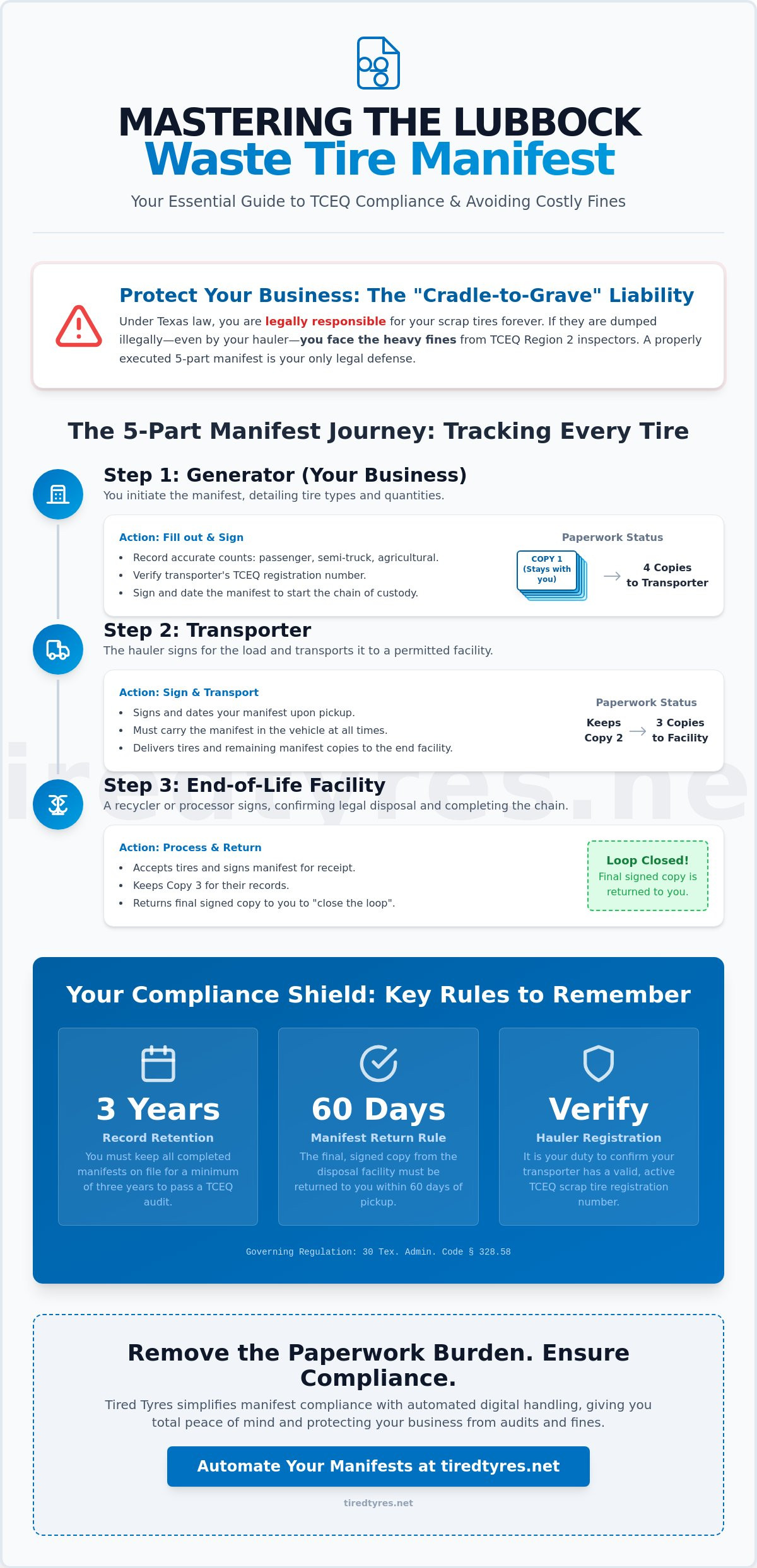
The manifest system functions like a high stakes relay race where the baton is a five part carbon copy document. Each person who touches the tires must sign and date the manifest to maintain a continuous chain of custody. This process ensures that every passenger, semi truck, or agricultural tire is accounted for from the moment it leaves your shop until its final processing. Understanding the waste tire manifest requirements Lubbock enforces means knowing that a simple handshake isn’t enough. You need the paper trail to prove you’ve followed the law.
The process begins with the “Generator,” which is your business. You are responsible for initiating the document and filling out the first section. You must list the quantity and type of tires being removed. Once the “Transporter” arrives, they sign the second section and take the tires. They are legally required to carry this manifest in their vehicle at all times during transit. If they are pulled over for a roadside check in Lubbock County, this document is their only proof that the load is legal. Finally, the “End of Life” facility, such as a recycler or landfill, signs the document upon receipt. This final signature confirms the tires reached a permitted destination.
Breaking Down the Five Copies
The system uses color coded copies to ensure everyone has a record of the transaction. Copy 1 is your initial record. It stays at your Lubbock shop the moment the hauler leaves your lot. Copy 2 belongs to the transporter as their permanent record for DOT or TCEQ inspections. Copy 3 is kept by the disposal facility for their own processing logs. The remaining copies are used to close the loop, eventually providing you with the final proof of disposal. Following industry best practices for scrap tire management helps ensure these documents are handled with the precision the state requires.
The 60-Day Return Rule
Your responsibility doesn’t end when the truck pulls away. Under the waste tire manifest requirements Lubbock businesses must follow, you must receive a completed, signed copy back from the disposal facility within 60 days. This returned copy is your “Get Out of Jail Free” card during a TCEQ audit. It proves the tires were actually disposed of correctly. If your hauler fails to return this document, you should contact them immediately and, if necessary, notify the TCEQ to protect yourself from liability. The manifest cycle is only “closed” once the generator holds the final signed copy. If you want to avoid the stress of tracking these deadlines, using a professional service for scrap tire collection can ensure your paperwork is always in order.
Generator Responsibilities: Your Legal Duties as a Lubbock Business
As a business owner in the South Plains, you are legally defined as the “Generator.” This title carries significant weight. You don’t just hand over scrap rubber and walk away. You must take an active role in the documentation process to remain compliant. Under the waste tire manifest requirements Lubbock enforces, loading tires onto an unregistered vehicle is a direct violation of state law. You are responsible for ensuring every load is handled by a professional who follows the rules.
Your first duty is to verify that the destination facility is an “Authorized” site under Texas law. Tires cannot simply be dropped at any plot of land. They must go to a permitted processor, recycler, or landfill. Additionally, you must control who signs the manifest at your Lubbock location. Only authorized employees should sign these documents. By signing, your staff is testifying that the tire count and category are accurate. This signature links your business to the load until it reaches its final, legal destination.
Verifying Your Tire Hauler
Before a single passenger or semi-truck tire hits the trailer, ask for the hauler’s TCEQ registration number. You can verify this credential instantly on the TCEQ Central Registry database. Hiring an unpermitted “guy with a trailer” might seem like a cost-saving measure, but it’s a legal disaster. If those tires are found in a Lubbock alley or a rural ditch, the TCEQ will trace them back to your shop. Following the Texas tire disposal regulations is your only shield against these “cradle-to-grave” liabilities. Always ensure the transporter’s registration is current before signing off on a haul.
Documenting the Load
Accuracy in your manifest is non-negotiable. You must categorize the load correctly to avoid TCEQ red flags. Standard passenger and light truck tires are typically recorded by unit count. However, for OTR (Off-the-Road) tires or large agricultural units, you may need to record the load by weight or specific tire type. Precision here prevents discrepancies that trigger audits.
- Record the exact date and time of the pickup to create a reliable timeline.
- List the specific pickup location in Lubbock or Odessa clearly.
- Double-check the transporter’s section for completeness before they leave your lot.
Common errors in the generator section, such as mismatched tire counts or illegible signatures, are the first things inspectors look for. If your records show 100 tires picked up but the facility only received 80, you are the one responsible for the missing 20. Clear, honest documentation is the only way to prove you have met the waste tire manifest requirements Lubbock mandates for local businesses.
Avoiding Audits and Fines: A Compliance Checklist for Lubbock
Organizing your records is the difference between a 15 minute inspection and a multi day audit. Most Lubbock shop managers fail not because they dump tires, but because they lose the paperwork. To meet the waste tire manifest requirements Lubbock inspectors look for, you need a centralized manifest binder. We recommend a chronological filing system. This allows you to quickly match outgoing loads with the return copies received within the 60 day window. If you work with multiple facilities, a facility based sub folder can help, but date based organization remains the industry standard for TCEQ readiness.
Under Texas law, you must retain all manifests, work orders, and invoices for three years. In 2026, relying solely on paper is risky. Heat, moisture, or simple human error can destroy your only legal defense. Digital backups are now a necessity. Scan every signed manifest as soon as it returns to your shop. This ensures that even if your physical binder is damaged, you can demonstrate a clear chain of custody for every passenger or agricultural tire that left your property.
Your Weekly Compliance Routine
Maintaining these waste tire manifest requirements Lubbock mandates requires a proactive approach. Dedicate time each week to these three steps:
- Step 1: Verify all outgoing loads from the past seven days have an initiated manifest with a valid generator signature.
- Step 2: Check your “pending” folder for any manifests approaching the 60 day limit without a returned facility signature.
- Step 3: Update your on site tire count. If you are storing more than 500 tires on the ground, you must ensure your registration status is current.
Preparing for a TCEQ Inspector
When an inspector arrives at your Lubbock or Odessa location, they will ask for your records immediately. Keep your binder in a location where any authorized employee can access it, even if the manager is off site. You must be able to demonstrate a clear “chain of custody” for your scrap rubber. This includes showing that your hauler is registered and that the destination facility is permitted. Knowing how to present this data is key to avoiding illegal dumping fines in Lubbock County.
Not all tires go to landfills. Some are used for “beneficial reuse,” like tire derived fuel or civil engineering projects. Even in these cases, you aren’t exempt from documentation. Ensure your hauler provides specific paperwork if your scrap rubber is destined for anything other than standard disposal. We also suggest conducting internal “mock audits” twice a year. Walk your staff through the manifest process to ensure no one is cutting corners when a truck arrives.
If you’re tired of managing the binder yourself, let us handle your commercial tire collection and manifest automation to keep your shop compliant.
How Tired Tyres Simplifies Manifest Compliance in West Texas
Compliance doesn’t have to be a burden for your business. At Tired Tyres, we operate as a fully permitted and registered TCEQ tire hauler, specifically designed to handle the heavy lifting of documentation for you. We understand that managing the waste tire manifest requirements Lubbock enforces is time consuming. Our team takes over the paperwork management, ensuring your shop stays protected while you focus on daily operations. We act as your professional partner in navigating the “cradle-to-grave” liability discussed throughout this guide.
Our expertise spans the entire spectrum of rubber waste. We provide professional collection for passenger and light truck tires, semi-truck tires, and massive OTR or agricultural units. We also specialize in difficult items like scrap skid steer tracks, hoses, conveyor belts, and solid tires. By serving the Lubbock, Midland, and Odessa corridor, we provide a reliable, legal disposal route for the entire South Plains and Permian Basin. You can trust that every load we haul is tracked with precision.
The Tired Tyres Advantage
Our drivers are more than just haulers. They’re professionals trained in the specific waste tire manifest requirements Lubbock inspectors demand. We guarantee the return of completed manifests within the legal timeframe, so your binder is always audit ready. You’ll find our pricing is transparent and straightforward. We don’t hide costs behind vague environmental fees. We provide honest service that keeps your business in the clear and your lot clean.
- Professional drivers who understand TCEQ documentation standards.
- Automated tracking to ensure you never miss the 60 day return deadline.
- Comprehensive collection for all scrap rubber types, including industrial and agricultural waste.
- Direct communication and reliable scheduling throughout West Texas.
Ready to Clean Up Your Lot?
Whether you need a one time pickup to clear out a backlog or a recurring service to keep your shop tidy, we have a solution. We offer custom plans for industrial rubber waste and large scale agricultural tire collections. Our team ensures that every step of the process, from the first signature to the final disposal, meets state standards. Don’t let a paperwork error turn into a costly fine or a legal headache. Contact Tired Tyres for a compliant tire pickup quote in Lubbock and let us handle the compliance for you.
We take pride in being a korrekt and helpful specialist for West Texas businesses. By choosing a permitted hauler, you’re not just getting rid of waste; you’re securing the future of your business. Let us take the stress out of manifest management so you can get back to what you do best.
Secure Your Business Compliance Today
Managing the waste tire manifest requirements Lubbock enforces doesn’t have to be a source of constant stress for your team. By implementing a strict filing routine and understanding your role as a generator, you’ve taken the most important steps toward avoiding heavy TCEQ fines. Your legal responsibility for scrap rubber only ends when you hold that final, signed manifest copy in your records. Don’t leave your compliance to chance with unpermitted haulers who lack proper credentials.
Tired Tyres is a TCEQ Registered Transporter serving the Lubbock, Midland, and Odessa corridor. We are specialists in OTR and industrial rubber, providing the equipment and expertise needed to handle your most complex loads while guaranteeing manifest accuracy. We manage the paperwork loop so you don’t have to deal with manual tracking or lost documents. We are committed to keeping West Texas clean and your business protected.
Get a Manifest-Compliant Pickup Quote from Tired Tyres today to secure your lot. Stay compliant and keep your focus on your business while we handle the disposal details.
Frequently Asked Questions
What is a waste tire manifest and do I really need one in Lubbock?
A waste tire manifest is a mandatory five part tracking document required by the Texas Commission on Environmental Quality (TCEQ). Every business in Lubbock that generates scrap tires must use this system to document the movement of rubber from their property to an authorized disposal site. It’s your primary legal defense against “cradle to grave” liability and proves you’ve followed state environmental laws.
How long am I required to keep scrap tire manifests in Texas?
Texas law requires you to retain all scrap tire manifests for a minimum of three years from the date of the haul. This retention period also applies to related work orders and invoices. You must make these records available to TCEQ inspectors immediately upon request during an unannounced audit at your Lubbock location.
What happens if my tire hauler doesn’t give me a manifest copy?
If a hauler fails to provide a manifest, you are in immediate violation of waste tire manifest requirements Lubbock businesses must follow. You must receive the initial copy before the truck leaves your lot and the final signed copy within 60 days. If the hauler refuses to provide documentation, you should find a permitted transporter and report the incident to the TCEQ Region 2 office.
Can I use a digital manifest system for TCEQ compliance in 2026?
Digital records are acceptable for TCEQ compliance provided they are complete and easily accessible during an inspection. Many Lubbock shop managers scan their paper manifests to create a secure backup. This practice ensures that even if physical copies are lost or damaged, you can still demonstrate a clear chain of custody for your scrap rubber.
Are there different manifest requirements for OTR or semi-truck tires?
The manifest form itself is the same for all tire types, but the documentation details vary. While passenger and light truck tires are typically recorded by individual unit count, larger loads like semi truck or OTR tires are often documented by weight or specific category. Accurate categorization on the manifest is essential to prevent discrepancies during facility reporting.
Who is legally considered the ‘Generator’ in a tire disposal transaction?
The “Generator” is the business or person who first produces the scrap tire, such as a tire dealership, auto repair shop, or fleet maintenance facility. In Lubbock, this title also applies to agricultural operations that remove tires from tractors or heavy equipment. As the generator, you are legally responsible for initiating the manifest process.
What is the penalty for disposing of tires in Lubbock without a manifest?
Disposing of tires without a manifest can lead to significant administrative fines and potential legal action from the TCEQ. Without this document, you cannot prove that your waste reached a permitted facility. If your tires are found in an illegal dump site, you may also be held financially liable for the entire cost of the environmental cleanup.
Does the City of Lubbock landfill require a manifest for commercial tire disposal?
Yes, all authorized disposal sites, including the City of Lubbock landfill and private processing centers, require a completed manifest for commercial loads. The facility must sign the document to confirm receipt and return a copy to the generator. This final signature is what officially “closes” the tracking loop for your waste tire manifest requirements Lubbock mandates.