

Did you know the TCEQ issued over $2.4 million in penalties for improper scrap tire management in 2025? For many Texas business owners, the fear of a heavy fine is constant, especially when you aren’t sure if a hauler is actually following the law. It’s a stressful position to be in because the state holds the generator responsible for the tire’s entire journey. You need to know exactly how to prove legal tire disposal to protect your company from environmental liability and costly violations.
We understand that manifest requirements and storage thresholds can feel like a maze of paperwork. This guide simplifies the process by providing a clear checklist of the documentation you must keep on file for three years. You’ll learn how to handle the TCEQ-10304 manifest and why verifying a hauler’s permit is your best defense. Whether you’re managing semi-truck tires or agricultural scrap in Midland or Odessa, this information ensures you stay compliant and audit-ready.
Key Takeaways
- Understand the “cradle-to-grave” liability principle and why Texas businesses remain responsible for tires even after they leave their property.
- Learn exactly how to prove legal tire disposal by correctly managing and retaining the five-part TCEQ-10304 scrap tire manifest.
- Discover how to verify a hauler’s registration status to avoid the legal and financial risks of hiring unauthorized “bandit” transporters.
- Master the “Three-Year Rule” for record-keeping to ensure your business stays fully compliant and ready for any environmental audit.
- Find out how professional collection services in West Texas can handle the complex documentation for your scrap tires, tracks, and rubber waste.
What Constitutes Legal Tire Disposal in Texas?
In Texas, legal tire disposal isn’t just about getting tires off your property. It’s a strictly regulated process defined by the Texas Commission on Environmental Quality (TCEQ) under Title 30 of the Texas Administrative Code. Legal disposal means your scrap tires must end up at a registered facility, processed for Tire recycling, or disposed of in a permitted landfill that’s authorized to accept shredded rubber. If the tires aren’t tracked from your door to a licensed destination, the state doesn’t consider the job done.
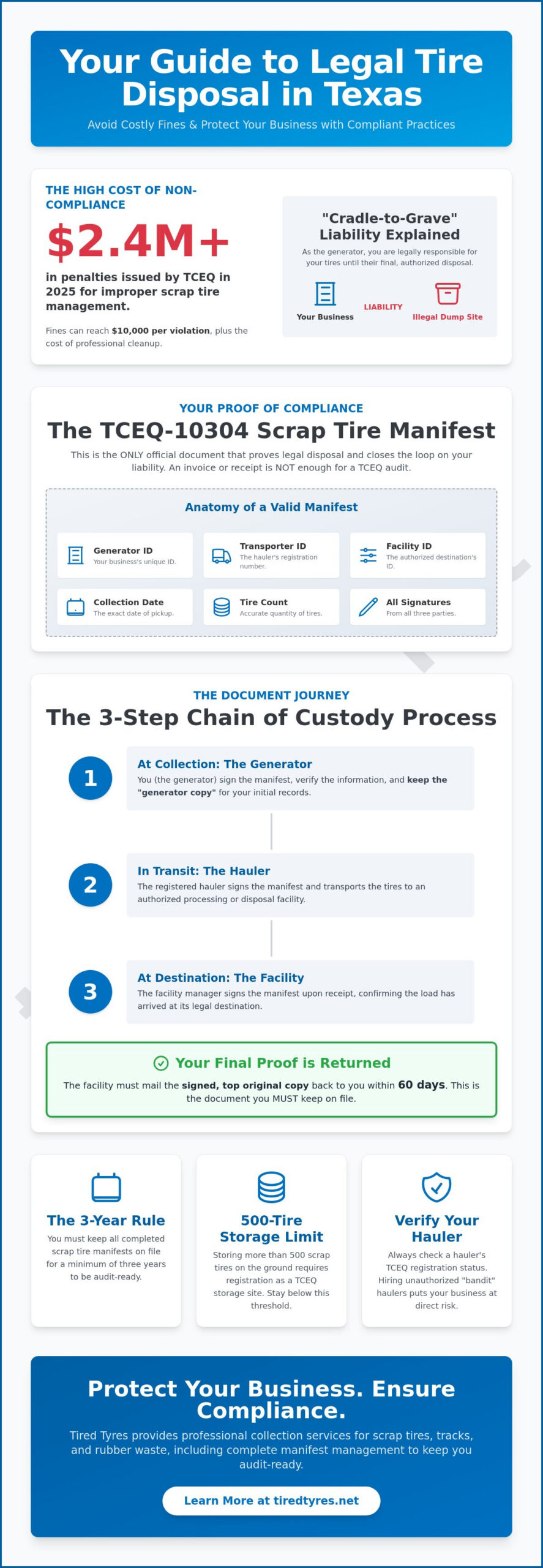
The most critical concept for any business owner to grasp is “Cradle-to-Grave” liability. This principle means you’re legally responsible for your tires from the moment they’re removed from a vehicle until they reach their final, authorized destination. If a hauler dumps your tires in a West Texas field, the TCEQ will trace them back to you. Knowing how to prove legal tire disposal through a documented chain of custody is the only way to protect your business from being held liable for someone else’s illegal actions.
The Legal Definition of a Scrap Tire
A tire becomes “regulated waste” the moment it can’t be used for its original intended purpose. While a used tire intended for resale is a commodity, a scrap tire is a liability. Texas law is firm about this distinction. Many businesses fall into the trap of “giving away” tires to individuals for fences or landscaping. Unless that person is a registered transporter or the site is a permitted facility, this often results in illegal dumping charges for the original business. Even small quantities are subject to storage rules; storing more than 500 tires on the ground requires formal registration as a storage site.
TCEQ Regulatory Oversight in West Texas
For businesses in Midland and Odessa (Region 7) or Lubbock (Region 2), oversight is active and local. Inspectors frequently visit industrial zones and oilfield service yards where tire accumulation is common. In 2025, the TCEQ issued over $2.4 million in penalties for improper scrap tire management. These fines aren’t just a minor expense. Penalties can reach $10,000 per violation. Beyond the initial fine, you may be forced to pay for the professional remediation of an unauthorized dump site. Understanding how to prove legal tire disposal with the right paperwork is your primary defense during these surprise inspections.
The Scrap Tire Manifest: Your Primary Proof of Compliance
If an inspector walks into your shop tomorrow, they won’t ask for your bank statements or your customer reviews. They’ll ask for your manifests. The TCEQ-10304 form is the only document that officially closes the loop on your liability. It’s the definitive answer for how to prove legal tire disposal to state authorities. Without this document, you’re essentially telling the state you hope your tires were disposed of correctly. Hope isn’t a valid legal defense when facing environmental audits.
Many business owners mistakenly believe a simple invoice or a hand-written receipt is enough. While those documents are fine for your internal accounting, they don’t carry any weight with the TCEQ. A manifest is a legal tracking document. It ensures that every scrap tire, from passenger tires to large OTR rubber, is accounted for from the moment it leaves your facility until it reaches a registered processing site. For reliable scrap tire collection that includes full manifest management, working with a professional partner is the most efficient way to stay protected.
Anatomy of a Valid Texas Tire Manifest
A valid manifest must be complete and legible to serve as proof. It requires three specific identification numbers: your Generator ID, the registered Transporter ID, and the authorized Facility ID. You must also include the exact date of collection and an accurate count of the tires being removed. In 2026, the TCEQ accepts both digital and traditional paper manifests, provided they capture all required signatures. If a field is left blank or a signature is missing, the document may be considered invalid during an inspection, leaving you vulnerable to fines.
The Chain of Custody Process
The manifest follows a strict three-part journey to ensure transparency. First, you sign the manifest at the time of collection and keep the “generator copy” for your initial records. Second, the hauler signs the document and transports the load to a registered facility. Finally, the facility manager signs the form upon arrival. The most important step for the business owner is receiving the “top original” copy back from the facility. Texas law requires the facility to return this signed original to you within 60 days of the collection date. This returned copy is the final piece of the puzzle for how to prove legal tire disposal, as it confirms the tires reached their legal destination.
How to Verify a Permitted Tire Hauler
Hiring a hauler just because they offer the lowest price is a dangerous game for West Texas businesses. These “bandit” haulers often operate without state registration and bypass the manifest system entirely. If they take your scrap tires and dump them in a Midland alley or an Odessa field, the TCEQ will trace those tires back to your shop. Because of the cradle-to-grave liability we discussed earlier, you will be the one paying for the cleanup and the resulting fines. Choosing a registered partner is the foundation of how to prove legal tire disposal; without a legal hauler, your paper trail ends before it even begins.
Spotting an unauthorized hauler is often easier than you might think. Legal transporters are required to display a valid TCEQ registration decal on their vehicles. This decal is usually found on the driver-side door or the front of the trailer. If a hauler arrives in an unmarked truck or a personal trailer with no visible registration numbers, you should refuse the service. Other red flags include cash-only demands or a refusal to provide a manifest on the spot. A legitimate professional will always have their paperwork ready before a single tire is loaded.
Verifying Registration in Real-Time
You don’t have to take a hauler’s word for their legal status. The TCEQ maintains a Central Registry database where you can search for active scrap tire transporters in Region 7 or Region 2. When you look them up, ensure their registration is active and that they’re authorized for your specific waste type. Some haulers are only registered for passenger tires and aren’t legal for OTR (Off-the-Road) tires or semi-truck tire collection. For a deeper look at these requirements, review our Texas Tire Disposal Regulations guide for 2026.
Questions to Ask Your Disposal Partner
Before you sign a contract or schedule a pickup, ask these three clarifying questions to ensure you’re working with a professional:
- Do you provide a completed manifest for every single load? If the answer is “no” or “only upon request,” they aren’t following the law.
- Where is the final authorized disposal or recycling facility? A legal partner will name a specific, permitted site in Texas where the tires are processed.
- Are you insured for environmental liability? This protects you if an accident or spill occurs while your scrap tires are in transit.
Verifying these details upfront is the most effective way to protect your business. It ensures that when an auditor asks how to prove legal tire disposal, you have a solid, verifiable answer backed by a registered partner.
Record-Keeping Best Practices to Avoid TCEQ Fines
The TCEQ is clear about record retention. You must keep all manifests, work orders, and invoices for at least three years. This isn’t just a suggestion; it’s a regulatory requirement. These documents must be available for inspection at your place of business. If you can’t produce a manifest from two years ago, you’ve lost your ability to show how to prove legal tire disposal for that specific load. This gap in documentation is often enough for an inspector to issue a citation, even if you did everything else right.
Large-scale generators have extra responsibilities. If your business stores more than 500 tires on the ground or 2,000 in enclosed containers, you must register as a scrap tire storage site. These registered sites must submit an annual operational status report to the TCEQ. The deadline for the 2025 calendar year is December 31st. Keeping your records organized throughout the year makes this reporting process much faster and reduces the risk of errors that trigger an audit.
Organizing Your Compliance Folder
A messy stack of papers won’t impress an environmental inspector. We recommend organizing your compliance folder by calendar year. Within those years, separate your manifests by waste type. Keeping Commercial Tire Disposal records for semi-truck tires separate from passenger tire manifests helps you quickly verify counts. As a secondary layer of evidence, take a quick photo of the loaded truck with the hauler’s decal visible before it leaves your property. Digital backups of these photos and your signed manifests ensure you’re protected even if physical copies are lost.
Dealing with Inspections in Midland, Odessa, and Lubbock
Inspectors in TCEQ Region 7 (Midland/Odessa) and Region 2 (Lubbock) focus heavily on industrial and oilfield service yards. When an inspector arrives, they’ll immediately look for signs of “unauthorized storage.” This usually happens when tires accumulate without a clear paper trail of regular pickups. If someone illegally dumps tires on your property, don’t just ignore them. Document the “abandoned tires” with photos and a police report to prove you aren’t the generator. This documentation prevents you from being held liable for waste you didn’t create. If you’re overwhelmed by the paperwork, our professional tire collection services include full manifest management to keep your records audit-ready.
Reliable, Documented Tire Collection with Tired Tyres
Managing scrap rubber shouldn’t be a legal headache for your business. At Tired Tyres, we focus on providing a seamless solution for companies across the Permian Basin and the South Plains. We understand that your priority is running your operation, not chasing down missing paperwork or worrying about environmental audits. That’s why we’ve built our service around total transparency and regulatory precision. We provide a professional solution that removes the risk from your waste management process.
Every pickup we perform comes with full manifest management. We provide the necessary TCEQ documentation on the spot and ensure the final signed copies reach you within the state-mandated timeframe. This process is exactly how to prove legal tire disposal if an inspector ever visits your facility. We take the guesswork out of compliance. You won’t have to wonder if your tires reached a legal destination because you’ll have the signed proof in your files.
Our services cover the diverse needs of West Texas industries. We specialize in semi-truck tire collection, agricultural tire removal, and heavy-duty OTR tire collection. Beyond standard tires, we also handle scrap skid steer tracks, industrial hoses, and scrap conveyor belts. Every piece of rubber we haul is tracked through the same rigorous manifest system, ensuring that your industrial waste doesn’t become a future liability.
Our Commitment to Legal Disposal
We prioritize the manifest system because it’s the only way to protect our clients from “cradle-to-grave” liability. A cheap, undocumented hauler might save a few dollars today, but a single TCEQ fine can cost your business up to $10,000 per violation. We operate as a registered partner that follows every state guideline. You can find more details about our standards in our guide to Reliable Tire Disposal. Whether you’re clearing out a small shop or a large industrial yard, our process remains professional and fully documented.
Get Your Documented Pickup Scheduled
Scheduling a collection is straightforward. When you reach out, we’ll provide a clear quote based on your specific volume and waste type. On the day of collection, our team arrives in marked vehicles with visible registration decals. We load the material, sign the manifest, and provide your generator copy immediately. This gives you an instant answer for how to prove legal tire disposal to any inquiring authority. We serve Midland, Odessa, Lubbock, and the surrounding communities with a commitment to speed and accuracy. Contact Tired Tyres for a compliant disposal quote today and let us handle the environmental paper trail for you.
Secure Your Business with Professional Tire Compliance
Protecting your Texas business from environmental liability starts with a commitment to proper documentation. The “cradle-to-grave” rule makes you responsible for your scrap rubber long after it leaves your yard. By maintaining a clean manifest trail and verifying every hauler’s TCEQ registration, you eliminate the risk of surprise fines and legal complications. Knowing how to prove legal tire disposal is your best defense against the heavy penalties the state issues for improper management.
Tired Tyres is here to take the complexity out of your environmental compliance. We provide TCEQ compliant manifesting for every pickup, serving businesses throughout Midland, Odessa, and Lubbock. Whether you need specialized OTR removal or industrial rubber disposal, we ensure your paper trail is flawless. You don’t have to leave your company’s reputation to chance with an unverified hauler.
Get a Compliant Tire Disposal Quote Today and gain the peace of mind that comes with professional service. We’re ready to help you keep your facility clean and your records audit-ready. Let’s ensure your business stays protected and fully compliant with Texas law.
Frequently Asked Questions
What is a scrap tire manifest and why do I need one?
A scrap tire manifest is the official TCEQ-10304 form that tracks the movement of waste rubber from your property to a final facility. It’s the most important document for anyone learning how to prove legal tire disposal because it provides a verified chain of custody. Without it, you have no legal evidence that your tires reached a permitted recycling or disposal site.
How long do I need to keep records of tire disposal in Texas?
You must keep all tire disposal records for at least three years. This timeframe includes manifests, invoices, and any work orders related to the collection. These records must be stored at your place of business and be available for immediate review if an inspector from the TCEQ visits your site for an audit.
Can I be fined if my hauler dumps tires illegally?
Yes, you can be held responsible for illegal dumping even if you didn’t do it yourself. Texas law follows a “Cradle-to-Grave” principle, meaning the business that generated the scrap tires is responsible for their legal destination. If a hauler dumps them in a field, the state can hold you accountable for remediation costs and heavy fines.
How do I know if a tire hauler is registered with the TCEQ?
You can verify a hauler by checking for a current TCEQ registration decal on their truck or trailer. For added security, search the TCEQ Central Registry database to confirm their registration is active and authorized for your specific waste type. Legitimate transporters will always be happy to show you their registration credentials before loading.
Is a receipt from a landfill enough to prove legal disposal?
A landfill receipt is a useful supporting document, but it isn’t a substitute for a manifest. Texas regulations require the five-part manifest system to track the entire journey of the waste. To fully understand how to prove legal tire disposal, you must ensure the top original copy of the manifest is signed by the facility and returned to you within 60 days.
What happens if I find tires abandoned on my commercial property?
Document the tires immediately with clear photos and file a report with local law enforcement. This establishes a formal record that you weren’t the generator of that waste. By creating this paper trail, you protect your business from being cited for an unauthorized dump site or illegal storage on your property.
Do small businesses have different tire disposal rules than large fleets?
The core manifest requirements apply to every business, regardless of size. However, businesses storing more than 500 scrap tires on the ground or 2,000 in lockable containers face additional registration and annual reporting rules. Even small shops must use registered haulers and keep three years of documentation to stay compliant with state law.