
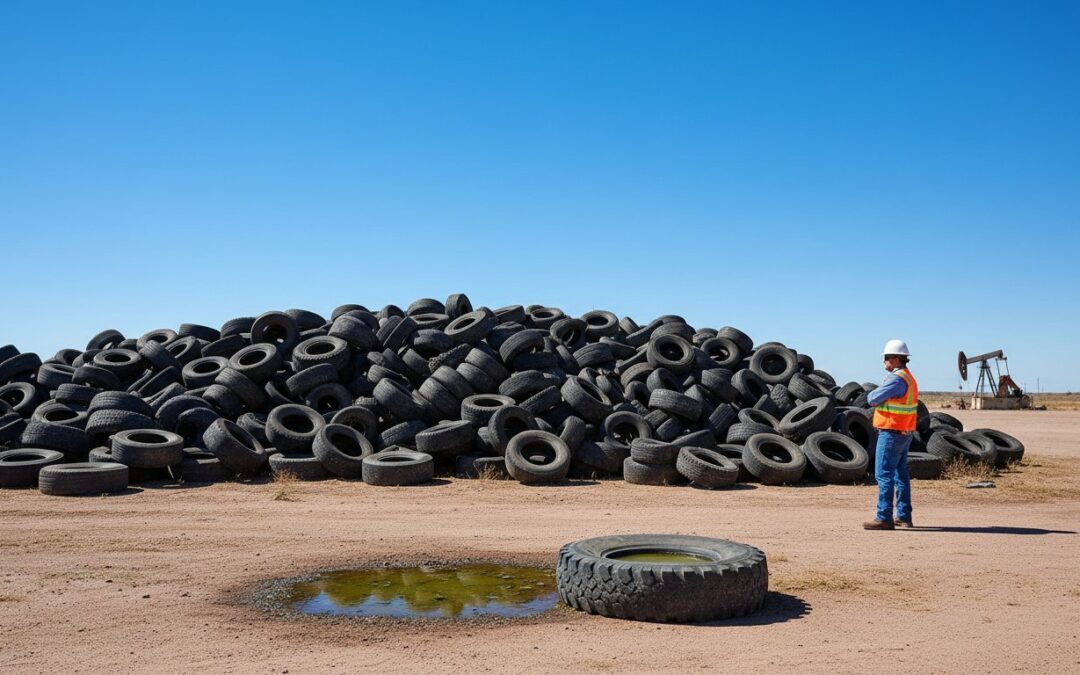
A single abandoned tire in the Permian Basin can produce over 10,000 mosquitoes in one rainy season. While it’s easy to view a stack of old rubber as just a messy eyesore, these piles are actually significant scrap tire health hazards that thrive in our unique West Texas climate. You likely already know that improper storage is a magnet for pests and a major fire risk during 100-degree Midland summers. It’s a stressful reality for local business owners who want to avoid the $5,000 daily fines often associated with TCEQ non-compliance.
This 2026 safety guide shows you exactly how to identify hidden biological and chemical dangers before they become a legal nightmare. You’ll learn how to safeguard your property from spontaneous combustion risks and ensure your facility meets every Texas environmental standard. We’ll also highlight how to secure a reliable, professional pickup service in Odessa to clear your site quickly. Let’s look at the specific risks facing your employees and family right now.
Key Takeaways
- Understand how the West Texas climate accelerates tire degradation, turning piles into breeding grounds for disease-carrying mosquitoes and rodents.
- Identify the critical scrap tire health hazards linked to heavy metal soil leaching and the toxic, uncontrollable nature of tire fires.
- Learn the essential TCEQ regulations and the legal distinction between generators and transporters to protect your property from liability.
- Discover why professional collection is the only safe way to handle disposal and avoid the physical risks and landfill rejections of DIY hauling.
The Hidden Dangers of Scrap Tire Accumulation in West Texas
Scrap tire health hazards are a complex intersection of biological, chemical, and physical risks that threaten the stability of West Texas communities. In Lubbock and the surrounding South Plains, an abandoned tire is more than just litter. It functions as a specialized vessel for environmental degradation. These hazards manifest through the release of toxic chemicals, the creation of fire-prone fuel stacks, and the establishment of breeding grounds for disease-carrying pests. When rubber stays exposed to the elements, it doesn’t just sit there; it actively interacts with the ecosystem in ways that jeopardize public safety.
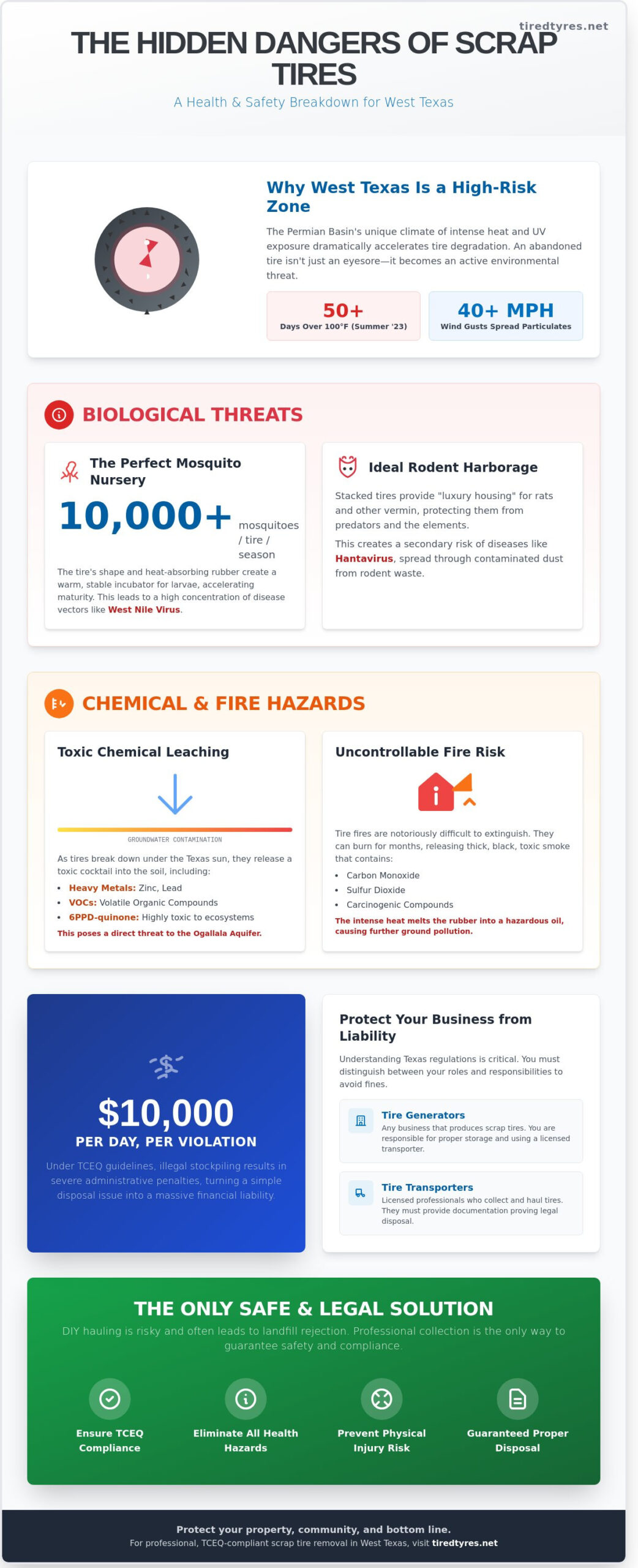
The Midland and Odessa climate accelerates tire degradation through intense UV exposure and extreme temperature fluctuations. During the 2023 summer season, West Texas experienced over 50 days of temperatures exceeding 100°F. This relentless heat breaks down the synthetic polymers in the rubber faster than in more temperate regions. The primary victims of these hazards include industrial employees handling the waste, local wildlife that can become trapped or poisoned, and the region’s groundwater. If heavy metals like zinc or lead leach into the soil, they can migrate toward the Ogallala Aquifer. Many property owners assume “out of sight” tires are harmless, but they represent a massive legal liability. Under 2024 TCEQ guidelines, illegal stockpiling can result in administrative penalties reaching $10,000 per day per violation.
The Anatomy of a Waste Tire Risk
A tire’s physical structure is designed to be durable, which makes it an environmental nightmare once discarded. The hollow, circular shape creates a permanent reservoir that traps moisture with incredible efficiency. Even a single half-inch rainfall in Lubbock can provide enough water for a tire to remain damp for 21 days. The dark rubber absorbs solar radiation, creating an “incubation effect” where internal temperatures stay 15 degrees higher than the ambient air. This warmth speeds up biological processes inside the casing. Larger agricultural and Off-The-Road (OTR) tires, which can weigh over 3,000 pounds, create massive micro-environments. These oversized casings hold gallons of stagnant water, making them significantly more dangerous than standard passenger tires for pest management.
Why West Texas Heat Changes the Equation
Extreme heat in the Permian Basin triggers thermal expansion within the tire’s layers. This expansion opens microscopic pores in the rubber, allowing for the off-gassing of volatile organic compounds (VOCs) that irritate the respiratory systems of nearby workers. 6PPD-quinone is a toxic byproduct of tire wear and aging that forms when the antioxidant 6PPD reacts with ozone in the atmosphere. Understanding the environmental risks of tire stockpiles is essential for any business owner in Lubbock.
The high winds and seasonal dust storms common in West Texas further complicate the issue. Particulates from degrading tires, including micro-rubbers and carbon black, are easily picked up by 40 mph gusts and spread across residential neighborhoods. This airborne spread means the health risks aren’t confined to the immediate vicinity of the pile. When you combine the chemical breakdown caused by the sun with the physical transport of dust, every abandoned tire becomes a source of long-term contamination for the local air and soil.
Biological Threats: Mosquitoes, Rodents, and Disease
A single discarded tire isn’t just an eyesore; it’s a biological incubator. In the Lubbock climate, one tire can hatch over 10,000 mosquitoes during a single West Texas summer. These aren’t just seasonal nuisances. They represent significant scrap tire health hazards because they concentrate disease vectors in residential and industrial zones. Standard pest control often fails here because the interior of a tire is nearly impossible to reach with traditional surface sprays.
The Perfect Mosquito Nursery
The unique geometry of a tire makes it an ideal breeding ground. Even in the arid conditions of Midland, the curved shape prevents water from evaporating. The black rubber absorbs sunlight, keeping the trapped water at a stable, warm temperature. This accelerated environment allows larvae to mature much faster than they would in a natural pond. The Aedes aegypti species, common across the Permian Basin, specifically seeks out these artificial containers. In 2023, West Texas reported dozens of confirmed West Nile Virus cases, many of which originated from stagnant water in unmanaged tire piles.
Rodent Infestations and Secondary Risks
Tire piles offer “luxury housing” for larger pests like Norway rats and roof rats. These animals find the deep cavities of stacked rubber perfect for nesting away from predators. The presence of rodents brings the risk of hantavirus, which spreads through contaminated dust and waste. This creates a dangerous cycle for nearby residents and workers.
- Rattlesnakes: Western Diamondbacks often move into industrial rubber waste to hunt the resident rodents, creating a strike hazard for anyone moving the tires.
- Property Value: A 2022 study on urban blight indicated that unmanaged scrap piles can reduce adjacent property values by up to 15 percent.
- Business Relations: Neighboring businesses often face increased pest control costs, leading to legal friction and damaged professional reputations.
These on-site physical dangers, from snakebites to lacerations from exposed steel belts in the rubber, highlight the need for robust safety protocols. For businesses managing such industrial hazards, having professional-grade first aid is crucial. Veteran-operated suppliers like MED-TAC International Corp. provide the tactical medical kits designed for handling these exact types of workplace emergencies.
The danger shifts from biological to chemical if these piles ever ignite. While pests are a daily threat, the environmental impact of tire fires involves the release of heavy metals and toxic oils that poison the soil. This runoff can contaminate local groundwater, making the land unusable for years. Because tires are designed to be durable, they don’t break down naturally, meaning the scrap tire health hazards only intensify as the pile grows larger and older.
Traditional mosquito fogging doesn’t work effectively on tire stacks. The insecticide can’t penetrate the deep, overlapping layers where the insects hide. The only way to truly eliminate the risk is to remove the habitat entirely. If you’re managing a site with accumulated waste, you can schedule a professional tire pickup to clear these biological risks before the next breeding season begins. Taking action now prevents a small pile from becoming a permanent public health liability for your neighborhood.
Chemical Leaching and the Threat of Tire Fires
Scrap tires left in Lubbock lots aren’t just eyesores. They’re chemical ticking time bombs. When rubber sits in the West Texas sun, it begins a slow process of degradation. This leaching releases heavy metals directly into the South Plains soil. Unlike organic waste, tires don’t break down into harmless components. They bleed toxins that persist in the environment for decades. These scrap tire health hazards create a legacy of contamination that affects the land long after the tires are gone.
Soil and Water Contamination
A single passenger tire contains approximately 1.5% lead and significant concentrations of cadmium and zinc by weight. During the intense rain events common to West Texas, these toxins wash off the rubber. They enter the local watershed and eventually migrate toward the Ogallala Aquifer. This groundwater source sustains the entire Permian Basin. Research into the health effects of waste tires confirms that these chemicals accumulate in the food chain. If a tire dump sits near agricultural land, toxins seep into the soil where cotton or sorghum grows. Livestock grazing on nearby pastures can ingest contaminated grass, leading to heavy metal buildup in local food supplies.
This concern for soil and environmental health extends beyond just waste removal. Proper care for a property’s natural landscape, including its trees, is also essential for preventing safety hazards and land degradation. As an example of a professional service handling these natural elements in Central Texas, you can check out We Love Trees.
- Lead: Causes neurological damage and developmental issues in children.
- Cadmium: Targets kidney function and bone density.
- Zinc: While a nutrient in small doses, high levels in soil are toxic to plants and aquatic life.
Spontaneous Combustion and Fire Hazards
Large tire piles create their own internal microclimates. Heat gets trapped between the layers of stacked rubber. If the core temperature hits a critical point, spontaneous combustion occurs. Once a fire starts, it’s a nightmare for Midland and Lubbock fire departments. Water doesn’t work well on rubber fires because the shape of the tires allows them to shed water while the fire burns inside. These blazes can reach temperatures exceeding 2,000 degrees Fahrenheit. A fire involving 10,000 tires can burn for weeks, releasing a thick, black plume of smoke. This smoke contains a dangerous cocktail of cyanide, carbon monoxide, and sulfur dioxide that threatens the respiratory health of everyone downwind.
As tires melt, they turn back into their base petroleum components. Each tire can produce up to two gallons of “pyrolysis oil.” This liquid is highly flammable and extremely toxic. It doesn’t evaporate; it sinks into the ground. In a major fire, thousands of gallons of this oil saturate the earth. We’ve seen cases where the soil had to be excavated to a depth of 10 feet to remove the contamination. Managing these scrap tire health hazards requires professional disposal before a spark ever flies. At Tired Tyres, we prioritize getting these risks off your property and into the proper recycling streams.
Legal Liabilities and Texas Disposal Regulations
Managing old rubber in West Texas isn’t just about keeping a clean shop; it’s a legal requirement enforced by the Texas Commission on Environmental Quality (TCEQ). Under Title 30 of the Texas Administrative Code, Chapter 328, the state follows a “cradle-to-grave” tracking system. This means the business that first removes a tire from a rim remains legally responsible for it until it reaches an authorized processing facility. If those tires end up in a ditch, the state looks at the original shop first. Understanding the distinction between a “generator” and a “transporter” is vital for any Lubbock or Midland business owner. A generator is the entity that creates the scrap, while the transporter is the registered individual or company hired to haul it away. You can’t simply hand off tires to anyone with a trailer and expect to be in the clear.
The TCEQ requires every tire movement to be documented using a scrap tire manifest, specifically Form 10311. This document tracks the number of tires, the date of pickup, and the destination. Businesses must keep these records on file for at least three years. Failing to produce a manifest during a spot inspection leads to immediate citations. These regulations exist because scrap tire health hazards, such as West Nile virus outbreaks, often stem from poorly managed stockpiles that aren’t tracked by the state. Proper documentation proves you’ve done your part to protect the community.
TCEQ Compliance for West Texas Businesses
In Lubbock and surrounding counties, most retail tire shops are allowed to store up to 500 scrap tires on-site without a specific scrap tire facility registration. Once you exceed this 500-tire threshold, the TCEQ requires additional permits and stricter vector control measures. Beware of “free” disposal offers from unregistered haulers. These individuals often bypass authorized landfills to avoid tip fees, leading to illegal dumping. If their truck is found with your tires and no manifest, you share the liability. Always verify a hauler’s 5-digit TCEQ registration number before letting them load a single tire.
The Cost of Non-Compliance
The financial math of illegal disposal never adds up in the long run. Professional pickup services typically cost between $2 and $5 per passenger tire, depending on volume. Compare this to the following penalties in Lubbock and Midland counties:
- Civil Penalties: TCEQ can assess fines up to $10,000 per day for ongoing storage violations.
- Criminal Charges: Dumping more than 200 pounds of tires (roughly 10-12 standard passenger tires) is a state jail felony in Texas.
- Cleanup Costs: Landowners are legally responsible for tires dumped on their property by third parties. If a “midnight dumper” leaves 50 tires on your lot, you are the one stuck with the removal bill and the scrap tire health hazards they create.
- Lubbock County Checklist: Local authorities use a specific “Avoiding Illegal Dumping Fines” checklist during inspections to ensure proper vector treatment and manifest compliance.
It’s much cheaper to do it right the first time. Professional disposal ensures your business stays off the radar of environmental enforcement officers. We help you stay compliant by providing the right tires and advice on maintaining your vehicle. If you’re ready for a fresh set of rubber that doesn’t come with legal baggage, check out our current tire inventory and let us handle the details.
For many property owners, the source of scrap tires is an abandoned or junk vehicle. In these cases, dealing with the tires individually is only part of the problem. A comprehensive solution involves removing the entire car. While local options vary, services in other states demonstrate how this can be handled efficiently. For example, a homeowner might sell my junk car for cash michigan, which removes the car and its associated tire hazards all at once.
Professional Removal: The Only Safe Solution
DIY tire hauling often turns into a logistical nightmare for shop owners and property managers. Most municipal landfills in West Texas won’t accept bulk tires from commercial entities without specific permits and pre-treatment. If you show up with a trailer full of rubber, you’ll likely face rejection at the gate. This wastes fuel, labor hours, and money. Worse, leaving these tires in an alleyway or behind a shop creates immediate scrap tire health hazards. Stagnant water inside a single discarded tire can host over 1,000 mosquito larvae. In cities like Lubbock and Midland, where West Nile virus remains a seasonal threat, this isn’t just a mess; it’s a liability that could lead to heavy fines.
Professional removal shifts the burden of liability away from your business. When tires sit on your property, you’re responsible for fire risks and vector control. Once Tired Tyres hauls them away, that liability vanishes. We provide the documentation needed to prove your shop follows Texas Commission on Environmental Quality (TCEQ) regulations. This keeps you compliant and protects your reputation. We’ve seen businesses face thousands of dollars in penalties because they trusted an unlicensed “guy with a truck” who dumped their tires in a field. We ensure every tire follows a 100% legal paper trail from your lot to the processing facility.
The Tired Tyres Collection Process
We’ve streamlined our pickup service to be as fast as a pit stop. Whether you have 20 passenger tires or a massive stack of heavy-duty OTR (Off-The-Road) rubber, we’ve got the gear to move it. Our fleet uses specialized hydraulic lifts and high-capacity trailers designed for industrial loads. We don’t just take the easy stuff; we handle semi-truck tires and agricultural equipment rubber that most local haulers won’t touch. You can find out more about our Tired Tyres: Reliable Scrap Tire Pickup in Odessa to see how we serve the local auto industry. We schedule pickups around your busiest hours so we never get in the way of your customers.
- Scheduled weekly or bi-weekly pickups for high-volume shops.
- One-time bulk cleanouts for properties with historical tire piles.
- Handling of passenger, light truck, semi, and industrial tires.
- Full compliance with Texas state disposal manifests.
Protecting the Permian Basin Together
Our team lives and works in West Texas. We’ve seen how illegal dumping ruins the landscape and increases scrap tire health hazards for our neighbors. By choosing professional disposal, you’re investing in a cleaner Permian Basin. We ensure every tire we collect undergoes environmentally sound processing, often being diverted for tire-derived fuel or civil engineering projects. This keeps West Texas disease-free and keeps our groundwater safe from leaching chemicals. Texas produces approximately 30 million scrap tires every year, and managing that volume requires professional precision. Don’t let old rubber become a breeding ground for pests. Understanding the full scope of tire pile environmental risk helps property owners make informed decisions about disposal. You can get a quote for tire disposal in Midland today and clear out your lot by the end of the week. We take the “tired” out of your inventory so you can focus on your customers.
Protect Your Permian Basin Property Today
Leaving old rubber to sit on your West Texas property creates more than just an eyesore; it’s a direct threat to your health and legal standing. Stagnant water trapped in a single abandoned tire can breed over 10,000 mosquitoes in one season, significantly increasing the local risk of West Nile virus. Beyond biological threats, the chemical leaching and spontaneous fire risks associated with scrap tire health hazards can lead to heavy TCEQ fines or permanent soil damage. You don’t have to carry these liabilities into 2026. Our team provides a direct, professional solution for businesses and landowners throughout Midland, Odessa, and Lubbock. We specialize in OTR and industrial rubber handling, ensuring every load follows strict TCEQ Compliant Hauling protocols. We’ll take the weight of disposal off your shoulders with efficient, documented service that meets every state safety requirement. Let’s clear your land and restore your peace of mind with one quick appointment. For a comprehensive understanding of all the environmental and health risks involved, read our detailed guide on waste tire problems in Midland, Odessa, and Lubbock to ensure you’re fully informed about proper disposal methods. Schedule Your Scrap Tire Pickup in West Texas to secure your site today. It’s the smartest move for your safety and your bottom line.
Frequently Asked Questions
What are the main health risks of having scrap tires on my property?
The primary scrap tire health hazards include the spread of West Nile virus and the release of toxic smoke during accidental fires. In 2023, Lubbock County reported 15 confirmed cases of West Nile virus, often linked to standing water in debris. Tires trap heat and moisture, creating a perfect incubator for Aedes aegypti mosquitoes. These pests carry Zika and Dengue, posing a direct threat to your family’s safety.
How do tires contribute to the mosquito problem in West Texas?
Tires act as specialized breeding chambers because their curved shape protects water from the dry West Texas wind. Even a small amount of rain, like the 18 inches Lubbock averages annually, stays trapped inside for weeks. This stagnant environment allows mosquito larvae to develop undisturbed by predators. One discarded tire can hatch over 10,000 mosquitoes during the peak summer months between June and September.
Are old tires toxic to the soil in the Permian Basin?
Old tires leach heavy metals into the soil as they break down over several decades. Research shows that roughly 1.5% of a tire’s weight consists of zinc oxide, which becomes toxic to local vegetation in high concentrations. In the sandy soil of the Permian Basin, these chemicals migrate easily into the groundwater. This process contaminates the land for future agricultural use or residential development.
What happens if a tire pile catches fire?
A tire fire releases thick black smoke containing benzene and butadiene while melting into a hazardous oily residue. Each passenger tire produces about two gallons of toxic oil that can seep into the soil and nearby water sources. These fires are notoriously difficult to put out; a 2017 tire fire in Texas burned for several days despite constant efforts from local fire departments.
Is it illegal to keep a large number of scrap tires in Texas?
It’s illegal to store more than 500 scrap tires on your property without a specific permit from the Texas Commission on Environmental Quality (TCEQ). Under Texas Health and Safety Code Chapter 361, landowners face fines up to $50,000 per day for unauthorized tire dumps. Local Lubbock ordinances are often even stricter to prevent public health nuisances. We recommend disposing of them immediately to avoid these heavy legal penalties.
How can I safely dispose of OTR or agricultural tires in Midland?
You should contact a TCEQ-registered scrap tire hauler who has the equipment to handle off-the-road (OTR) or large tractor tires. These massive tires require specialized shredders that standard facilities don’t own. In Midland, businesses often partner with professional recycling services to ensure every large casing is tracked with a manifest. This documentation proves you’ve followed state disposal laws and helps manage scrap tire health hazards in our community.
Does the Texas sun make scrap tires more dangerous?
Intense UV radiation in West Texas causes the rubber to oxidize and crack faster than in cooler climates. When the surface breaks down, it releases more chemicals and creates a rougher texture that attracts more mosquito eggs. Internal temperatures of a tire sitting in the 100-degree Lubbock sun can reach 140 degrees. This heat speeds up the incubation cycle of mosquito larvae, making them hatch in just 5 days.
Why won’t my local landfill take all my old tires?
Texas law has banned whole tires from landfills since 1991 because they don’t stay buried. Their hollow shape traps methane gas, causing them to float back to the surface and damage the landfill’s protective liner. Most municipal sites in Lubbock or Midland will only accept tires if they’re split, quartered, or shredded into small pieces. You’ll find it’s much easier to work with a dedicated tire recycling service instead.