
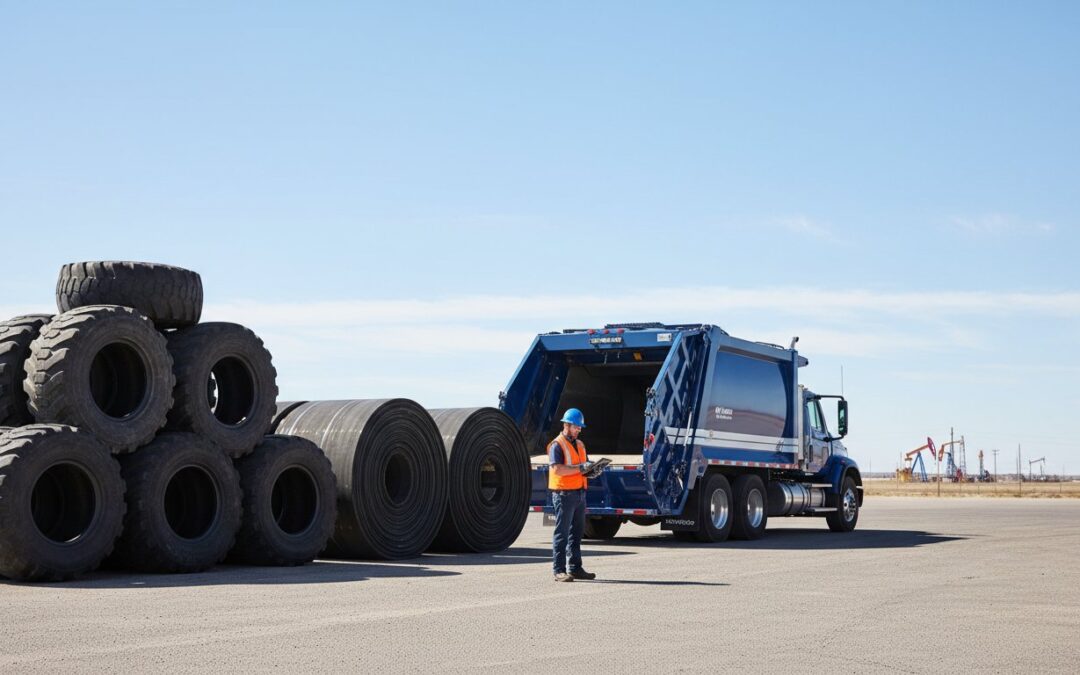
A single undocumented OTR tire or a stack of worn conveyor belts on your property can trigger TCEQ administrative penalties reaching $25,000 per day. For many Permian Basin operators, the risk of a “fly-by-night” hauler illegally dumping your waste is a constant source of anxiety. You understand that your business reputation depends on following the letter of the law, but the logistics of moving bulk rubber are often overwhelming. It’s frustrating to manage these environmental liabilities while trying to maintain a lean operation in a high-pressure industry.
This guide ensures you secure certified rubber disposal Odessa solutions that protect your bottom line and your legal standing. You’ll learn how to obtain a valid scrap tire manifest for every load and clear your site efficiently before the 2026 compliance season begins. We’ll cover the exact steps to vet haulers, handle bulk OTR logistics, and guarantee your facility passes its next environmental audit without a single fine. By the end of this article, you’ll have a clear roadmap to turn a logistical nightmare into a streamlined, compliant process that keeps your site clean and your records perfect.
Key Takeaways
- Understand why a TCEQ-permitted hauler and a state-approved manifest are the only ways to ensure your business remains compliant with 2026 regulations.
- Discover how professional certified rubber disposal Odessa services protect you from environmental liabilities and the increasing state oversight in the Permian Basin.
- Learn to manage industrial rubber waste beyond standard tires, including heavy-duty conveyor belts and high-pressure hoses common in the oil and gas sector.
- Master the “chain of custody” process and find out why the scrap tire manifest is your only valid legal defense against potential fines.
- Get a step-by-step checklist for verifying hauler credentials and inventorying your waste to secure accurate, transparent service quotes.
What is Certified Rubber Disposal in Odessa?
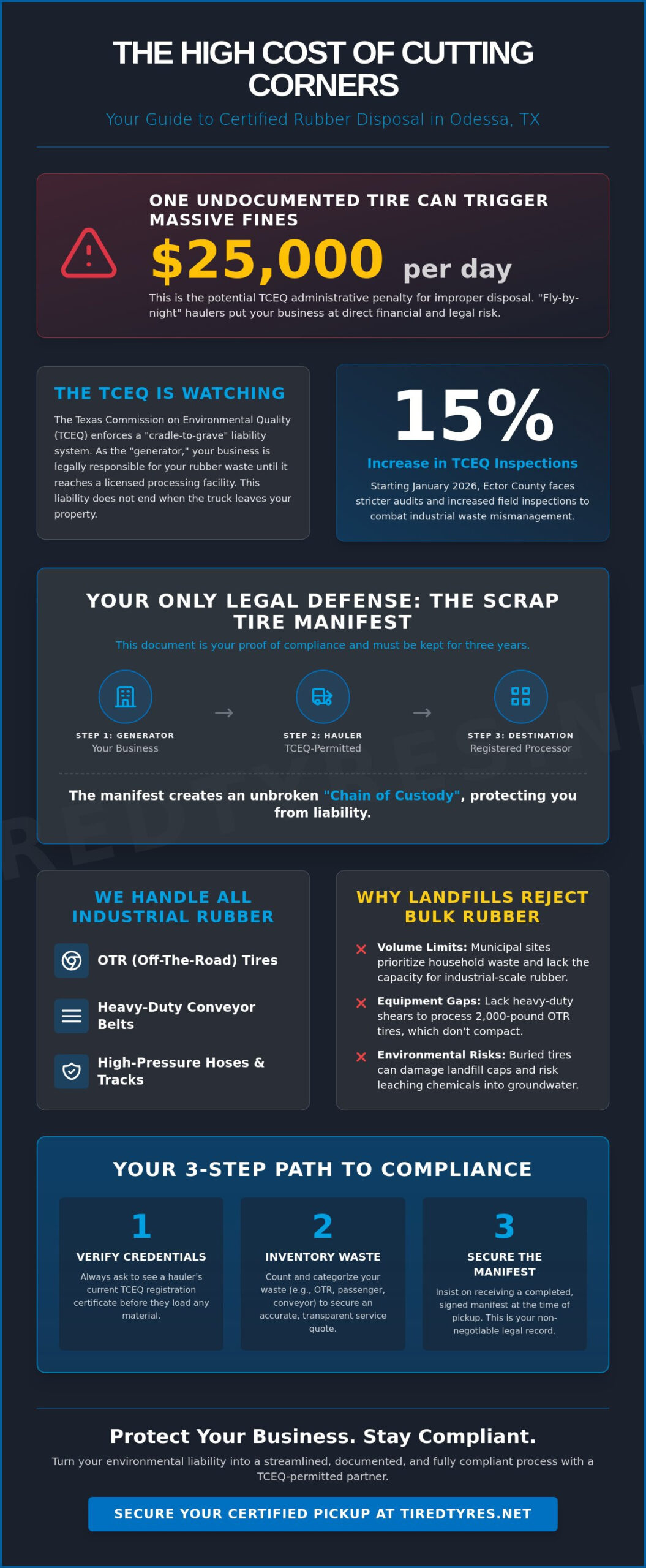
Certified rubber disposal Odessa refers to the legal process of removing, transporting, and processing scrap tires through a hauler permitted by the Texas Commission on Environmental Quality (TCEQ). It’s more than just a pickup service. This process requires a state-approved scrap tire manifest for every load. This document tracks the rubber from your facility to a registered processing site. If you don’t have this manifest, your business remains legally responsible for that waste, even after it leaves your property.
In 2026, certification is more critical than ever for Permian Basin businesses. The TCEQ increased its field inspections in Ector County by 15% starting in January 2026 to address industrial waste mismanagement. Local companies now face stricter audits. You need to verify that your hauler holds a valid TCEQ registration number. A professional collection service handles the logistics and compliance, whereas a local landfill often leaves the liability and heavy lifting to the business owner.
The Role of the TCEQ in West Texas
The TCEQ manages all aspects of scrap tire regulation in Texas. Odessa is a high-focus area due to the massive volume of industrial tires generated by the energy and logistics sectors. The state makes a clear legal distinction between scrap rubber and recyclable material. Rubber is only “recyclable” once it reaches a facility capable of the Tire recycling process. Until that point, it’s regulated waste. Proper oversight prevents the massive stockpiles that historically plagued West Texas, which create fire hazards and pest issues.
Why Landfills Often Reject Industrial Rubber
The City of Odessa landfill and other municipal sites in Ector County have strict volume restrictions. Most standard landfills ban bulk OTR (Off-The-Road) and agricultural tires because they don’t compact. These large tires take up excessive “airspace” in the landfill cell. Over time, buried tires can “float” back to the surface, damaging the landfill’s protective cap.
- Volume limits: Municipal sites prioritize household waste over industrial bulk.
- Equipment gaps: Standard landfills lack the heavy-duty shears needed to process 2,000-pound OTR tires.
- Environmental risks: Burying rubber in the dry West Texas soil can trap methane gas or leach chemicals into the local groundwater if the landfill liner fails.
Choosing a professional service for certified rubber disposal Odessa ensures your business stays compliant with 2026 standards. It protects you from the heavy fines associated with illegal dumping or improper manifest reporting. When you hire a hauler, always ask to see their current TCEQ registration certificate and confirm they provide a completed manifest at the time of pickup.
Navigating Texas Regulations: Why Manifests are Mandatory
In Odessa, business owners often assume their liability ends the moment a truck hauls away their old tires. That’s a dangerous misconception. Under state law, your business is the “generator,” and you’re legally responsible for those tires until they reach a licensed processing facility. If a hauler dumps your inventory in a West Texas field, the authorities will trace those tires back to your doorstep. Utilizing certified rubber disposal Odessa services isn’t just about cleanliness; it’s about protecting your business from the “cradle-to-grave” liability system enforced by the Texas Commission on Environmental Quality (TCEQ).
The chain of custody is a rigorous process. It tracks every tire from your site, through the hauler’s truck, to the final shredding or recycling plant. This system ensures that the 4 million scrap tires generated annually in Texas don’t become fire hazards or breeding grounds for mosquitoes. In the Permian Basin, “free” or “cheap” unpermitted haulers are common. These operators lack the proper bonding and insurance, leaving you fully exposed if an accident or illegal dumping occurs. Professional certified rubber disposal Odessa providers eliminate this risk by maintaining a transparent, documented trail for every pound of rubber removed.
The Anatomy of a Scrap Tire Manifest
A manifest is the receipt of legal transfer that must be kept for three years. This document isn’t just a piece of paper; it’s your primary defense during a TCEQ audit. A valid manifest must include your business information, the hauler’s specific TCEQ permit number, and the registration number of the destination facility. Before signing, always verify the hauler’s credentials. You can check a hauler’s permit number on the TCEQ database to ensure it’s active. If you’re unsure about your current inventory, let the team at Tired Tyres help you audit your disposal process to ensure every field is filled correctly.
Fines and Penalties for Non-Compliance
The costs of cutting corners are steep. The Texas Health and Safety Code outlines strict civil and criminal penalties for illegal tire storage and disposal. Businesses caught using unlicensed “scrappers” can face fines reaching thousands of dollars per day per violation. In 2026, Odessa businesses face even tighter scrutiny as local authorities ramp up efforts to prevent illegal tire piles that threaten the local water table. To avoid these pitfalls, it’s vital to stay informed through resources like the Texas Tire Disposal Regulations guide. One bad decision by a “cheap” hauler can result in a permanent stain on your business reputation and a massive hit to your bottom line.
Comprehensive Rubber Waste Solutions: Tires, Belts, and Tracks
Odessa’s industrial landscape generates massive volumes of non-standard rubber. While passenger tires are common, the Permian Basin’s oil and gas operations produce heavy-duty waste that requires specialized handling. Managing these materials ensures your business stays compliant with 2026 environmental standards. You’re dealing with more than just rubber; you’re managing complex, reinforced materials that don’t break down in a standard landfill.
Industrial Rubber Disposal in the Permian Basin
Scrap conveyor belts from mining or industrial sites present unique challenges. These belts are often hundreds of feet long and reinforced with thick steel cords. You can’t simply toss them into a standard bin. Processing these requires heavy-duty shears and specialized recycling facilities that can separate the metal from the rubber. High-pressure hoses used in drilling are equally difficult. Their multi-layer construction, often involving synthetic rubber and wire mesh, makes separation labor-intensive. For businesses seeking certified rubber disposal Odessa, selecting a partner with the right equipment is vital. Solid tires on forklifts or heavy machinery also require specialized hauling. Their weight can easily exceed the capacity of standard trailers, requiring flatbeds or heavy-duty loaders for safe transport.
Commercial and Agricultural Tire Collection
Odessa serves as a major logistics hub. This means semi-truck fleets generate thousands of casings annually. Bulk removal strategies are essential for fleet managers to avoid stockpiling penalties. In Ector and Midland counties, farmers and ranchers deal with massive tractor and OTR (Off-The-Road) tires. These tires often sit in fields, collecting rainwater and creating breeding grounds for pests. Proper collection involves specialized loaders to handle the 500-pound-plus weight of agricultural rubber. For more detailed logistics on fleet management, you can review our guide on Commercial Tire Disposal in West Texas.
Skid steers and compact track loaders are workhorses in West Texas construction. Replacing a solid rubber track isn’t like changing a tire. These tracks are heavy, awkward, and often contain internal steel cables. Most local landfills won’t accept them because they don’t decompose and can damage compacting equipment. Opting for certified rubber disposal Odessa ensures these tracks are shredded or repurposed into rubberized asphalt. This keeps your job site clean and your business within TCEQ (Texas Commission on Environmental Quality) guidelines. Proper documentation is required for every load to prove that the rubber didn’t end up in an unauthorized dump site.
- Bulk Fleet Services: Scheduled pickups for trucking companies to maintain yard space.
- OTR Solutions: specialized equipment for tires exceeding 50 inches in diameter.
- Reinforced Rubber: Shredding services for steel-lined hoses and belts.
- Track Disposal: Sustainable recycling for skid steer and excavator tracks.
Don’t let scrap rubber pile up. It’s a fire hazard and a liability. We handle the heavy lifting so you can focus on your operations. Whether it’s a single set of tracks or a mountain of industrial hoses, professional disposal is the only way to guarantee compliance in 2026.
The Step-by-Step Process for Legal Rubber Pickup in Odessa
Compliance starts with accurate documentation. For certified rubber disposal Odessa businesses must follow a strict chain of custody to avoid heavy fines. Start by inventorying your waste. Count the exact number of passenger tires and estimate the tonnage of larger commercial units. This prevents surprises when the invoice arrives and ensures the hauler dispatches the correct trailer size. Knowing your volume helps the team determine if a standard box trailer or a specialized flatbed is necessary for the job.
Before any truck enters your yard, verify their Texas Commission on Environmental Quality (TCEQ) credentials. Every legal hauler carries a current registration number. Ask for this up front. If they can’t provide it, your business remains liable for where those tires end up, even after they leave your property. Once the truck arrives, ensure the path is clear for heavy equipment. A knuckle boom crane or a 53 foot trailer needs a significant turning radius and stable, level ground to operate safely.
When the load is secure, the hauler must provide a manifest. This document is your primary defense during a state audit. It tracks the waste from your site to the final destination. File it immediately in your compliance folder. Finally, confirm the tires reached a permitted shredding or recycling facility. Legitimate vendors will provide proof of end-of-life processing upon request, ensuring your “tired tyres” don’t end up in an illegal dump site.
Preparing for a Bulk Collection
Efficiency lowers your costs. Stack tires in “laced” rows to maximize space. This method allows a single trailer to carry up to 25% more volume than loose piling. Ensure the rubber is dry and free of dirt or debris. Standing water inside tires attracts mosquitoes, which is a significant health code violation in Ector County during the warmer months. If you’re handling OTR or agricultural units, clear a 20 foot safety zone around the loading area. These units weigh thousands of pounds and require specialized rigging that needs ample room to maneuver.
Scheduling and Logistics in Ector County
Plan ahead for your pickup to avoid bottlenecks. Typical lead times for commercial collections in the Odessa-Midland area range from 48 to 72 hours. West Texas weather plays a major role in scheduling. High winds exceeding 40 mph or rare heavy rain events can delay knuckle boom operations for safety reasons. Choosing a partner for certified rubber disposal Odessa ensures your company stays on schedule despite these environmental challenges. For a deeper look at regional requirements, check out this guide on Reliable Tire Disposal in West Texas.
Tired Tyres: Your Permitted Partner for Odessa Compliance
Compliance in the Permian Basin isn’t just a suggestion; it’s a legal requirement for every fleet and industrial shop. Tired Tyres operates as a specialist partner for businesses that need to offload rubber waste without the headache of regulatory fines. We handle the heavy lifting so you can focus on your core operations. Our team provides 100% legal, manifest-backed certified rubber disposal Odessa companies need to stay on the right side of state law.
Why Local Expertise Matters
Odessa’s industrial landscape moves fast. You don’t have time to wait weeks for a pickup when your yard is reaching capacity. We provide rapid response times across Ector County and the South Plains, ensuring your site stays clear and compliant. Our team understands the specific pressures of the oilfield and logistics sectors in West Texas. We’ve optimized our routes to ensure that 95% of pickup requests in the Midland-Odessa area are serviced within 48 hours.
We provide direct access to a dedicated customer portal. This tool allows you to download and track every manifest in real-time, providing the paper trail needed for state audits or corporate reporting. Having this data at your fingertips eliminates the stress of lost paperwork during a surprise inspection.
Turning Waste into Resources
We don’t just dump tires. Every piece of rubber we collect is documented from pickup to final processing. We turn “fáradt” (tired) rubber into environmentally safe resources, redirecting waste from landfills into productive uses. As of 2024, we’ve successfully diverted over 500 tons of rubber from local landfills, converting that material into tire-derived fuel and rubberized mulch. This commitment protects your business from the liability of illegal dumping while supporting a circular economy in the Permian Basin. Our certified rubber disposal Odessa service ensures that your “tired” inventory finds a second life as a sustainable resource.
Get a Quote for Certified Disposal
Pricing should be straightforward. We provide transparent rates based on tire size and rubber type, whether you’re disposing of passenger tires or heavy OTR equipment used in the oil patch. You won’t find hidden surcharges or “environmental fees” tacked on at the last minute. What we quote is what you pay for legal, professional service. We currently serve Odessa, Midland, and Lubbock with specialized equipment designed for high-volume collection.
Don’t let rubber waste become a liability for your business. Contact Tired Tyres today for an Odessa rubber disposal quote to secure your compliance for 2026 and beyond. Our specialists are ready to provide a clear, fixed-price estimate for your specific volume needs.
Secure Your Compliance for 2026 and Beyond
Navigating Texas environmental laws doesn’t have to be a burden for your Permian Basin business. By 2026, the TCEQ oversight on scrap rubber will only get tighter, making professional documentation a non-negotiable part of your workflow. You need a partner who understands that a missing manifest is more than a clerical error; it’s a significant legal liability. We handle everything from standard passenger tires to heavy industrial belts and tracks. Our fleet uses specialized equipment designed specifically for OTR rubber, ensuring your site stays clear and professional. Every pickup we perform includes a full scrap tire manifest to keep your records audit-ready and your business protected. As a state-permitted TCEQ hauler, we prioritize your legal safety and operational efficiency at every turn. Choosing certified rubber disposal Odessa services means you’re investing in a cleaner, compliant future. Don’t let “tired” rubber pile up and create a fire hazard or a regulatory headache. We’re here to take that weight off your shoulders with professional, local expertise that you can rely on year-round.
Schedule your certified rubber pickup in Odessa today
Frequently Asked Questions
Is it illegal to dump tires on my own property in Odessa?
Yes, it’s illegal to dump or store scrap tires on your property under Texas Health and Safety Code 361.112. Ector County regulations state that property owners can’t store more than 500 tires without a specific TCEQ registration. Using certified rubber disposal Odessa experts prevents these legal headaches. We handle the paperwork so your property stays clean and compliant with 2026 local standards.
What is a TCEQ scrap tire manifest and why do I need one?
A TCEQ scrap tire manifest is a mandatory tracking document used by the Texas Commission on Environmental Quality. It proves your scrap tires were collected by a registered hauler and delivered to an authorized facility. You’ve got to keep these records for 3 years to avoid penalties during state inspections. It’s your primary defense against liability if the waste is ever found in an unauthorized location.
Can the Odessa landfill take my scrap conveyor belts?
No, the City of Odessa Time-West landfill doesn’t typically accept industrial rubber like conveyor belts in general waste streams. These items require specialized processing because they don’t compact well and can damage heavy landfill equipment. You’ll need a private contractor equipped for heavy industrial rubber to handle these materials. Our team manages these bulky items according to 2026 industrial disposal guidelines.
How much does certified rubber disposal cost in West Texas?
Disposal costs depend on the volume and type of material, as the state doesn’t regulate private pricing. TCEQ 2023 reports show that fees are usually calculated per tire for passenger vehicles or by weight for industrial loads. We offer transparent pricing based on your specific inventory. This approach ensures you get a fair rate without hidden surcharges for your West Texas business operations.
Do you pick up tires that are still on the rims?
Yes, we accept tires mounted on rims for collection. Our team uses specialized machinery to separate the rubber from the metal at our processing site. This saves you the labor and time of manual removal. Once separated, the metal is recycled as scrap and the rubber enters our certified rubber disposal Odessa pipeline for proper industrial repurposing.
What happens to the rubber after it is collected in Odessa?
Most collected rubber is processed into Tire-Derived Fuel or ground into crumb rubber. Data from 2024 indicates that nearly half of Texas scrap tires are used as high-energy fuel in industrial kilns. The remaining material often ends up in rubberized asphalt for Permian Basin road projects. This recycling loop keeps thousands of pounds of waste out of local West Texas landfills every year.
How can I verify if a tire hauler is actually permitted in Texas?
You can verify a hauler’s status through the TCEQ Central Registry database using their name or registration number. Every legitimate provider must have an active scrap tire transporter registration to operate legally. Ask to see their current TCEQ certificate before they load any material from your site. We maintain all necessary permits to ensure your business remains 100 percent compliant with state laws.
Can I get a fine if my hauler dumps tires illegally?
You’re legally liable for your scrap tires until they reach an authorized facility. If your chosen hauler dumps them illegally, the TCEQ can hold your business responsible under “cradle to grave” waste laws. Fines for illegal disposal can reach 10,000 dollars per day per violation. Always ensure you receive a completed manifest back from the processing site to prove the legal chain of custody.