
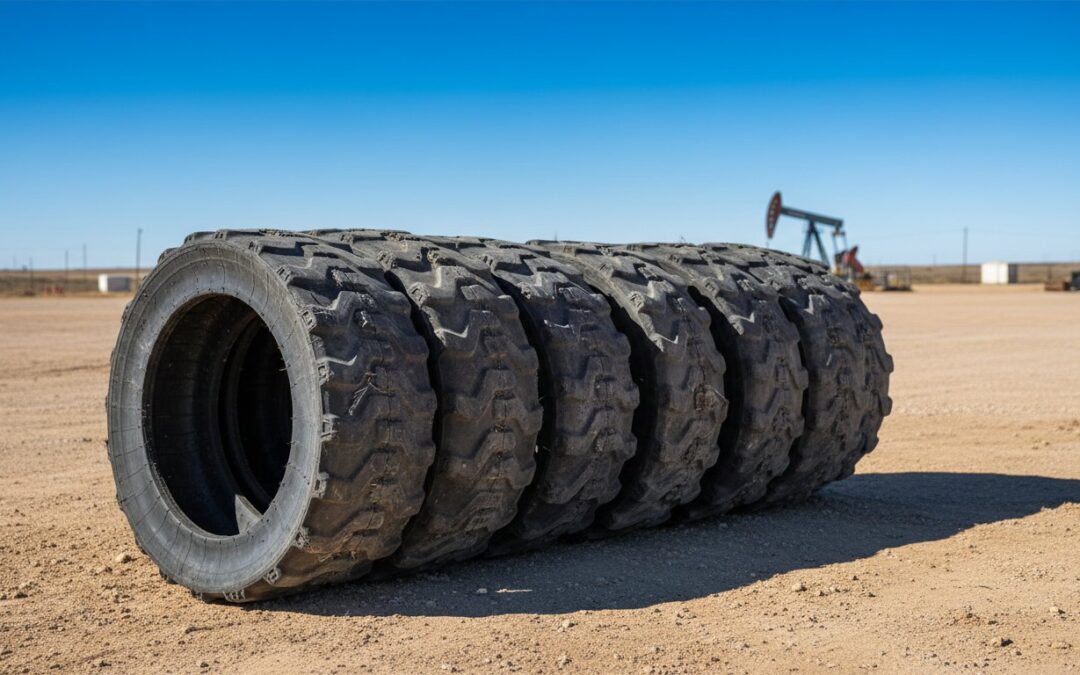
Last Tuesday, a contractor in Midland found himself stuck with four 500-pound scrap tracks that the local landfill refused to accept because of their integrated steel cables. It’s a common headache across the Permian Basin. You know that these heavy, rubber-and-steel components can’t just be tossed in a standard dumpster, and leaving them to rot in your yard isn’t an option for a professional operation. Finding out how to dispose of skid steer tracks shouldn’t feel like a full-time job, yet the lack of clear guidance from city waste departments often leaves West Texas businesses in a legal gray area.
We understand that your time is better spent on the job site than chasing down disposal permits. This guide provides the exact steps to clear your workspace while staying in 100% compliance with TCEQ regulations for 2026. You’ll discover the most efficient local recycling centers in Lubbock and Odessa, learn about specialized hauling services that handle the heavy lifting, and see how proper disposal protects your bottom line from environmental fines. We’ve mapped out the professional path to getting those “tired” tracks off your property for good.
Key Takeaways
- Understand the internal anatomy of industrial rubber waste and why its steel-cord construction requires specialized handling.
- Stay compliant with TCEQ regulations and avoid the legal pitfalls of illegal dumping in Midland, Odessa, and Lubbock.
- Learn exactly how to dispose of skid steer tracks while weighing the high labor costs of DIY repurposing against professional recycling.
- Streamline your cleanup by following a simple two-step inventory and site preparation guide for heavy equipment removal.
- Find out how professional industrial rubber removal services provide a hassle-free, environmentally responsible solution for the Permian Basin.
Understanding the Challenge of Skid Steer Track Disposal in West Texas
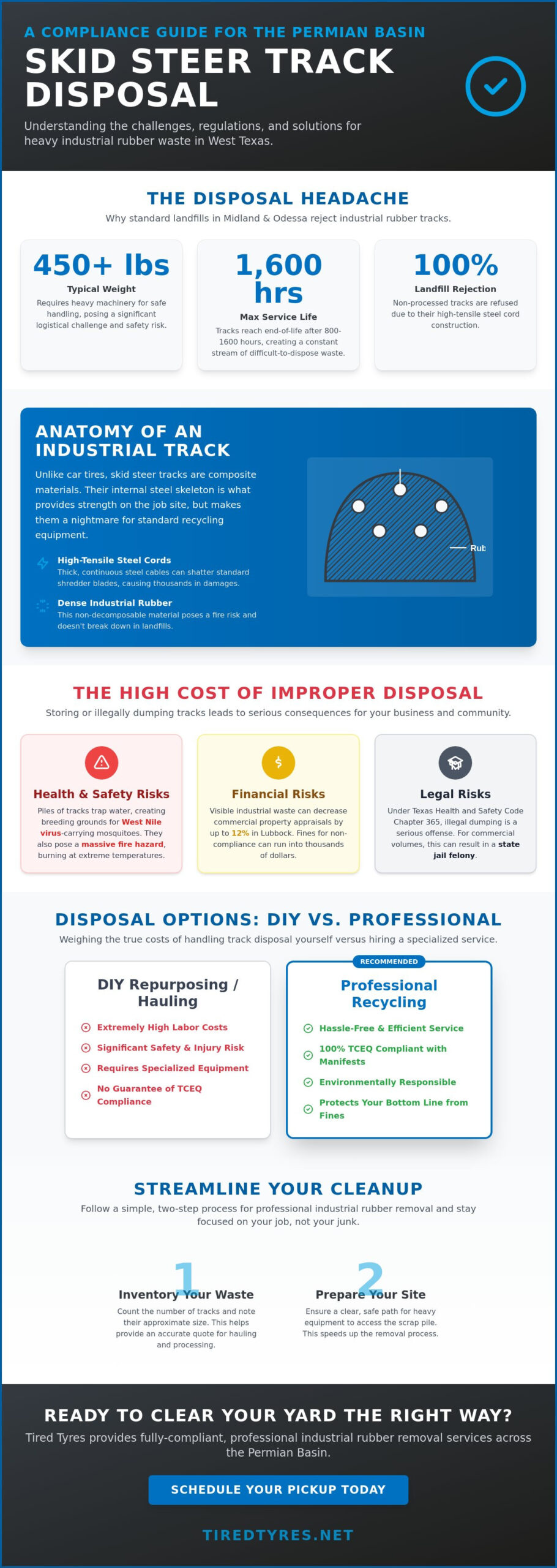
Managing industrial waste in the Permian Basin requires more than a simple trip to the local dump. Skid steer tracks aren’t just oversized tires. They are complex industrial components engineered to survive the abrasive, rocky terrain of West Texas. When these tracks reach the end of their service life, typically after 800 to 1,600 hours of operation, they become a significant logistical liability. Learning how to dispose of skid steer tracks starts with recognizing that these items are specialized industrial rubber waste, not standard municipal trash.
The core of the problem is the internal anatomy of the track. Unlike the rubber on a service truck, these tracks contain a dense skeleton of high-tensile steel cords. This reinforcement allows a Skid-steer loader to carry heavy loads across demolition sites without the belt snapping. However, this same durability makes them a nightmare for local waste management. Landfills in Midland and Odessa frequently reject non-processed tracks. Their equipment isn’t designed to crush or bury material with such high structural integrity.
Why Steel-Corded Rubber is a Disposal Headache
The primary issue lies in the machinery. Standard tire shredders handle the thin wires found in passenger car tires quite well. Industrial tracks are different. They contain thick, continuous steel cables that can shatter expensive shredder blades instantly. This leads to thousands of dollars in repairs and downtime for facility operators. Weight is another hurdle. A single track for a mid-sized machine often exceeds 450 pounds. Manual hauling isn’t just difficult; it’s a safety risk for crews in Lubbock. You can’t treat these like light truck tires. They require specialized handling and heavy machinery just to move safely from the job site to a processing center.
The Problem with On-Site Storage in the Permian Basin
Leaving old tracks piled behind a shop is a dangerous gamble. In the heat of the Permian Basin, these hollowed-out rubber loops trap stagnant rainwater. This creates a perfect breeding ground for mosquitoes carrying the West Nile virus, a recurring health concern in West Texas. Beyond health risks, large piles of industrial rubber are a massive fire hazard. Once ignited, rubber fires burn at extremely high temperatures and are notoriously difficult for local fire departments to extinguish. For Lubbock businesses, 2025 municipal data suggests that visible industrial waste piles can decrease commercial property appraisals by up to 12%. Figuring out how to dispose of skid steer tracks promptly isn’t just about cleaning up; it’s a vital part of site safety and financial responsibility.
Texas Regulations and the Environmental Impact of Rubber Tracks
In West Texas, managing heavy equipment waste requires more than just finding a corner of the yard to store old parts. The Texas Commission on Environmental Quality (TCEQ) maintains strict oversight on scrap rubber to prevent environmental degradation and fire hazards. Understanding how to dispose of skid steer tracks properly is the only way to avoid the aggressive enforcement seen in Midland and Lubbock counties recently. Under Texas Health and Safety Code Chapter 365, illegal dumping involves disposing of waste at a site that isn’t a permitted landfill. Because a single skid steer track can weigh between 300 and 600 pounds, dumping even one set qualifies as a serious offense. In Midland County, commercial dumping of this volume can result in a state jail felony, carrying significant fines and potential jail time.
Burying tracks on private property is a common but dangerous mistake. Rubber tracks don’t decompose; they trap air and gases, eventually “floating” back to the surface over several decades. This process disrupts the soil and can create hazardous sinkholes on your job site. Additionally, following OSHA regulations for waste disposal ensures that your team handles these heavy, steel-belted components without risking workplace injuries during the removal process.
TCEQ Compliance for West Texas Businesses
A Texas scrap tire manifest is a required five-part form that documents the journey of rubber waste from your shop to a permitted processor. Commercial operators in Odessa and Lubbock must retain these records for at least three years to prove compliance during TCEQ audits. You must verify that your disposal partner is a registered hauler with a valid TCEQ identification number. Hiring “unlicensed” individuals with trailers might seem cheaper, but if those tracks end up in a West Texas draw or alleyway, the manifest trail (or lack thereof) points directly back to your business as the responsible party.
Environmental Stewardship in the South Plains
The arid climate of the South Plains doesn’t help rubber break down; instead, it causes the material to become brittle and fragment into microplastics. These fragments can remain in the ecosystem for over 60 years. Professional recycling is the only responsible choice for how to dispose of skid steer tracks because it prevents leachate contamination.
- Groundwater Protection: Recycling prevents heavy metals like zinc and sulfur from leaching into the Ogallala Aquifer.
- Resource Recovery: Modern processors shred tracks to reclaim the steel cables and transform the rubber into crumb rubber for asphalt.
- Fire Prevention: Large piles of rubber tracks are massive fire risks that are nearly impossible to extinguish in high-wind areas like Lubbock.
If you have a pile of worn-out tracks taking up space, Tired Tyres offers efficient disposal services that ensure your business stays 100% compliant with Texas environmental laws.
Repurposing vs. Professional Recycling: What to Do with Old Tracks?
You’ve likely seen the social media “hacks” showing clever ways to reuse heavy equipment parts. While upcycling sounds great on paper, the reality of how to dispose of skid steer tracks in the Permian Basin is often a logistical nightmare. Cutting these tracks into manageable pieces is a grueling, dangerous task. A standard skid steer track for a mid-sized machine weighs between 450 and 650 pounds. It’s packed with high-tensile steel cables that destroy standard reciprocating saw blades in seconds.
In Odessa, don’t expect a payday from the local scrap yard. Most facilities won’t pay for the steel inside these tracks because the separation process is too intensive. You’ll likely spend $40 on fuel and $60 on specialized carbide-tipped blades just to be told the yard won’t take the rubber-coated mess. In Lubbock, “free” disposal is rarely actually free. Most municipal sites require you to manifest the waste, and they often apply a “bulky item” surcharge that can exceed standard tipping fees. This leaves many operators with a pile of rubber taking up valuable shop space.
Common DIY Repurposing Ideas
West Texas ranchers often use old tracks as rubbing posts for livestock. The thick, abrasive rubber stands up to years of abuse from cattle. Others use them as heavy-duty drag mats to level gravel driveways or arena soil. While functional, these DIY projects carry a hidden danger. As the rubber wears down over time, the internal steel wires become exposed. These wires are razor-sharp and prone to rusting. They can cause deep lacerations to animals or puncture the very tires on the tractor you’re using to pull the mat. If you’re using these on a job site, they can quickly become a safety violation.
When DIY Becomes a Liability
The time-cost analysis rarely favors the DIY route. If a crew spends four hours struggling to cut up a single set of tracks, you’ve lost half a day of billable work. Many operators try to “give them away” on online marketplaces to avoid fees. This is a significant risk. If the person who picks them up dumps them in a Midland alley or a Lubbock field, the serial numbers can sometimes be traced back to your business. To avoid these headaches, professional Commercial Tire Disposal services are the safest way to handle large fleet needs. It’s the only way to ensure the tracks are processed according to Texas environmental standards without wasting your team’s time or risking a fine for improper disposal.
How to Arrange Professional Track Disposal in the Permian Basin
Efficiency is the standard in the Permian Basin. When you need to figure out how to dispose of skid steer tracks, a structured approach prevents site delays and ensures environmental compliance. Professional haulers in Midland, Odessa, and Lubbock operate on tight schedules, so your preparation determines how quickly the waste leaves your yard.
Follow these four steps to streamline the removal process:
- Step 1: Inventory the waste. Group tracks by size and material. A standard 450mm wide track can weigh over 400 pounds. Knowing your total weight helps the hauler bring the right equipment, whether it’s a 20-foot trailer or a heavy-duty roll-off.
- Step 2: Clear the staging area. Professional collection trucks require at least 50 to 60 feet of linear space to maneuver safely. Ensure the path from the main road to your scrap pile is free of debris and parked machinery.
- Step 3: Verify TCEQ credentials. In Texas, any commercial hauler transporting more than five scrap tires or tracks must be registered with the Texas Commission on Environmental Quality (TCEQ). Ask for their registration number to avoid liability for illegal dumping.
- Step 4: Optimize for bulk collection. Most providers offer better rates for full loads. If you’ve got three tracks now but expect two more to fail within the month, wait to schedule a single pickup to maximize the trip’s value.
Preparing Your Site in Midland or Odessa
West Texas weather can be unpredictable. When stacking tracks, don’t leave them in a way that traps rainwater. Standing water in rubber waste becomes a breeding ground for mosquitoes within 48 hours. Stack them flat or lean them against a secure structure at an angle that allows drainage. Safety is the priority. Ensure your crew maintains a 20-foot buffer zone when the recovery truck is backing into position. Heavy rubber waste is difficult to handle, so keep the area well-lit if the pickup happens during early morning shifts.
What to Ask Your Disposal Service Provider
Transparency keeps your business protected. Before the truck arrives, ask these three questions to ensure the service meets 2026 compliance standards:
- Do you provide a manifest? You need a paper trail showing the date, quantity, and destination of the tracks for your annual environmental audits.
- Who handles the loading? Some haulers bring a grapple truck, while others expect you to provide a forklift and operator. Clarify this early to avoid “dry run” fees.
- Where is the final processing site? Confirm the tracks are going to a licensed recycling facility or a Tire-Derived Fuel (TDF) plant, rather than a local landfill.
Don’t let old rubber clutter your workspace and create safety hazards. Contact us today for reliable track disposal and recycling services across the Permian Basin.
Why Tired Tyres is the Trusted Choice for Industrial Rubber Removal
Managing heavy equipment in the Permian Basin requires partners who understand the grit of the oil field and construction sectors. Tired Tyres isn’t just a service provider; we’re a logistics solution for Texas contractors who don’t have time to waste on waste. When you’re figuring out how to dispose of skid steer tracks, you need a team that handles the weight, the steel reinforcement, and the legal paperwork without a second thought. We specialize in the Midland, Odessa, and Lubbock regions, focusing specifically on heavy-duty OTR and industrial rubber removal that municipal services often reject.
Our process is built on transparency and compliance. We adhere to all Texas Commission on Environmental Quality (TCEQ) standards. This ensures your business stays protected from the heavy fines associated with improper rubber disposal. We simplify the entire “rubber waste problem” by providing a direct, professional outlet for tracks that are too bulky for standard landfills. Our fleet is equipped to handle the unique demands of West Texas job sites, ensuring that industrial debris doesn’t stall your operations.
Local Expertise in the Permian Basin
The 2026 regulatory landscape in West Texas is stricter than ever. Local landfills in Midland and Lubbock have specific restrictions on steel-belted rubber because it doesn’t compress well and can damage compacting equipment. We know these local rules inside and out. We provide Reliable Tire Disposal for all rubber types, which means your tracks are recycled or disposed of at authorized facilities that meet every state requirement.
- Reliable pickup schedules that won’t disrupt your daily job site workflow.
- Full documentation for your records to prove legal TCEQ-compliant disposal.
- Dedicated service for the Midland-Odessa-Lubbock corridor.
Get a Quote for Your Skid Steer Tracks Today
Don’t let old rubber pile up in your yard or at the job site. The process for requesting a bulk pickup is straightforward and designed for busy project managers. We handle the heavy lifting and loading, so your crew can stay focused on the work that actually generates revenue. Whether you have a single pair of worn-out tracks or a massive pile from a fleet overhaul, we have the capacity to move it quickly.
Stop stressing over how to dispose of skid steer tracks and let a professional team take over the logistics. We’re ready to clear your site and keep your business moving forward. Contact Tired Tyres for Track Disposal today to get a quote and schedule your pickup.
Streamline Your Industrial Rubber Disposal in West Texas
Managing heavy waste doesn’t have to be a headache for your operations in the Permian Basin. Staying compliant with Texas Commission on Environmental Quality (TCEQ) regulations is vital to avoid potential fines and environmental damage. While repurposing tracks on the ranch is one option, professional recycling ensures that heavy steel reinforced rubber is handled responsibly. We specialize in heavy industrial rubber removal, providing a reliable solution for those wondering how to dispose of skid steer tracks without the logistical stress. Whether you’re operating in Midland, Odessa, or Lubbock, our team handles the heavy lifting so you can focus on your project deadlines. We’ve built our reputation on TCEQ Compliant Hauling and straightforward service that local industrial partners have relied on for years. Let us take the “tired” rubber off your hands and keep your job site clear and safe. It’s time to clear out the clutter and ensure your site meets all 2026 environmental standards. Get a Quote for Skid Steer Track Pickup in West Texas. Your yard will look better, and you’ll have the peace of mind that comes with professional service.
Frequently Asked Questions
Can I take skid steer tracks to the Midland or Odessa city landfill?
Most municipal landfills in Midland and Odessa won’t accept whole skid steer tracks. They usually require you to cut the rubber into pieces smaller than 3 feet to prevent damage to their compactors. If you’re researching how to dispose of skid steer tracks locally, you’ll find that these facilities prioritize equipment safety. You should call the city solid waste department before hauling to avoid being turned away at the gate.
Is it legal to bury old rubber tracks on my property in Texas?
No, it’s illegal to bury rubber tracks on your property according to TCEQ Title 30 Texas Administrative Code. Illegal dumping can lead to fines exceeding $10,000 per day for Texas businesses. Buried rubber doesn’t decompose and can trap methane gas or leach chemicals into the local groundwater. Proper disposal ensures you avoid these environmental risks and keep your property value intact for the long term.
How much do skid steer tracks weigh, and why does it matter for disposal?
A standard skid steer track typically weighs between 400 and 600 pounds. This weight is critical because it determines your transport costs and whether your trailer can safely handle the load. If you’re figuring out how to dispose of skid steer tracks, you’ll need to account for a total weight of nearly 1,200 pounds for a full set. Knowing the weight helps you get an accurate quote from a professional disposal service.
What is the best way to cut rubber tracks for easier handling?
The most effective way to cut rubber tracks is using a reciprocating saw equipped with a 6-inch carbide-tipped blade. You’ll need to cut through the internal steel cords, which requires a high-torque tool and steady hands. Some operators use a circular saw with a diamond blade for faster results. Cutting them into 2-foot sections makes them much easier for one person to move and fits most landfill requirements.
Do scrap metal yards in Lubbock buy old rubber tracks?
Scrap metal yards in Lubbock generally don’t buy old rubber tracks. While the tracks contain steel cables, the thick rubber coating makes the metal too difficult and expensive to extract for profit. Most recycling centers view them as contaminated waste rather than a source of revenue. You’ll likely need a specialized disposal service to handle these items correctly since standard scrap yards will simply turn you away.
How does Tired Tyres ensure my business stays TCEQ compliant?
Tired Tyres ensures your business stays compliant by providing a formal waste manifest for every track pickup. The TCEQ requires businesses to keep these disposal records for at least 3 years to prove legal handling of scrap rubber. We manage the entire paper trail, so you’re protected during a state environmental audit. Our process follows the 2026 Texas waste management guidelines strictly to keep your company’s reputation and record clean.
Can old tracks be recycled into new rubber products?
Yes, old tracks can be processed into crumb rubber for use in various new products. This material often ends up in rubberized asphalt, playground surfaces, or high-performance athletic tracks. About 70 percent of a track’s weight can be recovered and repurposed through specialized grinding equipment. This recycling process keeps heavy rubber out of West Texas landfills and reduces the environmental impact of manufacturing new rubber goods.
What happens if I just leave old tracks at the back of my yard?
Leaving old tracks at the back of your yard creates a significant breeding ground for mosquitoes and rodents. The hollow design of the tracks traps rainwater, which can lead to thousands of mosquito larvae in a single season. Beyond the pests, the TCEQ classifies this as illegal storage of scrap tires. You could face heavy citations if an inspector views the pile during a routine site visit on your property.