
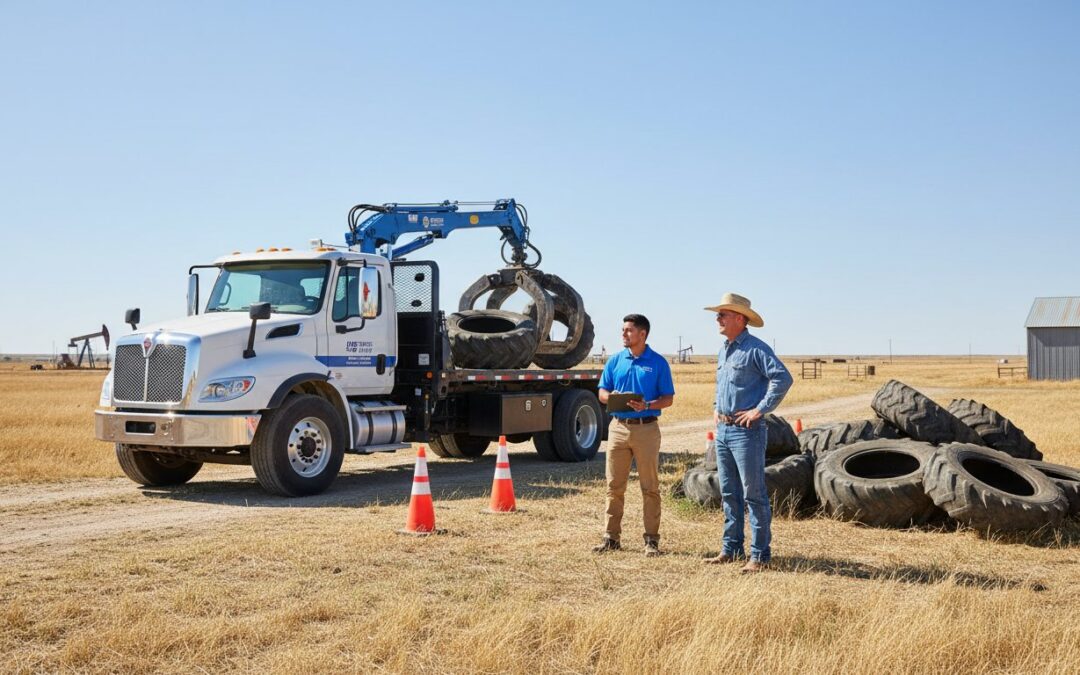
Storing a pile of old tractor tires isn’t just an eyesore; it’s a financial liability that could cost you up to $25,000 per day in fines. You’ve likely felt the frustration of watching heavy OTR tires take up valuable space on your property, creating breeding grounds for mosquitoes and complicating your environmental compliance. Hauling these massive rubber weights yourself is expensive, and navigating the complexity of Texas waste manifests can feel like a full time job.
This guide shows you how to implement effective agricultural tire waste solutions Texas farmers can rely on to stay TCEQ compliant while clearing their land efficiently. You’ll discover how to manage your bulk rubber waste without the stress of unexpected penalties or logistical nightmares. We’ll cover the 2026 storage thresholds, the critical December 31st reporting deadline, and how to establish a reliable pickup schedule for your scrap tires, hoses, and conveyor belts. By the end of this article, you’ll have a clear roadmap to maintain a clean, compliant, and professional operation.
Key Takeaways
- Learn how to properly document every load using the 2026 TCEQ scrap tire manifest system to ensure full legal protection.
- Understand the logistical requirements for handling OTR and tractor tires, including the specialized equipment needed for safe transport.
- Discover the most efficient agricultural tire waste solutions Texas ranchers use to clear bulk rubber piles before they become a site liability.
- Find out how to designate a dedicated “scrap zone” on your property to streamline pickups and prevent waste from spreading.
- Compare the hidden costs of self-hauling heavy farm tires against the efficiency of professional collection for machinery tires and rubber tracks.
The Challenge of Agricultural Tire Waste in West Texas
Managing a ranch or farm in West Texas involves dealing with massive equipment and even larger maintenance hurdles. When that machinery reaches the end of its life, it leaves behind a significant problem: heavy rubber. Texas manages approximately 57.1 million scrap tires annually, and a large portion of that volume comes from the agricultural and industrial sectors. Finding effective agricultural tire waste solutions Texas farmers can actually implement is difficult because these tires aren’t standard. A single rear tractor tire or an Off-the-Road (OTR) harvester tire can weigh hundreds of pounds. They don’t just sit there; they take up valuable acreage, trap heat, and become permanent, unsightly fixtures on the landscape.
Stockpiling these tires in a back pasture might seem like the easiest path, but it’s a gamble with your land health. Over time, these piles accumulate stagnant water, creating the perfect nursery for mosquitoes that carry West Nile and other illnesses. Because of the complex chemical makeup and sheer size of heavy rubber, Tire recycling is the only responsible way to ensure these materials don’t leach toxins into the West Texas soil. Allowing rubber to sit indefinitely doesn’t just hurt the environment; it actively devalues your property and creates a legacy of waste for the next generation.
Why Standard Disposal Methods Fail for Farmers
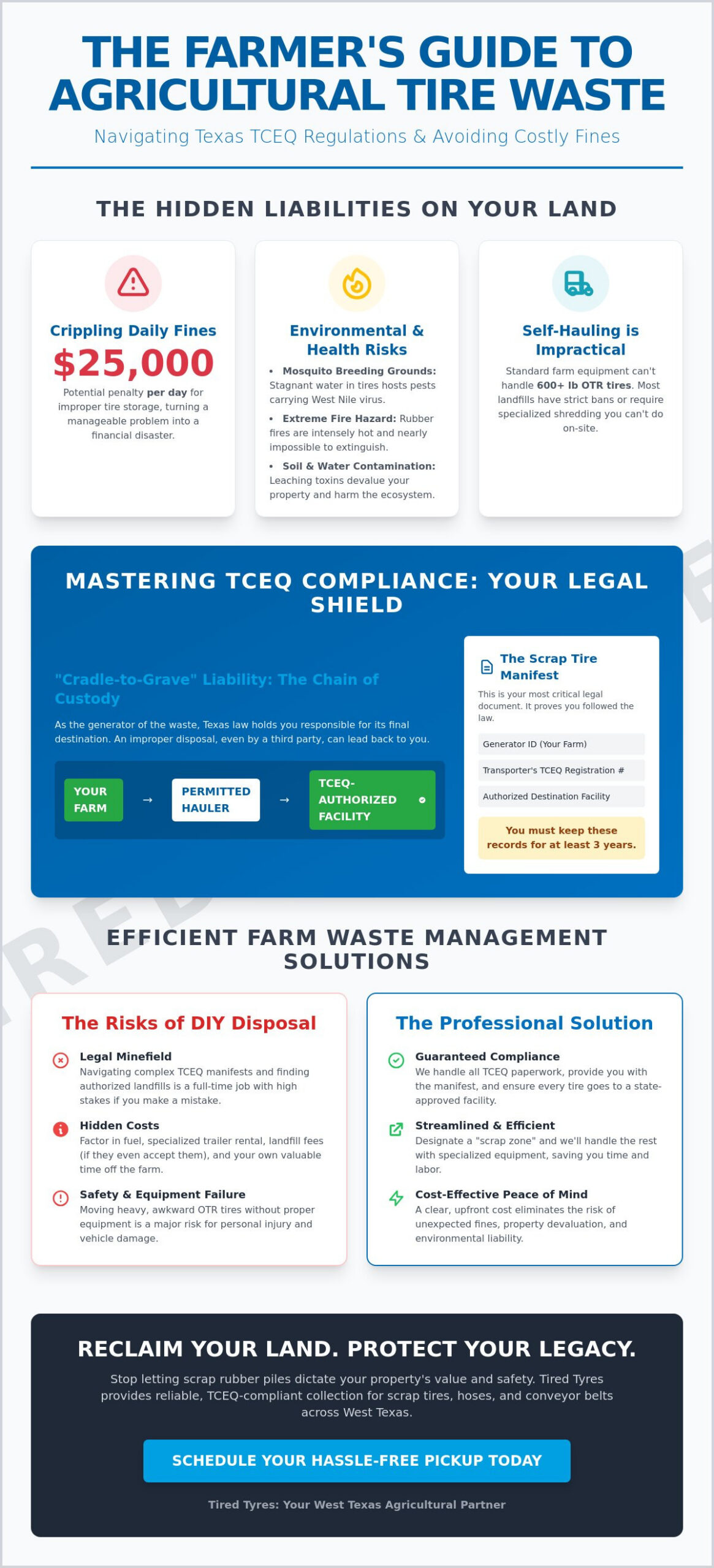
Most local landfills aren’t equipped to handle the needs of a modern farming operation. Many municipal sites in Texas have strict bans on whole tires, especially large OTR units. They often require the rubber to be split or shredded before they’ll even consider accepting it. This is a task most farmers don’t have the specialized machinery to handle. Even if a landfill accepts them, the physical logistics are a nightmare. You can’t just throw a 600-pound tractor tire into the back of a standard pickup truck. Without specialized loading equipment and heavy-duty trailers, moving even a small tire graveyard is practically impossible for a solo operation.
The Hidden Costs of Improper Storage
The financial risks of keeping old rubber on your property go beyond simple clutter. These piles represent a major fire hazard. Once a rubber stockpile ignites, it burns at incredible temperatures and is nearly impossible to put out with standard ranch equipment. This risk often leads to property insurance complications or higher premiums. Beyond the fire risk, you face significant waste tire problems like soil contamination and regulatory liability. If the TCEQ identifies an unpermitted scrap tire site on your land, the daily fines can be devastating. Implementing professional agricultural tire waste solutions Texas relies on is the only way to protect your property value and stay on the right side of the law.
TCEQ Regulations: Staying Compliant with Texas Law
The Texas Commission on Environmental Quality (TCEQ) maintains strict oversight of rubber waste to prevent environmental damage and public health crises. For a farm or ranch, this means you aren’t just responsible for getting the tires off your land; you’re responsible for where they end up. In 2025, the TCEQ issued over $2.4 million in penalties for improper scrap tire management. These fines aren’t just for large-scale industrial dumpers. They apply to any landowner who fails to follow the state’s “cradle-to-grave” liability rules. If you hire an unpermitted individual to haul away your tractor tires and they dump them in a West Texas wash, the state can hold you legally and financially accountable for the cleanup.
To avoid these risks, you must verify that you are working with a permitted tire hauler in Texas. A permit ensures the transporter is registered with the state and follows the legal pathways for disposal. Staying compliant requires more than just a handshake. You need a paper trail that proves every OTR tire or skid steer track left your property and arrived at an authorized facility. This is where agricultural tire waste solutions Texas professionals provide become essential, as they handle the regulatory burden so you can focus on your harvest.
The Anatomy of a Scrap Tire Manifest
The scrap tire manifest is the most important document in your compliance folder. It tracks the movement of waste from your farm to its final destination. Every manifest must include specific data points: your generator ID (if required), the transporter’s registration number, and the name of the authorized end-destination facility. You’re required to keep these records for at least three years. If a TCEQ inspector visits your property in Lubbock or Midland, these documents are your primary defense. They prove you’ve handled your waste according to Title 30 of the Texas Administrative Code.
Avoiding Illegal Dumping Fines
Many West Texas landowners mistakenly believe they can “repurpose” old tires for erosion control or livestock feeders without a permit. Under the Texas Health and Safety Code, using scrap tires in this way without specific TCEQ authorization can be classified as illegal dumping. The penalties are severe, with fines ranging from $10,000 to $25,000 per day for ongoing violations. It’s much more cost-effective to schedule a professional pickup than to risk a state investigation. If you’re unsure about your current storage status, reaching out to the team at tiredtyres.net can help you identify the safest path forward for your bulk rubber waste.
Logistics of Agricultural and OTR Tire Collection
West Texas farming relies on massive machinery, but when those tires fail, the logistics of moving them become a major hurdle. Most standard trash services won’t touch an OTR (Off-the-Road) tire. They’re simply too heavy and require specialized processing equipment that local municipalities don’t possess. For example, the Texoma Area Solid Waste Authority (TASWA) explicitly states they won’t accept tires over 44 inches in height. This leaves many ranchers with few options other than letting waste accumulate. Implementing professional agricultural tire waste solutions Texas providers offer is often the only way to clear a site without risking equipment damage or personal injury.
The choice between self-hauling and professional collection usually comes down to a cost and time analysis. If you try to haul these yourself, you’re looking at multiple trips, high fuel costs, and the risk of being turned away at the gate. Professional collection services bring the equipment to you. This is especially vital for “mixed loads.” A typical farm doesn’t just have one type of waste. You likely have a combination of tractor tires, semi-truck tires, and even scrap skid steer tracks or conveyor belts. A specialized partner like Tired Tyres can manage all these materials in a single scheduled pickup, saving you days of logistical planning.
Handling OTR and Heavy Equipment Rubber
Moving tires that weigh several hundred pounds requires winches, knuckle booms, and heavy-duty trailers. Attempting to manhandle these units into a standard trailer is a safety risk you don’t need to take. For fleet operations or large-scale ranches, commercial tire disposal services provide the necessary infrastructure to handle high volumes of heavy rubber efficiently. To ensure the fastest possible pickup, we recommend organizing your waste by type. Grouping your agricultural tires in one area and your scrap hoses or belts in another allows the loading crew to work quickly and keeps your manifest paperwork clean and accurate.
Bulk Site Remediation for Large Stockpiles
If your property has accumulated years of agricultural waste, a simple pickup might not be enough. Bulk site remediation involves a systematic clearing of legacy stockpiles that have often been buried or overgrown. In the Permian Basin, where industrial and agricultural sectors overlap, these cleanups often require coordinating with neighboring property owners for regional efficiency. We’ve seen how clearing these bulk sites immediately improves land utility and removes the environmental shadow hanging over a property. Whether it’s a few harvester tires or a massive pile of scrap rubber, a professional logistical approach ensures the job is done right the first time.
Best Practices for Managing Farm Rubber Waste
Effective property management in West Texas requires more than just maintaining active equipment; it involves a clear strategy for the waste that equipment leaves behind. Instead of allowing old tractor tires and scrap hoses to scatter across your acreage, you should establish a dedicated “scrap zone.” Centralizing your rubber waste in a single, accessible location prevents property sprawl and simplifies the pickup process. When you designate a specific area for collection, you ensure that agricultural tire waste solutions Texas professionals provide are as efficient as possible. This approach reduces the time spent on-site by recovery crews and keeps your operation looking professional for neighbors and potential land buyers alike.
Consistency is the key to preventing a small pile from becoming a massive regulatory headache. By implementing a reliable tire disposal schedule, you can move waste off your land before it reaches the TCEQ registration threshold of 500 tires. Training your staff to recognize this threshold is vital. Your team should also be familiar with the manifest process, ensuring every load is documented and signed off correctly. Proper documentation isn’t just a chore; it’s your primary defense against liability. If you need help setting up a routine pickup for your OTR tires or skid steer tracks, you can contact Tired Tyres today to discuss a plan that fits your seasonal needs.
Preventing Vector Breeding and Fire Risks
Temporary storage requires careful planning to meet 2026 health and safety standards. Tires should be stacked in a way that minimizes water retention, as stagnant water is a primary breeding ground for mosquitoes. If you’re storing more than 500 tires on the ground, you must follow specific TCEQ vector control guidelines to prevent the spread of West Nile virus. Additionally, you should create a clear fire break of at least 50 feet around your scrap zone. This gap should be cleared of all brush and flammable materials, protecting your barns and active machinery from the intense heat of a potential rubber fire.
Integrating Disposal into Farm Maintenance
The most successful West Texas operations treat tire disposal as a routine operational expense rather than an emergency cleanup. Budgeting for the removal of agricultural tires and conveyor belts throughout the year prevents large, unexpected costs during tax season. You might also consider working with local agricultural associations to coordinate bulk collection days, which can streamline logistics for multiple properties in the same area. Maintaining a “clean farm” policy does more than satisfy regulators; it protects your long-term land health and ensures that your property remains a valuable asset for the future.
Tired Tyres: Your West Texas Agricultural Partner
Tired Tyres operates with a clear understanding of the Permian Basin and South Plains agricultural landscape. We recognize that farmers in Lubbock or ranchers near Odessa face unique logistical hurdles when it comes to scrap rubber. General waste management companies often lack the specialized equipment required to handle massive OTR units or heavy tractor tires. Our team bridges this gap by providing professional agricultural tire waste solutions Texas producers can rely on for prompt, compliant removal. We don’t just pick up tires; we provide a complete service that includes full TCEQ manifest management to protect your operation from regulatory liability.
Our commitment to the West Texas community is built on trust and professional competence. We understand the “cradle-to-grave” responsibility that comes with waste generation. When our trucks leave your property, you can be confident that your tires are being transported by a registered hauler to an authorized facility. We handle all the technical details of the scrap tire manifest, ensuring you have the records needed for any state inspection. This direct, no-nonsense approach is why we’ve become a preferred partner for agricultural operations from the Panhandle down to the heart of the Permian Basin.
Our Service Area and Capabilities
Our reach extends across the heart of West Texas, serving remote farm and ranch locations that others might find difficult to access. We maintain a fleet of heavy-duty trucks equipped with the necessary loading technology to move hundreds of pounds of rubber safely. Our collection services go beyond just tires. We handle a wide variety of industrial and agricultural rubber waste, including:
- Agricultural and OTR tire collection
- Scrap skid steer track collection
- Scrap hose and lay-flat hose collection
- Scrap conveyor belt collection
- Semi-truck and passenger tire collection
This comprehensive approach allows you to clear your entire “scrap zone” in one visit. Whether you’re dealing with a few harvester tires or a massive pile of legacy rubber, we have the capacity to handle the volume efficiently. Our flexible scheduling ensures we can work around your seasonal demands, providing pickups when it’s most convenient for your maintenance cycle.
Get Your Agricultural Tire Pickup Quote
We believe in transparent, straightforward communication. Our pricing is based on the volume and type of material we collect, ensuring you only pay for what you need. The process for clearing your land is simple. You provide the details of your stockpile, and we offer a clear estimate that accounts for the specific logistics of your location. You won’t have to worry about hidden fees or complicated paperwork. We handle the manifest from start to finish, providing you with the documentation required by state law. If you’re ready to clear your property and ensure you’re meeting all TCEQ standards, contact Tired Tyres today for tire disposal in Midland, TX and across the surrounding counties. Let our experts take the weight of scrap rubber off your hands so you can get back to the work that matters.
Secure Your Land with Professional Rubber Removal
Don’t let old rubber dictate your property’s health or your financial security. Staying on top of TCEQ manifests and storage thresholds is the only way to protect your operation from the significant penalties Texas issues for improper management. Implementing professional agricultural tire waste solutions Texas ranchers can trust ensures that every OTR tire, skid steer track, and scrap hose is removed legally. We handle the heavy lifting and the complex paperwork so you don’t have to worry about state inspections or environmental risks.
It’s time to clear your scrap zone and return your land to its full potential. As a TCEQ permitted hauler serving Midland, Odessa, and Lubbock, Tired Tyres brings the specialized equipment needed for heavy rubber recovery. You can Get a Professional Quote for Agricultural Tire Collection today to start your property cleanup. Taking this step now ensures your farm remains compliant, safe, and ready for the next growing season. We’re here to help you get the job done right and keep your operation moving forward with confidence.
Frequently Asked Questions
Can I legally bury old tractor tires on my property in Texas?
No, you cannot legally bury scrap tires on your property in Texas. TCEQ regulations strictly prohibit the burial of tires, as it’s classified as illegal disposal. Landowners who bury rubber waste face significant daily fines and potential environmental remediation costs if the site is discovered.
How much does it cost to dispose of an OTR (Off-the-Road) tire?
Disposal costs for OTR tires vary based on the physical size, weight, and quantity of the units. Because these tires require specialized loading equipment and heavy-duty trailers, they’re priced differently than standard passenger tires. Most professional providers offer a custom estimate after evaluating the specific logistical needs of your ranch or farm.
Do I need a special permit to transport my own scrap agricultural tires?
You don’t need a transporter registration to move your own scrap tires to an authorized facility. However, if you’re hauling tires for others or transporting more than 500 tires at a single time, you must register as a scrap tire transporter with the TCEQ. Most farmers find that professional collection is more efficient than managing the logistics and paperwork of self-hauling.
What is a TCEQ scrap tire manifest and why do I need one?
A TCEQ scrap tire manifest is a mandatory tracking document that records the movement of waste from your property to a permitted end-site. It’s your primary legal defense during a state inspection. This document proves you’ve followed the “cradle-to-grave” liability rules and ensures you aren’t held responsible if a hauler dumps your tires illegally.
Does Tired Tyres pick up scrap skid steer tracks and rubber hoses?
Yes, our collection services include scrap skid steer tracks, rubber hoses, and conveyor belts. We provide comprehensive agricultural tire waste solutions Texas farmers use to clear all types of rubber debris from their land. This allows you to manage multiple waste streams with a single professional partner rather than hiring different haulers for each material.
How do I prepare a large pile of agricultural tires for professional collection?
Stack your tires in a centralized “scrap zone” that’s easily accessible by heavy trucks and trailers. Clear away any brush, tall grass, or debris that might hinder loading equipment or create safety hazards. Organizing your waste by type, such as grouping tractor tires separately from rubber hoses, helps the crew work faster and ensures your manifest is accurate.
Are there any Texas landfills that accept whole tractor tires?
Most Texas landfills won’t accept whole tractor tires because state law generally requires tires to be split, quartered, or shredded before they’re buried. Many regional facilities also have strict size limits; for instance, some sites in North Texas won’t accept any tire over 44 inches in height. Professional recycling is usually the most reliable way to handle oversized agricultural rubber.
How does professional tire disposal help prevent mosquito outbreaks on my ranch?
Removing old rubber eliminates the stagnant water pools where mosquitoes breed. Professional disposal is a permanent solution that’s much more effective than using chemical larvicides on a temporary pile. By clearing these sites, you reduce the risk of West Nile virus and other illnesses affecting your family and livestock.