
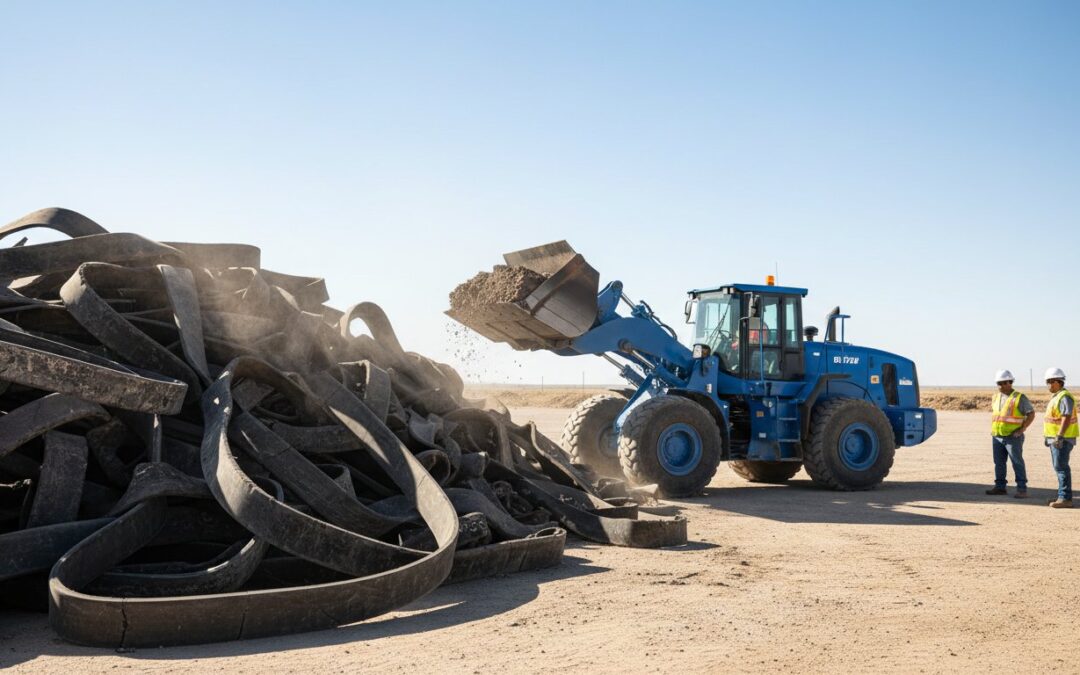
Leaving a 500-foot stack of industrial rubber to bake in the West Texas sun isn’t just a fire hazard; it’s a financial ticking clock. Since the TCEQ tightened scrap storage regulations in 2024, those “temporary” piles in Midland and Odessa have become magnets for heavy fines and unwanted pests. You’re likely looking at your yard right now and realizing that the safety risk outweighs the convenience of keeping it. The total cost to dispose of conveyor belt material often feels like a moving target when you factor in specialized hauling and disposal fees.
We believe in providing the clear, objective facts you need to clear your site without overpaying. This 2026 guide explains the specific variables that drive pricing across Lubbock and the Permian Basin, from weight per ton to the necessity of legal disposal manifests. You’ll learn how to navigate the logistics of heavy removal while ensuring your business remains fully compliant with state environmental laws. We’ve outlined the most efficient ways to secure a fast, professional pickup that restores your yard space and protects your bottom line.
Key Takeaways
- Understand how the 2026 industrial market in West Texas influences local disposal rates across Midland, Odessa, and Lubbock.
- Identify the four critical factors, including volume and material condition, that determine your total cost to dispose of conveyor belt.
- Protect your business from TCEQ liability by ensuring your industrial rubber is handled by a legal, professional service rather than high-risk haulers.
- Learn simple preparation techniques like sorting and rolling that can drastically reduce your labor costs and pickup fees.
- Discover how specialized heavy-duty equipment streamlines the removal process for massive scrap belt piles and industrial rubber.
Understanding Conveyor Belt Disposal Costs in West Texas
Industrial rubber disposal isn’t just about hauling junk to a curb. It involves the professional collection, transport, and processing of heavy-duty belting used in mining and oilfield operations. In 2026, the market in Midland, Odessa, and Lubbock has shifted significantly due to increased industrial activity. Businesses can’t rely on standard municipal waste services in Ector or Midland County for these needs. These local facilities are designed for residential and light commercial trash. They aren’t equipped to handle industrial rubber, which doesn’t compact and can easily damage landfill machinery.
Determining the cost to dispose of conveyor belt depends on several factors. The most important is whether the material is seen as a waste product or a reusable resource. Understanding rubber recycling processes helps clarify why some belts carry a fee while others might have residual value. You’re either paying for a service or selling a secondary raw material. In the Permian Basin, the distinction between “recycling value” and “disposal fees” often comes down to the physical condition and the chemical makeup of the rubber itself.
The State of Rubber Waste in the Permian Basin
The oil and gas industry in West Texas generates thousands of tons of belt waste every year. In 2026, stockpiling this material is no longer a viable or safe option. It creates a massive fire risk and a breeding ground for pests. Under 2026 TCEQ regulations, scrap rubber liability refers to the legal and financial responsibility an owner bears for the improper storage or disposal of industrial rubber materials that pose fire or environmental hazards. Local authorities in Midland and Odessa have increased site inspections to ensure compliance.
Asset or Liability: The Two Sides of Belt Disposal
Not every belt is destined for a shredder. If a belt is “repurposable,” it’s an asset. Ranchers near Lubbock often use old fabric-reinforced belts for livestock mats or windbreaks. In these cases, the cost to dispose of conveyor belt might be lower because the material has a second life. We look for belts with intact surfaces and minimal fraying for these applications.
However, most industrial belts are eventually classified as “waste.” This is especially true for steel-core belts. While they’re incredibly durable, they’re much harder to process than fabric-reinforced versions. The steel must be mechanically separated from the rubber, which requires specialized equipment. This complexity usually results in a disposal fee. We focus on providing a clear, upfront assessment so you know exactly which category your materials fall into.
The 4 Key Factors Determining Your Removal Price
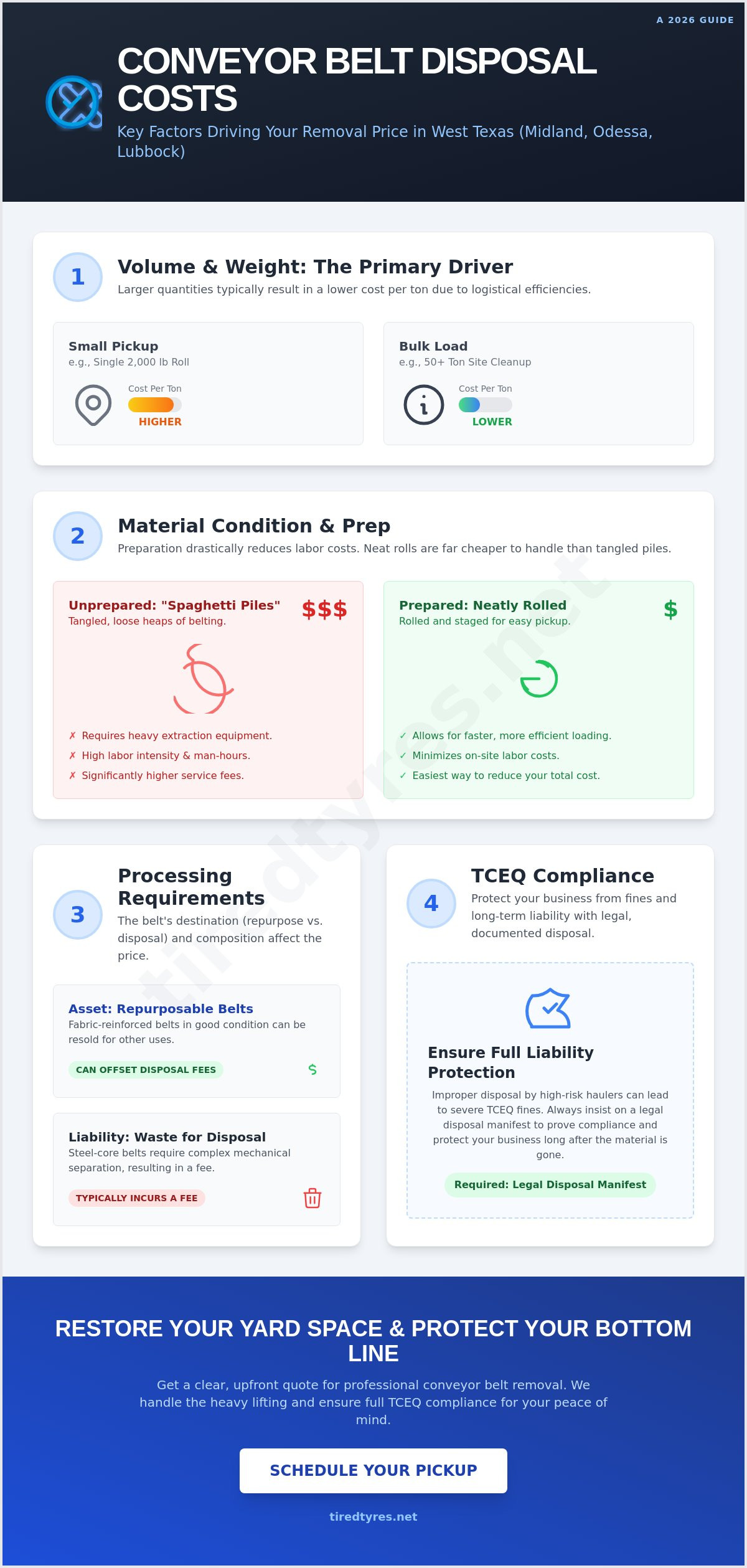
Calculating the cost to dispose of conveyor belt involves more than just weighing a piece of rubber. In 2026, West Texas industrial sites face specific variables that dictate the final invoice. Volume and weight are the primary drivers. A 50-ton bulk load from a Lubbock agricultural facility requires different logistics than a single, 2,000-pound roll pickup in Midland. Larger volumes often allow for better per-ton rates, but the initial mobilization of heavy equipment stays constant.
Material condition is the second major factor. We often encounter “spaghetti piles” at older sites. These are tangled, loose heaps of belt that haven’t been prepped for transport. They take significantly longer to load than neatly rolled belts. Processing requirements also play a role in the 2026 market. Shredding for landfill alternative daily cover is a standard procedure, but repurposing the belt for livestock mats or industrial flooring can sometimes offset disposal fees. Staying compliant with local regulations and Avoiding TCEQ Fines is a priority for every project we handle. Proper documentation ensures you aren’t liable for improper dumping long after the belt leaves your site.
Roll Condition and Labor Intensity
The price gap between pre-rolled belts and loose piles is substantial. Tangled piles require specialized heavy-duty extraction equipment and extra man-hours to manage the steel-reinforced rubber. If your team uses winding equipment on-site before our crew arrives, you’ll likely see a reduction in the overall service fee. Labor costs for extraction in high-risk industrial environments remain high, so prepping the material is the easiest way to save. If you’re unsure how to prep your rolls, the team at Tired Tyres can provide guidance on staging.
Transportation and Fuel Surcharges in West Texas
Logistics in the Permian Basin are unique. Diesel prices in the Midland-Odessa corridor fluctuate frequently, which directly impacts hauling fees. Proximity to major arteries like I-20 or US-84 is a significant factor in your quote. A site located 45 miles off the main highway will incur higher transport costs than a warehouse in central Lubbock. You should also consider the difference between a full-service pickup and a drop-off. Full-service includes our technicians doing the heavy lifting, while drop-off options are available for companies with their own transport capabilities. We’ve seen transport costs rise by 12% over the last two years, making efficiency more important than ever.
Avoiding TCEQ Fines: Legal Disposal in Midland and Odessa
The Texas Commission on Environmental Quality (TCEQ) classifies industrial rubber, including heavy-duty belts, as Class 2 industrial solid waste. You can’t simply toss these materials into a standard construction dumpster. If you do, the cost to dispose of conveyor belt scrap shifts from a manageable service fee to a massive legal liability. Under Texas law, you are responsible for your waste from “cradle to grave.” This means if a “midnight hauler” takes your money and dumps the belts in a Permian Basin ravine, the TCEQ tracks those materials back to your facility. You pay the fines; the hauler disappears.
West Texas landfills, specifically those serving Midland and Lubbock, have strict acceptance criteria. Most municipal sites won’t accept bulk rubber products unless they are processed, cut, or shredded into pieces smaller than 18 inches. Following TCEQ industrial waste regulations ensures your documentation stays clean during state audits. Proper manifest systems are mandatory for industrial waste transport. These documents must track the waste from your site to a permitted processing facility, providing a clear chain of custody that protects your business.
The Risks of Improper Rubber Storage
Stacking old belts behind your shop in Odessa creates two major problems. First, rubber piles are extreme fire hazards. Once ignited, rubber fires are nearly impossible to extinguish in the high West Texas winds. Second, these piles collect rainwater and become breeding grounds for mosquitoes, which triggers health department interventions. The City of Odessa and Midland County officials monitor industrial lots for these violations. As of 2026, administrative penalties for illegal dumping or improper storage can reach $25,000 per day per violation. You can find more specifics on Texas Tire Disposal Regulations to keep your business compliant and avoid these costs.
Verification of Permitted Haulers
Don’t let a truck leave your yard without verifying their credentials. It’s the only way to ensure the cost to dispose of conveyor belt materials doesn’t include a future lawsuit. Before signing any contract, ask the disposal company for their TCEQ registration number and proof of environmental liability insurance. Tired Tyres prioritizes documented, legal processing for all industrial waste. We provide a full paper trail for every load we handle.
The most important document for your corporate records is the Certificate of Disposal. This document proves the waste reached a permitted facility and was processed according to state law. We provide this certificate to every client. It acts as your shield against liability if state regulators ever audit your waste management practices. Our process is direct, professional, and designed to take the compliance burden off your shoulders.
- Always request a TCEQ-registered hauler number.
- Keep manifest copies for at least three years.
- Ensure belts are cut or shredded before landfilling.
- Verify the final disposal site is a permitted facility.
How to Prepare Your Scrap Belt Piles for Lower Pickup Fees
Preparing your site before the truck arrives is the most effective way to manage the cost to dispose of conveyor belt materials. Haulers in the Permian Basin typically charge based on labor time and equipment usage. If a driver spends two hours untangling a messy heap, those extra labor costs will appear on your final invoice. Efficiency on your end leads directly to savings on ours.
Effective Sorting Strategies
Don’t mix different waste streams into a single pile. Separating steel-cable belts from fabric-reinforced belts allows for faster processing and better recycling rates. When you mix rubber belts with scrap skid steer tracks or poly pipe, the load is classified as contaminated. Contamination fees often increase the price because the recycling facility must manually sort the debris. You should also remove any non-rubber attachments. Cutting off metal fasteners or mechanical splices ensures the rubber is ready for the shredder immediately.
Roll and secure your belts whenever possible. A tightly rolled belt has a much smaller footprint and is significantly safer to handle with a forklift or loader. Use heavy-duty banding or wire to keep the rolls from uncoiling during transport. Loose piles, often called “spaghetti” piles, take up three times more space on a trailer. This inefficiency means you pay for more trips than necessary to clear the same amount of tonnage.
Site Accessibility and Equipment
Site accessibility is a major factor in your total bill. Collection trucks and OTR-capable loaders require at least 50 feet of clearance to maneuver and load safely. If our team has to navigate through narrow paths or muddy back lots, the job takes longer. Staging your rubber waste near the main facility entrance or on a flat, gravel-packed surface makes the process seamless. Achieving a “ready-to-load” status, where the driver can pull up and immediately begin lifting, can cut your pickup costs by up to 20% compared to unorganized sites.
- Sort materials by core type (steel vs. fabric)
- Roll belts to minimize trailer space
- Clear a 50-foot radius for heavy machinery
- Remove all metal fasteners and debris
Always request a quote by providing high-resolution photos of your scrap piles. This transparency helps us send the right equipment the first time and prevents “surprise” onsite surcharges. Show the scale of the pile by placing a familiar object, like a truck or a pallet, in the frame for reference. Clear communication about the volume ensures the cost to dispose of conveyor belt scrap stays within your budget.
Ready to clear out your yard? Contact Tired Tyres for a professional scrap assessment and get a firm quote for your next pickup.
Efficient Industrial Rubber Removal with Tired Tyres
Tired Tyres stands as the primary partner for industrial waste management across Midland, Odessa, and Lubbock. We’ve built our reputation on being direct, reliable, and technically proficient. Managing industrial rubber isn’t just about hauling; it’s about specialized logistics and environmental responsibility. Our team understands that West Texas businesses need a partner who shows up on time and handles the heavy lifting without constant oversight. We focus on the Permian Basin because we live and work here too. Keeping our local environment healthy is a core part of how we operate.
Our fleet is specifically equipped to handle the unique challenges of the oilfield and agricultural sectors. We use heavy-duty loaders and specialized transport trailers designed for OTR (Off-The-Road) tires and massive industrial belts. Understanding the total cost to dispose of conveyor belt requires a partner who knows the Permian Basin logistics inside and out. We don’t guess at weights or distances. We use calibrated equipment and transparent 2026 market rates to ensure your bill reflects the actual work performed. Our goal is to provide a seamless service that lets you focus on your primary operations while we manage the scrap.
Comprehensive Rubber Collection Services
We provide a single point of contact for all your rubber disposal needs. Our crews manage everything from standard passenger tires at fleet shops to massive industrial hoses and multi-ply conveyor belts from mining or agricultural sites. We’ve expanded our reach to cover the entire region, from the remote oilfields outside Midland to the sprawling farms surrounding Lubbock. If it’s made of rubber and it’s taking up space, we can remove it. For a detailed look at our coverage and how we manage different materials, you can view our Reliable Tire Disposal Guide for service area maps and material specifications.
Get Your Custom Quote Today
Getting a clear estimate shouldn’t be a headache. Our quoting process is built for speed and accuracy. To give you the most competitive rate, we just need a few details: the approximate volume of material, the type of rubber (such as steel-reinforced belts or OTR tires), and your exact location. This data allows us to calculate the most efficient route and the right equipment for the job. While the market cost to dispose of conveyor belt fluctuates based on rubber recycling demand, we maintain stable, transparent pricing for our regional partners. You won’t find hidden surcharges or vague “processing fees” on our invoices. When you’re ready to clear out your yard, simply Request a Pickup Quote from Tired Tyres. We’ll get back to you quickly with a straightforward plan to handle your industrial rubber waste.
Streamline Your West Texas Industrial Rubber Disposal
Managing scrap rubber in the Permian Basin requires a focus on both efficiency and legal compliance. The cost to dispose of conveyor belt materials depends on volume, material type, and site accessibility. Since 2024, TCEQ has increased oversight on industrial waste, making documented, compliant disposal a necessity to avoid heavy fines. Proper staging of your belt piles can reduce pickup times by up to 20 percent, directly lowering your final invoice. It’s a simple way to protect your bottom line while staying within state regulations.
Tired Tyres handles the heavy lifting for operations in Midland, Odessa, and Lubbock. We’re a local, family-owned West Texas business with the specialized heavy-duty hauling equipment needed for industrial-scale loads. You get TCEQ-compliant disposal without the headache of managing the logistics yourself. Our team understands the unique demands of the 2026 industrial landscape. We provide the reliability you need to keep your site clean and your operations moving forward. We’re ready to help you clear out the clutter today.
Get a Professional Conveyor Belt Disposal Quote
Frequently Asked Questions
How much does it typically cost to dispose of a conveyor belt in Midland, TX?
The cost to dispose of conveyor belt materials in Midland typically ranges from $35 to $55 per ton at local industrial landfills. These rates depend on the total weight and whether the material is rolled or loose. Transportation fees from the job site to the facility usually add an extra $150 to $300 per load depending on the distance from the city center.
Can I get paid for my used conveyor belts in Lubbock?
You can get paid for used conveyor belts in Lubbock if the material is still in a reusable condition for agricultural or flooring applications. Buyers often pay between $1 and $3 per linear foot for high-quality, fabric-reinforced belts that lack major tears. If the belt is damaged or contains exposed steel cables, it’s considered scrap and will likely require a disposal fee instead of generating profit.
Is it legal to bury old conveyor belts on my property in Texas?
It’s illegal to bury old conveyor belts on your property under Texas Commission on Environmental Quality (TCEQ) Title 30, Part 1, Chapter 335. Violating these solid waste regulations can result in fines exceeding $10,000 per day for unauthorized industrial waste disposal. You must transport these materials to a permitted facility to ensure compliance with state environmental laws and avoid long-term liability.
What is the difference between steel-cable and fabric-reinforced belt disposal?
Steel-cable belts require specialized heavy-duty cutting equipment because the internal wires damage standard blades and increase processing difficulty. This often increases the processing time by 40% compared to fabric-reinforced belts, which affects your total labor costs. Fabric belts are lighter and easier to roll, which often results in lower transportation costs and more recycling options for livestock mats or windbreaks.
Does Tired Tyres provide the equipment to roll up loose conveyor belts?
Tired Tyres provides hydraulic winding equipment and specialized trailers to roll up loose conveyor belts directly at your site. We don’t expect you to have the heavy machinery required to handle 5,000-pound rolls on your own. Our team manages the entire extraction process, which reduces your labor costs and ensures the material is safe for transport on Texas highways.
How do I know if a rubber disposal company is TCEQ-permitted?
You can verify a company’s status by searching the TCEQ Central Registry database for their specific registration or permit number. Every legitimate transporter or processor in Texas must maintain an active MSW (Municipal Solid Waste) registration to handle industrial rubber. Tired Tyres maintains all necessary state authorizations to ensure your disposal chain remains fully documented and legal for your corporate records.
Can conveyor belts be recycled into other products?
Conveyor belts are frequently recycled into heavy-duty products like cattle oiler strips, truck bed liners, and industrial floor mats. Approximately 30% of recovered belts in the Permian Basin find a second life in the agricultural sector where durability is a priority. This repurposing helps reduce the overall cost to dispose of conveyor belt waste by diverting tonnage away from local landfills and into useful applications.
What happens if my conveyor belt pile is contaminated with oil or dirt?
Contaminated belts often require a “Special Waste” classification, which increases disposal fees by 50% or more at most Texas facilities. If the rubber is saturated with petroleum products, it must undergo testing to ensure it meets the 1990 EPA standards for non-hazardous waste. We recommend keeping your belt piles on clean pads to avoid these extra processing charges and keep your project on budget.