
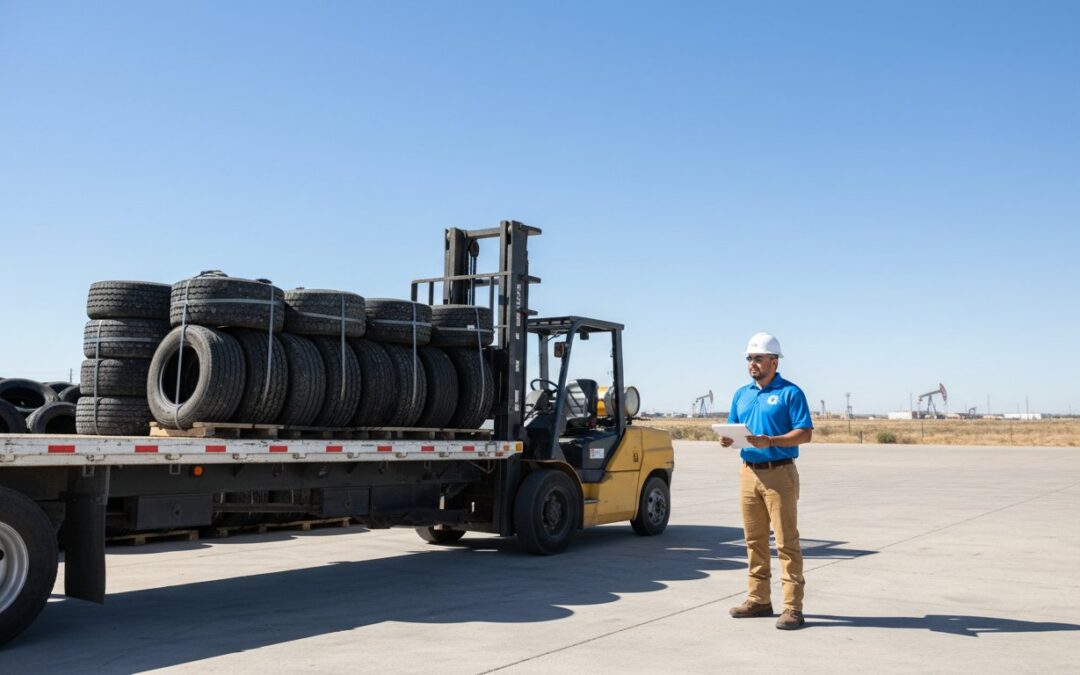
What if a single stack of old tires behind your shop cost you $25,000 in a single day? In West Texas, that isn’t a scare tactic; it’s the reality of current TCEQ enforcement. If you’re looking to reduce business risk with proper tire disposal, you’ve likely realized that a simple pile of rubber can quickly turn into a legal and financial nightmare. We understand that managing scrap inventory often feels like a secondary concern, especially when you’re focused on daily operations. It’s easy to let a few casings sit until they become a breeding ground for mosquitoes or a serious fire hazard.
This article explains how professional tire management protects your operation from heavy environmental penalties and health risks. You’ll learn why the manifest system is your best defense against cradle-to-grave liability and how to maintain a clean, hazard-free workplace. We’ll walk through the specific steps needed to ensure your disposal process creates a verified paper trail that keeps regulators satisfied and your business secure. By the end, you’ll know exactly how to turn a potential liability into a managed, worry-free part of your business.
Key Takeaways
- Identify the hidden physical threats of scrap rubber, including nearly inextinguishable fire hazards and mosquito-borne health risks to your workforce.
- Learn how to reduce business risk with proper tire disposal by mastering the TCEQ manifest system to ensure a legally protected chain of custody.
- Compare the manageable cost of professional hauling against potential civil penalties that can reach $25,000 per day for improper storage or disposal.
- Follow a five-step audit to categorize your inventory—including OTR, agricultural, and industrial rubber—and secure your storage site for safety.
- Discover how specialized collection for semi-truck tires and scrap conveyor belts protects your business reputation and legal standing in West Texas.
The Hidden Liabilities of Improper Tire Storage and Disposal
Accumulating scrap rubber isn’t just an eyesore; it’s a liability that threatens your bottom line. In West Texas, business risk means more than just a bad quarter. It’s the tangible threat of property damage, legal action, and rising operational costs. You can reduce business risk with proper tire disposal by addressing these issues before they escalate into a crisis. When tires sit idle, they transform from simple waste into active hazards that can compromise your entire operation.
The physical danger starts with fire. Tire fires are a nightmare for local fire departments in places like Midland or Lubbock. Because rubber is petroleum-based, it burns at incredibly high temperatures. Standard water hoses often fail to extinguish these blazes; they require specialized foam or massive amounts of dirt to smother. These fires release thick, black smoke and an oily residue that can contaminate your entire facility and lead to expensive environmental cleanup costs.
Financial consequences follow close behind. If your facility has large piles of unmanaged scrap, your insurance provider will likely take notice. High-risk stockpiles often lead to increased premiums or even policy cancellations. Additionally, the presence of waste rubber can significantly decrease your property’s market value. It makes the land harder to sell or use as collateral for business loans because of the perceived cleanup liability.
Environmental Hazards in the Permian Basin
The Permian Basin climate adds unique challenges to waste management. Intense West Texas heat accelerates the off-gassing of old rubber, which releases volatile organic compounds into the air. When rainwater collects in tires, it doesn’t just evaporate. It leaches chemicals into the soil over time. Tire recycling is the only effective way to prevent these toxins from reaching local groundwater. Large OTR and agricultural tires are particularly problematic. Their massive size allows them to hold gallons of stagnant water, creating long-term environmental hazards that are difficult to manage without professional help.
Health and Safety Risks for Your Workforce
Your workforce faces direct threats from unmanaged scrap. Piles of passenger or semi-truck tires are ideal homes for rattlesnakes, rodents, and other vermin common in Odessa. Beyond pests, poorly stacked tires are unstable. They can collapse without warning, causing serious injuries to employees working nearby. Local health departments frequently inspect commercial sites because tires are primary breeding grounds for mosquitoes that carry the West Nile Virus. You reduce business risk with proper tire disposal by keeping your site clean and your team safe from these preventable workplace dangers.
Navigating Texas Tire Regulations: Compliance as a Risk Mitigation Strategy
Operational safety in West Texas requires a firm grasp of the Texas Commission on Environmental Quality (TCEQ) standards. These rules aren’t merely suggestions; they’re rigid legal requirements designed to track every scrap tire from the moment it’s removed from a vehicle until its final disposal. You can reduce business risk with proper tire disposal by treating compliance as an active insurance policy. When you follow the letter of the law, you create a defensive barrier that protects your company during surprise inspections or environmental audits.
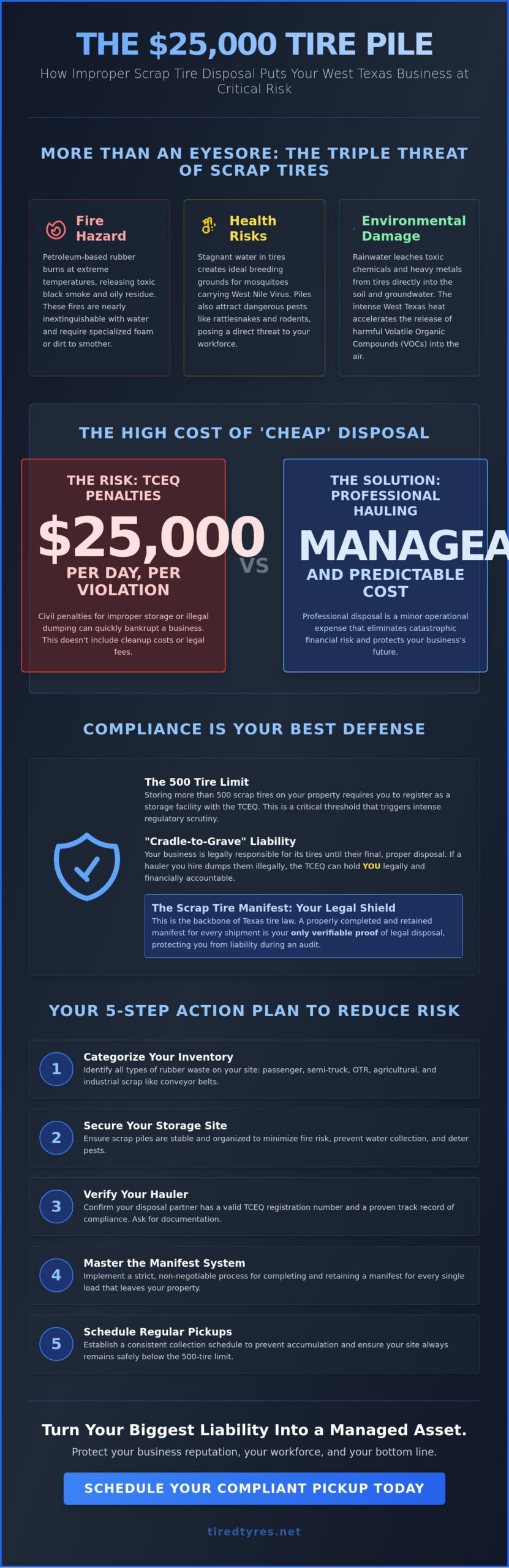
The state operates under the Texas Administrative Code, Title 30, Chapter 328. One of the most critical thresholds for any business owner to remember is the 500-tire limit. If your facility stores more than 500 scrap tires at any time, you’re required by law to register the site as a storage facility. Failing to do so can trigger civil penalties ranging from $50 to $25,000 per day, per violation. These costs can easily bankrupt a small to mid-sized operation in the Permian Basin.
Your liability doesn’t end when a truck pulls away from your loading dock. Texas enforces “cradle-to-grave” responsibility. This means if a hauler illegally dumps your tires in a Lubbock ravine, the TCEQ can hold your business legally and financially accountable. Proper documentation is the only way to prove you fulfilled your legal obligations. Without a verified paper trail, you’re essentially gambling with your company’s future.
Understanding the TCEQ Manifest System
The Scrap Tire Manifest is the backbone of Texas tire law. Every shipment must be accompanied by this document, which records the generator’s information, the hauler’s registration number, and the total tire count. It must also identify the authorized end-site where the tires will be processed. You’re required to retain these records to prove legal disposal during state audits. For a deeper look at these requirements, consult our Texas Tire Disposal Regulations guide.
The Role of Permitted Tire Haulers
Hiring an unpermitted “guy with a truck” is one of the fastest ways to invite a lawsuit. Before any rubber leaves your yard, you must verify that your hauler is currently registered with the TCEQ. Professional services ensure that every load of semi-truck or OTR tires is handled by experts who understand the manifest system. This verification step is a simple but effective way to reduce business risk with proper tire disposal. It ensures that your waste reaches a permitted facility that will split, quarter, or shred the tires according to state law before they ever reach a landfill.
The High Cost of ‘Cheap’ Disposal: Fines vs. Professional Services
Cutting corners on waste management might look like a saving on a spreadsheet, but it’s a high-stakes gamble. Many business owners in West Texas are tempted by “cheap” hauling options that lack proper documentation. Choosing an unverified path doesn’t just invite legal trouble; it often results in costs that far exceed professional collection fees. You can reduce business risk with proper tire disposal by viewing professional service as a fixed operational cost rather than a variable expense to be minimized.
The financial impact of a single mistake is staggering. While professional collection for passenger, semi-truck, or OTR tires is a predictable line item, a TCEQ enforcement action is not. In 2025 alone, the TCEQ issued over $2.4 million in penalties related to improper scrap tire management. These aren’t just abstract numbers; they represent real businesses that faced massive hits to their liquidity because of poor disposal choices. Beyond the fines, you’re also responsible for the full cost of remediation, which includes hiring specialized crews to clean up dumped sites and paying for legal representation during state proceedings. To mitigate these financial pressures and restore cash flow, many companies also look for recovery opportunities like Trump Tariff Relief, which helps businesses reclaim capital through specialized tariff refund claims.
Local reputation is a fragile asset in the Permian Basin. Illegal dumping news travels fast in communities like Midland and Lubbock. If your business’s tires are found in a ditch or an unauthorized stockpile, the “brand risk” can be terminal. Customers and partners prefer working with responsible operators who don’t cut corners on environmental safety. Professional disposal ensures your company name stays associated with quality and compliance, not environmental negligence.
Quantifying the Fines for Illegal Dumping in Texas
Texas law doesn’t take unauthorized disposal lightly. Violations are often categorized under the Texas Solid Waste Disposal Act, where civil penalties can range from $50 to $25,000 per day for each violation. Local enforcement in Midland and Lubbock counties has increased as authorities look to crack down on unauthorized scrap tire sites, which currently number over 120 across the state. The maximum administrative penalty for unauthorized disposal of municipal solid waste, including scrap tires, is $10,000 per day per violation in 2026.
Long-term Savings of Scheduled Collection
Proactive management is always cheaper than a reactive cleanup. By scheduling monthly or quarterly collections, you avoid the heavy “bulk cleanup” surcharges that come with clearing years of neglected rubber. Professional services also save you money on labor. Your staff should be focused on their core jobs, not struggling to move heavy agricultural tires or loading scrap conveyor belts into a trailer. Using specialized equipment for OTR and semi-truck tire collection ensures the job is done quickly and safely, allowing your business to maintain its momentum without the distraction of waste management crises. You reduce business risk with proper tire disposal by turning a potential disaster into a routine, managed process.
5 Steps to Audit Your Business’s Rubber Waste Management
Performing a regular internal audit is the most effective way to identify vulnerabilities before the TCEQ does. You can reduce business risk with proper tire disposal by systematically reviewing how your facility handles every piece of scrap rubber. Start by walking your yard and documenting exactly what you have. This isn’t just about counting units; it’s about understanding the specific types of waste your operations generate and where your documentation might be thin.
- Step 1: Identify all rubber waste types. Categorize your inventory into passenger, OTR, agricultural, and semi-truck tires. Don’t overlook secondary items like solid tires or scrap rubber piles.
- Step 2: Evaluate current storage conditions. Check for standing water inside casings and ensure piles are away from flammable structures. Proper drainage is a legal requirement in Texas to prevent mosquito breeding.
- Step 3: Review past disposal manifests. Cross-reference your records with your hauler’s TCEQ registration. If you’re missing manifests from the last few years, your business is currently at risk during an audit.
- Step 4: Assess accumulation frequency. Determine if your current pickup schedule matches your waste generation. If piles are growing faster than they’re being removed, you’ll soon hit the 500-tire storage threshold.
- Step 5: Partner with a permitted specialist. Secure a relationship with a hauler who provides verified manifests and uses specialized equipment for heavy industrial rubber.
Identifying Industrial Rubber Waste
Many Permian Basin operators focus only on standard tires and forget about specialized industrial waste. You must include scrap skid steer tracks, industrial hoses, and solid tires in your audit. Oilfield conveyor belts require unique disposal methods because of their weight and material composition. Failing to account for these items can lead to unexpected fines. For a full breakdown of what qualifies as commercial waste, see our Commercial Tire Disposal guide.
Optimizing On-Site Storage
How you stack your waste determines your level of risk. Avoid “barrel stacking” where tires stand upright and collect water; instead, use “laced stacking” or keep them under cover to ensure proper drainage. You should also implement security measures like fencing or lighting to prevent “midnight dumping,” where others leave their scrap on your property. This is a common issue in Odessa and Lubbock that leaves you holding the bill for someone else’s waste. Understanding these waste tire problems helps you maintain a safer, compliant yard. You can reduce business risk with proper tire disposal by contacting Tired Tyres to schedule a professional collection and secure your manifest records today.
Protecting Your Permian Basin Business with Tired Tyres
Choosing a disposal partner in West Texas requires more than just a truck and a trailer. You need a specialist who understands the logistical and legal pressures of the oilfield, agricultural, and commercial sectors. Tired Tyres provides that certainty. We help you reduce business risk with proper tire disposal by taking full responsibility for the collection and documentation of your scrap rubber. Our team operates with the precision and reliability that Midland, Odessa, and Lubbock businesses expect.
We don’t shy away from the heavy lifting. While generic haulers might struggle with massive OTR or agricultural tires, we utilize specialized equipment designed for the toughest jobs. Our fleet is capable of handling high volumes of semi-truck tires and industrial scrap without disrupting your daily operations. We also manage the items others often reject, including:
- Scrap conveyor belt collection
- Scrap hose and industrial rubber collection
- Scrap skid steer track collection
- Scrap solid tire collection
Transparency is the foundation of our service. Every load we collect comes with a verified TCEQ manifest, providing you with a permanent legal shield. We handle the paperwork so you can focus on your core business. You’ll never have to worry about where your scrap ends up or if a surprise audit will find a gap in your records. Our commitment to 100% compliance is your best defense against environmental liabilities.
Local Expertise in West Texas
Our roots are deep in the South Plains and Permian Basin. We understand the specific needs of local auto shops, large-scale farms, and active oilfield sites. If you’re operating in the heart of the region, our Tire Disposal in Midland guide offers localized insights into staying compliant. We provide the reliable, scheduled pickups that keep your business running smoothly and safely.
Get Started with a Risk-Free Quote
Managing your rubber waste doesn’t have to be a headache. We offer customized pickup frequencies that match your specific volume, whether you’re clearing a small shop or a massive industrial yard. It’s a simple, straightforward process that starts with a conversation. Don’t let scrap rubber become a legal or physical hazard on your property. Request a commercial tire disposal quote from Tired Tyres today and reduce business risk with proper tire disposal through a partnership built on trust and professional expertise.
Secure Your Business Future through Professional Waste Management
Managing scrap rubber is a fundamental part of West Texas business operations. You can reduce business risk with proper tire disposal by shifting from reactive piling to proactive, documented collection. By maintaining a clean site and a verified manifest trail, you eliminate the threat of heavy daily fines and protect your workforce from environmental hazards. We’ve shown that the cost of professional service is a minor investment compared to the massive financial risks of non-compliance.
Tired Tyres is your local partner for this transition. As a TCEQ permitted hauler, we provide the specialized OTR and industrial equipment needed to handle everything from agricultural tires to scrap conveyor belts. We serve the entire Permian Basin and South Plains, including Midland, Odessa, and Lubbock. Our goal is to take the weight of waste management off your shoulders while ensuring you stay fully compliant with state law. Don’t let unmanaged rubber threaten your reputation or your bottom line.
Protect your business—schedule your professional tire pickup with Tired Tyres today. It’s the simplest way to gain peace of mind and keep your operation running safely.
Frequently Asked Questions
What are the legal requirements for business tire disposal in Texas?
Texas law requires commercial tire generators to use only TCEQ-registered haulers and authorized end-sites. You must follow the “cradle-to-grave” responsibility rule, which means you’re legally liable for the tires until they reach a permitted processing facility. Additionally, businesses cannot store more than 500 scrap tires on their property without a specific TCEQ site registration. Failing to meet these standards can lead to daily administrative penalties.
How can improper tire disposal lead to business lawsuits?
Improper disposal creates environmental and public health hazards that can trigger civil litigation. If dumped tires from your business cause soil contamination or lead to a localized disease outbreak, you can be sued for damages and remediation costs. Because liability stays with the generator, you’re also responsible for any illegal dumping committed by a third-party hauler you hired without proper verification.
What is a scrap tire manifest and why does my business need one?
A scrap tire manifest is a state-required document that tracks the chain of custody from your business to the final disposal site. You need these records to prove legal compliance during TCEQ audits or property inspections. Maintaining a complete manifest history is the most effective way to reduce business risk with proper tire disposal by providing a verified paper trail of your waste management.
Can I take my business tires to a local landfill in Midland or Odessa?
You can only dispose of scrap tires in a permitted landfill if they’ve been split, quartered, or shredded first. Most municipal landfills in Midland and Odessa won’t accept whole tires from commercial businesses. Professional disposal services handle this processing for you, ensuring the rubber meets state requirements before it ever reaches a landfill for final disposal.
What happens if I hire an unlicensed tire hauler?
Hiring an unlicensed hauler leaves your business fully exposed to all legal and financial consequences of illegal dumping. If the hauler abandons your tires in a West Texas field, the TCEQ will hold you accountable for the cleanup. Administrative penalties for unauthorized disposal of municipal solid waste can reach as much as $10,000 per day per violation in 2026.
How do scrap tires increase fire risk at my commercial property?
Scrap tires are petroleum-based and serve as a highly flammable fuel source that’s incredibly difficult to extinguish. Once a tire pile ignites, it burns at extreme temperatures and releases toxic oils and smoke. These fires often require specialized foam or massive amounts of dirt to smother, leading to astronomical firefighting and environmental cleanup bills that standard insurance may not fully cover.
Does Tired Tyres provide disposal for industrial rubber like conveyor belts?
Yes, we collect various types of industrial rubber including conveyor belts, scrap hoses, and skid steer tracks. We utilize specialized heavy equipment to manage these bulky materials that standard waste providers often refuse. Our service ensures that even your toughest industrial waste is handled according to state regulations and backed by a professional manifest.
How often should a business schedule tire pickups to remain compliant?
Your pickup frequency should be high enough to ensure you never exceed the 500-tire storage threshold on your property. Most active commercial sites in Lubbock or Odessa find that monthly or quarterly collections work best for managing inventory levels. Regular scheduling helps reduce business risk with proper tire disposal by preventing hazardous accumulations and keeping your compliance documentation up to date.