
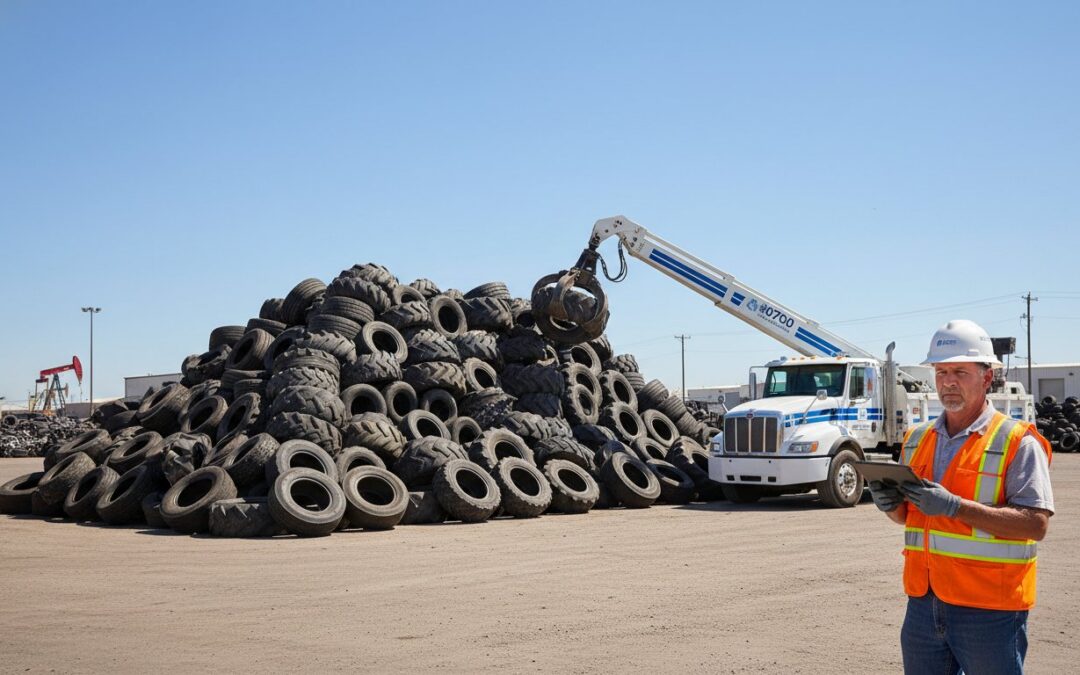
In 2025, the TCEQ issued over $2.4 million in penalties for improper scrap tire management, proving that a single pile of rubber can quickly become a massive financial liability. If you’re managing a fleet or an industrial site, you already know that legal rubber waste disposal in Lubbock is about more than just clearing space. It’s a critical strategy to protect your business from heavy fines and the logistical headache of moving oversized OTR or tractor tires. You likely want the peace of mind that comes with knowing your waste won’t be illegally dumped, leaving you legally responsible for the cleanup.
This guide explains how to stay compliant with 2026 TCEQ regulations, including the mandatory manifest system and specific storage thresholds. You’ll learn how to secure professional collection for everything from passenger tires and semi-truck rubber to scrap conveyor belts and skid steer tracks. We’ll simplify the disposal process so you can clear your site, obtain legal proof of disposal, and get back to your core operations with total confidence.
Key Takeaways
- Learn how to align your business with 2026 TCEQ standards to avoid the heavy financial penalties associated with improper tire storage.
- Discover how the scrap tire manifest system protects your business by providing legal proof that your waste reached an authorized facility.
- Evaluate the hidden costs of self-hauling to landfills versus the efficiency of professional legal rubber waste disposal Lubbock services.
- Understand the specific logistical requirements for managing bulk industrial waste, including OTR tires, scrap conveyor belts, and heavy-duty hoses.
- Find out how a professional collection partner can handle the heavy lifting while ensuring 100% compliance with Texas environmental laws.
Understanding Legal Rubber Waste Disposal in Lubbock (2026)
Legal rubber waste disposal Lubbock isn’t just a best practice; it’s a strict requirement under Title 30 of the Texas Administrative Code, Chapter 328. The Texas Commission on Environmental Quality (TCEQ) defines legal disposal as the documented movement of scrap rubber to an authorized processor or storage site. Many local businesses confuse standard municipal waste with regulated scrap tire materials. While you can toss general trash in a dumpster, whole tires are strictly banned from Texas landfills. They must be split, quartered, or shredded before they can be legally buried. Understanding Legal Rubber Waste Disposal helps clarify why these materials require specialized handling to prevent environmental degradation and long term soil contamination.
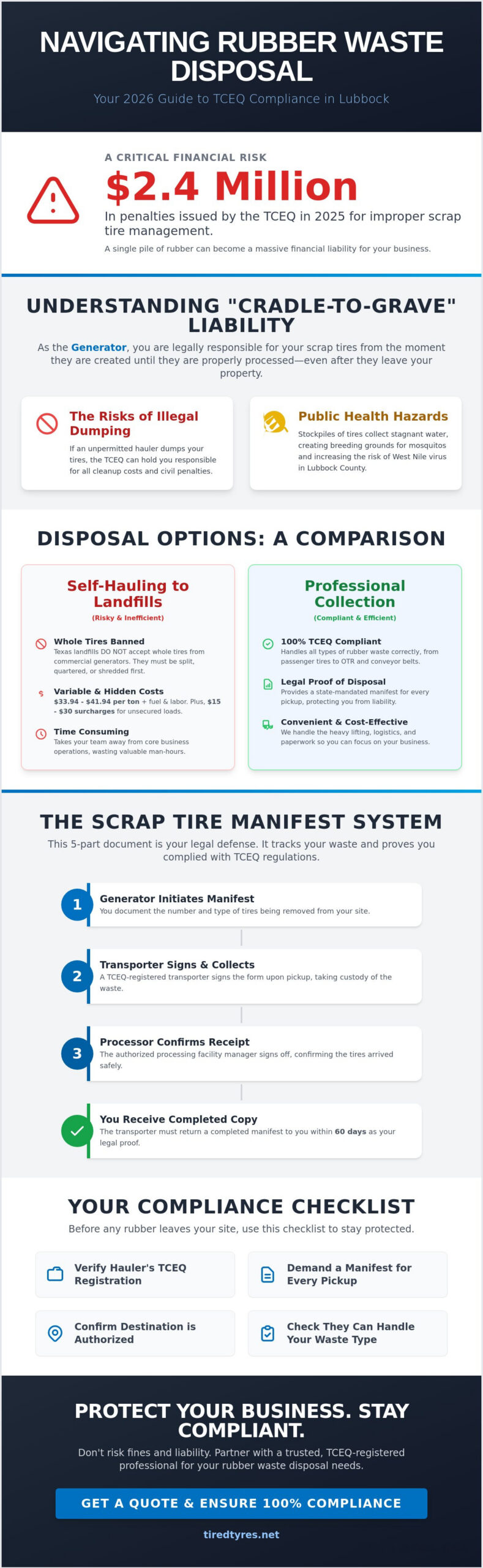
Lubbock businesses are currently under a microscope. In 2025, the TCEQ issued over $2.4 million in penalties for mismanagement, highlighting the state’s aggressive stance on compliance. The local landscape offers two primary landfill options: Caliche Canyon and the West Texas Regional Disposal Facility. Caliche Canyon handles municipal waste generated within city limits for a fee of $33.94 per ton. The West Texas Regional facility serves the broader area at $41.94 per ton. However, neither facility accepts whole tires from commercial generators. If you attempt to haul an unsecured load to these sites, you’ll face additional surcharges of $15.00 for noncommercial or $30.00 for commercial vehicles. This makes professional collection a more predictable and compliant path for local shops and industrial sites.
The Risks of Illegal Dumping in Lubbock County
Improper disposal carries consequences far beyond a simple ticket. You face “cradle-to-grave” liability. This means you remain legally responsible for your scrap tires even after they leave your property. If an unpermitted hauler dumps your tires in a West Texas field, the TCEQ can hold you responsible for the entire cleanup cost and associated civil penalties. Beyond financial risks, rubber stockpiles create major health hazards. Stagnant water inside tires serves as a primary breeding ground for mosquitos. This directly contributes to the spread of West Nile virus and other illnesses across Lubbock County during the warmer months.
Who Is Responsible for Your Waste?
TCEQ regulations divide the disposal process into three specific roles: generators, transporters, and processors. As a business producing scrap rubber, you’re the generator. You’re legally required to ensure your transporter is registered with the state. Hiring an unpermitted hauler to save a few dollars is a major legal risk that rarely pays off. Before any rubber leaves your site, use this checklist to stay protected:
- Verify Registration: Ask for the hauler’s current TCEQ registration number.
- Demand Manifests: Ensure they provide a state-mandated manifest for every pickup.
- Confirm Destination: Verify that the rubber is going to an authorized processor, not just a storage lot.
- Check Capabilities: Ensure the provider can handle your specific waste, such as OTR tires, scrap conveyor belts, or industrial hoses.
By following these steps, you ensure that your legal rubber waste disposal Lubbock strategy protects your bottom line and the local environment. Documentation is your only shield against state audits and potential litigation.
TCEQ Compliance and the Scrap Tire Manifest System
For business owners in West Texas, the manifest system isn’t just a bureaucratic hurdle; it’s your primary legal defense. The Texas Commission on Environmental Quality (TCEQ) uses this paper trail to track every tire from the moment it leaves your site until it reaches an authorized processing facility. Ensuring legal rubber waste disposal Lubbock compliance starts with understanding this five-part documentation process. Without a completed manifest, you have no proof that your waste didn’t end up in a roadside ditch, leaving you vulnerable to the “cradle-to-grave” liability mentioned earlier.
The process follows a strict chain of custody. First, the generator initiates the manifest by documenting the number and type of tires being removed. The transporter then signs the form upon pickup. Once the tires reach an authorized processor, the facility manager signs off, confirming receipt. Crucially, the transporter must return a completed copy of this manifest to you within 60 days of the initial pickup. Following Texas tire disposal regulations is the only way to safeguard your commercial license and ensure you’re prepared for a state audit. You’re required to keep these records on-site for at least three years.
How the Manifest Protects Your Business
Environmental audits can happen without much warning. When an inspector visits your Lubbock facility, they’ll ask for your disposal receipts and manifests. Common mistakes, like missing signatures or failing to match the tire count to your inventory, can trigger immediate fines. In 2026, while digital manifesting is becoming more common, the legal requirement for accuracy remains the same. A properly filled-out manifest proves you’ve done your due diligence and transferred the waste to a registered professional. If you’re overwhelmed by the paperwork, choosing a partner for professional rubber collection can streamline your record-keeping and ensure every form meets state standards.
Manifest Requirements for Different Rubber Types
While the standard TCEQ manifest is designed for tires, other industrial rubber materials like scrap conveyor belts and industrial hoses require similar professional documentation. Large-scale agricultural and OTR tire removals involve higher volumes and specialized transport, making the manifest even more critical. You should be wary of any hauler offering “free” or “cheap” pickups without providing a manifest. These operators often skip the legal steps required to process the rubber correctly. For legal rubber waste disposal Lubbock, the paperwork is just as important as the physical removal. If there’s no manifest, the state considers that rubber to be your responsibility indefinitely, regardless of who hauled it away.
Landfills vs. Professional Collection: A Comparison
Many Lubbock businesses initially consider self-hauling to save money. On the surface, paying the per-ton fee at a local landfill seems like the most direct route. However, this approach often ignores the hidden operational drains on your business. When you choose legal rubber waste disposal Lubbock through a professional service, you eliminate the logistical friction that turns a simple “trash run” into a full-day project. Municipal facilities are designed for household waste and small-scale commercial debris, not the high-volume rubber waste generated by fleet operations or industrial yards. Bulk loads of scrap tires often face volume limitations at standard facilities because they don’t compact easily, taking up valuable “air space” in landfill cells.
The true cost of self-hauling includes more than just the tipping fee. You have to account for employee labor, fuel, and the wear on your own vehicles. Most importantly, you must factor in the time lost. If your team is spending four hours loading, driving, and unloading a trailer, they aren’t performing the revenue-generating work you hired them for. Professional collection removes these variables from your balance sheet, replacing them with a predictable service that handles the heavy lifting on your behalf.
Logistics of the West Texas Regional Disposal Facility (WTRDF)
The West Texas Regional Disposal Facility in Abernathy has strict operational requirements that many businesses find difficult to meet. Beyond the $41.94 per ton tipping fee, you’ll pay a $30.00 commercial unsecured load surcharge if your tires aren’t perfectly tarped and tied down. Manual loading of hundreds of passenger tires is a grueling task that increases the risk of workplace injuries. Heavy industrial rubber, such as scrap skid steer tracks or solid tires, is even more difficult to process at standard landfills. These items often require specialized equipment just to move them from your yard to a trailer, making the DIY approach a major logistical hurdle.
Why Commercial Tire Disposal Saves Money
Investing in professional Commercial Tire Disposal saves money by shifting the labor burden to experts with the right tools. Professional collection teams use mechanical loading systems to clear a site in a fraction of the time it takes a manual crew. This is especially vital for OTR (Off-the-Road) and agricultural tires, which can weigh hundreds of pounds and are nearly impossible to move without a forklift or crane. You don’t need to own specialized trailers or hire extra hands just to clear out an old stockpile. Reliable legal rubber waste disposal Lubbock ensures your yard stays clean and your team stays focused on their actual jobs, all while maintaining 100% compliance with Texas environmental laws.
Managing Bulk Rubber and OTR Waste Legally
Bulk rubber waste presents a unique set of challenges that standard disposal methods simply can’t handle. When dealing with OTR (Off-the-Road) and earthmover tires, the sheer scale and weight make traditional transport impossible for most businesses. Leaving these massive tires to sit in a yard isn’t just an eyesore; it’s a liability that can lead to TCEQ inspections. Achieving legal rubber waste disposal Lubbock for these oversized items requires specialized equipment and a clear understanding of how high-density rubber is processed. Instead of letting these materials take up valuable space, focusing on tire recycling in West Texas ensures that your heavy industrial waste is repurposed into tire-derived fuel or crumb rubber.
Managing these materials correctly protects the local environment. Industrial rubber doesn’t break down like organic waste; it persists for decades if dumped illegally. By choosing a professional collection route, you ensure that even the most difficult materials, like solid rubber tires and skid steer tracks, are handled according to 2026 environmental codes. This proactive approach keeps your site clean and prevents the “cradle-to-grave” legal issues that arise when bulk waste is mismanaged.
Disposal Solutions for Agricultural and Heavy Equipment
Standard retail tire shops won’t accept tractor or combine tires because their equipment isn’t rated for the size. This often leaves farmers and equipment dealers with legacy tire piles that grow over several years. Clearing these sites requires more than a trailer; it needs a partner capable of site remediation. Professional teams can assess these stockpiles, provide the necessary equipment for loading, and ensure every agricultural tire is documented on a state manifest. This process effectively turns a long term logistical nightmare into a clean, compliant workspace.
Industrial Rubber Waste Beyond Tires
Many Lubbock businesses struggle with non-tire rubber waste, such as scrap conveyor belts from Permian Basin operations or bulk industrial hoses. Standard landfill pages rarely mention these items, yet they are subject to strict disposal rules. You can’t simply roll up a hundred feet of heavy-duty belt and leave it by a dumpster. Preparing your yard for a bulk pickup involves consolidating these materials in an accessible area where mechanical loaders can reach them. If you’re ready to clear out your inventory of scrap solid tires or industrial hoses, you can schedule a professional rubber collection to handle the entire removal process from start to finish. This ensures your industrial waste doesn’t become a permanent fixture on your property or a red flag for environmental inspectors.
Professional Rubber Waste Removal with Tired Tyres
Tired Tyres provides a direct, efficient solution for businesses requiring legal rubber waste disposal Lubbock. We understand that managing a yard full of scrap rubber is a distraction from your primary business goals. Our team specializes in clearing sites across Lubbock, Midland, and Odessa, ensuring every piece of debris is handled with 100% legal compliance. We don’t just haul away your waste; we manage the entire regulatory paper trail, providing the TCEQ-compliant manifests you need to protect your commercial license and pass environmental audits without stress.
Our fleet is equipped with specialized machinery designed for high-density and oversized rubber removal. While standard haulers might struggle with the weight of OTR tires or the awkward length of scrap conveyor belts, our mechanical loading systems make short work of even the largest stockpiles. We collect a wide range of materials, including semi-truck tires, agricultural equipment rubber, and scrap skid steer tracks. By choosing a professional partner, you avoid the physical risks and logistical hurdles of self-hauling, replacing them with a streamlined process that prioritizes your time and business safety.
The process is built on transparency and predictability. It starts with a custom quote tailored to your specific waste volume and material types. Once a pickup is scheduled, our team arrives on-site to handle all the loading and transport. You won’t have to worry about the 60-day deadline for receiving your completed manifest; we ensure all documentation is returned promptly to your office for your three-year record-keeping requirement. This professional approach turns a potential liability into a simple, managed task.
Why West Texas Businesses Trust Tired Tyres
Local expertise is our greatest asset. We’ve spent years working within the Permian Basin and South Plains regions, understanding the specific needs of local auto shops, industrial yards, and agricultural operations. We know the local geography and the strict requirements of West Texas disposal facilities. Our reliable scheduling ensures your yard stays clean, which is vital for both operational efficiency and community health. Supporting the local environment through reliable tire disposal practices is a core part of our mission, helping businesses stay compliant while keeping West Texas free of illegal rubber stockpiles.
Get Started with Your Lubbock Rubber Disposal
Requesting a custom quote for your specific waste volume is the first step toward a cleaner site. Whether you have a handful of scrap solid tires or a legacy pile of heavy duty truck tires, we provide a clear path to removal. During your first scheduled pickup, you can expect a professional team that respects your property and works quickly to minimize disruption to your workday. We handle everything from scrap hose collection to bulk rubber tracks, providing you with the peace of mind that only comes from expert service. Contact Tired Tyres today for a professional tire pickup quote and secure your business compliance for 2026 and beyond.
Secure Your Lubbock Business Compliance Today
Managing scrap rubber is no longer just a cleanup task; it’s a vital part of your business’s liability management strategy. By now, you understand that legal rubber waste disposal Lubbock requires more than just hauling items to a local landfill. It demands a rigorous manifest system to prove every tire and industrial belt reached an authorized destination. Relying on professional collection ensures you meet these strict TCEQ standards while avoiding the physical and financial strain of self-hauling bulk or OTR waste.
Tired Tyres is a TCEQ Permitted Hauler dedicated to keeping West Texas yards clean and compliant. We provide state-mandated manifests with every load and use specialized equipment to handle even the heaviest industrial rubber. Don’t let old stockpiles become a legal or environmental risk for your operation. You can Request a Legal Disposal Quote for Your Lubbock Business today to clear your site with confidence. Let our team handle the heavy lifting and the paperwork so you can focus on growing your business safely.
Frequently Asked Questions
Is it illegal to dump tires on my own property in Lubbock?
Yes, it’s illegal to dump or store scrap tires on your property without a TCEQ permit if you exceed specific storage thresholds. Businesses must register with the state if they store more than 500 tires on the ground or 2,000 in lockable, enclosed containers. Stockpiling rubber creates significant health hazards and fire risks, making legal rubber waste disposal Lubbock essential for property owners who want to avoid environmental penalties.
How many tires can I haul in Texas without a transporter permit?
You can haul your own scrap tires to an authorized facility, but commercial transporters must be registered with the TCEQ. If you’re hauling tires for others or as part of a commercial service, you’re required to have a transporter registration. It’s best to verify current Title 30 Texas Administrative Code requirements to ensure your specific volume and frequency don’t trigger the need for a formal permit.
Does the City of Lubbock landfill accept tractor or OTR tires?
The City of Lubbock landfills, including Caliche Canyon and the West Texas Regional Disposal Facility, do not accept whole tractor or OTR tires. Texas law prohibits the disposal of whole tires in any municipal landfill. These oversized items must be split, shredded, or quartered by a professional processor before they can be legally buried. This is why most businesses choose specialized collection services for heavy equipment rubber.
What is a scrap tire manifest and why does my business need one?
A scrap tire manifest is a state-mandated document that tracks the chain of custody from the generator to the final authorized processor. Your business needs a completed manifest for every load to prove you didn’t illegally dump the waste. It serves as your primary legal defense during a TCEQ audit and confirms that the transporter delivered the rubber to a permitted facility for proper processing.
Can I put scrap rubber hoses or conveyor belts in a standard dumpster?
You shouldn’t put industrial rubber like conveyor belts or heavy hoses in a standard municipal dumpster. While they aren’t always regulated as strictly as tires, their high density and inability to compact can lead to “unsecured load” fees or rejection by waste haulers. Professional legal rubber waste disposal Lubbock services are better equipped to handle these heavy materials, ensuring they’re managed without violating local landfill codes.
How do I find a permitted tire hauler in Lubbock?
You can find a permitted hauler by searching the TCEQ’s Central Registry database for registered scrap tire transporters. It’s important to ask any potential provider for their current registration number and verify that they provide completed manifests for every pickup. Working with an established local partner ensures the hauler has the specialized equipment needed to safely load and transport industrial and agricultural rubber waste.
What are the fines for illegal tire dumping in Texas?
Fines for illegal tire dumping in Texas are substantial and can reach thousands of dollars per day for each violation. In 2025, the TCEQ issued over $2.4 million in total penalties for improper scrap tire management across the state. These costs often far exceed the price of professional disposal, especially when you include the mandatory expenses for site remediation and the potential loss of your commercial license.
Does Tired Tyres provide disposal for residential customers or just businesses?
Tired Tyres focuses on commercial and industrial rubber collection, including fleet operations, auto shops, and agricultural sites. We specialize in handling large volumes of passenger, semi-truck, and OTR tires that require heavy-duty loading equipment. If you’re a residential customer with only a few tires, you should check with the City of Lubbock’s citizen collection stations for local disposal options that serve individual households.