
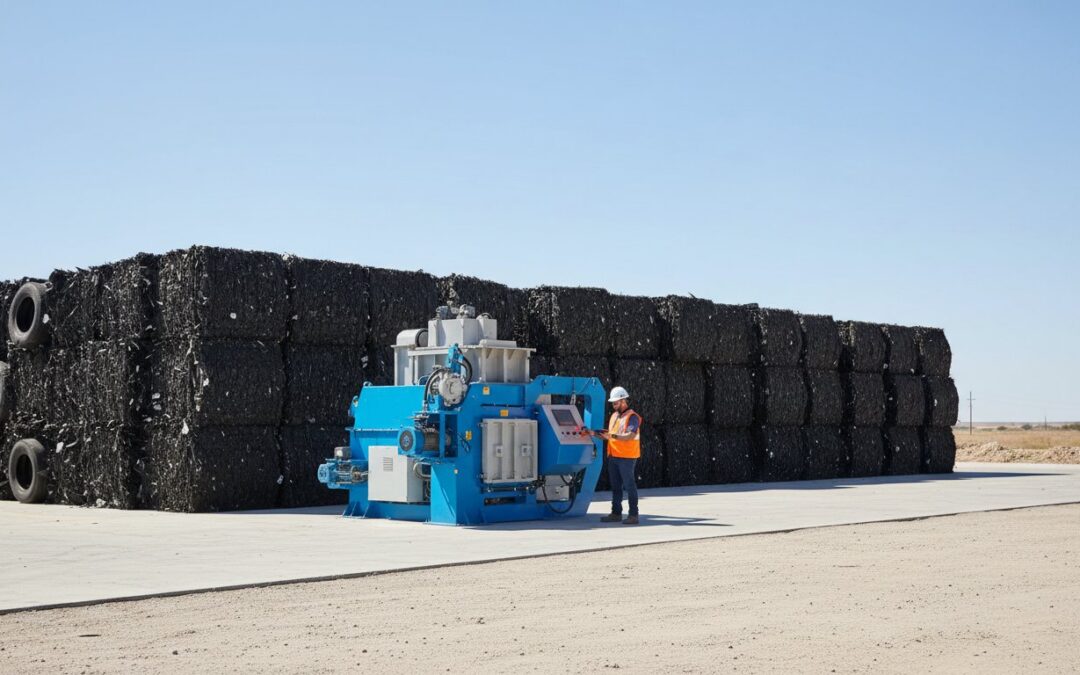
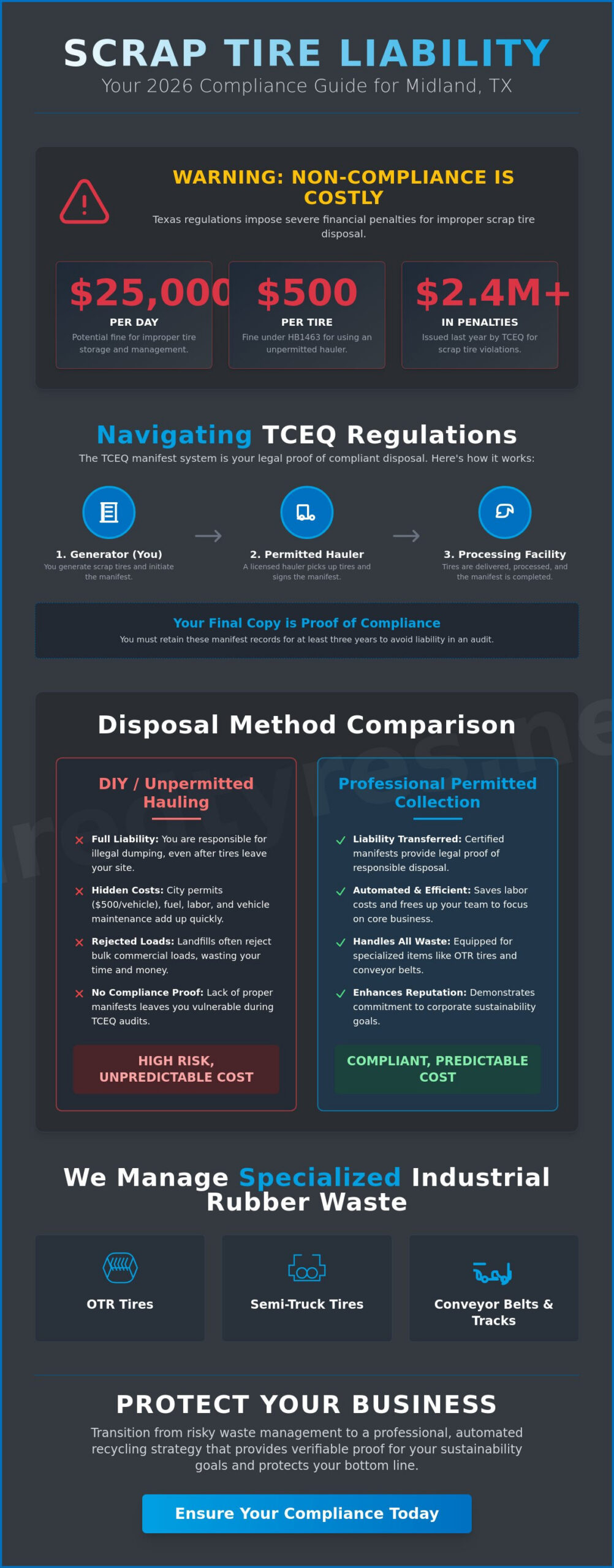
Did you know the TCEQ issued over $2.4 million in penalties for improper scrap tire management last year? For companies operating in the Permian Basin, a single oversight in your waste stream can lead to fines of up to $25,000 per day. Finding reliable, responsible tire disposal for businesses Midland is no longer just an environmental choice; it’s a critical legal necessity to protect your bottom line. Under the strict HB1463 regulations, using an unpermitted hauler could cost you $500 per tire even after the rubber leaves your property.
It’s frustrating to manage rising labor costs while trying to find facilities that actually accept large OTR tires or industrial conveyor belts. You want a clean, compliant site without the headache of manual logistics or the constant fear of a surprise audit. This 2026 compliance guide shows you how to automate your disposal process and meet all state reporting deadlines. We’ll cover the latest storage thresholds, electronic manifest requirements, and professional collection strategies for everything from semi-truck tires to scrap skid steer tracks.
Key Takeaways
- Identify how to avoid $25,000 daily TCEQ fines by meeting the latest 2026 storage and reporting thresholds for scrap tires.
- Compare the true costs of DIY landfill hauling against automated collection to save on labor and vehicle maintenance.
- Establish a reliable system for responsible tire disposal for businesses Midland that covers specialized items like OTR tires and industrial conveyor belts.
- Learn how the new HB1463 regulations impact your liability even after scrap rubber is removed from your facility.
- Transition from simple waste management to a professional recycling strategy that provides verifiable proof for your corporate sustainability goals.
The Growing Liability of Commercial Tire Waste in Midland
In the Permian Basin, managing industrial waste is a daily reality. However, the standards for scrap rubber have shifted significantly. Responsible tire disposal for businesses Midland now means more than just clearing space in the yard. It requires a documented, TCEQ-compliant process that ensures every casing is tracked from your site to a permitted facility. With Texas discarding approximately 55,000 tires every single day, the sheer volume of waste in 2026 has forced regulators to increase their scrutiny on commercial operators. You aren’t just responsible for what happens on your property; you’re liable for where that rubber ends up.
We are seeing a major transition in how Texas handles this material. Instead of viewing old rubber as “trash,” the local industry is moving toward resource recovery. This involves the Tire recycling process where scrap is converted into tire-derived fuel or crumb rubber for road projects. Businesses are the primary targets for inspections because they generate the bulk of high-risk waste. Items like semi-truck tires, OTR tires, and scrap conveyor belts require specialized handling that smaller, “budget” haulers simply cannot provide legally.
Identifying Local Environmental and Health Risks
Midland’s extreme summer heat creates a dangerous environment for stockpiled rubber. Tire piles trap heat and become significant fire hazards. Once an industrial tire fire starts, it’s nearly impossible to extinguish and releases toxic smoke into the West Texas air. Beyond the fire risk, even small amounts of standing water inside tires in Midland County become breeding grounds for mosquitoes. This creates a public health liability for your company. Over time, abandoned rubber also leaches chemicals into the soil, potentially leading to expensive remediation requirements that can haunt a business for years.
The Financial Impact of Improper Disposal
The cost of a mistake is staggering. Under current Texas law, illegal dumping or improper storage can trigger fines of up to $25,000 per day. The HB1463 regulations mean you can be held liable for $500 per tire if you hire an unpermitted hauler who dumps your waste illegally. These financial hits go beyond government penalties. Large stockpiles of industrial rubber often lead to higher insurance premiums and can significantly decrease your property’s market value during an appraisal. Implementing responsible tire disposal for businesses Midland builds your reputation. Professional clients today look for partners who provide proof of responsible recycling as part of their corporate social responsibility (CSR) metrics. It’s a competitive advantage that protects your balance sheet and your brand.
Navigating Texas Tire Regulations for Midland Businesses
The Texas Commission on Environmental Quality (TCEQ) is the primary authority for waste management in West Texas. They regulate the storage, transportation, and disposal of all scrap tires. If your shop or fleet facility has tires piled up, you’re legally a “generator.” This isn’t just a label; it’s a set of responsibilities. You must ensure your waste doesn’t end up in a ditch or an unpermitted lot. Many local businesses try to use municipal landfills, but these sites often reject commercial bulk loads to preserve space. Even if they accept them, the City of Midland requires a $500 annual permit per vehicle just to haul waste. It’s often more cost-effective to hire a permitted tire hauler Texas to handle the logistics of responsible tire disposal for businesses Midland.
Understanding the TCEQ Manifest System
The manifest system is your best defense against liability. A manifest is a multi-part form that tracks the tire’s journey from your gate to the final processor. When a hauler picks up your tires, you fill out the generator section and record the exact count. Both you and the driver sign it. You keep one copy immediately. Once the tires reach a permitted recycling facility, the facility signs the form and sends a completed copy back to you. You must keep these records for at least three years. If an inspector knocks on your door, these papers are the only proof that you’ve maintained responsible tire disposal for businesses Midland.
Why Midland Businesses Face Strict Oversight
Midland and Odessa are under a microscope in 2026. The industrial boom in the Permian Basin has led to a massive increase in rubber waste. TCEQ has responded by ramping up local enforcement and conducting more frequent site visits. They’re looking for “midnight haulers,” which are unlicensed individuals who take your tires for a cheap cash price and dump them in the desert. Because tires contain hazardous materials, the environmental impact of commercial tire waste is severe when left in unmanaged piles. If your tires are found in an illegal dump, the state won’t go after the hauler alone; they’ll come after your business. Working with professional collection services ensures every tire is accounted for and legally processed.
Comparing Disposal Methods: Landfills vs. Professional Collection
Choosing between DIY hauling and professional pickup is a decision that impacts your operational budget and legal risk. Many fleet managers in the Permian Basin initially consider self-hauling to save on service fees. However, responsible tire disposal for businesses Midland involves looking at the full cost of the process. When you factor in specialized vehicle requirements, staff downtime, and the regulatory burden, the “cheap” option often becomes the most expensive. Professional collection moves the liability and the labor away from your team, allowing you to focus on your core operations.
Landfills in West Texas are increasingly restrictive about what they accept. Large agricultural tires or heavy OTR casings often require specialized shredding before they can be landfilled, a service many municipal sites don’t provide. This leads to rejected loads and wasted fuel. For high-volume sites, the efficiency of reliable tire disposal lies in the ability to handle mixed loads, including scrap skid steer tracks and conveyor belts, in a single pickup. This streamlined approach ensures your facility remains compliant without the logistical nightmare of multiple trips to different disposal sites.
The Logistics of Self-Hauling in Midland
Taking a load to the City of Midland Landfill isn’t as simple as loading a pickup truck. To haul waste legally, you must obtain a hauler’s permit, which currently costs $500 per vehicle each year. If you skip this step, you risk significant fines before you even reach the gate. Once there, you’ll face tipping fees and potentially long wait times during peak hours. You also have to consider the physical strain on your employees. Manually loading and unloading heavy semi-truck tires leads to workplace injuries and increased workers’ compensation risks. Most standard commercial vehicles aren’t designed for high-volume tire transport, leading to accelerated wear on suspension and tires.
Advantages of Scheduled Commercial Collection
Switching to a scheduled service changes the dynamic of your waste management. Instead of letting old rubber pile up until it becomes a hazard, you establish a predictable rhythm. We provide customized collection frequencies based on your specific volume. This consistency eliminates on-site stockpiling and keeps your facility looking professional. For businesses with multiple locations, professional collection offers consolidated billing and centralized manifest management. This makes the TCEQ audit process significantly easier. All your records for responsible tire disposal for businesses Midland are organized in one place rather than scattered across various landfill receipts.
Managing Specialized Industrial Rubber Waste in the Permian Basin
Industrial operations in West Texas generate waste that standard garbage trucks simply can’t haul. While passenger tires are common, the Permian Basin’s energy and agricultural sectors produce massive amounts of specialized rubber. Responsible tire disposal for businesses Midland requires a specific approach for items like OTR tires and scrap skid steer tracks. These aren’t just larger versions of car tires; they are engineered with steel reinforcements and dense rubber compounds that require heavy-duty processing equipment. Standard municipal landfills often lack the machinery to shred these items, leading to high rejection rates for commercial loads.
Burying this industrial rubber is a short-sighted solution. Large tires and belts take up massive amounts of landfill space and never fully decompose. Recycling these materials is the only way to ensure long-term site safety and compliance. When you choose a professional partner for commercial tire disposal, you’re choosing a path that turns industrial waste into crumb rubber or tire-derived fuel. This supports the local circular economy while keeping your facility clear of hazardous stockpiles.
Solutions for OTR and Agricultural Tires
OTR (Off-the-Road) tires are the massive casings found on earthmovers, loaders, and mining equipment. These tires can weigh several thousand pounds each. Midland farmers and oilfield operators often struggle with these because they require specialized loading equipment. You can’t manually load a tractor tire into a trailer. Our collection process uses heavy-duty machinery to lift and transport these items safely. By streamlining your oversized rubber waste, you reduce the risk of workplace injuries and eliminate fire hazards in your yard.
Disposing of Conveyor Belts and Skid Steer Tracks
There is a significant amount of “hidden” rubber waste in Midland’s industrial sector. This includes:
- Scrap conveyor belts from mining and sorting facilities.
- Industrial hoses used in oilfield fluid management.
- Rubber skid steer tracks from construction fleets.
- Scrap solid tires from forklifts and warehouse equipment.
These items require different processing than standard pneumatic tires. Because they are often reinforced with heavy fabric or steel cables, they are difficult to cut and recycle without industrial-grade shredders. Responsible tire disposal for businesses Midland must account for these secondary materials to maintain a truly compliant site. If you have accumulated industrial rubber that standard haulers won’t touch, professional scrap rubber collection is the most efficient way to manage your inventory and avoid TCEQ scrutiny.
Partnering with Tired Tyres for a Compliant Midland
Midland is more than just a service area for us; it’s our home base. We understand that Permian Basin businesses need a partner who knows the local terrain and the specific demands of the energy sector. Tired Tyres supports the tire recycling infrastructure across West Texas by ensuring that scrap rubber doesn’t sit in dangerous stockpiles. We manage the entire lifecycle of your waste rubber. Your tires travel from your commercial site directly to local processing plants where they’re converted into useful resources. This local approach reduces transportation emissions and ensures your business supports the Texas economy.
We are committed to 100% legal, TCEQ-compliant disposal. In an environment where state regulations like HB1463 are tightening, you can’t afford to guess about your hauler’s credentials. We maintain the necessary permits and insurance to protect your company from third-party liability. When you choose us for responsible tire disposal for businesses Midland, you’re choosing a transparent process. We don’t just move tires; we provide the documentation you need to prove your environmental diligence to auditors and stakeholders.
Our Professional Collection Process in Midland
Starting the process is straightforward and efficient. You can request a custom quote tailored to your specific volume and rubber types, whether you have a stack of semi-truck tires or a warehouse full of scrap conveyor belts. On pickup day, our team follows strict safety protocols to ensure a fast, clean removal. We handle the heavy lifting so your crew can stay focused on their primary tasks. Once the load is secured, we provide the initial manifest paperwork. After the tires reach the processing facility, you’ll receive the completed TCEQ manifest. This document is your permanent record of compliance and your shield against potential fines.
Securing Your Business Future
A consistent disposal partnership offers benefits that go beyond simple waste removal. It allows you to meet corporate sustainability goals and maintain a professional, hazard-free facility. By automating your rubber waste stream, you eliminate the risk of missing TCEQ reporting deadlines or accumulating tires beyond legal storage thresholds. We help you stay ahead of regulatory changes so you’re never caught off guard by new state laws. It’s time to move your old rubber out and move your business forward. Schedule your Midland business tire pickup today to secure a clean, compliant site for the years ahead.
Take Control of Your Commercial Waste Compliance
Managing industrial rubber waste in the Permian Basin doesn’t have to be a source of stress. By moving away from risky self-hauling and unpermitted services, you protect your company from heavy TCEQ penalties and environmental liability. We’ve seen how the right manifest system and specialized equipment for OTR and agricultural tires can turn a cluttered yard into a compliant, professional site. Implementing responsible tire disposal for businesses Midland ensures you meet all 2026 regulatory deadlines while supporting local recycling efforts.
Our team provides the expertise and machinery needed to handle everything from standard passenger tires to heavy-duty scrap conveyor belts and skid steer tracks. As a TCEQ-permitted hauler serving Midland, Odessa, and Lubbock, we take the logistical burden off your shoulders. You get clean facilities and verifiable proof of recycling for your records. It’s time to stop worrying about surprise audits and start focusing on your operations. Get a Professional Tire Disposal Quote for Your Midland Business and secure your facility’s future today. We look forward to helping you maintain a safe and sustainable workplace.
Frequently Asked Questions
Is tire disposal for businesses different than residential disposal in Midland?
Yes, commercial entities face much stricter regulations than households. While residents might use city drop-off events, businesses are classified as “generators” by the state. This means you must use a permitted hauler and maintain a manifest system to prove every tire was handled legally. Commercial volumes are generally not accepted at residential collection points and require professional logistics to ensure compliance with Texas law.
What is a TCEQ tire manifest and why does my business need one?
A TCEQ tire manifest is a legal tracking document that records the movement of scrap tires from your site to a processing facility. Your business needs this because it serves as your only proof of legal disposal. If an inspector visits your property or if your tires are found in an illegal dump, the manifest protects you from liability. You must keep these signed records for at least three years to remain compliant.
Can I take my business tires to the Midland landfill myself?
You can haul them yourself, but it’s rarely the most cost-effective choice for a professional operation. The City of Midland requires a $500 annual hauler’s permit for every vehicle used to transport waste to the landfill. Additionally, landfills have strict limits on the size and quantity of tires they accept. Most commercial sites find that the permit fees, labor costs, and vehicle wear make self-hauling more expensive than professional collection.
How much does professional commercial tire disposal cost in Midland?
Pricing for responsible tire disposal for businesses Midland is based on the specific type and volume of rubber you need removed. Factors include whether you are disposing of standard passenger tires, heavy semi-truck casings, or oversized OTR equipment. We provide custom quotes that reflect your specific inventory and the frequency of service your site requires. This ensures you only pay for the exact level of support your business needs.
Does Tired Tyres handle large OTR and agricultural tires?
Yes, we specialize in collecting heavy-duty rubber that standard waste haulers won’t touch. Our fleet is equipped with specialized machinery to load and transport OTR tires, agricultural casings, and solid industrial tires. We also collect scrap skid steer tracks and conveyor belts. If your business generates large-scale industrial rubber waste, we have the equipment to clear your site safely and efficiently.
What happens to the tires after they are collected in Midland?
Collected tires are transported to a state-permitted processing facility rather than being buried in a landfill. Most scrap rubber is shredded and recycled into tire-derived fuel or crumb rubber for civil engineering projects. This process keeps hazardous waste out of the West Texas environment and supports the regional circular economy. You receive a completed manifest once the tires reach their final destination.
How often should a Midland auto shop schedule tire pickups?
Most active auto shops in Midland find that monthly or bi-monthly pickups work best for maintaining a clean site. The ideal frequency depends on how quickly you accumulate casings and your available storage space. Regular scheduling is important to stay below the TCEQ registration threshold of 500 tires. Consistent pickups prevent fire hazards and ensure your business always stays within local safety ordinances.
Are there fines for storing too many tires on my business property in Texas?
Yes, the TCEQ can issue significant fines if you exceed storage limits without a permit. In Texas, you must register as a storage site if you have more than 500 scrap tires on the ground or more than 2,000 in lockable containers. Exceeding these numbers without proper registration can lead to penalties of up to $25,000 per day. Keeping your inventory low through professional collection is the easiest way to avoid these risks.