
Would your business survive a $25,000 daily fine that starts the moment an inspector walks off your property? In June 2026 alone, the TCEQ approved over $2.6 million in penalties against entities that failed to meet state standards. Understanding the consequences of failed environmental inspection Texas is no longer just about avoiding a slap on the wrist; it’s about protecting your company from a points-based penalty system that now counts even minor violations toward “repeat violator” status.
You likely feel the pressure of keeping up with shifting regulations, from new Bexar County emissions rules to strict scrap tire storage permits. It’s challenging to navigate facility waste requirements while Texas landfills continue to restrict whole tire disposal. This guide explains the legal and financial risks you face under the 2026 TCEQ enforcement rules and how to fix site violations before they escalate. We’ll look at the specific 2026 penalty updates, the difference between vehicle and facility compliance, and how professional scrap rubber management keeps your operations running smoothly and your license secure.
Key Takeaways
- Learn how TCEQ calculates daily fines and “Economic Benefit” penalties that can cost your business $25,000 per violation.
- Understand the legal and operational consequences of failed environmental inspection Texas, including immediate vehicle registration denials for commercial fleets.
- Discover the five essential steps to stop the “per-day” fine clock and restore compliance through immediate containment and professional waste audits.
- Identify the specific risks for businesses in Midland, Odessa, and Lubbock as local landfills continue to tighten restrictions on whole tire disposal.
- Find out how scheduled scrap rubber collection and professional disposal services prevent non-compliance before inspectors arrive at your facility.
What Triggers an Environmental Inspection Failure in Texas?
An inspection failure occurs when a business falls short of the rigorous standards set by the Texas Commission on Environmental Quality (TCEQ) or the Department of Public Safety (DPS). These state-level mandates are built upon the broader framework of U.S. environmental policy, which establishes the legal foundation for protecting air, water, and soil. In Texas, failing usually means a facility has neglected essential record-keeping, exceeded permitted emission limits, or stored industrial waste improperly. These oversights aren’t just paperwork errors. They represent a direct risk to the environment and the community.
Common triggers for a failed audit include improper hazardous waste disposal, air permit violations, and illegal tire stockpiling. Many owners don’t realize that the “Two Steps, One Sticker” program creates a mandatory link between vehicle health and legal operation. If your commercial fleet fails its emissions test, you cannot renew your registration. This effectively grounds your vehicles until the issue is resolved. Understanding the consequences of failed environmental inspection Texas starts with recognizing that compliance is a facility-wide responsibility, not just a tailpipe requirement.
Vehicle Emissions vs. Facility Compliance
Many fleet managers in West Texas confuse vehicle inspections with facility audits. The TCEQ Vehicle Inspection and Maintenance (I/M) program focuses specifically on tailpipe emissions in designated counties. While the DPS enforces road safety and emissions testing, a facility audit is much broader. Inspectors look at your entire site to ensure you aren’t leaking chemicals or mismanaging waste. A facility can have perfectly maintained trucks but still fail an inspection due to how it handles shop fluids or scrap rubber. Both sides of compliance are essential to avoid the consequences of failed environmental inspection Texas.
The Role of Scrap Tires in Inspection Failures
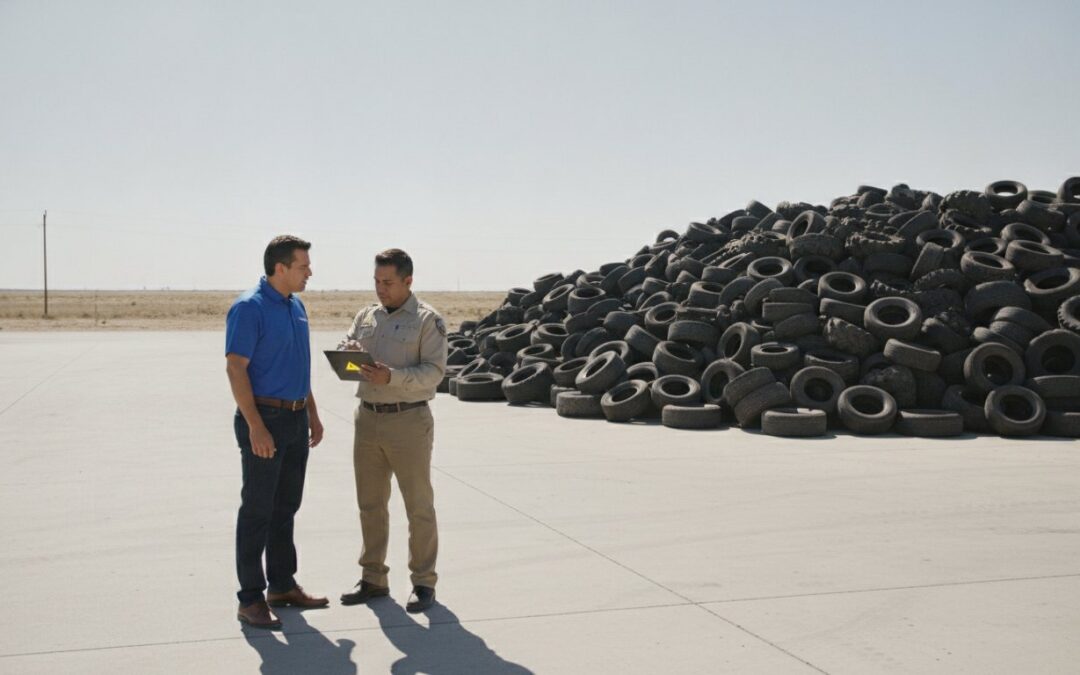
Scrap tires are a frequent and avoidable trigger for facility failures. Texas law is very specific about how these items are stored. Storing more than 500 scrap tires on your property requires a formal permit from the TCEQ. Without this permit, those tires are legally classified as an illegal stockpile or a public nuisance. These piles are major fire hazards and breeding grounds for pests, which often leads to an automatic failure during a surprise audit.
To maintain a clean record, businesses must strictly follow texas tire disposal regulations. Landfills in Midland and Odessa have stopped accepting whole tires from commercial entities, making it easy for piles to grow beyond legal limits. If an inspector finds an unpermitted pile, your business is immediately at risk for significant fines. Passing your inspection depends on proving that every piece of scrap rubber is accounted for and removed by a registered transporter.
Financial and Legal Fallout: The $25,000-per-Day Reality
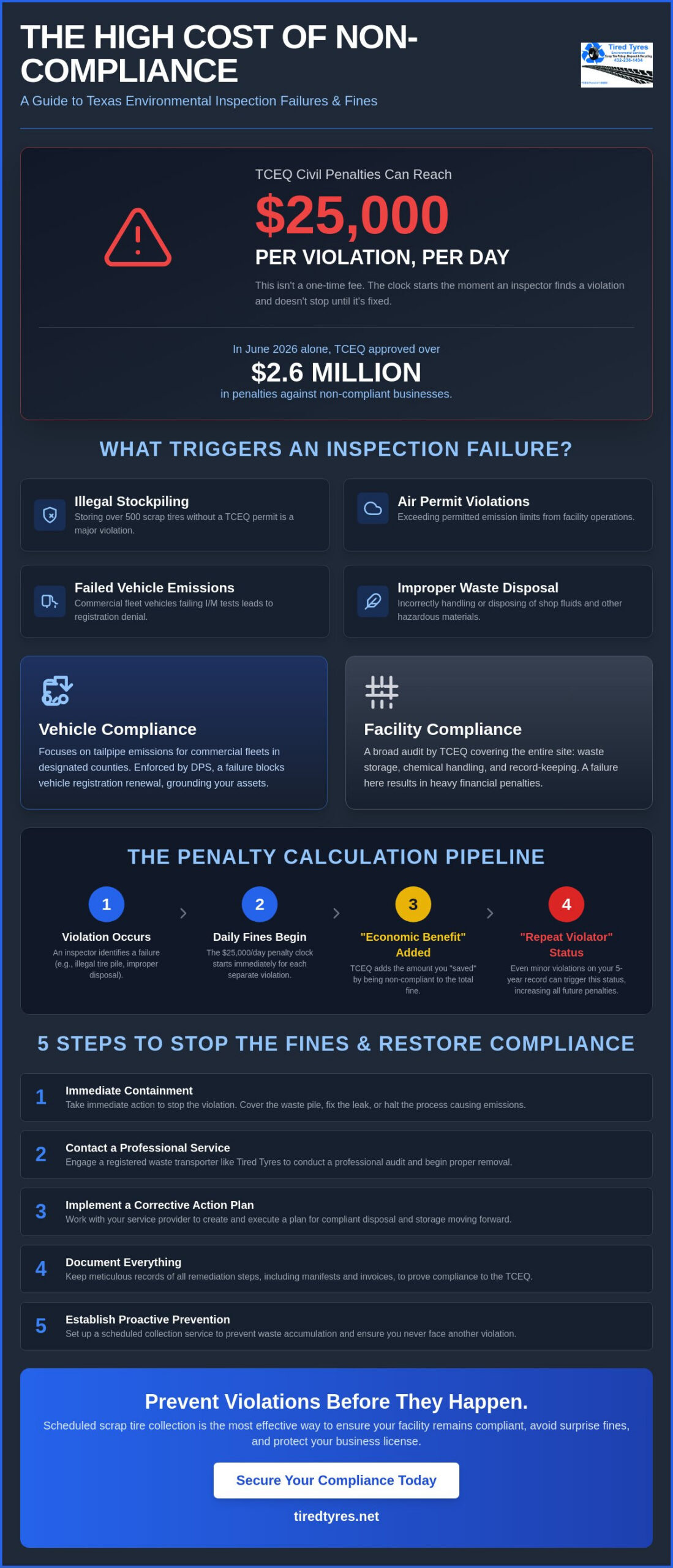
The financial consequences of failed environmental inspection Texas are designed to be punitive. The TCEQ has the authority to levy civil penalties up to $25,000 per day for each individual violation. This isn’t a one-time fee. If an inspector identifies three separate issues on Monday and you don’t fix them until Friday, you could face $375,000 in fines before the week is out. In June 2026 alone, the state approved over $2.6 million in total penalties against businesses. According to the TCEQ Penalty Policy, these amounts are non-negotiable once the enforcement order is finalized.
Beyond the base fine, Texas uses an “Economic Benefit” penalty. This allows the state to calculate exactly how much money your business saved by not installing proper equipment or skipping professional waste services. They then add that amount to your fine. It ensures that non-compliance is never more profitable than following the law. Inspectors categorize failures into minor, moderate, or serious harm. As of January 2026, even minor violations stay on your record and contribute to a “repeat violator” status, which automatically increases future fines.
Calculating the Civil Penalty Burden
The total cost often surprises West Texas business owners. TCEQ looks at your compliance history over the last five years. If you’ve had previous issues, your daily fine amount can be maximized. We see this frequently when businesses ignore waste tire problems. Improper storage is a leading cause of multi-day penalties in the Permian Basin. If you’re struggling with overflow, professional scrap tire collection can prevent these compounding costs before an inspector arrives at your gate.
The Risk of Criminal Prosecution
Administrative fines are just the beginning. If an investigation proves that management “willfully ignored” known violations, the case can move to criminal court. In Texas, dumping more than 200 pounds of tires is a state jail felony. Site managers and owners in West Texas can be held personally liable for these actions. “Willful neglect” is often defined as having knowledge of a violation, such as an illegal tire pile, and choosing not to act. Criminal charges can lead to jail time and permanent business closure, making immediate remediation your only viable path forward.
Operational Consequences: Registration Denial and Business Disruptions
The operational consequences of failed environmental inspection Texas extend far beyond the accounting department. When a facility fails to meet TCEQ standards, the state has the power to halt your revenue-generating activities immediately. This isn’t just about paying a fine. It’s about whether you can legally open your doors tomorrow morning. For businesses in the Permian Basin, a single failure can trigger a domino effect that disrupts your entire supply chain.
Operational disruptions usually take two forms: vehicle grounding and facility shutdowns. Both are costly. Both are preventable. In June 2026, the TCEQ’s stricter points-based system means that even minor operational oversights can lead to a “repeat violator” status. This status makes it significantly harder to negotiate with inspectors or secure future permits. Your environmental standing is a core part of your business’s value, and a failed inspection puts that value at risk.
Vehicle Registration Denial in Texas
Texas uses the “Two Steps, One Sticker” system. This means your vehicle must pass its required emissions test before you can renew its registration. While safety inspections for non-commercial vehicles were abolished in 2025, emissions testing remains mandatory in 17 counties, with Bexar County joining the list on November 1, 2026. Failing this test effectively grounds your fleet.
For mobile service businesses and delivery fleets in Midland, Odessa, and Lubbock, a registration block is a major hurdle. If your trucks can’t get legal tags, they can’t be on the road. This leads to lost contracts, idle staff, and missed deadlines. For professional drivers navigating these regulatory challenges, it is helpful to visit The Truckermann. Resolving a registration block requires more than just a quick fix. You must provide proof of a passed inspection and pay any associated “Inspection Program Replacement Fees” before the state releases your tags.
Facility Shutdowns and Permit Revocation
A facility-wide failure is even more severe. If an inspector finds that your site poses an immediate threat to public health, they can issue a Cease and Desist order. This forces an immediate shutdown of all operations. These orders are common when inspectors find uncontained hazardous waste or illegal tire stockpiles exceeding 500 units.
Regaining your operating permits isn’t a quick process. You’ll need to prove that you’ve implemented a sustainable waste management plan. Following commercial tire disposal best practices is often a prerequisite for getting your license back. Beyond the legal hurdles, your company’s reputation takes a hit. TCEQ violations are public record. Clients and partners in West Texas often check these records before signing contracts. A history of environmental negligence can make your business a liability in the eyes of the community.
5 Steps to Remediate a Failed Inspection and Avoid Further Fines
Receiving a notice of violation is a high-pressure moment, but your response determines the final cost. The primary goal is to stop the consequences of failed environmental inspection Texas from compounding. Since TCEQ fines accrue daily, every 24 hours of inaction can cost your business up to $25,000. You must move from a state of panic to a state of documented remediation immediately.
Remediation isn’t just about fixing the specific problem the inspector found; it’s about proving to the state that you’ve implemented a permanent solution. Follow these five steps to restore your compliance status:
- Immediate Containment: Stop the violation. If you have an unpermitted tire pile, secure the area to prevent further dumping. If a leak is detected, contain it. This stops the “per-day” fine clock.
- Professional Waste Audit: Don’t assume the inspector found everything. Conduct a full audit of your facility to identify hidden non-compliance issues before the re-inspection.
- Hire a Permitted Hauler: Use a registered professional to remove unauthorized waste. For rubber waste, this is the only legal way to clear your record.
- Maintain the Manifest Trail: Every pound of waste leaving your site must be documented. These manifests are your legal shield.
- Schedule Re-inspection: Once the violation is cleared and documented, contact the TCEQ or DPS to verify your compliance and close the enforcement case.
Clearing Waste Tire Violations
If your failure involved scrap rubber, your options are limited. You cannot simply haul these tires to a local landfill in Midland or Lubbock. Most municipal landfills have stopped accepting whole tires from commercial businesses as of 2026. Attempting to dump them illegally will only lead to criminal charges and even steeper fines. You must hire a permitted tire hauler Texas to remove the inventory. They will provide the necessary paperwork to prove the tires reached an authorized recycling facility rather than an illegal dump site.
Documentation and the Manifest System
Paperwork is the only language the TCEQ speaks during an enforcement case. To pass your re-inspection, you must present a complete “Manifest Trail.” This is a set of documents signed by you, the transporter, and the final disposal site. It proves that your waste was handled legally from start to finish. Common errors, like missing signatures or using an unregistered hauler, will keep your business in “non-compliant” status despite the physical waste being gone.
If you’re currently facing a violation and need to clear a site quickly, contact a registered scrap rubber transporter to secure the manifests you need for the state. Having professional documentation ready for your follow-up audit is the fastest way to get your business back to normal operations.
Ensuring Long-Term Compliance with Professional Tire Disposal
Avoiding the severe consequences of failed environmental inspection Texas requires more than just reactive cleanup. It demands a shift from crisis management to proactive stewardship. Many businesses in West Texas wait until a scrap pile becomes a nuisance before seeking help. By then, the TCEQ may have already initiated an enforcement screening. A scheduled disposal plan ensures your facility never reaches the 500-tire permit threshold that triggers intense regulatory scrutiny and those $25,000 daily fines.
Investing in reliable tire disposal is a strategic financial decision. When you compare the predictable cost of professional collection to the $2.6 million in penalties approved by the TCEQ in June 2026 alone, the choice is clear. Professional services remove the risk of “Economic Benefit” penalties. You’ve already invested in the correct, legal path for your waste rubber, leaving no room for the state to claim you gained a financial advantage through non-compliance. Our goal is to take the burden of waste management off your shoulders so you can focus on your core operations.
Tailored Solutions for West Texas Industries
West Texas industries have unique waste needs that standard trash services can’t meet. We provide specialized collection for a wide range of rubber waste. This includes Passenger & Light Truck tires, Semi-Truck tires, and heavy-duty Agricultural or OTR (Off-the-Road) models. Our team also handles industrial rubber waste that often causes inspection failures, such as scrap conveyor belts, hoses, and solid tires. Whether you’re operating an oil field service in Midland, a logistics hub in Odessa, or an agricultural center in Lubbock, we provide the local support needed to keep your site clean and compliant.
Partnering with Tired Tyres for Peace of Mind
We’re committed to legal, efficient, and transparent rubber disposal. Our team understands the complexities of the 2026 TCEQ points-based penalty system. We handle the manifest paperwork for you, ensuring every load is documented according to state law. This “Manifest Trail” is your best defense during an audit. It proves that your scrap skid steer tracks or semi-tires were recycled or disposed of at an authorized facility.
Don’t wait for a surprise inspection to find out your waste management plan is lacking. Proactive disposal is the only way to maintain a valid business license and a clean corporate reputation in the Permian Basin. Contact us today to secure your facility against future inspection failures and keep your operations running without the threat of state-ordered shutdowns.
Protecting Your Business Future in West Texas
Environmental compliance in 2026 is a continuous process that demands your attention before an inspector arrives. As we’ve discussed, the consequences of failed environmental inspection Texas can ground your fleet and drain your bank account through compounding daily fines. Staying ahead of these risks means maintaining a clean site and a perfect paperwork trail. By implementing a scheduled disposal plan, you eliminate the threat of “nuisance” violations and ensure your facility is always ready for a surprise TCEQ audit.
We provide specialized collection for OTR and industrial rubber waste, ensuring your business stays on the right side of the law. Our team handles the TCEQ-compliant manifest tracking for you, giving you the documentation needed to pass any inspection. Whether you operate in Midland, Odessa, or Lubbock, we’re here to manage your scrap rubber professionally. Get a Professional Quote for Legal Tire Disposal in West Texas and secure your facility today. Taking these proactive steps now is the best way to ensure your operations remain profitable and uninterrupted.
Frequently Asked Questions
What happens if my business fails a TCEQ environmental inspection?
You’ll receive a formal notice of violation or enforcement that outlines the specific failures discovered at your facility. The TCEQ then initiates a screening process to determine the severity of the non-compliance and the daily penalty amount. Failing to address these issues promptly leads to the consequences of failed environmental inspection Texas, including a permanent entry on your compliance history that increases future fine amounts.
How much are the fines for illegal tire dumping in Texas?
Dumping fines can exceed $4,000 depending on the weight and location of the waste rubber. If the dumping involves more than 200 pounds of tires, the offense can be prosecuted as a state jail felony in Texas. Beyond these criminal penalties, the TCEQ often adds administrative fines that accrue for every day the illegal waste remains on the property or at the dump site.
Can I still drive my commercial vehicle if it fails emissions?
No, you cannot legally operate a vehicle if it fails its required emissions test and its registration has expired. Texas law requires a passed inspection before you can renew your registration tags under the “Two Steps, One Sticker” program. Operating a fleet with expired registration leads to immediate law enforcement citations and can result in your commercial vehicles being impounded until compliance is met.
How do I clear a vehicle registration denial in Texas?
You must first repair the mechanical issues that caused the initial failure and then pass a re-inspection at a certified testing station. Once the vehicle passes, the state’s digital system updates, allowing you to pay your registration fees and the mandatory Inspection Program Replacement Fee. It’s vital to keep your passing report as backup documentation in case the digital record doesn’t update immediately.
What is the “Economic Benefit” penalty in Texas environmental law?
This is a specific fine designed to strip away any financial advantage a business gained by not following environmental regulations. The TCEQ calculates exactly how much money you saved by skipping professional disposal services or avoiding equipment upgrades. This calculated savings is added to your base fine, ensuring that it’s always more expensive to ignore the law than it is to stay compliant.
How long do I have to fix a violation after a failed inspection?
The specific deadline for remediation is listed in your enforcement order, but you should act immediately to stop daily penalties. While some minor paperwork violations might allow for a short correction period, serious facility threats often trigger fines that accrue from the first day of non-compliance. Taking fast action to clear the violation is the only way to limit your total financial liability.
Do I need a special permit to transport my own scrap tires?
Yes, you must be registered with the TCEQ as a transporter if you haul more than 500 scrap tires at any time. Even if the tires are your own business waste, transporting them without the proper state registration is a violation of Texas law. Most businesses in Midland and Odessa avoid this risk by hiring a registered hauler who provides the required manifest documentation.
How does Tired Tyres ensure my business stays TCEQ compliant?
We provide a complete manifest trail for every load of scrap rubber we collect, including OTR and semi-truck tires. This documentation serves as your legal proof during an audit that your waste was disposed of at an authorized facility. Our scheduled collection services help you avoid the consequences of failed environmental inspection Texas by keeping your on-site tire inventory well below the state’s permit threshold.