
Did you know the TCEQ approved over $661,000 in penalties against regulated entities in a single day in February 2026? For a West Texas business, those growing piles of scrap rubber and hydraulic lines aren’t just an eyesore; they’re a massive financial risk. Securing professional industrial hose disposal solutions is the only way to ensure your operation stays on the right side of the Texas Commission on Environmental Quality. With daily civil penalties ranging up to $25,000 for solid waste violations, leaving old hoses to rot in the yard is a gamble you can’t afford to take.
It’s a common struggle to manage industrial waste while staying focused on your core operations. You likely want to clear out that clutter but worry about the legal headache of improper disposal or the environmental hazards of hydraulic fluid residue. This article shows you exactly how to navigate the current Texas regulatory environment and secure disposal services that eliminate your liability. We’ll break down the latest TCEQ fine structures, the necessity of using permitted haulers, and the specific steps you can take to keep your West Texas site clean and compliant.
Key Takeaways
- Identify how bulk scrap hoses consume high-value floor space and create safety hazards in busy West Texas industrial zones.
- Protect your business from “cradle-to-grave” liability by choosing professional industrial hose disposal solutions that follow TCEQ regulations.
- Learn the essential steps to verify a hauler’s permit and equipment capabilities before they step foot on your property.
- Understand the environmental risks of improper storage, from mosquito breeding grounds to the threat of toxic pyrolytic oil runoff.
- Ensure full compliance with every pickup through documented manifests that satisfy state record-keeping requirements.
The Operational Challenge of Industrial Hose Disposal in West Texas
In Odessa and Midland, shop floor space is a premium asset. Every square foot should contribute to your bottom line. When old hydraulic lines and suction hoses pile up, they do more than just collect dust. They consume high-value real estate that should be used for active projects or equipment storage. Many managers focus on the downtime caused by a hose failure but overlook the long-term cost of the scrap left behind. It’s a hidden drain on your facility’s efficiency.
Securing reliable industrial hose disposal solutions is a matter of operational logic. It isn’t just about small hydraulic fittings; West Texas businesses deal with massive agricultural hoses and oilfield-grade rubber that weigh hundreds of pounds. These bulky items are difficult to move and even harder to store. Holding on to this scrap rubber prevents efficient inventory planning and creates a physical barrier to smooth logistics. It’s easy to tell yourself you’ll deal with it later, but “later” usually means the pile has tripled in size and complexity.
Space Management and Shop Efficiency
Think about the hourly rate of your shop. If a pallet of oily scrap hoses occupies a corner for six months, you can calculate the lost revenue based on the work that could’ve happened in that space. Disorganized waste impacts how your technicians move. It forces them to take longer routes or work in cramped conditions, which directly increases the risk of trips and falls. An operational bottleneck for industrial waste occurs when the accumulation of scrap exceeds the facility’s capacity to store it safely, slowing down every other process in the shop. Clearing this debris is the fastest way to restore your workflow and keep your team focused on billable tasks.
Fire Hazards and Insurance Compliance
The Texas heat is a major factor in waste management. Rubber stockpiles are highly combustible, especially when they’re saturated with hydraulic fluid or oil. In Midland and Lubbock, local fire codes are strict about bulk rubber storage for a reason. A single spark can turn a neglected pile into a toxic emergency. Improper storage can even void your commercial insurance policies if an inspector finds you aren’t following safety protocols. Professional disposal helps you avoid these risks. By utilizing modern rubber recycling methods, specialized haulers ensure your waste is processed safely rather than sitting as a fire hazard on your property. This keeps your business compliant and your insurance premiums stable.
Navigating Texas Regulations: Your Legal Responsibility for Scrap Rubber
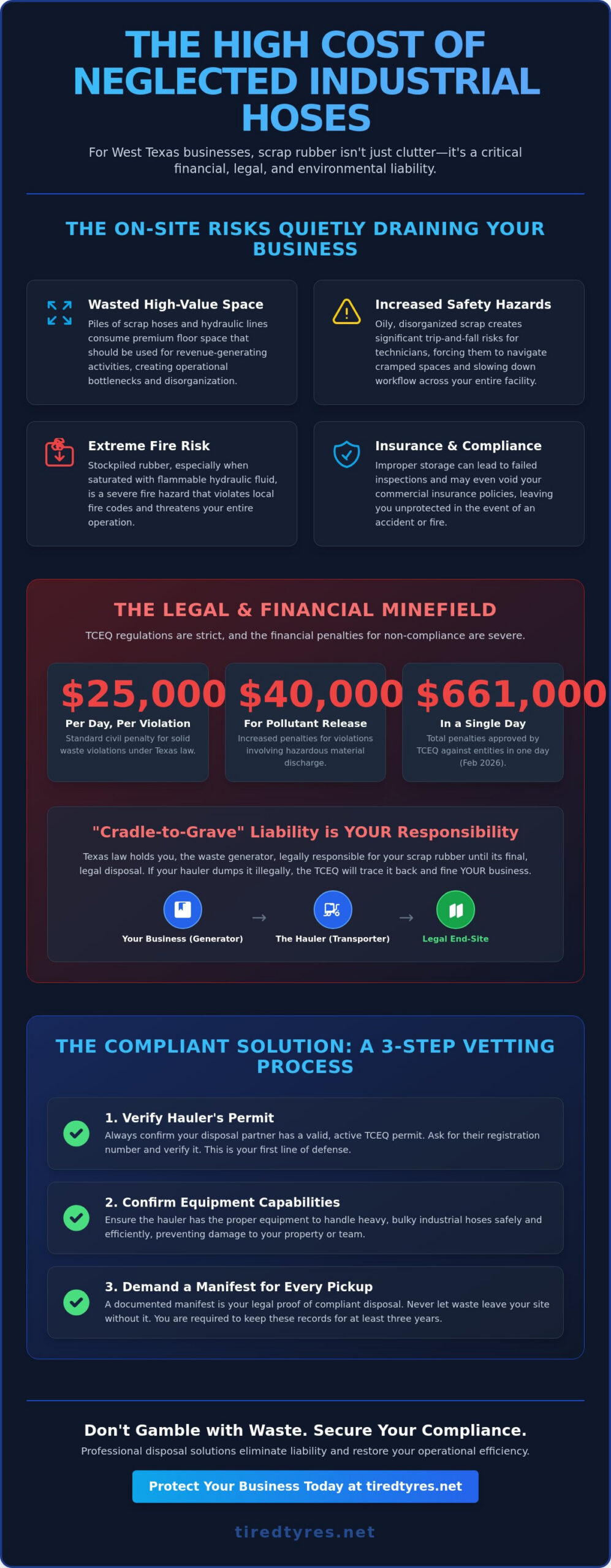
Texas law is clear: if you produce the waste, you’re legally responsible for it until it reaches its final, legal destination. This is known as “Cradle-to-Grave” liability. For businesses in the Permian Basin, this means your responsibility doesn’t end when a truck leaves your yard with old hydraulic lines. If that hauler dumps those hoses in a rural county or an unpermitted site, the Texas Commission on Environmental Quality (TCEQ) will trace that waste back to your shop. The financial consequences are severe. Civil penalties for violating waste disposal statutes can range from $50 to $25,000 per day for each violation. For certain violations related to the release of pollutants, those penalties can climb as high as $40,000.
Securing professional industrial hose disposal solutions ensures you have a documented paper trail. Without a valid TCEQ Scrap Tire and Rubber Manifest, you have no proof of legal disposal. Regulatory scrutiny is at an all-time high. On February 25, 2026, the TCEQ approved penalties totaling $661,093 against regulated entities for various environmental violations in a single day. Many of these fines stem from improper manifesting or using unpermitted haulers. Hiring a “fly-by-night” collector might seem like a way to save on overhead, but the risk of a state environmental audit makes it a dangerous gamble for your company’s future.
The TCEQ Compliance Paper Trail
Proper documentation is your primary defense during an inspection. Every load of scrap rubber that leaves your facility must be accompanied by a manifest that identifies the generator, the transporter, and the authorized end-site. You must maintain these records for at least three years to remain compliant with state requirements. For a deeper look at the specific paperwork and classification rules required in our state, see our Texas Tire Disposal Regulations guide. Keeping organized records is the most effective way to survive a state environmental audit without facing heavy fines.
Generator Liability: Why the Source Matters
The EPA has conducted extensive research on the environmental and health impacts of rubber waste, which explains why Texas authorities take illegal dumping so seriously. Unpermitted collectors often lack the insurance or the state-issued permits required to access legitimate recycling facilities. Verified end-destinations are the only way to guarantee your business is protected from downstream litigation and environmental cleanup costs. If you’re unsure about your current waste management plan, it’s time to evaluate your scrap rubber collection strategy with a permitted partner who understands the local landscape.
Vetting Your Hauler: How to Choose a Reliable Industrial Waste Partner
Picking a waste partner in West Texas requires more than a quick search. You’re hiring a company that carries your legal reputation on the back of their truck. If they fail to follow state law, the TCEQ won’t just look at the hauler; they’ll look at the generator. Finding legitimate industrial hose disposal solutions means looking for transparency in every step of the process. You need to know exactly where your scrap rubber ends up and have the paperwork to prove it. This prevents the “Cradle-to-Grave” liability issues we covered previously from ever reaching your desk.
Reliability is another critical factor. In the fast-paced Permian Basin, you can’t afford to have scrap piles sitting around because a hauler didn’t show up. Evaluate whether a provider offers scheduled routes or just on-call services. Scheduled pickups allow for better shop planning and keep your high-traffic work zones clear of debris. A professional partner should also provide clear, upfront pricing and digital documentation for all commercial accounts. This level of transparency is what separates a legitimate business from a temporary collector.
The 5-Minute Permit Audit
Don’t take a hauler’s word for it. You can verify a valid Texas Scrap Tire Hauler Permit through the TCEQ’s Central Registry database in minutes. If a company can’t provide a permit number, they aren’t authorized to transport your waste. Watch out for red flags like cash-only payment requests or a refusal to sign a formal manifest. Professionalism also shows in their equipment. Industrial-scale rubber waste and OTR hoses are heavy and awkward. A reliable partner arrives with specialized trailers and loading equipment capable of handling bulk loads safely. This ensures the job gets done quickly without creating new safety hazards on your site.
Service Agreements vs. Handshake Deals
A handshake might still mean something in Midland, but it won’t hold up in a state environmental audit. Formal service agreements provide a clear record of your compliance efforts. For many West Texas businesses, moving from on-call pickups to a scheduled service prevents the operational bottlenecks that slow down shop efficiency. You can find more about setting up reliable tire disposal and rubber collection contracts that fit your specific volume. Always ask if your partner carries adequate liability insurance for on-site work. You don’t want to be responsible for an accident that happens during the loading process. Finally, ask about their end-site processing. A trustworthy partner will be honest about whether your rubber is destined for a landfill or a recycling center.
The Environmental and Health Stakes of Improper Hose Storage
Leaving scrap rubber to sit in the West Texas sun does more than take up space. It creates a biological and chemical hazard that can impact your entire community. While many shop owners focus on the immediate clutter, the long-term environmental stakes are much higher. Professional industrial hose disposal solutions are designed to mitigate these risks before they become a liability that requires expensive site remediation. Neglecting these piles can lead to health crises and permanent soil damage that stays with your property for decades.
Site remediation for contaminated industrial properties is a slow and costly process. If a pile of hoses catches fire or begins to leak fluids, the cleanup costs often exceed the original value of the land. Proactive management is the only way to protect the resale value of your industrial land in the Permian Basin. Staying ahead of these hazards demonstrates a commitment to safety that regulators and future buyers will notice.
Vector-Borne Disease Risks in Lubbock and Midland
The physical structure of industrial hoses makes them perfect incubators for pests. Coiled hoses and large rubber segments trap stagnant water after a West Texas rainstorm. This creates a primary breeding ground for mosquitoes that carry the West Nile virus. Because the rubber provides insulation, the water stays warm and protected, which facilitates rapid larvae growth. For a detailed look at how unmanaged rubber waste impacts local health, read our Waste Tire Problems Guide. Keeping your yard clear of these piles is a critical step in protecting your employees and the surrounding community from preventable disease outbreaks.
Groundwater and Soil Contamination
Groundwater quality is a lifeline for West Texas businesses and residents alike. When rubber is exposed to extreme heat or fire, it undergoes a chemical breakdown that produces toxic pyrolytic oil. This oil is highly mobile and can quickly seep through the porous soil of the Permian Basin, reaching the water table. Rubber degradation is the slow release of chemical polymers and heavy metals into the surrounding ecosystem as the material breaks down over time. Once these toxins enter the soil, they are incredibly difficult to remove. This contamination can lead to permanent environmental restrictions on your property. You can prevent this damage today by scheduling a scrap hose collection to clear out hazardous waste before the next heatwave hits.
Professional Disposal Solutions with Tired Tyres
Managing a commercial site in Midland, Odessa, or Lubbock requires partners who understand the local landscape. Tired Tyres provides the logistical backbone for businesses that can’t afford to let scrap rubber accumulate. When you choose us, securing professional industrial hose disposal solutions becomes a streamlined process rather than an administrative burden. We bring specialized equipment directly to your yard, ensuring that even the heaviest OTR hoses and bulk rubber loads are removed quickly and safely. Our local expertise means we know the routes and the specific regional requirements that out-of-state haulers often overlook.
Efficiency in West Texas is about more than just speed; it’s about reliability. We operate with a transparency that builds trust, providing clear communication from the moment you request a pickup to the final processing of the material. By maintaining a robust local supply chain, we offer a faster response time for commercial accounts. This allows you to keep your shop floor clear and your operations moving without the operational bottlenecks mentioned earlier. You don’t have to worry about whether a hauler will show up; we’re part of the same community you serve.
Beyond Tires: Our Industrial Rubber Capabilities
Our expertise extends far beyond standard passenger tires. We provide comprehensive collection services for a wide range of industrial waste products. Whether you’re dealing with high-pressure hydraulic hoses from an oilfield site or heavy-duty industrial lines from a manufacturing plant, we have the capacity to handle the load. Our offerings include:
- Scrap hose collection: Efficient removal of hydraulic, agricultural, and industrial-grade hoses.
- Scrap conveyor belt collection: Handling the massive weight and size of industrial belt systems.
- Scrap skid steer track collection: Specialized removal for heavy rubber tracks used in construction and agriculture.
- Scrap solid tire collection: Disposal for forklift and industrial equipment tires.
We work with high-volume industrial clients to create customized pickup schedules. This ensures your waste never reaches the point of becoming a fire hazard or a mosquito breeding ground. You can rely on us for industrial hose disposal solutions that adapt to your specific operational needs, regardless of the volume your facility generates.
Partnering for Compliance and Safety
Your business reputation is your most valuable asset. Tired Tyres protects that reputation by ensuring every commercial pickup is documented with TCEQ-compliant manifests. We take the “Cradle-to-Grave” liability off your shoulders by serving as a permitted, professional hauler that follows every state regulation. You’ll have a clear paper trail for every load that leaves your property, which is essential for surviving any future state environmental audits. Don’t leave your legal standing to a handshake deal with an unpermitted collector. Choosing a partner with the right credentials is the only way to guarantee peace of mind for your management team and your stakeholders. Schedule your professional hose disposal with Tired Tyres today to secure your facility and simplify your waste management.
Securing Your West Texas Operation for the Future
Your West Texas operation shouldn’t be weighed down by the physical and legal risks of scrap rubber. Managing your waste properly is a critical step in protecting your business from heavy fines and the environmental liabilities discussed in this guide. Implementing reliable industrial hose disposal solutions ensures your facility remains an efficient, safe, and compliant workspace for your entire team.
Tired Tyres is ready to take that burden off your shoulders. As a TCEQ Permitted Waste Hauler with specialized equipment for industrial rubber and OTR, we provide the professional service you need across the Permian Basin and South Plains. We handle the heavy lifting and provide the mandatory manifests so you can focus on your core business goals. Don’t let scrap piles dictate your shop’s safety or legal standing.
Get a Professional Quote for Industrial Hose Disposal and clear your yard today. We’re here to help you maintain a cleaner, safer, and more profitable operation.
Frequently Asked Questions
What are the legal risks if my hose collector dumps waste illegally in Texas?
You remain legally liable for your waste under “Cradle-to-Grave” laws even after it leaves your property. If a collector dumps hoses in a rural county, the TCEQ can trace that material back to your business through fluid residue or serial numbers. This exposure can lead to daily civil penalties of up to $25,000. You’ll also be responsible for the full cost of environmental remediation and site cleanup.
How can I verify if an industrial hose hauler is properly permitted by the TCEQ?
Search the TCEQ Central Registry database using the company’s name or their specific permit number. A legitimate hauler must maintain an active Texas Scrap Tire Hauler Permit to transport any industrial rubber waste. Always ask the driver to show their state-issued registration card before they begin loading. If they can’t provide this proof, they aren’t authorized to manage your industrial hose disposal solutions.
Why is a scrap rubber manifest required for my business?
The manifest is your primary legal defense during a state environmental audit. It provides a documented chain of custody proving that your waste reached an authorized processing site rather than an illegal dump. Texas law requires businesses to keep these records for at least three years. Without a signed manifest, you have no way to prove your company complied with state waste disposal statutes.
What happens to industrial hoses after they are collected by Tired Tyres?
Most industrial hoses are transported to specialized facilities where they undergo shredding for recycling or energy recovery. This process prevents rubber from sitting in landfills where it poses a fire risk or leaches toxic pyrolytic oil into the soil. By utilizing professional industrial hose disposal solutions, you ensure your scrap is handled through sustainable methods that meet all Texas Commission on Environmental Quality standards.
Do I need a separate service for hydraulic hoses versus industrial hoses?
No, you don’t need multiple providers for different types of rubber waste. A professional service can collect hydraulic lines, agricultural hoses, and heavy-duty industrial lines during a single scheduled pickup. This includes other items like scrap conveyor belts or skid steer tracks. Consolidating your rubber waste disposal simplifies your shop logistics and ensures that all hazardous materials are cleared from your facility at once.
How often should a fleet maintenance shop schedule rubber waste pickups?
Pickups should be scheduled based on your shop’s volume to prevent waste from consuming valuable floor space. High-traffic fleet shops in Midland and Odessa often benefit from monthly or bi-monthly rotations to maintain safety. If you notice scrap piles are beginning to trap water or block technician movement, it’s a sign to increase your frequency. Regular removals keep your yard clear of mosquito breeding grounds and fire hazards.
Can improper hose disposal affect my commercial business insurance?
Yes, storing large quantities of combustible scrap rubber can lead to the cancellation of your commercial insurance policy. Insurance inspectors view unmanaged piles of oily hoses as a significant fire liability that endangers your entire property. If a fire occurs and your storage doesn’t meet local fire codes in Lubbock or Midland, your claim might be denied. Professional disposal keeps your site safe and your premiums stable.
What should I do if a hauler refuses to provide a manifest for my hoses?
Stop the loading process immediately if a hauler refuses to sign or provide a manifest. This refusal is a clear indication that the collector is likely unpermitted and may dump your waste illegally. Protect your business reputation by only working with haulers who offer transparent documentation. Allowing an unpermitted collector to take your waste leaves you fully exposed to TCEQ fines without any legal paper trail for your defense.