
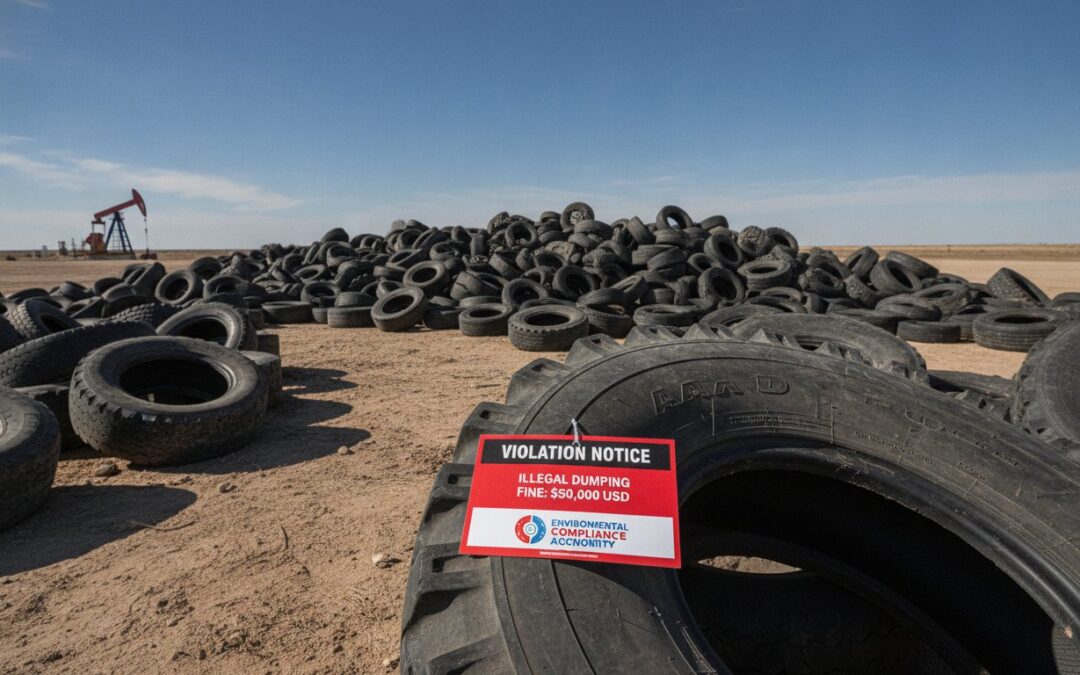
Did you know that starting September 1, 2025, a single unregistered scrap tire could cost your business $500 in fines? For West Texas business owners, the hidden cost of non-compliant tire disposal is a ticking time bomb that far outweighs the price of professional service. You’re already dealing with rising operational costs and complex environmental regulations, so a surprise inspection from the TCEQ is the last thing your bottom line needs.
It’s frustrating to manage waste when you’d rather focus on your fleet or equipment. You’ll understand the heavy financial penalties, legal risks, and hidden liabilities of improper tire disposal for West Texas businesses by the end of this guide. We’ll preview the new Texas laws, explore how civil penalties can reach $25,000 per day, and show you how to protect your business through compliant, professional practices.
Key Takeaways
- Identify the immediate financial risks under the Texas Health and Safety Code, where civil penalties can reach $25,000 per day.
- Understand why the scrap tire manifest is your most important legal defense against the mounting cost of non-compliant tire disposal.
- Uncover hidden liabilities like groundwater remediation and the extreme specialized costs of extinguishing scrap tire fires.
- Evaluate the long-term financial benefits of legal disposal compared to the risk of insurance rate hikes or total policy cancellations.
- Learn how to secure your West Texas business by partnering with a permitted collection service that ensures 100% compliance with state law.
Immediate Financial Penalties for Illegal Tire Dumping in Texas
Texas law doesn’t treat scrap tires like ordinary trash. The Texas Health and Safety Code governs disposal through strict regulations that hold businesses accountable for every piece of rubber they generate. If your West Texas business mishandles these materials, you face a tiered system of penalties designed to deter negligence. The cost of non-compliant tire disposal often begins with an investigation from the Texas Commission on Environmental Quality (TCEQ). They classify violations based on their severity and the risk they pose to public health.
Fines aren’t assigned at random. The TCEQ uses a standardized “Penalty Policy” to calculate the final bill. They evaluate whether the non-compliance was “accidental” or “knowledgeable.” If an inspector determines you intentionally ignored regulations to cut costs, the penalty scales up significantly. They also look at your compliance history. A second violation is always more expensive than the first, and a history of ignoring warnings can lead to the maximum possible fine amounts. Using professional tire recycling channels is the only reliable way to keep these numbers at zero.
TCEQ Administrative Penalties
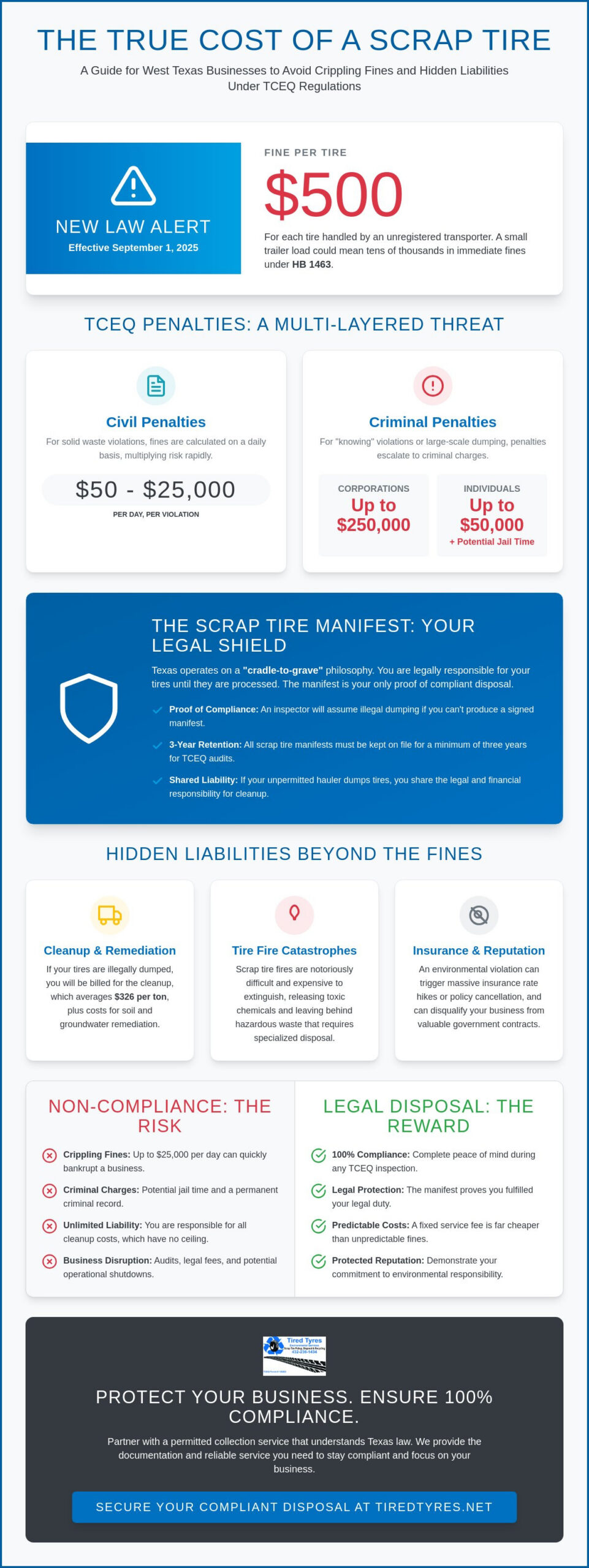
The financial impact of a TCEQ citation is often staggering. Civil penalties for solid waste violations can range from $50 to $25,000 per day, per violation. This “per day” clause is what destroys business budgets. If an inspector finds a non-compliant pile that has been sitting for thirty days, the math works against you quickly. New legislation, specifically HB 1463 effective September 1, 2025, allows counties to impose fines of up to $500 per tire for those who use unregistered transporters. A small trailer load of tires could result in a fine that exceeds the value of the vehicle hauling them.
Criminal Penalties and Jail Time
When illegal dumping crosses specific thresholds, it moves from a civil matter to a criminal one. This typically occurs when large volumes of tires are abandoned or when the dumping is deemed a “knowing” violation of the law. For corporations, criminal penalties can reach $250,000. Individuals aren’t safe either; they can face fines up to $50,000 and potential jail time. Beyond the immediate cash loss, a criminal environmental record is a permanent burden. It can disqualify your business from government contracts, lead to the loss of professional licenses, and make it nearly impossible to secure affordable business insurance in the future.
The Cost of Paperwork: Manifest Violations and Recordkeeping
The cost of non-compliant tire disposal isn’t always tied to a physical pile of rubber. Often, the most expensive mistakes happen in the office. Texas law operates on a “cradle to grave” philosophy. This means you are legally responsible for every tire your business generates until it reaches a permitted processing facility. The only way to prove you’ve met this obligation is through the scrap tire manifest. If you can’t produce a signed manifest during a surprise inspection, the state assumes the tires were disposed of illegally.
TCEQ recordkeeping rules are strict. You must retain every scrap tire manifest for at least three years. During an audit, missing signatures or incomplete dates on these forms lead to automatic fines. These administrative errors are easy for inspectors to spot and difficult for businesses to defend. The scrap tire manifest serves as the primary legal shield for Texas tire generators, proving that waste was transferred to a state-authorized hauler. Without it, you’re exposed to the full weight of state penalties.
Using Unpermitted Haulers
It’s tempting to hire the “guy with a truck” who offers a lower price than professional services. This is a dangerous financial trap. Under Texas law, you share “joint and several liability” with the hauler. If that unpermitted driver dumps your tires in a West Texas field, the state will trace them back to your shop. You’ll be hit with the cleanup costs, which average $326 per ton in North Texas, plus administrative fines. Under Texas House Bill 1463, using an unregistered transporter can trigger fines of up to $500 per tire. Always verify a hauler’s TCEQ registration number before they touch your inventory.
Audit Risks for Midland and Odessa Businesses
In the Permian Basin, TCEQ inspections are frequent due to the high volume of industrial and commercial activity. A single complaint from a neighbor or a visible pile of tires behind your shop can trigger an inspection. Once an inspector arrives, they won’t just look at your yard; they’ll ask for your paperwork. Responding to a Notice of Violation (NOV) costs more than just the fine. It requires billable hours for legal counsel, administrative time to gather records, and potential operational shutdowns. Working with a permitted tire collection service takes the guesswork out of these audits by providing records that meet every state requirement.
Hidden Liabilities: Fire, Health, and Remediation Costs
Financial risk doesn’t stop at state-issued fines. The cost of non-compliant tire disposal often includes massive expenses that business insurance simply won’t cover. Consider the risk of a scrap tire fire. These incidents are chemical events, not standard fires. They require specialized fire-fighting foam and heavy machinery to extinguish. Standard water is often useless against a deep-seated rubber fire; it usually just creates toxic runoff that can seep into West Texas groundwater. You’re legally liable for that runoff and the smoke damage affecting neighboring properties. These civil lawsuits can bankrupt a business long before the TCEQ even arrives.
Property devaluation is another silent killer for West Texas business owners. An environmental lien is a permanent mark on your commercial real estate. If the state of Texas has to step in to clean your property, they will place a lien on the deed to recover every cent. This makes it impossible to sell or refinance the property until the debt is settled. Even after cleanup, the “stigma” of being a former dump site can permanently lower your property’s market value. Your real estate quickly shifts from a valuable asset to a long-term liability.
Environmental Remediation and Cleanup
If your property is flagged for illegal storage, you can’t just throw the tires in a dumpster. You’ll need a formal environmental site assessment. This involves hiring specialized consultants to test soil and water for contamination. Emergency remediation is significantly more expensive than planned disposal. If tires are buried or mixed with dirt, processing facilities often charge heavy surcharges for “dirty” material. In North Texas, clearing an illegal dumpsite averages $805 per site, but industrial-scale remediation can easily reach six figures.
Public Health and Local Ordinances
Local health departments in Lubbock County and city inspectors in Midland and Odessa are aggressive about vector control. Scrap tires are perfect breeding grounds for mosquitoes because they trap stagnant water and provide heat insulation. Local ordinances often allow for daily citations if tires aren’t stored according to specific safety standards. If a vector control unit identifies your lot as a public health nuisance, they can issue fines that accumulate every 24 hours until the site is cleared. These local citations often bypass the lengthy TCEQ process, hitting your bank account almost immediately.
Legal Disposal vs. Non-Compliance: A Financial Comparison
Many businesses in Midland, Odessa, and Lubbock fall into the “Penny Wise, Pound Foolish” trap. They view a small collection fee as an avoidable expense. However, the cost of non-compliant tire disposal isn’t just about the fine. It’s about the total financial impact on your operations. If your business is named in a local news story regarding illegal dumping, your brand reputation takes a hit that marketing dollars can’t fix. Customers in West Texas value integrity. Once you’re associated with environmental negligence, reclaiming that trust is a long and expensive process. Local news outlets in the Permian Basin are quick to cover environmental violations, and that negative press stays online forever.
Insurance premiums also reflect this risk. Insurance providers view non-compliance as a sign of poor management and high liability. A single environmental citation can lead to immediate policy cancellations or massive rate hikes. When you factor in the opportunity cost of losing weeks of productivity while dealing with TCEQ inspectors and legal counsel, the “savings” from illegal disposal disappear. An inspection isn’t a one-hour meeting. It involves document searches, site tours, and lengthy follow-up correspondence. For a small or mid-sized business, this pulls the owner away from revenue-generating tasks for days or even weeks.
The ROI of Professional Tire Collection
Compliant businesses operate with predictable costs. You know exactly what your disposal budget is every month. This contrasts sharply with the unpredictable, catastrophic nature of state fines. Following Texas tire disposal regulations ensures your business is protected during audits. A completed, legal manifest in your files is a tangible asset that provides peace of mind. It’s the only proof that you’ve done your part to protect the local environment. State laws are specifically designed to favor businesses that use permitted channels, often offering lower scrutiny to those with a clean paper trail.
Landfill Fees vs. Professional Pickup
Hauling tires to a landfill yourself seems like a way to save money, but the math rarely works out. You have to account for labor hours, fuel for heavy trucks, and landfill tipping fees. Many local landfills in West Texas have strict limits on bulk tire intake. They may refuse large loads or charge premium rates for non-compacted tires. The efficiency of scheduled commercial tire disposal removes these logistics from your plate. It’s a more efficient use of your team’s time and your company’s equipment. If you want to trade these legal risks for a professional solution, contact a permitted tire collection expert today to secure your operations.
Protecting Your Business with Permitted Collection Services
Managing scrap rubber doesn’t have to be a source of stress or a legal liability. When you partner with Tired Tyres, you’re choosing a team that understands the specific demands of the Permian Basin. We ensure 100% compliance with Texas state law, taking the regulatory burden off your shoulders. The cost of non-compliant tire disposal is simply too high when compared to the peace of mind that comes with professional, permitted service. We operate with a transparent, efficient process designed to keep your shop or job site clean and your records audit-ready.
Our manifest process is the core of our compliance promise. It begins the moment we arrive for a pickup in Midland, Odessa, or Lubbock. We generate the required TCEQ documentation on-site, ensuring every tire is accounted for before it leaves your property. This “cradle to grave” tracking follows the load through transportation to final processing. You receive a copy of the completed manifest for your permanent files, serving as your primary defense against future state inspections. We handle the heavy lifting and the paperwork so you can focus on your daily operations.
West Texas industrial sites often deal with more than just standard passenger tires. We provide specialized equipment to handle heavy OTR (Off-the-Road) tires, agricultural tires, and large semi-truck tire collections. These oversized items require specific hauling capabilities that standard “guys with a truck” can’t provide. By using a permitted fleet, you ensure that even your largest scrap items are managed according to environmental standards.
Comprehensive Rubber Waste Solutions
Industrial operations frequently generate a variety of rubber waste beyond just tires. Our services extend to handling conveyor belts and industrial rubber waste, including scrap skid steer tracks and hoses. We offer customized pickup schedules for auto shops, regional farms, and large-scale industrial sites. Local businesses trust our permitted fleet because we are reliable and punctual. Whether you have a one-time pile or need a recurring collection plan, we adapt to your specific volume and frequency needs.
Get Started with a Legal Disposal Plan
Moving from a non-compliant pile to a clean, documented lot is straightforward. First, we’ll assess your current inventory and provide a clear, predictable quote for collection. Once scheduled, our team arrives, loads the materials, and provides the necessary legal documentation immediately. Don’t wait for a TCEQ notice or a local health department citation to take action. Proactive management is the most cost-effective way to run your business in Texas. Contact Tired Tyres for a compliant scrap tire pickup quote to secure your business today.
Securing Your West Texas Business Against Disposal Risks
The financial math for West Texas businesses is clear. Between TCEQ fines that can hit $25,000 daily and the operational nightmare of an environmental audit, cutting corners isn’t worth the gamble. You’ve seen how manifest documentation acts as your primary legal shield and how professional collection prevents hidden liabilities like fire hazards and property liens. The true cost of non-compliant tire disposal includes lost time, damaged reputations, and catastrophic legal fees that far outweigh the price of a permitted pickup service.
Managing your scrap inventory shouldn’t be a source of constant worry. As a TCEQ Permitted Hauler serving Midland, Odessa, and Lubbock, we ensure your business remains 100% compliant with state law. We provide full manifest documentation for every load, giving you the records needed to pass any inspection with confidence. You can trade the risk of surprise fines for a predictable, professional solution that protects your property and your bottom line. Let us handle the rubber so you can focus on your fleet and customers. It’s time to move forward with a partner who understands the local regulatory landscape.
Secure Your Business with a Permitted Tire Pickup Quote
Frequently Asked Questions
What is the maximum fine for illegal tire dumping in Texas?
The Texas Commission on Environmental Quality (TCEQ) can assess civil penalties ranging from $50 to $25,000 per day, per violation. For criminal cases, corporations face fines up to $250,000, while individuals can be fined up to $50,000 and face potential jail time. These high stakes illustrate the true cost of non-compliant tire disposal for businesses that ignore state mandates.
Do I really need a manifest if I only have 10 scrap tires?
Yes, the manifest system is mandatory for all commercial scrap tire transactions regardless of the quantity. Texas law requires generators to document the transfer of waste to a registered hauler to maintain a clear chain of custody. If an inspector audits your shop and you can’t produce a signed manifest for those 10 tires, you’re liable for an administrative violation.
Can I be held responsible if my hired hauler dumps tires illegally?
You remain legally responsible for your tires until they reach a permitted processing facility. Under the principle of “joint and several liability,” the state can hold the original generator accountable for cleanup costs and fines if the hauler dumps the load illegally. This “cradle to grave” responsibility makes it vital to verify your transporter’s TCEQ registration before any tires leave your lot.
Are there specific tire storage rules for businesses in Midland and Odessa?
Midland and Odessa have local ordinances that focus heavily on vector control and fire safety. Tires must be stored in a manner that prevents the accumulation of stagnant water, which serves as a breeding ground for mosquitoes. Some local rules also require tires to be stored in secure, designated areas to minimize fire risks and ensure they don’t become a public nuisance.
What happens if a fire starts in my scrap tire pile?
A scrap tire fire creates an immediate environmental crisis with massive financial liabilities. You’ll be responsible for the cost of specialized firefighting foam, heavy equipment, and the remediation of toxic runoff into the soil or groundwater. The state often places an environmental lien on the property to recover these emergency cleanup expenses, which can easily reach six figures.
How do I verify if a tire hauler is properly permitted by the TCEQ?
You should ask the hauler to provide their TCEQ registration number before signing any contracts. Legitimate transporters will have this number on their manifest paperwork and often on their vehicles. You can also use the TCEQ Central Registry database to search for the company name and confirm their permit is active and has no history of major violations.
Does the city of Lubbock allow tires in the regular commercial trash?
No, tires are strictly prohibited from regular commercial trash containers in Lubbock. Landfills don’t accept whole tires because they don’t compact well and tend to “float” to the surface of waste cells over time. You must dispose of tires through a permitted scrap tire hauler or a designated recycling facility that is equipped to process rubber waste.
Is there a difference in fines for passenger tires vs. large OTR tires?
While the daily TCEQ civil penalties are the same, the total financial impact of non-compliance is much higher for OTR tires. Larger tires carry significantly higher transportation and processing surcharges if the state has to manage a cleanup. Furthermore, under HB 1463, the per-tire fines of up to $500 apply regardless of size, making large OTR tire violations exceptionally expensive.