
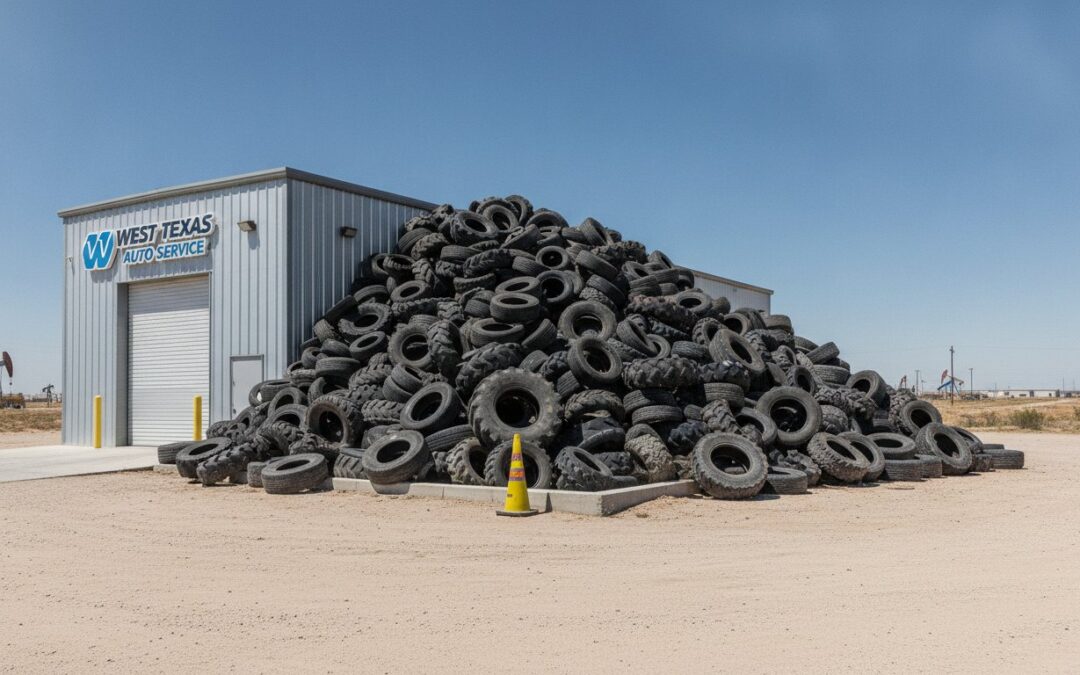
Your tire pile isn’t just taking up space; it’s a massive liability waiting to happen if your hauler isn’t following the rules. If you’ve noticed missed pickups or sudden price hikes, you’re likely asking yourself why my current tire disposal service is failing and whether you’re at risk for a TCEQ fine. It’s a common frustration for shop owners who just want a clean site and a partner who does what they say they’ll do.
We understand that you need reliability and transparency, not excuses. In this guide, we’ll identify the hidden risks of poor tire hauling and show you how to secure a dependable, compliant disposal partner in West Texas. We’ll preview five critical red flags, from lack of proper manifests to illegal dumping risks, and give you the tools to ensure your shop stays professional and protected. By the end, you’ll know exactly how to transition to a service that offers predictable schedules and the proper documentation you need for every load.
Key Takeaways
- Recognize the operational red flags that explain why my current tire disposal service is failing, including missed schedules and dangerous on-site stockpiling.
- Protect your business from “cradle-to-grave” liability by understanding why you remain legally responsible for tires until they reach a certified recycling facility.
- Learn how to verify a partner’s TCEQ Hauler Registration and processing capacity to avoid the legal risks of illegal dumping.
- Identify the specialized equipment requirements needed to safely handle heavy loads like OTR, agricultural, and semi-truck tire collections.
Signs Your Scrap Tire Disposal Service is Failing
A failing tire disposal service often starts with small delays before escalating into a major liability. You might notice your shop’s back lot becoming an eyesore or, worse, a fire hazard. Identifying why my current tire disposal service is failing requires looking past simple excuses like “the truck is down” and recognizing systemic issues in your hauler’s operations. When a partner stops prioritizing your site, the risks shift entirely onto your shoulders.
Watch for these specific warning signs to protect your business:
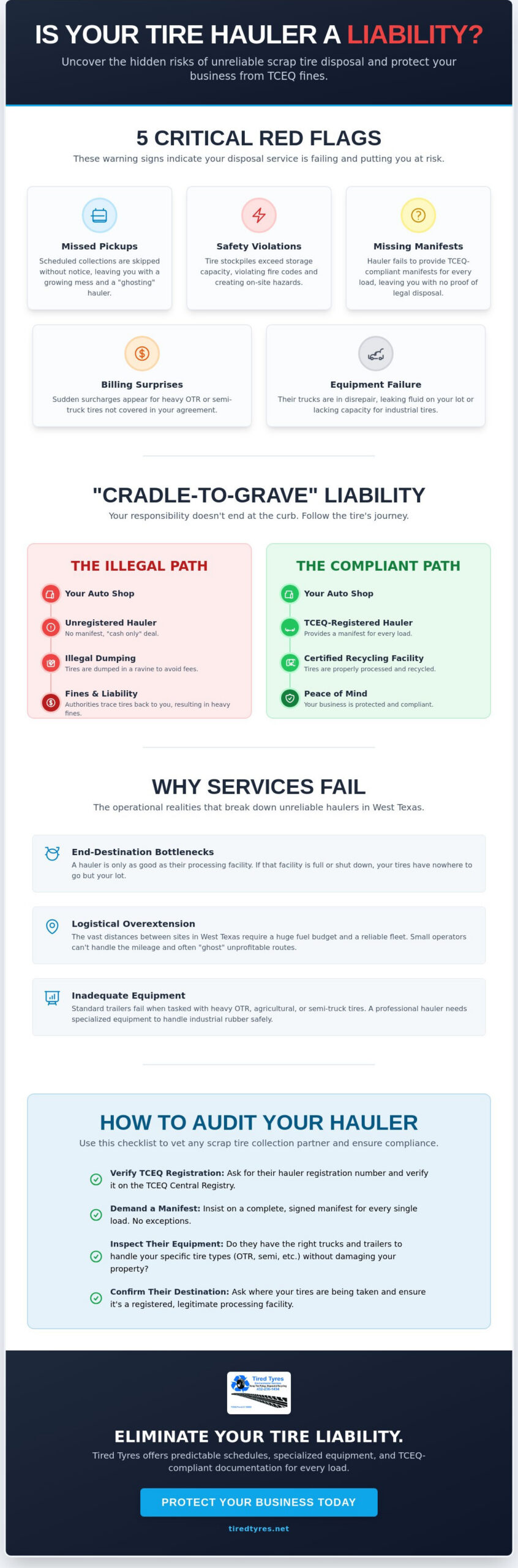
- Missed Pickups: Scheduled collections pass without a call or email, leaving you with a growing mess.
- Safety Violations: Stockpiles grow until they exceed your storage capacity or violate local fire codes.
- Missing Manifests: The hauler fails to provide a TCEQ-compliant tire manifest for every load taken.
- Billing Surprises: You receive sudden surcharges for semi-truck or OTR tires that weren’t in your original agreement.
- Equipment Failure: The hauler’s trucks leak hydraulic fluid on your pavement or damage your lot during loading.
The “Ghosting” Phenomenon in West Texas Hauling
In West Texas, the vast distances between service sites make fuel costs a significant factor for haulers. Many small-time operators work on razor-thin margins. When diesel prices spike, these haulers often “ghost” their clients because the trip is no longer profitable for them. This isn’t just an inconvenience; it ruins your shop’s curb appeal and attracts pests. You should document every missed pickup with photos and dates. This log protects you if the TCEQ questions why your site exceeds legal storage limits because your hauler failed to show up.
Documentation Gaps: The Red Flag You Can’t Ignore
Under Texas law, you’re responsible for your scrap tires until they’re properly processed. This “cradle-to-grave” liability means that if a hauler dumps your tires in a ravine, the authorities can trace them back to your shop. A professional hauler always provides a multi-part manifest. This document tracks the Tire recycling process from your door to the final destination facility.
If a hauler insists on “cash only” or refuses to sign a manifest, they’re likely not registered with the TCEQ. This is a massive red flag. A professional disposal receipt must include the hauler’s registration number, the date, the exact count of tires, and the destination facility. Without this, you have no proof of compliance. Understanding why my current tire disposal service is failing often comes down to these missing pieces of paper that stand between you and a heavy fine. Don’t let a hauler’s lack of professionalism become your legal nightmare.
The Hidden Reasons Behind Disposal Service Breakdowns
While visible issues like growing stockpiles are easy to spot, the root causes of service failure often lie deep within a hauler’s business model. If you’re analyzing why my current tire disposal service is failing, you have to look at the logistical realities of West Texas. The Permian Basin presents unique challenges that many small-scale operators simply aren’t equipped to handle. From the massive distances between sites to the sheer weight of industrial rubber, a lack of operational maturity leads directly to the service gaps you’re experiencing.
Most breakdowns happen for three specific reasons:
- End-Destination Bottlenecks: A hauler is only as good as the facility where they drop the tires. If their partner facility reaches capacity or shuts down, your tires stay on your lot.
- Logistical Overextension: Driving between Midland, Odessa, and remote oil field sites requires a massive fuel budget and a fleet that can handle high mileage.
- The Broker Problem: Some services are actually “middlemen” who don’t own trucks. They hire third-party drivers who may lack the commitment or the specific training to service your site reliably.
Permit Issues: Are They Actually Legal?
There’s a significant difference between a “guy with a trailer” and a permitted tire hauler. In 2026, the TCEQ has increased its focus on scrap tire management, making it harder for unpermitted haulers to operate legally. You can verify a hauler’s registration status through the TCEQ’s Central Registry. Hiring an unpermitted hauler in Midland or Odessa is a gamble. If they can’t get into a registered processing site, they might dump your tires illegally, leaving you with the legal and financial fallout. A professional partner should always be able to produce their current registration number on demand.
Equipment and Capacity Limitations
Standard trailers are designed for light passenger tires. They often fail when tasked with industrial rubber waste disposal, such as agricultural or OTR tire collection. Heavy-duty tires require specialized loading equipment and reinforced decks to prevent trailer floor collapse. If your hauler shows up with inadequate gear, they’ll likely leave the heaviest, most difficult tires behind. This leads to a “cherry-picking” situation where you’re left with the most problematic waste. A dedicated fleet for industrial rubber ensures that every tire, regardless of size, is moved on schedule. If your service provider lacks the right tools for your specific inventory, it’s a clear sign their business model isn’t built for your needs.
The Legal and Environmental Risks of Unreliable Haulers
Many shop owners view tire hauling as a simple task of removing clutter. However, when you look at why my current tire disposal service is failing, you have to consider the massive legal shadow it casts over your business. In Texas, you’re not just paying for a pickup. You’re paying for the transfer of legal risk. If your hauler isn’t registered or cuts corners, that risk never actually leaves your property. This exposure can lead to consequences that far outweigh the cost of a professional service.
Texas law operates on a “cradle-to-grave” principle. This means you, the generator, are legally responsible for every tire until it reaches a permitted recycling or disposal facility. If a cut-rate hauler dumps your tires in a West Texas field, the TCEQ will trace them back to you. The fines aren’t just a minor inconvenience. Improper storage or illegal disposal can lead to significant daily penalties that threaten your shop’s survival. Beyond the courtroom, failing services create physical dangers that are just as serious.
Scrap tire fires are a constant threat for those with unmanaged stockpiles. These fires are notoriously difficult to extinguish. They burn at extreme temperatures and release toxic oil and smoke into the air and soil. A fire on your property could lead to a complete loss of assets and permanent soil contamination. Understanding why my current tire disposal service is failing requires a look at these physical health risks alongside the legal ones. Pests and environmental degradation follow closely behind every missed pickup.
Understanding Your Liability as a Tire Generator
When a hauler fails to show up, your inventory grows. This accumulation isn’t just unsightly; it’s a compliance trap. Following Texas tire disposal regulations is the only way to shield your business from state enforcement. Proper documentation, specifically the multi-part manifest, is your proof of compliance. It acts as your primary defense by proving you handed the waste to a registered professional. Without that paper trail, you have no way to prove you didn’t dump the tires yourself.
Environmental and Community Impact
In West Texas, stagnant water trapped in tire casings is the primary breeding ground for mosquitoes during the summer months. These small pools are protected from the wind and sun, making them perfect incubators for pests. Additionally, these piles become homes for rodents and snakes, creating a hazardous environment for your employees. Over time, tire piles can leach chemicals into the ground, affecting property values and local water sources. Understanding waste tire problems in cities like Midland, Odessa, and Lubbock is vital for any business owner who cares about their community standing. A clean, compliant site maintains your property’s value and ensures you remain a good neighbor.
How to Audit and Vet a Scrap Tire Collection Partner
Identifying why my current tire disposal service is failing is the first step toward a cleaner, safer shop. The second step is building a vetting process that prevents you from hiring another unreliable hauler. In West Texas, where distances are long and industrial demands are high, you can’t afford to take a hauler’s word at face value. You need a partner who views compliance as a core part of their business, not an afterthought.
- Step 1: Verify Registration. Request their TCEQ Hauler Registration number. Don’t just look at the paper; verify the number on the TCEQ Central Registry to ensure it’s active and matches their business name.
- Step 2: Inspect the Fleet. Assess their equipment against your specific inventory. A hauler using a light-duty utility trailer isn’t equipped for OTR or agricultural tire collections.
- Step 3: Confirm Service Areas. Ensure they have a dedicated route that consistently covers Midland, Odessa, and Lubbock. If you’re an “outlier” on their map, you’ll be the first pickup they cancel.
- Step 4: Review the Paperwork. Ask to see a sample manifest. It should be a professional, multi-part document that clearly identifies the generator, the hauler, and the permitted end-destination.
- Step 5: Check Local References. Ask for two or three references from other West Texas businesses. A reliable hauler will have long-standing relationships with local tire shops or industrial sites.
The Logistics Audit: Can They Handle Your Volume?
Vetting isn’t just about legal status. It’s about operational capacity. Ask prospective partners about their pickup frequency and the total size of their fleet. You need to know they have enough trucks to stay on schedule even if one vehicle goes into the shop. They must demonstrate a clear ability to manage commercial tire disposal for high-volume operations without letting stockpiles sit for weeks. In the Permian Basin, a local presence is vital. Local haulers have a shorter response time and a better understanding of the unique logistical hurdles in our region.
The Compliance Audit: Protecting Your Bottom Line
A professional partner protects your business from on-site and off-site liabilities. Verify that they carry comprehensive insurance that covers pickups and loading on your property. This prevents a simple accident from turning into a costly lawsuit for your shop. You should also ensure they provide a “closed-loop” solution where tires are tracked all the way to a legitimate facility. You can often spot a high-quality tire recycling operation by the cleanliness of their equipment and the precision of their record-keeping. If you’re ready for a partner that respects your schedule and your legal safety, contact Tired Tyres for a site evaluation today.
Reliable Tire Disposal Solutions with Tired Tyres
Once you understand why my current tire disposal service is failing, the next step is finding a partner that treats your compliance as their own. Tired Tyres provides a professional, local alternative to the unreliable haulers that often plague West Texas. We’ve designed our operations to handle the high volume and heavy-duty requirements of the Permian Basin. Our team doesn’t just clear away clutter; we provide a secure, documented path for every piece of rubber that leaves your site.
We offer specialized collection services for a wide range of rubber waste, including:
- Passenger & Light Truck Tire Collection: Efficient routes for retail shops and automotive centers.
- Semi-Truck Tire Collection: Dedicated equipment to handle the weight and volume of commercial fleets.
- Agricultural Tire Collection: Large-scale removals for farming and ranching operations.
- OTR (Off-the-Road) Tire Collection: Specialized handling for the massive tires used in mining and heavy construction.
By maintaining a diverse fleet, we ensure that no tire is too large or too heavy for our team to move. This capability is often the primary reason businesses realize why my current tire disposal service is failing, as smaller haulers frequently leave difficult OTR or agricultural tires behind. We take the entire load, every time.
Beyond Just Tires: Industrial Rubber Disposal
Many industrial sites in West Texas struggle with rubber waste that isn’t shaped like a tire. We’ve expanded our services to include the collection of scrap skid steer tracks, industrial hoses, and scrap conveyor belts. These items are often rejected by municipal programs or standard haulers because they require specialized loading and processing. We provide a single-partner solution for all these waste streams, which simplifies your logistics and reduces the number of vendors on your lot. This comprehensive approach is why we’re the preferred choice for tire disposal in Midland, TX and the surrounding areas.
The Tired Tyres Commitment to West Texas
We operate with a “no-pile” guarantee, meaning we work with you to establish a pickup frequency that keeps your site clean and compliant with TCEQ limits. Our team handles the heavy lifting of documentation by providing accurate, multi-part manifests for every load. In light of the March 2026 EPA proposal to reclassify scrap tires as a non-waste fuel, professional handling is more important than ever to ensure your waste ends up at a legitimate processing facility. We take the guesswork out of compliance so you can focus on your business. Contact us today for a reliable tire disposal quote and experience the difference of a professional, West Texas-based partner.
Secure Your Compliance with Professional Disposal
Your business deserves a partner that values your property and your legal safety as much as you do. By recognizing the specific operational red flags of unreliable haulers, from missing manifests to inadequate loading equipment, you can protect your shop from the physical risks of fires and the financial hit of state fines. It’s clear that understanding why my current tire disposal service is failing is the first step toward reclaiming your site. A clean shop isn’t just about appearances; it’s about shifting liability away from your doorstep.
Tired Tyres is ready to provide the reliability you need. As a TCEQ Registered Hauler serving Midland, Odessa, and Lubbock, we bring specialized OTR and industrial equipment to every collection. We ensure your documentation is flawless and your site stays clear of hazardous rubber waste. You don’t have to manage the stress of missed pickups or compliance gaps any longer.
Request a Reliable Tire Pickup Quote for Your West Texas Business today. We’re committed to helping you maintain a professional and compliant operation for years to come.
Frequently Asked Questions
Is my business liable if my tire hauler dumps tires illegally?
Yes, you remain legally responsible for your scrap tires until they reach a permitted processing facility. This “cradle-to-grave” liability means the state can fine the original generator even if a third-party hauler committed the dumping. Proper documentation, specifically a signed TCEQ manifest, is your only defense against these penalties and potential legal action.
How often should a commercial auto shop have tires picked up?
Most high-volume shops require weekly or bi-weekly pickups to stay within TCEQ storage limits and maintain a safe workspace. Allowing tires to sit for longer increases fire risks and pest issues on your lot. If you’re wondering why my current tire disposal service is failing, it often starts with a schedule that doesn’t match your actual generation rate.
What is a TCEQ tire manifest and why do I need one?
A TCEQ manifest is a multi-part tracking document that records the movement of scrap tires from your site to a registered recycler. You need this document to prove you’ve complied with Texas environmental laws during an audit. Without a signed copy for every load, you have no legal shield if an inspector questions your disposal history.
Can I take commercial scrap tires to the Midland or Odessa landfill?
Most municipal landfills in West Texas have strict restrictions or outright bans on whole scrap tires. Even those that accept them often charge high gate fees and require tires to be split or quartered before arrival. Working with a registered hauler is typically more efficient and ensures your tires are recycled rather than buried in a landfill.
What types of industrial rubber besides tires can be recycled?
Professional recyclers can handle scrap skid steer tracks, industrial hoses, and conveyor belts in addition to standard tires. Many oilfield and construction sites generate these heavy-duty rubber waste streams regularly. Consolidating these items with your tire pickups helps keep your site clean and simplifies your waste management logistics with a single partner.
How much does professional tire disposal cost in West Texas?
Costs vary based on the volume of tires, the specific tire types, and your location within the Permian Basin. Generally, larger industrial tires like OTR or agricultural tires require higher fees due to the specialized equipment needed for transport and processing. Requesting a custom quote is the best way to get accurate pricing for your specific shop needs.
What happens if I accumulate too many tires on my property?
Excess accumulation can lead to heavy daily fines from the TCEQ and local fire marshals. Large piles also create significant health hazards by providing breeding grounds for mosquitoes and rodents in West Texas. If your hauler keeps missing dates, this buildup is a clear sign of why my current tire disposal service is failing and needs to be replaced.
Why do some tire disposal services only take passenger tires?
Many haulers use light-duty trailers and lack the heavy-duty loading equipment required for semi-truck or OTR tires. Handling industrial rubber waste requires specialized hydraulic lifts and reinforced vehicles to prevent equipment failure. If your current provider is cherry-picking only the light tires, they likely lack the operational capacity to service a full-scale commercial or industrial site.