
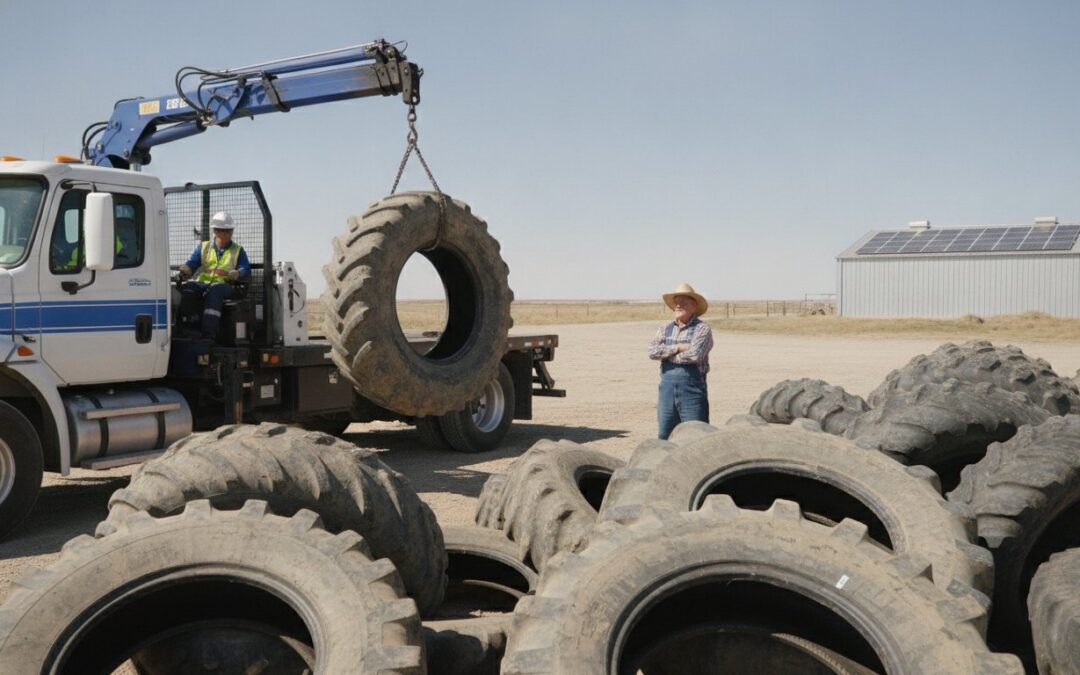
Stacking scrap tractor tires behind the barn isn’t just an eyesore; it’s a liability that could cost you thousands in TCEQ fines. You’ve likely watched those massive 900/60R32s take up more acreage every season, knowing that hauling them yourself to a landfill that might reject them isn’t a viable option. It’s frustrating to manage heavy rubber waste when you’re trying to run a productive farm in the Permian Basin or South Plains. We understand that your priority is a clean, functional property, and that professional agricultural tire collection is the only way to handle these heavy OTR loads safely.
This guide shows you how to clear your land efficiently while staying on the right side of 2026 environmental regulations. You’ll learn how to avoid the common pitfalls of stockpiling, such as mosquito hazards and fire risks, by using a service that provides the legal manifest documentation you need. We’ll cover the latest Texas storage thresholds, which currently require registration for more than 500 tires on the ground. We also preview how to handle bulk removal without disrupting your daily operations in Midland, Odessa, or Lubbock. By the end of this article, you’ll have a clear path to a compliant and clutter-free farm.
Key Takeaways
- Learn why West Texas landfills often reject whole tractor tires and how specialized disposal handles these oversized loads.
- Understand the 2026 TCEQ 500-tire rule to ensure your farm stockpile doesn’t become a legal liability or an environmental hazard.
- Discover how professional agricultural tire collection clears valuable acreage and eliminates fire and pest risks on your property.
- Get practical tips on consolidating your scrap rubber to ensure a fast, efficient pickup that won’t disrupt your daily operations.
- Secure the necessary manifest documentation to prove legal disposal and protect your business from future environmental fines.
The Challenge of Agricultural Tire Disposal in West Texas
Agricultural tire collection involves the specialized removal of oversized rubber from tractors, combines, and various implements. In West Texas, these items often become “invisible” waste. They sit in the corner of a field or behind a shop because they don’t fit into standard disposal workflows. Municipal recycling programs in cities like Lubbock or Midland are designed for passenger vehicles. They simply aren’t equipped to handle a tire that weighs more than the person trying to move it. This leads to growing stockpiles that farmers eventually stop noticing until they become a legal or safety problem.
Moving a single rear tractor tire often requires machinery capable of lifting over 500 pounds safely. Without the right trailers and loaders, these tires stay where they fall. This creates a significant environmental burden. Stagnant water inside a tire casing is a perfect breeding ground for mosquitoes, which is a major concern for West Texas health standards. In the heat of the Permian Basin, these piles also represent a massive fire hazard. The challenge of tire disposal is compounded by the fact that these tires are built to be indestructible. They are a permanent fixture on your land unless professional agricultural tire collection occurs.
Common Types of Scrap Farm Tires
Texas farms generate a wide variety of rubber waste. R-1 (bar lug) tractor tires are the most frequent sight in scrap piles. While these were the industry standard for decades, modern high-horsepower radial tires present a newer challenge. Tires for 400hp tractors are wider and heavier, requiring even more specialized handling during the agricultural tire collection process. Combine harvester drive and steering tires are perhaps the most difficult. These are often the largest pieces of rubber on any farm. Their sheer volume makes them impossible to transport without heavy-duty commercial equipment.
Why Landfills Often Reject Agricultural Rubber
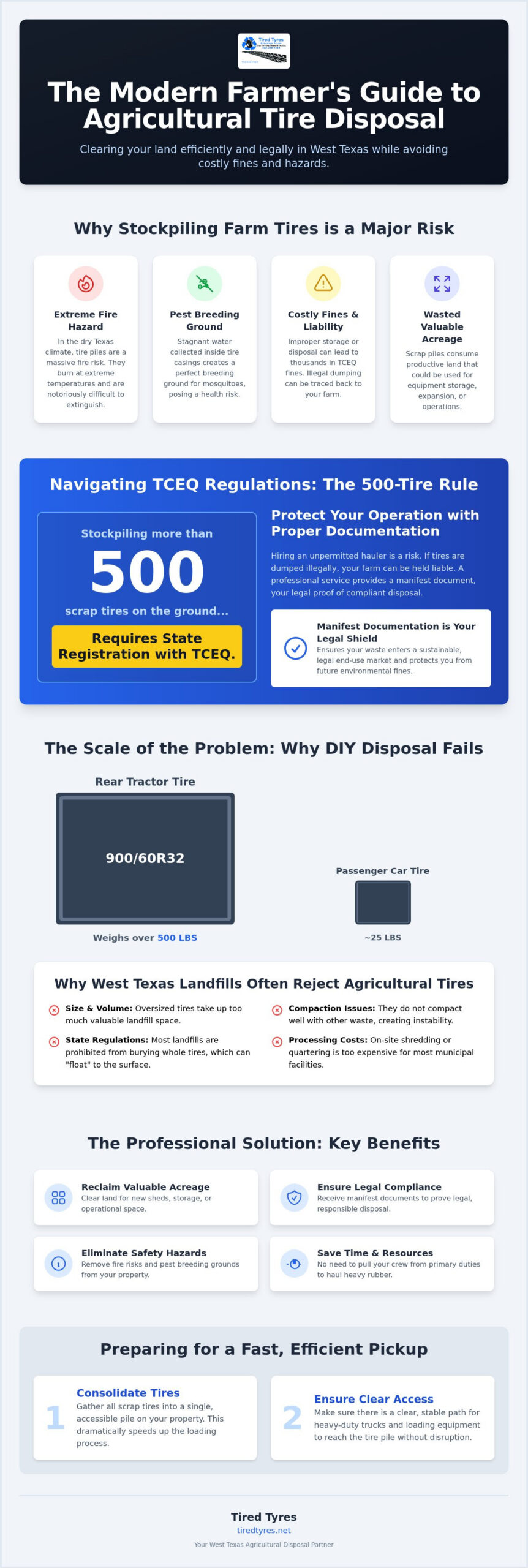
Local facilities in Midland and Odessa frequently turn away agricultural loads. The primary reason is size and volume. Municipal cells are optimized for household waste and small tires. Agricultural rubber takes up too much space and doesn’t compact well. Texas state regulations also play a role. Most landfills are prohibited from burying whole tires because they tend to “float” back to the surface over time, damaging the landfill cap. Processing requirements, such as shredding or quartering, are often too expensive or labor-intensive for local sites to handle. This leads to outright rejections for farmers who try to haul their own waste.
Why Professional Collection is Essential for Farm Operations
Managing a large-scale farm in the Permian Basin requires every square foot of land to serve a purpose. When scrap rubber piles up, it does more than just take up space. It creates a physical barrier to expansion. Professional agricultural tire collection allows you to reclaim that acreage for new equipment sheds, grain storage, or improved turn-around areas for your fleet. Clearing this debris is a direct investment in your property’s operational efficiency and long-term value.
Liability is a major factor for modern agricultural businesses. If you hire an unpermitted hauler and those tires are later found in a ravine or an illegal dump site, the TCEQ can trace them back to your farm. Professional services provide the necessary manifest documentation. This paperwork acts as your legal shield, proving that the waste was handled by a registered transporter and delivered to a legitimate facility. Ensuring your rubber waste enters sustainable and circular end-use markets is the only way to guarantee you won’t face future environmental litigation.
The “rural distance” challenge is real for farms near Lubbock or Odessa. Most processing plants are located far from the fields. Hauling heavy OTR tires yourself is expensive when you calculate fuel, labor, and the risk of damaging your own trailers. We bridge this gap by bringing specialized loading equipment directly to your site. If you’re looking to streamline your cleanup, scheduling a professional agricultural tire collection ensures the job is done without pulling your crew away from their primary duties.
Safety Risks of On-Farm Tire Piles
Fire hazards are a primary concern in the dry West Texas climate. Tire fires are notoriously difficult to extinguish; they burn at extreme temperatures and can smolder for weeks. Local rural fire departments often lack the specialized equipment to handle a large rubber blaze. Beyond fire, these piles harbor pests. In the South Plains, old tires are the leading cause of localized mosquito outbreaks, which can carry West Nile virus or other illnesses that threaten your family and your livestock.
Beyond Tires: Handling Other Farm Rubber Waste
Modern farms generate more than just scrap tires. Many operations now rely on skid steers for daily tasks, leading to a steady supply of scrap skid steer tracks. These tracks are difficult to cut and even harder to dispose of at local landfills. We provide a comprehensive solution by collecting these tracks alongside other industrial rubber, such as scrap hoses and conveyor belts. Consolidating all your rubber waste into a single professional pickup is the most efficient way to keep your shop and yard clean.
Texas Scrap Tire Regulations and TCEQ Compliance
In Texas, the Texas Commission on Environmental Quality (TCEQ) sets the rules for how scrap rubber is managed. These aren’t just suggestions. They are strict requirements under Title 30 of the Texas Administrative Code. As of the February 18, 2026 update to state regulations, the oversight on rural waste has become even more rigorous. For agricultural operations in the South Plains, understanding these boundaries is essential to avoid heavy fines that can disrupt your bottom line.
One of the most critical figures for any farm or ranch is the 500-tire storage threshold. If you have more than 500 scrap tires stored on the ground, you’re legally classified as a scrap tire storage site. This status requires formal TCEQ registration and annual operational status reports submitted through the STEERS system. Failing to register while exceeding this limit exposes your business to significant environmental penalties. Even if you stay below this number, the state requires that tires be managed to prevent pests and fire hazards. Professional agricultural tire collection ensures you never cross into high-risk regulatory territory.
To stay protected, you must work with a permitted tire hauler in Texas. These transporters are registered with the state and are the only ones authorized to provide the necessary compliance paperwork. Without a registered hauler, you have no legal proof that your waste was disposed of correctly.
Understanding the Scrap Tire Manifest System
The manifest is a multi-part document that tracks tires from the moment they leave your property until they reach a registered processing facility. It’s your proof of legal disposal. Texas law requires generators to keep a copy of every manifest for at least three years. If an inspector visits your farm in Lubbock, these papers are your defense. Tired Tyres manages this entire process for you. We provide the completed documentation that shows the exact chain of custody, ensuring your business stays fully compliant with state law.
Avoiding Illegal Dumping Fines in West Texas
Local enforcement in Midland and Lubbock counties has increased significantly. With the implementation of SB910, more resources are now directed toward identifying and cleaning up illegal dump sites. This makes “handshake” deals with unpermitted haulers extremely dangerous. If a hauler offers “free” disposal, they often dump the rubber in a remote pasture or bar ditch. Because tires can often be traced back to the original owner, you remain liable for cleanup costs and resulting fines. Professional agricultural tire collection is a necessary step to protect your business from the legal fallout of a dumping investigation.
Preparing for Bulk Agricultural Tire Pickup
Preparing for a professional pickup saves time and keeps your farm running without interruption. Unlike small passenger tires, 600 pound tractor tires can’t be tossed into a trailer by hand. They require mechanical loading and a clear plan. For those in need of high-performance machinery to assist with heavy-duty property maintenance, Ayr Tracked Plant & Equipment Hire provides a range of specialized tracked plant that can tackle even the most difficult agricultural terrain. Start by consolidating your scrap into a central location on your property. This staging area should be situated away from low lying spots that turn to mud after a South Plains thunderstorm. A firm, hard packed surface is non negotiable for the heavy loading equipment used during agricultural tire collection.
Next, separate your rubber from other debris. Scrap metal rims, industrial trash, and old wood shouldn’t be mixed with the tire pile. Processing plants have strict intake rules, and contaminated piles often lead to delays. Keeping the rubber clean and accessible ensures the crew can work quickly. Finally, take a quick inventory of what you have. Knowing the split between tractor, implement, and standard truck tires helps us provide an accurate quote and send the right trailer for the job. Once your pile is ready, schedule your reliable tire disposal with a team that understands West Texas logistics.
Access Requirements for Collection Vehicles
Heavy duty trucks need significant space to maneuver safely. Most collection trailers require at least 14 feet of overhead clearance and wide gates to enter your staging area. Ground stability is the most important factor. If your property has deep sand or soft soil, it’s best to coordinate pickups during the dry season. Stuck equipment is a major setback. Ensure the path from the main road to your tire pile can support the weight of a fully loaded semi truck.
Inventorying Your Scrap Rubber
Not all rubber waste is processed the same way. You need to distinguish between passenger, semi, and OTR tires for an accurate quote. OTR tires, like those from a massive combine harvester, are far heavier and require different equipment than a standard truck tire. You should also identify solid rubber tires versus pneumatic versions. Solid tires are significantly heavier and have different disposal requirements. Always note if tires are still on the rim. For a professional quote and efficient removal, contact Tired Tyres today.
Tired Tyres: Your West Texas Agricultural Disposal Partner
Tired Tyres operates with a specific mission: to provide the most reliable commercial tire disposal for the agricultural sector in West Texas. We understand that farmers in Midland, Odessa, and Lubbock face unique waste management hurdles that city residents never encounter. Our agricultural tire collection service is designed to remove the burden of heavy, oversized rubber from your daily operations. We don’t just haul tires; we provide a complete compliance solution that prioritizes environmental stewardship and legal security for your business.
While municipal landfills often reject whole tires, we specialize in the “tough stuff” that others turn away. Our fleet is equipped to handle massive OTR tires from combines and tractors, as well as scrap skid steer tracks and industrial rubber. We manage the removal of scrap hoses, conveyor belts, and solid tires that often accumulate in shop corners. By choosing a partner dedicated to 100% legal disposal, you ensure that every pound of rubber is processed at a registered facility. This protects the local South Plains environment for future generations and ensures your farm stays in compliance with the latest state mandates.
Local Expertise in the Permian Basin
Being a local West Texas business isn’t just a label; it’s a logistical advantage. We’re familiar with the backroads of Lubbock County and the ranching corridors of the Permian Basin. We know that rural pickups require a different level of coordination, from understanding gate clearances to navigating seasonal ground conditions. Our team speaks the language of local agriculture because we live and work in the same communities. Supporting Tired Tyres means keeping your investment within the local economy while ensuring your land remains clean and productive. We take pride in helping our neighbors maintain professional, hazard-free properties.
Ready to Clear Your Land?
The process for reclaiming your acreage is straightforward. When you contact us, we’ll walk through your inventory to determine the best equipment for the job. Professional collection is the most cost-effective long-term solution because it eliminates the risk of TCEQ fines and the high cost of self-hauling. You won’t have to worry about your crew’s safety or damaging your own trailers with 500lb loads. We handle the heavy lifting, the loading, and the legal documentation. Contact Tired Tyres today to schedule your agricultural tire collection and take the first step toward a compliant, clutter-free farm.
Reclaim Your Land and Protect Your Operation
Reclaiming your property from oversized scrap rubber is more than just a cleanup project; it’s a strategic move for your farm’s safety and legal standing. By choosing professional agricultural tire collection, you eliminate the daily risks of mosquito-borne illnesses and the severe threat of uncontrollable tire fires. You also ensure that your operation stays within the TCEQ’s 500-tire storage threshold, avoiding the heavy penalties associated with unrecorded stockpiles. Keeping your land clear allows you to focus on production rather than managing a growing liability.
Tired Tyres has served Midland, Odessa, and Lubbock since our inception with a commitment to straightforward, professional service. We provide a TCEQ-compliant manifest with every pickup, giving you the permanent legal documentation you need for your records. Our specialized equipment handles even the largest OTR and Ag tires without damaging your land or disrupting your schedule. Don’t let old rubber waste hold back your farm’s potential any longer. Request a Bulk Agricultural Tire Pickup Quote in West Texas today and see how easy it is to clear your property for good. We look forward to helping you maintain a clean and compliant property.
Frequently Asked Questions
Do you pick up agricultural tires directly from my farm or ranch?
Yes, we provide on-site collection services directly from your farm or ranch across the entire Permian Basin and South Plains. Our team brings specialized loading equipment to your property in Midland, Odessa, or Lubbock to handle the heavy lifting. This service eliminates the logistical headache of trying to move 500lb tractor tires with standard farm trailers. We work around your operational schedule to ensure a smooth and professional pickup.
Is there a limit to how many tractor tires you can collect at once?
We don’t have a fixed limit on the number of tires we can collect in a single visit. Our fleet is equipped with heavy duty trailers specifically designed for bulk agricultural removal. Whether you’re clearing out a small stack or a major multi-year stockpile, we can scale our equipment to meet your needs. For very large piles, we coordinate a multi-load schedule to clear your land as efficiently as possible.
Do I need to remove the metal rims from my Ag tires before collection?
Tires should ideally be removed from their metal rims before our crew arrives for pickup. Mounted tires are significantly heavier and require different handling at the processing facility. If you have a large number of tires still on rims, please mention this when requesting your quote. We can then discuss the specific equipment needed and how it might impact the overall logistics and cost of your collection.
Will you provide a TCEQ manifest for my disposal records?
Yes, we provide a formal TCEQ manifest with every professional agricultural tire collection to ensure your business remains fully compliant. This document serves as your permanent legal record of disposal and tracks the rubber from your property to the final processor. Texas state law requires generators to keep these manifests for three years. We handle all the paperwork so you have total peace of mind during an inspection.
Do you also collect scrap skid steer tracks or irrigation hoses?
We collect a wide range of industrial rubber waste including scrap skid steer tracks, scrap hoses, and conveyor belts. These items are common byproducts of modern ranching and farming that municipal landfills usually won’t accept. By including these materials in your bulk pickup, you can clear out your entire shop and yard in one visit. This comprehensive approach helps maintain a clean, professional, and hazard-free agricultural property.
How much does agricultural tire collection cost in Midland or Lubbock?
The cost for service is determined by the total volume of rubber, the size of the tires, and your distance from our processing partners. Every farm has different needs, so we provide customized quotes based on your specific inventory. Factors like accessibility for our trucks and whether the tires are consolidated in one spot also play a role. We focus on providing a fair, transparent rate for professional and legal disposal.
Can you handle the massive OTR tires used in mining or heavy construction?
Yes, our team is equipped to handle massive OTR tires used in mining, heavy construction, and earthmoving. These oversized tires require specialized loaders and trailers that most standard hauling companies simply don’t possess. We have the experience and the hardware to move these heavy assets safely and legally. Whether it’s from a construction site or a large-scale industrial operation, we can manage the entire removal process for you. For those who also need to manage time-critical shipments of high-value industrial equipment worldwide, you can discover ICAT Detroit for specialized logistics support.
What happens to the agricultural tires after they are collected?
After an agricultural tire collection, the rubber is transported to a registered Texas facility for recycling or energy recovery. Most agricultural tires are shredded and repurposed for applications like tire-derived fuel or rubberized asphalt. This process keeps bulk waste out of local landfills and prevents the environmental hazards of illegal dumping. Your scrap rubber contributes to a more sustainable and circular economy through these professional and monitored disposal channels.