
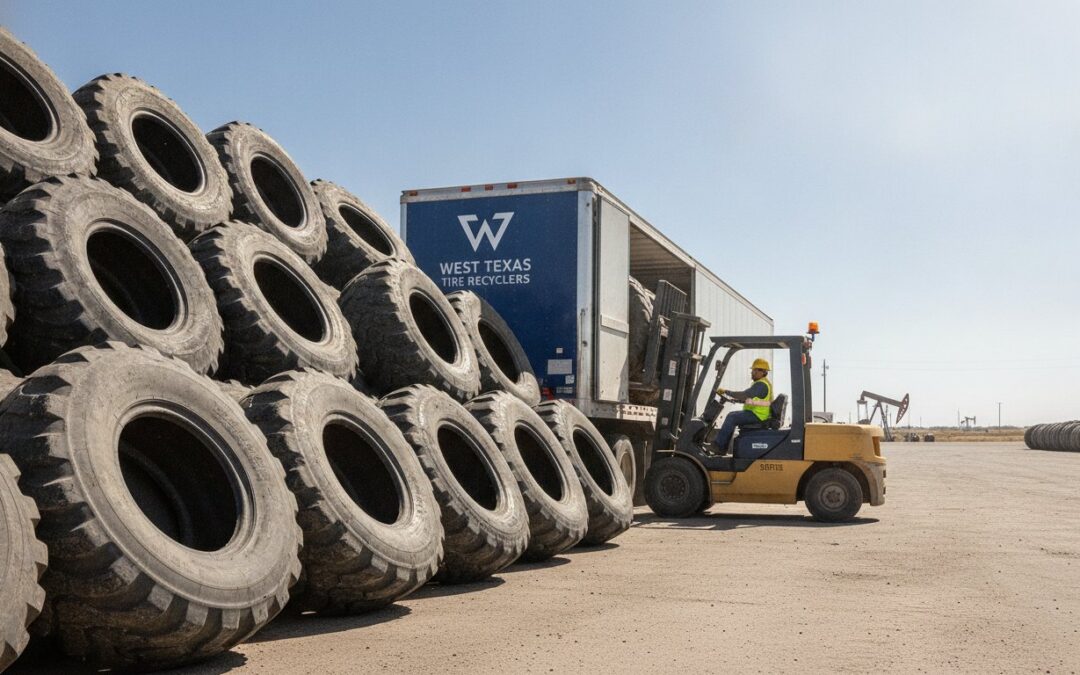
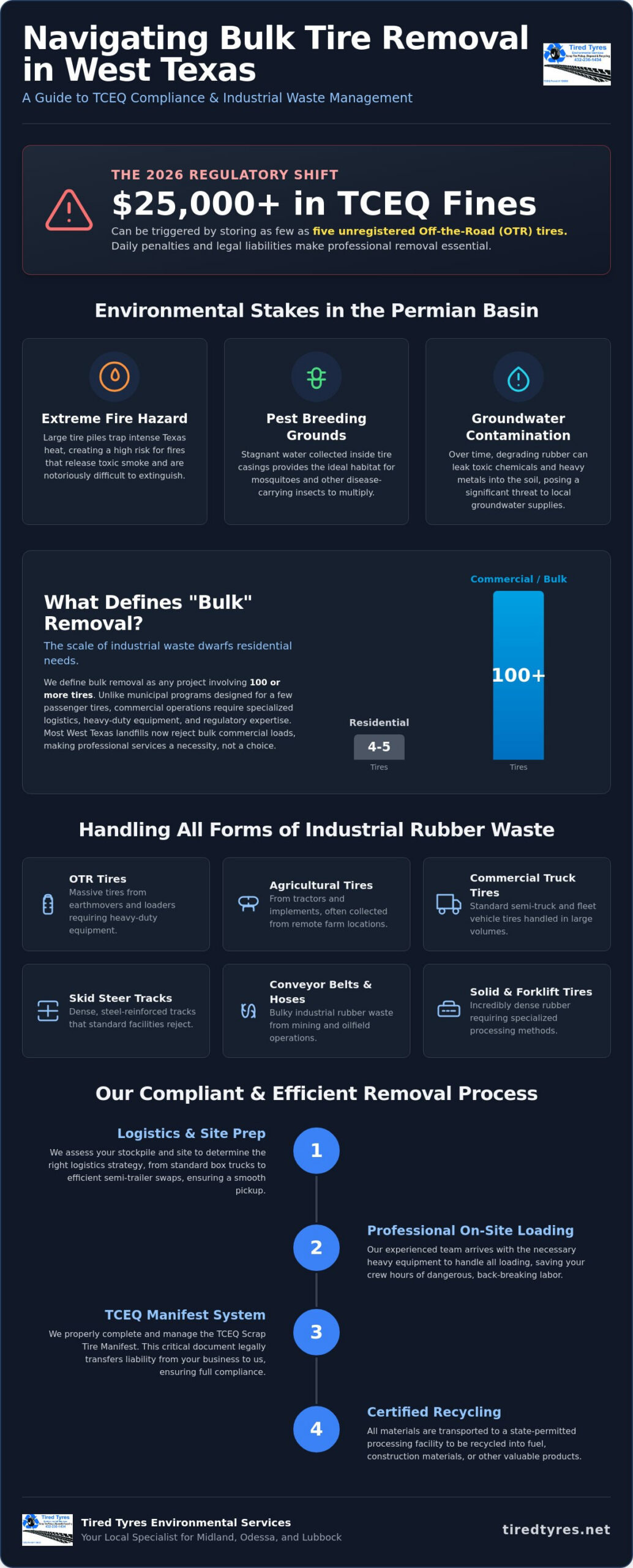
Storing as few as five unregistered off-the-road tires in 2026 can trigger TCEQ fines exceeding $25,000. It’s a staggering figure that highlights how strictly the state now monitors scrap rubber management. If you operate an industrial site, fleet, or farm in West Texas, you’ve likely found that local landfills are increasingly turning away large commercial loads. Securing reliable bulk tire removal Texas services is no longer just about clearing space; it’s a necessary step to protect your business from massive legal liabilities and daily penalties.
We know that moving heavy OTR or agricultural tires is a physical challenge, and navigating the latest TCEQ manifest requirements often feels like a bureaucratic headache. You deserve a solution that’s both transparent and dependable. This guide explains how to legally and affordably clear your stockpiles while ensuring every piece of paperwork is handled correctly. We’ll preview the 2026 regulatory landscape in the Permian Basin and show you the most efficient way to achieve a completely cleared site through a professional, reliable pickup schedule.
Key Takeaways
- Understand the specific logistical requirements for bulk tire removal Texas businesses must follow when managing large-scale stockpiles of 100 units or more.
- Identify the specialized handling needs for heavy-duty rubber waste, including OTR tires, agricultural tires, and industrial tracks.
- Learn how to maintain full legal compliance by properly utilizing the TCEQ Scrap Tire Manifest system to transfer liability.
- Prepare your site for efficient pickup by choosing the right logistics strategy, from standard box trucks to semi-trailer swaps.
- Discover the advantages of partnering with a local specialist who understands the unique industrial landscape of Midland, Odessa, and Lubbock.
Understanding Bulk Tire Removal in West Texas
Bulk tire removal isn’t just a simple cleanup task; it’s a specialized logistics operation. For West Texas businesses, we define “bulk” as clearing stockpiles of 100 units or more. Whether these tires sit on commercial lots, fleet yards, or private oilfield land, they represent a significant liability. In the Texas waste ecosystem, a permitted tire hauler acts as the bridge between your site and a processing facility. This process is the first step in understanding tire recycling and how discarded rubber eventually finds a second life in road construction or fuel. If you’re managing a fleet or an industrial site, you’ve likely seen how quickly a few dozen tires turn into a mountain. Professional bulk tire removal Texas services provide the heavy-duty equipment needed to handle these volumes safely and efficiently.
The Environmental Stakes in Midland and Odessa
The intense heat in Midland and Odessa creates a volatile environment for rubber. Large tire piles trap heat, creating a high risk for fires that are notoriously difficult to extinguish. These fires can burn for weeks, releasing thick, toxic smoke across the Permian Basin. Beyond the fire hazard, these piles are perfect breeding grounds for mosquitoes and other pests in the South Plains. Stagnant water inside the tire casings provides the ideal habitat for disease-carrying insects, making general property maintenance essential. For those in Tennessee, Ray Lawns provides similar outdoor care to keep landscapes healthy and pest-free. Additionally, abandoned rubber waste can leak toxic chemicals into the soil over time. This degradation threatens local groundwater supplies, making it vital to clear sites before the environmental damage becomes permanent.
Commercial vs. Residential Disposal Needs
Most municipal drop-off programs are designed for residents with four or five old tires. They aren’t equipped for the scale of a commercial operation. In 2026, many West Texas landfills have stopped accepting bulk commercial loads entirely. They lack the space and the specialized processing equipment required for industrial volumes. This makes professional bulk tire removal Texas services essential for business owners. Instead of making dozens of trips with a small trailer, an on-site pickup uses industrial-grade equipment to clear the entire site in one go. If you’re dealing with OTR or agricultural tires, you’ll need specialized machinery that standard waste management simply doesn’t provide. Efficiency is the key here. A professional team assesses the pile, brings the right trailers, and handles the loading, saving your crew hours of back-breaking labor.
Managing Industrial Rubber Beyond Passenger Tires
Most people think of passenger car tires when they hear about disposal, but West Texas industries face much larger challenges. The Permian Basin and South Plains are hubs for heavy machinery that utilizes massive amounts of rubber. Effective bulk tire removal Texas requires a partner who can handle more than just light truck tires. We categorize these waste streams into three main groups: standard commercial (semi-trucks), agricultural (tractors and implements), and OTR (Off-the-Road) tires used in mining and oilfield operations. Each category requires different handling techniques and disposal pathways to ensure your site stays clear and compliant.
OTR and Agricultural Tire Collection
Off-the-Road tires are the giants of the industry. These massive units, often found on earthmovers and loaders, can weigh thousands of pounds. You can’t simply roll these onto a standard trailer. They require specialized loading equipment and heavy-duty transport to move safely. Agricultural tires present a different logistical hurdle. Often located on remote farms far from main highways, collecting these requires precise scheduling and equipment that can navigate unpaved access roads. We also handle solid tires, which are common on forklifts and specialized industrial machinery. Because these lack air, they’re incredibly dense and require specific processing that standard landfills simply can’t provide.
Industrial Rubber Waste Solutions
It isn’t just about the tires. Industrial sites frequently accumulate other forms of rubber waste that standard haulers won’t touch. Scrap skid steer tracks, for instance, are notoriously difficult to dispose of because of their internal steel reinforcement. Similarly, scrap hoses and massive conveyor belts from mining or oilfield operations take up huge amounts of space and are often rejected by local waste facilities. Industrial rubber cannot be treated like standard municipal waste because its density and material composition require specialized shredding and recycling processes. Managing these materials requires a comprehensive approach to keep your site clean. If you’re struggling with a buildup of heavy industrial rubber, it’s time to look into professional scrap rubber collection options that cover your entire inventory.
Conveyor belts are perhaps the most challenging material for any business to manage. These long, heavy strips of reinforced rubber are designed to be indestructible, which makes them a nightmare for traditional waste facilities. In the Texas industrial sector, abandoning these materials isn’t an option. Professional bulk tire removal Texas services ensure that even these difficult materials are tracked and disposed of according to state guidelines. Whether it’s a pile of worn-out skid steer tracks or miles of decommissioned hoses, a specialized partner ensures that every pound of rubber is accounted for and removed from your property efficiently.
Texas Scrap Tire Regulations & TCEQ Compliance
Operating a business in West Texas means adhering to some of the nation’s strictest environmental standards. The Texas Commission on Environmental Quality (TCEQ) oversees the management of scrap tires to prevent environmental hazards. Understanding Texas tire disposal regulations is the only way to ensure your facility remains in good standing. If you store more than 500 scrap tires on the ground or 2,000 in locked containers, you must register your site with the state. For many industrial operations, these thresholds are reached quickly. Professional bulk tire removal Texas services help you manage these volumes while maintaining the required documentation to prove every tire was handled legally.
The state uses a “cradle-to-grave” liability model. This means your business is responsible for a tire from the moment it’s removed from a vehicle until it reaches an authorized processing facility. If a hauler dumps your tires in a ravine or an unauthorized lot, the TCEQ can trace those tires back to you. Penalties are severe. Storing as few as five unregistered off-the-road tires can result in fines exceeding $25,000. For larger stockpiles, daily fines can reach $10,000. Using a permitted hauler is the only way to legally transfer this liability and protect your bottom line.
The Manifest Process Explained
The Scrap Tire Manifest is your primary legal shield. It’s a multi-part form that tracks the movement of rubber waste. When a hauler arrives for a bulk tire removal Texas pickup, the process follows a specific sequence. First, the generator (you) and the hauler sign the manifest, noting the total tire count. Once the tires reach the disposal site, the facility signs off, confirming receipt. You must receive a completed copy of this document back from the facility. In 2026, while many systems have moved to digital tracking, the TCEQ still requires businesses to maintain these records for at least three years. These files are the first thing an inspector will ask to see during an audit.
For field managers who need to maintain these digital records while traveling between remote sites, Tak-tical provides durable laptop bags designed to protect essential tech in rugged environments.
Avoiding Illegal Dumping Liability
It’s tempting to hire “fly-by-night” haulers who offer low rates, but these operators often lack the necessary TCEQ registrations. If they don’t provide a valid manifest, you haven’t legally disposed of anything. You can verify a hauler’s status through the TCEQ’s central registry to ensure they’re authorized to transport scrap rubber. Investing in professional commercial tire disposal provides the legal protections your business needs. A registered hauler ensures that your manifest is filled out correctly, your tires reach a permitted facility, and your liability is fully discharged. Don’t risk thousands in penalties for a slightly cheaper pickup; the legal security of a permitted partner is worth the investment.
How Bulk Tire Pickup Works: Logistics and Preparation
A successful pickup starts with an accurate assessment. You can’t just guess the size of a stockpile. You need a solid count. Estimating counts for a massive pile isn’t always easy, but it’s the foundation of a smooth bulk tire removal Texas operation. We look at the total unit count and the mix of rubber types. A pile of 200 passenger tires requires different logistics than 50 OTR tires. Your location in the Permian Basin also plays a role. Remote oilfield sites or rural farms in the South Plains require more planning than an auto shop in central Lubbock. We need to know if we’re sending a standard truck or specialized heavy-duty equipment.
Costs aren’t one-size-fits-all. Several factors influence the final quote. Volume is the biggest driver, but tire size and accessibility matter just as much. Large agricultural or mining tires take up more trailer space and require more labor to load. If your site is difficult to reach or lacks a solid staging area, specialized equipment might be necessary. High-volume industrial hubs often benefit from recurring pickup schedules. This keeps the site clear and prevents the mountain from growing too large for a single haul. Regular service also helps you stay below the TCEQ storage thresholds we discussed earlier.
Preparing Your Site for Removal
Organizing your site saves time and money. Drivers need clear access to the pile. If your tires are mixed with rims, separate them beforehand. Most recyclers charge extra or refuse loads that aren’t sorted. Sort your inventory by size: passenger, semi, and OTR. This allows the loading team to maximize trailer space. Ensure there’s enough clearance for a 53-foot semi-trailer to maneuver. In tight industrial zones in Midland or Odessa, this often means clearing a specific path through the yard before the truck arrives. A well-prepared site ensures the driver can get in, load, and get out without costly delays.
Equipment Options for Large Volumes
Your volume determines the truck type. Box trucks are excellent for one-time remediations or smaller commercial piles. They’re maneuverable and perfect for tight spaces. For ongoing projects or massive stockpiles, a semi-trailer swap is the most efficient choice. We drop an empty trailer at your site. You fill it at your convenience. When it’s full, we swap it for a fresh one. This keeps your yard organized without the pressure of a single-day loading window. Be aware of dirty piles. Tires mixed with heavy dirt, brush, or demolition debris are much harder to process. Keeping your pile clean ensures the fastest possible removal and the lowest processing fees.
Choosing the right logistics partner means you don’t have to worry about the heavy lifting. If your site is ready for a professional assessment, you can schedule your bulk tire collection with our team today. We handle the equipment, the loading, and the legal paperwork so you can get back to running your business.
Partnering with a West Texas Removal Specialist
Local expertise isn’t just a buzzword in West Texas; it’s an operational necessity. When you’re managing a site in the Permian Basin, you need a partner who knows the difference between a standard auto shop and a remote oilfield staging area. Many statewide companies claim to cover the entire state, but they often lack the specialized equipment or the regional presence to handle bulk tire removal Texas needs promptly. We focus specifically on this region, ensuring that we’re always close enough to provide a reliable tire disposal solution that fits your schedule. Our team understands the unique challenges of our climate and our industries, from the heat of Midland to the agricultural expanses of the South Plains.
Dealerships often need a regular, predictable pickup schedule to keep their bays clear and their inventory manageable. Oilfield service companies, however, might have sporadic needs for massive OTR removal after a project concludes. We recognize these differences. For farms in the South Plains, we coordinate around seasonal cycles to ensure our heavy equipment doesn’t interfere with your harvest or planting schedules. This regional insight is what separates a local specialist from a generic hauler. We’re part of the West Texas community, and we take pride in helping our neighbors maintain compliant, safe, and organized properties. Every load we haul is a step toward a cleaner Permian Basin.
This commitment to community excellence is shared by other long-standing Texas institutions; for instance, Darseys Furniture & Mattress has served families in the eastern part of the state for generations with high-quality home furnishings.
Serving the Permian Basin and South Plains
Our service radius extends from Lubbock down through the heart of Odessa and Midland. We’ve built our reputation by providing customized solutions for the specific businesses that drive our local economy. Whether you’re managing a fleet of semi-trucks or a yard full of decommissioned agricultural equipment, we have the logistics in place to help. We don’t offer a one-size-fits-all service. Instead, we adapt our bulk tire removal Texas strategies to your specific site, whether you’re dealing with hundreds of passenger tires or a few dozen massive OTR units. Our commitment is simple: keep West Texas clean, compliant, and free of the liabilities associated with improper rubber waste management.
Next Steps for Your Scrap Rubber
Ready to clear your site? The process is straightforward and transparent. Start by documenting your pile. Take a few photos and provide a rough estimate of the counts and types of rubber you have. This helps us provide a faster, more accurate quote. On the day of the pickup, you can expect a professional arrival and a streamlined loading process. We’ll handle the manifest signing on-site, providing you with the legal documentation you need for your records. If you’re tired of looking at a growing stockpile, contact Tired Tyres today for a specialized bulk removal plan. We’ll take the problem off your hands so you can focus on your core operations. For businesses managing broader site preparation or hazardous materials, check out TSIAC International for their comprehensive guide on abatement and safety regulations.
Secure Your Site and Stay Compliant in 2026
Managing large volumes of scrap rubber in the Permian Basin doesn’t have to be a source of stress. You’ve seen how the right documentation and specialized equipment can turn a massive liability into a cleared, safe site. By following the TCEQ manifest process and choosing a partner who understands the physical demands of OTR and agricultural tires, you protect your business from the “cradle-to-grave” liability that causes so many legal headaches in Texas. Efficiency comes from local knowledge and having the right trailers for the job.
As a TCEQ Permitted Hauler serving Midland, Odessa, and Lubbock, we specialize in the heavy-duty industrial rubber waste that others won’t touch. Whether you’re clearing a fleet yard or an oilfield staging area, our team provides the transparent, reliable service you need to stay organized. Don’t let your stockpile grow into a regulatory risk. It’s time to take control of your inventory with professional bulk tire removal Texas services. Get a Quote for Bulk Tire Removal in West Texas and let us handle the logistics while you focus on your business. We’re ready to help you keep West Texas clean and compliant.
Frequently Asked Questions
What is considered “bulk” tire removal in Texas?
We define bulk removal as the collection of 100 or more tire units from a single commercial or private site. This volume typically exceeds what municipal residential programs can handle. It requires specialized industrial equipment and trailers to move efficiently. For businesses in the Permian Basin, reaching this threshold means you need a professional partner to manage the logistics and legal paperwork.
Does Tired Tyres handle OTR and agricultural tires?
Yes, we specialize in the collection of heavy-duty OTR and agricultural tires. These massive units are common in West Texas mining, oilfield, and farming operations. They require specialized loading machinery because of their extreme weight and size. Our team is equipped to handle these large-scale removals safely while ensuring they’re transported to the correct processing facilities.
How do I know if a tire hauler is legally permitted by the TCEQ?
You can verify a hauler’s status by asking for their TCEQ registration number or checking the Texas Commission on Environmental Quality’s central registry. Every legitimate bulk tire removal Texas service must display this number on their transport vehicles and manifests. Checking this status protects your business from the legal liabilities associated with illegal dumping by unpermitted “fly-by-night” operators.
Can I dispose of conveyor belts and skid steer tracks with my tires?
Yes, we collect various forms of industrial rubber waste including conveyor belts, skid steer tracks, and hoses. These materials are often rejected by standard landfills because of their density and internal reinforcements. We provide specialized collection for these items to help industrial sites in Midland and Odessa maintain a clean and compliant workspace without needing multiple waste contractors.
What happens if I have tires with rims still attached?
We prefer that tires are removed from their rims before we arrive for pickup. Tires with rims require different processing and add significant weight to the load, which can affect transport logistics. If you have a large number of tires on rims, please mention this during your initial assessment so we can bring the appropriate equipment to handle the extra weight.
How much does bulk tire removal typically cost in Midland?
The cost for removal in Midland depends on your total volume, the size of the tires, and how accessible your site is for our trailers. We provide customized quotes rather than flat rates to ensure you only pay for the specific logistics your project requires. Factors like whether the pile is “clean” or mixed with debris will also influence the final estimate.
What paperwork does my business need to keep after a tire pickup?
Your business must retain a copy of the completed Scrap Tire Manifest for at least three years. This document is your legal proof that the tires were transferred to a permitted hauler and reached an authorized facility. During a TCEQ audit, these records are the primary way you demonstrate compliance with state environmental regulations and avoid costly penalties.
Do you provide recurring tire collection for auto shops in Lubbock?
Yes, we offer scheduled, recurring collection services for high-volume auto shops and dealerships throughout Lubbock. This service prevents rubber from stockpiling and ensures you stay well below the state’s unregistered storage limits. Regular bulk tire removal Texas schedules allow your team to focus on service work while we handle the consistent removal of your scrap inventory.