
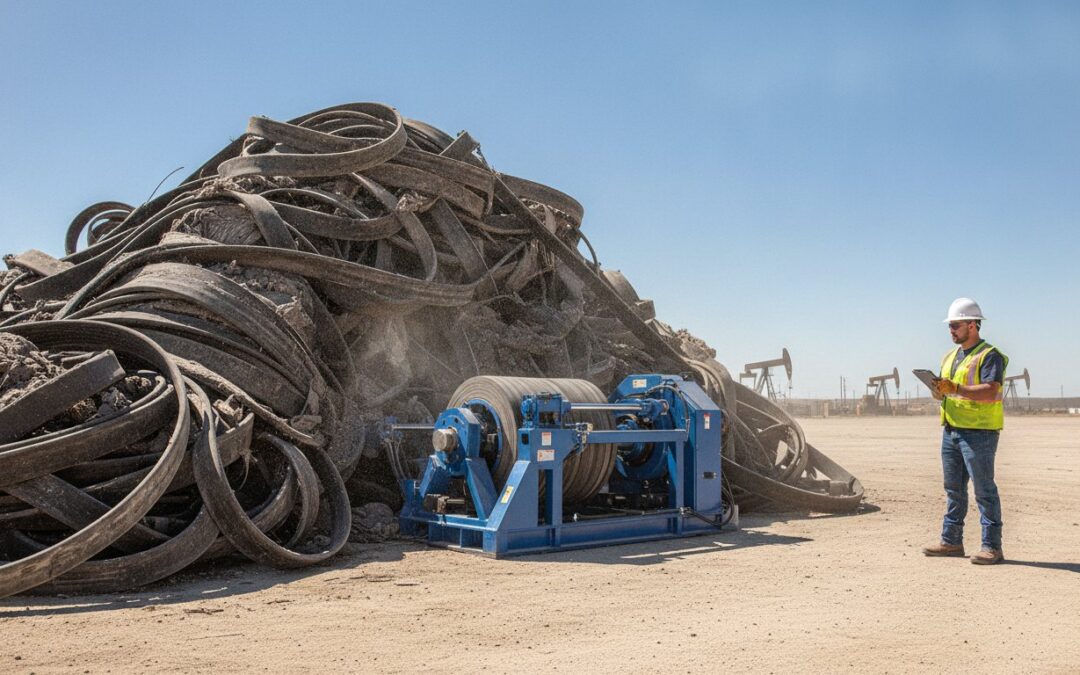
A single 500-foot industrial conveyor belt can weigh more than 15,000 pounds, turning a decommissioned line into a massive liability the moment it hits the ground. If you operate in the Permian Basin, you’ve likely watched these “spaghetti piles” grow until they swallow valuable operational space. Most standard haulers don’t have the specialized equipment to lift or transport heavy-duty industrial rubber. This leaves many businesses stuck between a cluttered site and the fear of TCEQ fines for improper storage. Finding professional conveyor belt disposal solutions is about more than just cleaning up; it’s about protecting your company from environmental penalties.
You deserve a clear site and a documented paper trail to stay compliant. It’s stressful to manage heavy rubber rolls when you’re focused on daily operations. This 2026 guide provides a straightforward roadmap for managing bulk rubber waste in Midland, Odessa, and Lubbock. We’ll cover the latest TCEQ requirements, the logistics of heavy-duty hauling, and how to ensure your disposal process is both cost-effective and legally sound. We’ll show you how to move those massive rolls off your property and off your mind for good.
Key Takeaways
- Learn how to clear “spaghetti piles” of industrial rubber using professional conveyor belt disposal solutions that prioritize site safety.
- Understand the difference between Grade A reusable belts and scrap material to determine the most cost-effective path for your waste.
- Navigate 2026 TCEQ regulations with documented manifest tracking to eliminate long-term environmental liability for your property.
- Compare the risks of DIY hauling against specialized mechanical winding to avoid injuries and equipment damage on-site.
- Identify the specific steps for bulk removal in Midland, Odessa, and Lubbock through a professional audit and disposal process.
The Challenge of Industrial Rubber: Why Conveyor Belt Disposal is Unique
Industrial conveyor belts are engineered to withstand extreme tension, heat, and abrasion. While this durability is a massive asset during operation, it creates a significant logistical burden when the belt reaches the end of its life. These materials are classified as high-volume, non-biodegradable industrial waste. They don’t break down like standard refuse. In the Permian Basin, where sand mining and oilfield logistics run around the clock, the volume of rubber waste generated can quickly overwhelm a facility. A single 500-foot industrial belt can weigh more than 15,000 pounds. When these belts are left in loose, tangled heaps known as “spaghetti piles,” they become nearly impossible to move with standard loaders. Unlike neat rolls, these tangles require specialized conveyor belt disposal solutions to prevent them from becoming permanent, unmanageable fixtures on your property.
The environmental footprint of a multi-ply rubber belt is substantial. These components are designed to resist biological decay, meaning they will persist in a landfill or on a lease site for centuries. This permanence is precisely why the TCEQ monitors industrial rubber waste so closely in West Texas. Managing this waste requires a clear understanding of what you’re dealing with before the first truck arrives.
Material Composition: More Than Just Rubber
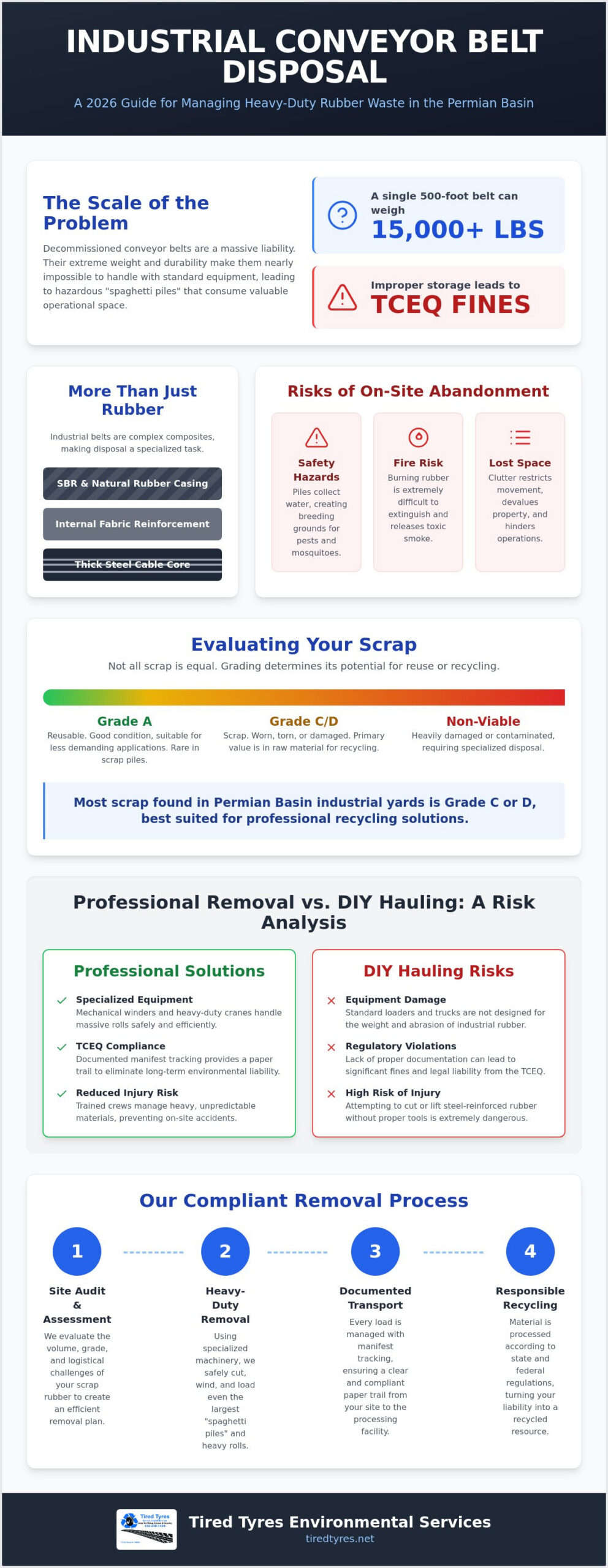
Most industrial belts are a complex blend of SBR (Styrene-Butadiene Rubber) and natural rubber. These materials are vulcanized to ensure they don’t stretch or tear under load. The real complexity in disposal comes from the internal reinforcements. Many heavy-duty belts contain thick steel cables that run the entire length of the material. These cables make the belt incredibly heavy and difficult to cut without specialized industrial tools. Other belts use fabric-reinforced layers, which offer a different recycling potential compared to solid rubber or steel-core varieties. Because each material type requires different processing, you can’t treat all scrap rubber the same way.
The Problem with On-Site Abandonment
It’s tempting to push scrap rubber to the edge of a property and forget about it, but this creates long-term risks. In high-activity areas like Midland and Lubbock, operational space is a valuable resource. Large piles of abandoned rubber restrict movement for crews and machinery. Beyond the lack of space, these piles are significant safety hazards. They collect rainwater, which creates a breeding ground for pests and mosquitoes. Even more concerning is the fire risk. Industrial rubber is difficult to ignite, but once it starts burning, it’s nearly impossible to extinguish and releases toxic, heavy smoke. This leads to property devaluation and potential legal liabilities that far outweigh the cost of professional conveyor belt disposal solutions.
Evaluating Your Scrap: Grading and Recycling Potential
Before you can clear your site, you need to understand the value and the volume of the material you’re holding. Industrial rubber isn’t a monolith. Professional conveyor belt disposal solutions rely on a grading system to determine if a belt can be repurposed or if it must be processed as pure scrap. Grading is based on the remaining thickness of the top cover, the integrity of the internal carcass, and the presence of any structural damage like edge fraying or longitudinal rips. While some national companies look for high-grade material to resell, most belts found in West Texas industrial yards have been run to the limit. These “Grade A” belts, which are suitable for immediate reuse in less demanding systems, are rare in scrap piles. Most of what we see in the Permian Basin is Grade C or D, meaning its primary value lies in its raw material rather than its function as a belt.
Localized recycling centers often struggle with industrial-grade rubber. Many facilities in Midland or Odessa are equipped for consumer plastics or cardboard, but they lack the heavy-duty machinery required to shear through steel-reinforced belts. This is why a specialized assessment is necessary. We look at the load to determine the most efficient removal path, ensuring that even the most degraded material doesn’t end up as a permanent environmental liability. If you aren’t sure where your material fits, our team can provide a professional scrap rubber assessment to clear your site.
Repurposing vs. Shredding
Low-grade belts that can no longer move industrial loads still have a second life. Common secondary uses include heavy-duty cattle mats, dock bumpers for warehouses, and floor liners for shops. These applications take advantage of the belt’s natural durability without requiring it to withstand high-tension operation. When a belt is too thin or the steel cables are exposed, it must be shredded. This follows the same sustainable tire recycling principles we apply to OTR and semi-truck tires. Shredded rubber is often used in civil engineering projects or as tire-derived fuel, keeping the material out of Texas landfills.
Calculating Total Weight and Volume
Logistics planning starts with accurate weight estimation. A simple way to estimate the weight of a rolled belt is to multiply the length by the width and the thickness, then apply a density factor for industrial rubber. For example, a standard 3-ply belt often weighs about 0.045 to 0.050 pounds per square inch per inch of thickness. Don’t forget that West Texas wind and rain add weight. Dirt, sand, and moisture trapped in “spaghetti piles” can increase the total weight of a load by 10% or more. This extra weight impacts hauling logistics and disposal costs, making it vital to roll and secure belts whenever possible before the removal crew arrives.
Professional Removal vs. DIY Hauling: A Risk Analysis
Trying to handle a 15,000-pound belt with a standard forklift and a flatbed is often a recipe for disaster. While DIY hauling might seem like a way to save on overhead, the hidden costs of specialized equipment rental and potential landfill rejection usually make it the more expensive choice. Many municipal landfills across West Texas aren’t equipped to process bulk industrial rubber. They’ll often turn away trailers full of loose belts; this leaves you with a fuel bill and a pile of waste you still can’t get rid of. Professional conveyor belt disposal solutions eliminate this guesswork by using established routes to permitted facilities that specialize in heavy-duty rubber processing.
For operations already managing diverse industrial waste streams, integrating your conveyor belt disposal with other heavy rubber waste services offers significant advantages. Partnering with a comprehensive provider ensures that all your heavy rubber waste, from OTR tires to decommissioned belts, is handled under a single compliant manifest. This streamlined approach saves time, reduces administrative burden, and keeps your documentation organized for future audits, ensuring compliance across the board.
The Logistics of the “Spaghetti Pile”
Loading loose, tangled belts onto a standard trailer is a logistical nightmare. These “spaghetti piles” don’t behave like standard cargo. They shift, catch on equipment, and are incredibly difficult to secure for transport on Texas highways. Professional teams use high-torque mechanical winders and specialized winches to roll the material into dense, manageable cylinders. This process is much safer than manual loading. Our commercial tire disposal experts bring the right tools to the site, turning a multi-day headache into a few hours of efficient work.
Site Safety and Liability
Handling heavy industrial rubber falls under strict OSHA safety considerations. The sheer weight of the material, combined with the stored tension in a tangled belt, poses a significant risk of crushing injuries or equipment failure. If a worker’s injured during a DIY extraction, the company faces direct liability and potential safety audits. Outsourcing this task to a professional service transfers the operational risk to the hauler. It’s a straightforward way to protect your employees and your bottom line from the unpredictable nature of heavy rubber removal.
Navigating Texas Regulations for Industrial Rubber Disposal
In the state of Texas, industrial waste management is strictly overseen by the Texas Commission on Environmental Quality (TCEQ). While conveyor belts are a specific type of industrial waste, they are often regulated under the same environmental scrutiny as scrap tires due to their size, volume, and non-biodegradable nature. Texas law operates on a “cradle-to-grave” responsibility model. This means that as the waste generator, your company is legally responsible for the belt from the moment it is decommissioned until it reaches its final, permitted disposal destination. Choosing the right conveyor belt disposal solutions ensures you have a documented path from your site to the final disposal facility, protecting your business from long-term liability.
Understanding these rules is essential for any facility manager in the Permian Basin. If you are already familiar with Texas Tire Disposal Regulations, you’ll recognize the emphasis on proper transportation and site security. The state wants to ensure that heavy rubber waste doesn’t end up in unauthorized stockpiles where it can become an environmental or fire hazard. Because belts are so difficult to process, the state closely monitors how they are moved across county lines in Midland, Odessa, and Lubbock.
The Importance of the Waste Manifest
A waste manifest is the most important document in your disposal process. This paper trail confirms that your scrap rubber was collected by a permitted hauler and delivered to a facility authorized to accept it. You should never hand off bulk rubber without receiving a completed manifest for your records. TCEQ requirements typically mandate that industrial waste generators keep these records for at least three years. Before hiring a service, always verify that the hauler is legally permitted to transport industrial waste in Texas. This simple check prevents your company from being tied to a hauler who might cut corners or dump material illegally.
Avoiding Illegal Dumping Fines
The financial reality of TCEQ enforcement is significant. Fines for improper disposal can reach thousands of dollars per day, per violation. Many businesses mistakenly believe that “unintentional” dumping is a valid defense. However, if you hire an unpermitted hauler and they dump your belts in a remote area, the state can still hold you responsible for the cleanup costs and the resulting penalties. This enforcement is part of a broader effort to solve waste tire problems and industrial rubber mismanagement across West Texas. To ensure your site remains compliant and your company stays out of the regulatory spotlight, you can schedule a TCEQ-compliant rubber removal with our experienced team today.
Efficient Solutions: How Tired Tyres Manages Bulk Belt Removal
Tired Tyres understands that industrial rubber isn’t just a waste issue; it’s a space and safety issue. We deploy a specialized fleet across West Texas designed specifically for heavy-duty conveyor belt disposal solutions. Our equipment includes high-torque mechanical winders that can handle the massive weight of steel-reinforced belts, even when they’re tangled in complex piles. We don’t just haul the material away; we manage the entire process from the initial site audit to the final legal disposal. This hands-on approach ensures that your property is cleared quickly without straining your own crew or equipment.
Industrial sites rarely have just one type of waste. We simplify your logistics by accepting mixed loads. Whether you have scrap conveyor belts, OTR (Off-the-Road) tires, or industrial hoses, our team can consolidate these into a single pickup. This approach reduces the number of trucks on your site and ensures every piece of rubber is tracked under a compliant manifest. Our commitment to environmental stewardship means we prioritize repurposing and recycling whenever possible. We work to keep bulk rubber out of Permian Basin landfills while providing you with the documentation needed to prove your company’s compliance with state law.
Our Permian Basin Service Area
We focus our operations on the industrial hubs of Midland and Odessa, where the demand for rapid site clearance is highest. Our teams are frequently in these areas, allowing for efficient scheduling and fast turnaround times. However, we also manage bulk pickups for remote mining and oilfield sites near Lubbock. We understand that in the oilfield and mining sectors, an “impossible” pile of rubber can block critical access roads or occupy high-value staging areas. We offer responsive scheduling to clear these obstructions, ensuring your operations don’t slow down due to unmanaged waste. Our crews are experienced with the unique terrain and safety requirements of West Texas industrial sites.
Getting a Quote for Your Site
To provide an accurate estimate, we need a few basic details about your scrap pile. Please have the approximate belt length, width, and an honest assessment of its condition ready. Knowing if the belt is currently rolled or in a “spaghetti pile” helps us bring the right winding equipment for the job. Bundling your disposal needs, such as including scrap hoses or solid tires, is often the most cost-effective way to clear your yard. This consolidation reduces your total hauling fees and streamlines your record-keeping. You can schedule a professional conveyor belt pickup in West Texas today to get a clear site and a documented paper trail.
Secure Your Site and Stay Compliant
Managing heavy industrial rubber doesn’t have to be a permanent logistical headache for your team. By choosing professional conveyor belt disposal solutions, you protect your business from the safety risks of unmanaged piles and the severe financial penalties of TCEQ non-compliance. You’ve seen how specialized equipment and a documented manifest system turn a massive liability into a managed process. Since our inception, we’ve focused on providing these essential services to the industrial hubs of Midland, Odessa, and Lubbock.
Our team uses specialized industrial winding equipment to handle even the heaviest steel-reinforced belts, ensuring they’re removed efficiently and legally. We take the burden of liability off your shoulders by providing a full TCEQ-compliant manifest system for every load. Don’t let abandoned rubber devalue your property or create unnecessary safety hazards for your workers. It’s time to clear your yard and get back to your core operations with a partner you can trust.
Get a Quote for Industrial Rubber and Belt Disposal and see how quickly we can clear your site. We’re ready to help you move forward.
Frequently Asked Questions
Can I legally dispose of conveyor belts in a standard West Texas landfill?
Most municipal landfills in West Texas won’t accept bulk conveyor belts because they don’t compact and can damage compacting machinery. You typically can’t just drop off large rolls or tangled piles at a city dump. These materials require disposal at specialized industrial waste facilities that are permitted to handle high-volume rubber waste. It’s best to verify with your local facility or use a professional service to avoid being turned away at the gate.
How much does it cost to have a scrap conveyor belt pile removed?
Pricing for removal is determined by the total weight of the rubber, your location, and the current condition of the material. “Spaghetti piles” that are tangled and loose generally require more labor and specialized winding equipment than neat rolls, which can influence the final service cost. Because every industrial site has different logistical challenges, you should request a site-specific quote to get an accurate estimate for your cleanup project.
Do conveyor belts count as scrap tires under TCEQ regulations?
Conveyor belts are categorized as industrial waste, but they often face the same regulatory scrutiny as scrap tires in Texas. The TCEQ monitors bulk rubber closely because it poses similar fire and pest risks if left unmanaged. Utilizing professional conveyor belt disposal solutions ensures that your waste is handled according to the specific environmental standards required for industrial rubber. This keeps your business compliant with state-level waste management rules.
What is the best way to roll up loose conveyor belts for transport?
The safest and most efficient method is using a high-torque mechanical winder or a specialized industrial winch. Manual rolling is dangerous due to the weight of the material and the stored tension in the rubber. Mechanical winding creates tight, dense cylinders that are much easier to secure on a trailer for transport. This process also significantly reduces the footprint of the waste on your site before the hauler arrives.
Are there any recycling centers in Lubbock that take industrial rubber?
Standard recycling centers in Lubbock usually focus on consumer goods like paper, plastic, and aluminum. They lack the heavy-duty shredders needed to process multi-ply or steel-reinforced industrial rubber. To recycle these materials, you’ll need to work with a specialized industrial rubber processor. Most businesses find it’s most efficient to hire a hauler who already has established delivery routes to these specialized regional facilities.
Can I burn scrap conveyor belts on my property in Texas?
Burning industrial rubber is strictly illegal in Texas and results in heavy fines from the TCEQ. Rubber fires release toxic pollutants and are incredibly difficult to put out once they start. Beyond the legal penalties, the environmental damage to your property can be permanent. Legal disposal through a permitted hauler is the only safe and responsible way to clear your site of decommissioned belts.
What happens to the steel cables inside reinforced conveyor belts during disposal?
Steel cables are typically extracted during the industrial shredding process at a processing facility. Once the rubber is broken down, the steel is separated and sent to metal recyclers for reuse. This recovery process is an important part of modern conveyor belt disposal solutions. It ensures that valuable raw materials are salvaged rather than wasted in a landfill, supporting a more sustainable industrial waste cycle.
How do I verify if my rubber waste hauler is TCEQ-permitted?
You should ask the hauler for their TCEQ registration number and verify it through the TCEQ Central Registry online database. A legitimate, permitted hauler will have no problem providing this information. Always ensure they provide a completed waste manifest during pickup. This document is your proof that the material was handled legally and is essential for your company’s environmental record-keeping requirements.