
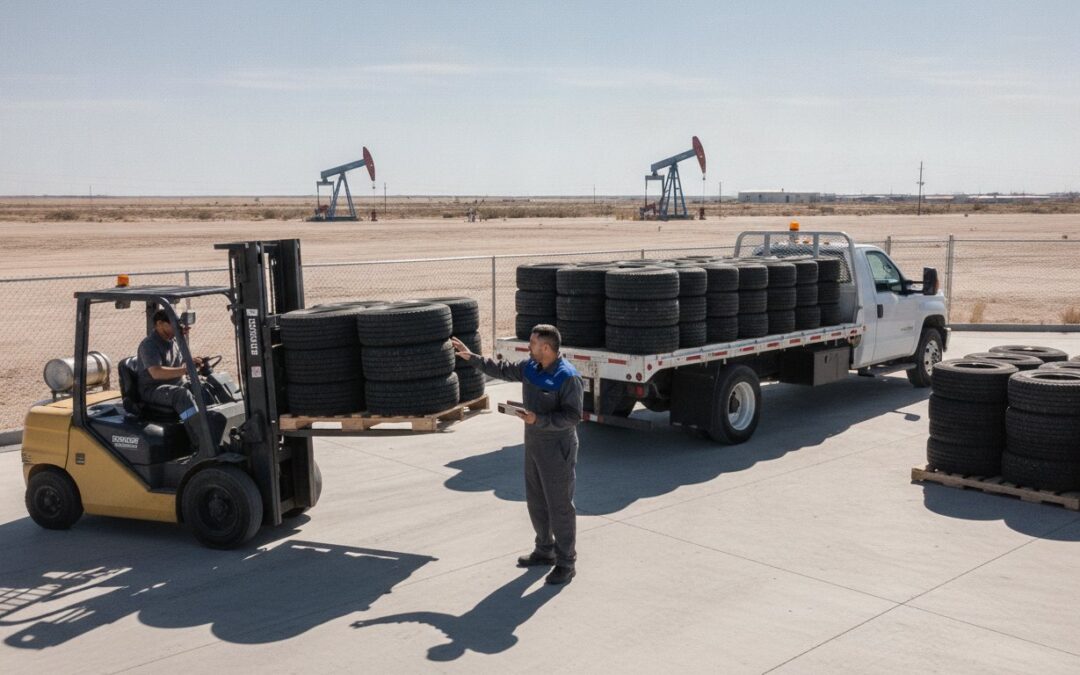
Storing as few as five unregistered off-the-road tires can trigger a TCEQ fine exceeding $25,000. For many business owners, scrap rubber isn’t just a fire hazard. It’s a massive legal liability that can lead to daily penalties of up to $25,000 per violation. Staying current with texas tire disposal regulations is no longer just about being environmentally conscious; it’s about shielding your company from the financial fallout of improper storage or a hauler’s illegal dumping.
It’s frustrating to keep track of every manifest and storage limit while trying to run an efficient shop or industrial site. You need a clear path to compliance without the headache of complex paperwork or the fear of a surprise audit. This 2026 guide provides exactly that, offering a comprehensive look at the latest scrap tire laws and reporting deadlines. We’ll walk you through the cradle-to-grave manifest system, new STEERS digital reporting requirements, and local landfill restrictions in Midland, Odessa, and Lubbock to ensure your operations remain fully protected.
Key Takeaways
- Understand the latest texas tire disposal regulations to avoid administrative penalties that can reach $25,000 per day.
- Learn the specific storage thresholds, including the 500-tire limit, that require mandatory TCEQ registration for your facility.
- Discover how the “cradle-to-grave” manifest system acts as your primary legal shield against liability for illegal dumping.
- Identify local disposal restrictions in Midland, Odessa, and Lubbock, where whole tires are often banned from municipal landfills.
- Explore how partnering with a permitted collector ensures every scrap tire is documented and disposed of in full regulatory compliance.
What Are the Texas Tire Disposal Regulations for 2026?
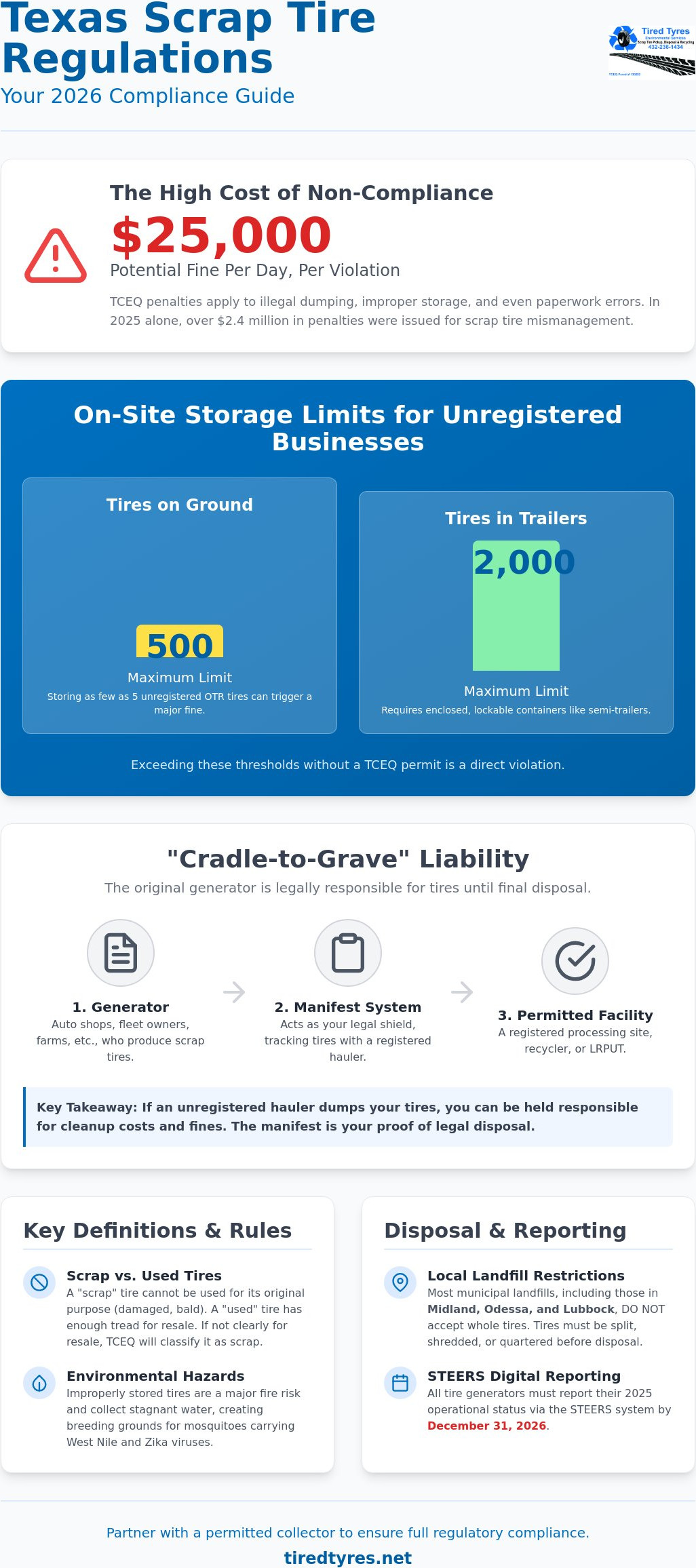
Under the Texas Health and Safety Code, a scrap tire is defined as any tire that can no longer be used for its original intended purpose. The Texas Commission on Environmental Quality (TCEQ) manages these items as municipal solid waste, and they enforce strict rules regarding how they are moved and stored. In 2026, texas tire disposal regulations are designed to prevent the significant environmental hazards associated with rubber waste. Abandoned tire piles are notoriously difficult to extinguish if they catch fire, and they collect stagnant water that serves as a primary breeding ground for mosquitoes carrying West Nile and Zika viruses.
While Tire recycling has become more efficient, the state requires a rigorous paper trail to ensure every casing reaches a permitted facility. There is a critical legal distinction between a “used” tire and a “scrap” tire. A used tire still has enough tread and structural integrity to be sold for reuse on a vehicle. A scrap tire is damaged, bald, or otherwise unfit for the road. If your business stores tires that are not clearly for resale, the TCEQ will likely classify them as scrap, triggering specific storage and manifest requirements.
Regulated Activities Under TCEQ
Anyone who produces scrap tires in the course of business is considered a “generator.” This category includes auto repair shops, fleet owners, and farmers across the Permian Basin and South Plains. Generators must follow specific rules for the transportation and storage of rubber waste. If you are not processing the tires yourself, you must use a registered transporter to move them to a permitted processing site or a Land Reclamation Project Using Tires (LRPUT). These LRPUT sites use shredded tires for engineering or construction projects, but they are subject to new reporting standards. By December 31, 2026, all generators and LRPUTs must report their 2025 operational status through the State of Texas Environmental Electronic Reporting System (STEERS).
The Legal Risks of Non-Compliance
The financial consequences for ignoring texas tire disposal regulations are severe and immediate. In 2025, the TCEQ issued over $2.4 million in penalties for improper scrap tire management. Administrative cases can result in fines of up to $25,000 per day for every single violation. These penalties apply to illegal dumping, improper storage, and even simple paperwork errors. Liability doesn’t end when the tires leave your property. Under the “Cradle-to-Grave” liability principle, the generator remains legally responsible for the scrap tires from the moment they are removed from a vehicle until they are officially disposed of or recycled at a permitted facility. If an unregistered hauler dumps your tires illegally, you can still be held responsible for the cleanup costs and state fines.
The 500-Tire Rule and Storage Limits for Businesses
Texas law is very specific about how many tires a business can keep on site before it’s classified as a storage facility. According to Texas Health and Safety Code § 361.112, you don’t need to register as a storage site as long as you have fewer than 500 scrap tires on the ground. If you use enclosed, lockable containers like trailers, that limit increases to 2,000 tires. Exceeding these numbers without a permit is a direct violation of texas tire disposal regulations. For most auto shops or industrial yards, hitting these limits happens faster than expected.
Staying under the legal threshold requires a proactive approach. Regular removal is the most effective way to maintain compliance. If you find your inventory growing too large, scheduling a professional scrap tire collection can prevent your property from being flagged during a TCEQ investigation.
Whole vs. Shredded Tire Regulations
Most municipal landfills in Texas won’t accept whole tires because they tend to “float” to the surface of the waste pile and trap methane gas. To comply with disposal standards, tires must be split, shredded, or quartered. This process is a vital part of tire recycling, as it prepares the rubber for further processing into tire-derived fuel or rubberized asphalt. Some energy recovery facilities are permitted to take whole tires for fuel, but these are specialized sites. For the average business, shredding is the standard requirement for legal landfill entry.
Managing Agricultural and OTR Tire Storage
West Texas operations often deal with massive Off-the-Road (OTR) and agricultural tires. These units present unique challenges under texas tire disposal regulations because their size makes them prone to collecting large volumes of stagnant water. Even a few OTR tires left outdoors can become a breeding ground for pests, leading to health code violations. While there are some exemptions for tires used in agricultural commodities or specific industrial applications, they must be managed to prevent environmental nuisance. For farmers and oil field operators in the Permian Basin, keeping these large casings organized and dry is critical. If tires are no longer serving a functional purpose, they should be removed promptly to avoid the steep fines discussed in the previous section.
A clean, hazard-free property is particularly important for those managing livestock or equestrian facilities in the region. Once you have addressed your rubber waste, you can discover Texas Equine Education & Horsemanship to further explore foundational horsemanship and equine care classes tailored for riders of all ages.
The Scrap Tire Manifest: Your Proof of Legal Disposal
A TCEQ scrap tire manifest is the only legal document that proves your business followed texas tire disposal regulations. It acts as a formal receipt, documenting exactly how many tires left your property, who took them, and where they were delivered. Without this paperwork, you have no defense if those tires are later found in an illegal dump site. The state uses these forms to maintain a “cradle-to-grave” tracking system, ensuring that every casing is accounted for from the moment it’s removed from a vehicle until it’s shredded or recycled.
Record-keeping is a mandatory part of this process. You must store your copies of all completed manifests for at least three years. During a TCEQ investigation or a routine local health department inspection, these records are the first thing officials will ask to see. If you cannot produce a manifest for every tire you’ve generated, you may face fines even if the tires were disposed of correctly. Relying on “ghost haulers” who offer cheap pickups without providing a manifest is a massive risk. These operators often dump tires in rural areas or vacant lots, leaving you legally and financially responsible for the cleanup costs.
How to Verify a Permitted Tire Hauler
Before you allow any vehicle to load scrap rubber from your site, you must verify their credentials. Every legitimate permitted tire hauler Texas businesses use must have a valid TCEQ registration number. You can ask to see their registration card or look for the required markings on their vehicle. Watch out for red flags like cash-only payment requests or trucks that lack company branding. A professional hauler will always have the correct manifest forms ready for your signature and will be able to tell you exactly which permitted facility will receive the load.
The 3-Part Manifest Process
The manifest journey involves three distinct signatures to ensure full accountability. If any part of this chain is broken, the document is considered incomplete and may not protect you during an audit.
- Part 1: The Generator. Your business initiates the document. You record the number and type of tires being removed and sign to certify the information is accurate.
- Part 2: The Transporter. The hauler signs the form upon pickup. This signature confirms they have accepted physical custody and legal responsibility for the tires during transit.
- Part 3: The Disposal Facility. Once the tires reach a permitted processing site or landfill, the facility manager signs the final section. A completed copy is then returned to you to close the loop and prove final, legal disposal.
Local Disposal Options in Midland, Odessa, and Lubbock
While texas tire disposal regulations provide a statewide framework, local municipalities in West Texas often implement even stricter ordinances to manage their landfill capacity. The City of Midland landfill, for instance, has a zero-tolerance policy for whole tires. Every casing must be split, shredded, or quartered before it’s accepted for disposal. Placing tires in residential or commercial trash containers is also strictly prohibited. In Odessa and Ector County, local authorities have stepped up monitoring efforts. They now use tools like satellite imaging to identify businesses with illegal tire accumulation, making compliance a matter of public record.
Lubbock handles scrap rubber through specific convenience stations, but these sites are designed for residents rather than industrial generators. Most municipal landfills in the South Plains will reject bulk commercial loads in 2026, forcing businesses to seek out private, permitted processing facilities. This is especially true for OTR and agricultural rubber. Because these massive tires require specialized shredding equipment, they are almost never accepted at standard city drop-off points. Relying on municipal sites for industrial waste often leads to rejected loads and wasted fuel costs.
Landfill Fees and Surcharges
Most West Texas landfills use a “per tire” or “per ton” fee structure that can quickly become expensive for high-volume generators. Fees are typically scaled based on the size of the tire; a single OTR tire can cost significantly more to process than a standard passenger casing. Successfully navigating tire disposal Midland TX requires local knowledge because the landfill may change its processing requirements or surcharges without much notice. If your tires aren’t pre-processed to their exact specifications, you’ll likely face a rejection at the gate.
Commercial vs. Residential Disposal Routes
A common pitfall for small business owners is trying to use community “clean-up days” or bulky waste events to offload shop scrap. These programs are funded by residential taxes and are legally barred from accepting commercial waste. If you’re a “generator” under TCEQ definitions, you must use a dedicated route for commercial tire disposal. This ensures that your business remains compliant with texas tire disposal regulations while avoiding the risk of local citations for misusing residential services. For businesses dealing with large abandoned piles on private property, professional removal is the only way to clear the hazard without incurring municipal penalties.
If the complexity of local landfill rules is slowing down your operations, schedule a pickup with Tired Tyres to ensure your scrap rubber is handled by professionals who understand every local and state requirement.
Partnering with Tired Tyres for Guaranteed Compliance
Tired Tyres acts as a strategic partner for businesses struggling with the complexities of texas tire disposal regulations. We don’t just pick up scrap; we manage the entire legal trail. Our team handles the TCEQ manifest process from start to finish, providing the exact documentation you need to survive a state audit. Whether you operate a single auto shop or a massive industrial site, we ensure your liability is protected the moment our trucks leave your property. We understand that in the Permian Basin, your time is better spent on operations than on deciphering waste management codes.
Handling OTR (Off-the-Road) and agricultural tires requires more than a standard flatbed. We use specialized equipment designed to move heavy duty rubber waste safely and efficiently. By serving Midland, Odessa, and Lubbock, we’ve developed a deep understanding of the unique logistical challenges faced by oil field and farming operations. Our reliable tire disposal services are built around these local needs, ensuring that even the largest industrial casings are removed without delay.
Full-Service Rubber Waste Removal
We offer more than just standard tire collection. Our team is equipped to handle a wide range of industrial rubber waste, including scrap skid steer tracks, hoses, and conveyor belts. These items are often overlooked but can lead to the same waste tire problems as standard casings if left to accumulate on your property. We work with you to establish customized pickup schedules that keep your site clear and compliant. This proactive approach eliminates fire hazards and health risks before they become a liability for your business.
Get Your Compliance Quote Today
Preparing for a pickup is a straightforward process. We recommend consolidating your tire pile in an accessible area that allows our heavy equipment to maneuver safely. Our pricing is transparent and based on the specific volume and type of scrap you need removed, from passenger tires to solid OTR units. We don’t believe in hidden fees or vague estimates. You’ll receive a clear quote and professional service that prioritizes your company’s legal safety. Don’t leave your business vulnerable to state fines or environmental hazards. Contact Tired Tyres today for a manifest-backed disposal solution that meets all texas tire disposal regulations and keeps your facility running smoothly.
Secure Your Compliance for 2026
Staying ahead of texas tire disposal regulations is the most effective way to protect your business from massive environmental fines and public health hazards. We’ve explored the critical importance of the 500-tire storage threshold and the necessity of maintaining a clear manifest trail for every load. These rules aren’t just red tape; they are your primary defense against the liability of illegal dumping. Commercial operators in West Texas must prioritize these standards to ensure their long-term operational safety.
Managing scrap rubber doesn’t have to be a source of constant stress for your team. As a permitted TCEQ tire hauler, Tired Tyres takes the legal guesswork out of the disposal process. We are specialists in OTR and agricultural tires, providing professional removal for industrial sites and auto shops across Midland, Odessa, and Lubbock. We handle the manifest documentation with precision, so you can focus on your daily operations without the fear of a surprise state audit or daily penalties.
Schedule a TCEQ-compliant tire pickup with Tired Tyres today and ensure your scrap removal is handled by local experts. We’re here to help you maintain a clean, safe, and fully compliant facility.
Frequently Asked Questions
Is it illegal to throw tires in a dumpster in Texas?
Yes, it’s illegal to place scrap tires in any residential or commercial trash container in Texas. The TCEQ prohibits tires from being disposed of in the standard municipal waste stream. If a waste hauler discovers tires in your dumpster, they’ll likely refuse the pickup, and your business could face local code enforcement citations or significant state fines.
How many tires can I legally store on my property in Texas?
You can legally store up to 500 scrap tires on the ground or up to 2,000 tires in enclosed, lockable containers like trailers before you must register with the TCEQ as a storage site. Exceeding these specific limits without the proper permit is a direct violation of texas tire disposal regulations. It’s best to schedule regular removals to stay well below these thresholds and avoid the risk of a surprise on-site investigation.
What is the penalty for illegal tire dumping in Lubbock County?
Illegal dumping is a serious environmental offense that can lead to administrative penalties of up to $25,000 per day for each violation. In Lubbock County, local authorities work closely with the TCEQ to enforce these rules. Beyond the state fines, the original generator of the tires can be held liable for the full cost of site remediation and environmental cleanup if a hauler dumps them illegally.
Do I need a permit to haul my own tires to the landfill?
You don’t need a transporter registration to haul tires you generated yourself to a permitted facility, but you must still follow all manifest and documentation requirements. You’re responsible for ensuring the tires reach a legal processing site. Many municipal landfills in West Texas have specific rules about who can drop off tires, so call ahead to verify their current policy for commercial loads.
What should I do if someone dumps tires on my private property?
If tires are illegally dumped on your property, contact local law enforcement or the TCEQ immediately to file an official report. Do not move or dispose of the tires yourself until the incident is documented. New legislation like HB 464 is establishing grant programs to help counties with the cleanup of illegal sites, and having an official report on file is your best protection against being held liable for the mess.
How long do I need to keep scrap tire manifest records?
You must keep copies of all scrap tire manifests for a minimum of three years from the date of the pickup. These records are your primary proof of compliance during a TCEQ audit or a local health department inspection. Keeping both physical and digital copies organized by date ensures you can quickly demonstrate that your obligations under texas tire disposal regulations were met.
Can I burn old tires on my farm in West Texas?
No, burning tires is strictly prohibited across the state of Texas, even on private farmland. Tire fires release toxic chemicals into the air and produce a hazardous oily residue that contaminates groundwater and soil. Open burning of rubber is a major environmental violation that will trigger heavy fines and potential criminal charges from state authorities.
Why do landfills require tires to be cut or shredded?
Landfills require tires to be split or shredded because whole tires trap methane gas and naturally “float” to the surface of a waste pile over time. This movement can damage the landfill’s protective liners and surface cap. Shredding the rubber also eliminates the pockets of stagnant water where mosquitoes breed, which helps control the spread of West Nile and other diseases in our communities.