
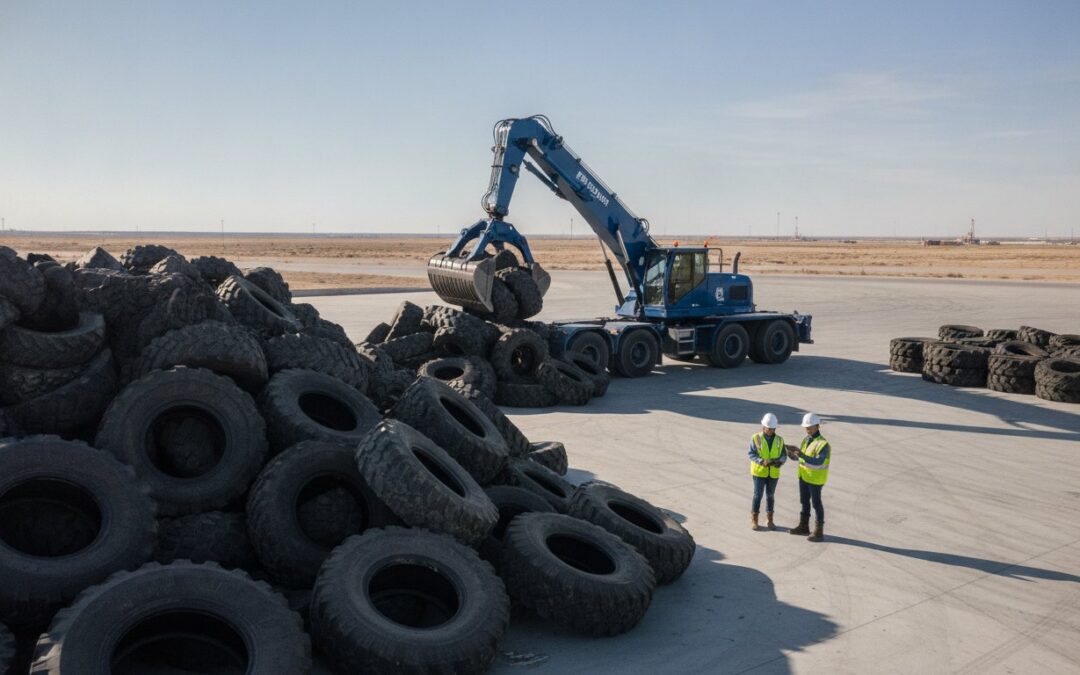
Did you know that storing as few as five unregistered off-the-road tires can result in TCEQ fines exceeding $25,000? In the Permian Basin, a growing stockpile isn’t just an eyesore; it’s a massive financial liability that can attract $10,000 per day in penalties. You’ve likely felt the frustration of trying to clear a site only to find that nearly a quarter of Texas landfills refuse tires entirely, while others demand they be shredded before arrival. Managing bulk tire disposal west texas shouldn’t feel like a legal minefield or a logistical nightmare for your operations in Midland, Odessa, or Lubbock.
We understand that your priority is a clean, compliant site without the headache of complex manifest tracking. This guide shows you exactly how to manage large-scale rubber waste efficiently while meeting every 2026 TCEQ requirement. We’ll walk through current storage limits for registered generators, the necessity of the 60-day manifest return, and specialized solutions for heavy OTR or agricultural tires. By the end of this article, you’ll have a clear roadmap to avoid fines and establish a reliable, scheduled pickup system that keeps your industrial or commercial site moving forward.
Key Takeaways
- Learn the 2026 TCEQ storage limits and reporting requirements to protect your business from heavy financial penalties.
- Discover the most efficient logistics for bulk tire disposal west texas, specifically tailored for high-volume industrial and oilfield sites.
- Understand how to manage specialized rubber waste like OTR, agricultural tires, and skid steer tracks that many landfills won’t accept.
- Master the scrap tire manifest system to ensure your documentation is audit-ready and fully compliant with state law.
- Compare the hidden costs of self-hauling against the efficiency of professional on-site collection services in the Permian Basin.
What Qualifies as Bulk Tire Disposal in West Texas?
Bulk disposal isn’t defined by a single number. It’s the point where standard waste services can’t handle your volume. For a commercial fleet or an oilfield site, this usually means hundreds of tires or massive industrial components that won’t fit in a standard bin. In the heat of the Permian Basin, these piles become more than just clutter. They’re significant fire hazards and potential breeding grounds for pests during the rainy season. Managing bulk tire disposal west texas requires specialized equipment because you can’t simply toss OTR tires or 500 passenger tires into the back of a pickup.
Bulk materials encompass a wide range of rubber waste found across our industrial landscape. This includes everything from standard passenger and light truck tires to heavy semi-truck and agricultural tires. We also see significant volumes of industrial rubber waste, such as scrap skid steer tracks, conveyor belts, and industrial hoses. While understanding various tire recycling methods is helpful for sustainability goals, the immediate priority for West Texas businesses is moving these materials off-site safely and legally.
Commercial vs. Industrial Rubber Waste
There’s a clear line between standard commercial waste and industrial scrap. A local tire shop in Lubbock might generate a steady stream of passenger tires. An oilfield operation near Odessa deals with heavy-duty OTR tires and solid rubber components. The scale is different. When you’re dealing with industrial-grade rubber, the weight alone makes self-hauling impossible. Large-scale piles in the Permian Basin are under constant scrutiny. TCEQ regulations are strict because a tire fire in our dry climate is nearly impossible to extinguish and creates severe environmental damage. If your stockpile has grown beyond a single trailer load, you’ve moved into the category of industrial bulk waste.
Geographic Focus: Midland, Odessa, and Lubbock
Regional dynamics in the South Plains make disposal tricky for many operators. Many local landfills have specific rules and fees that can change without much notice. Some facilities refuse whole tires entirely. If they do accept them, they often require them to be split or quartered first. This creates a massive labor burden for businesses in Midland and Odessa. Proximity is the biggest hurdle. Hauling bulk loads over long distances increases your fuel costs and liability. Working with a dedicated hauler who understands the local landscape ensures your waste moves from your yard to a compliant facility without unnecessary delays.
TCEQ Regulations and Compliance for Texas Businesses
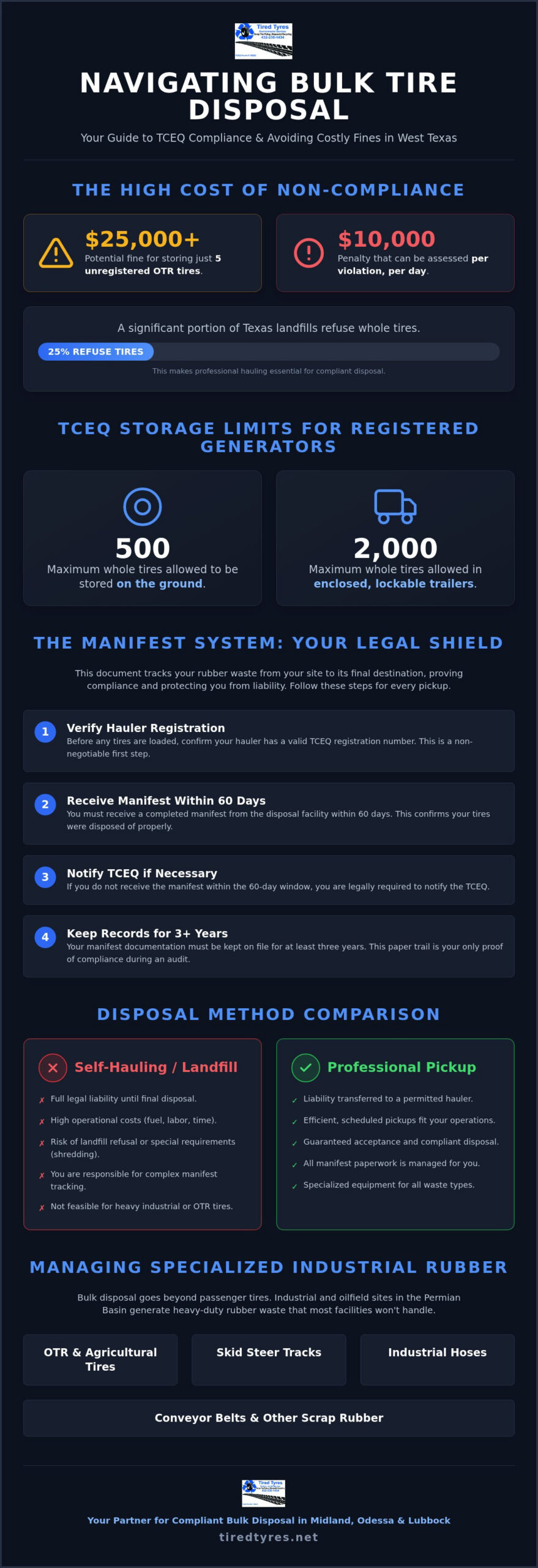
Compliance isn’t just about following rules; it’s about protecting your bottom line from massive enforcement actions. The Texas Commission on Environmental Quality (TCEQ) oversees every aspect of scrap tire management under Title 30 of the Texas Administrative Code. If you’re a registered generator, you can store up to 500 tires on the ground or 2,000 in enclosed, lockable trailers. Exceeding these limits without the right permits invites immediate scrutiny. In 2025 alone, the TCEQ issued over $2.4 million in penalties for improper scrap tire management. For businesses needing bulk tire disposal west texas, the manifest is your primary shield against these liabilities. Hiring a permitted hauler isn’t just a convenience. It’s a legal necessity that ensures you aren’t held responsible for tires after they leave your property.
The backbone of this legal defense is the Scrap Tire Manifest. This document tracks rubber waste from your site to the final authorized disposal facility. It’s essential because the TCEQ holds the generator responsible until the waste reaches a permitted destination. Research into the environmental impacts of tires highlights why these regulations are so strict. Improperly managed piles lead to groundwater contamination and toxic fires that are nearly impossible to extinguish. A properly completed manifest proves you’ve taken the required steps to mitigate these risks and followed the law.
The Manifest Process Step-by-Step
Stay compliant by following a strict documentation routine every time you clear your yard. When a hauler arrives, verify their TCEQ registration number before any tires are loaded. You must receive a completed manifest from the disposal facility within 60 days of the tires leaving your property. If you don’t receive this confirmation, you’re required to notify the TCEQ. Keep these records on file for at least three years. This paper trail is the only way to prove you aren’t responsible for any illegal dumping that might occur downstream. If you’re overwhelmed by the paperwork, our team handles the documentation as part of our standard service.
Landfill Rules and Pre-Processing Requirements
Many West Texas landfills have strict acceptance policies that make bulk disposal difficult. A 2026 study found that 24% of Texas landfills refuse tires entirely. Those that do accept them usually require you to shred, split, or quarter them first. This pre-processing is labor-intensive and expensive for bulk tire disposal west texas. When you calculate the man-hours and equipment wear needed to prep hundreds of tires, the landfill fee often becomes your most expensive option. You can find more detail on these specific requirements in our guide on Texas Tire Disposal Regulations: A 2026 Guide for West Texas Businesses. Pre-processing is a burden you don’t have to carry if you use a professional collection service.
Comparing Disposal Methods: Landfill vs. Professional Pickup
Many operators assume that self-hauling is the cheapest way to handle bulk tire disposal west texas. On the surface, the math seems simple. You pay a tipping fee and use your own trucks. However, a 2026 study of 300 Texas landfills found that while the median rate is $47.80 per ton, the logistical burden tells a different story. For industrial sites in Midland or Odessa, the time spent prepping, loading, and transporting tires often costs more than the disposal itself. Professional pickup isn’t just about moving rubber; it’s about reclaiming your team’s time and reducing operational risk.
Scalability is where professional services truly outshine municipal options. While a landfill might handle a dozen tires from a residential customer, they aren’t equipped for the rapid arrival of 100+ industrial tires. Professional haulers use specialized trailers designed for high-volume loads. This means your scrap skid steer tracks, OTR tires, and conveyor belts are moved in a single, efficient trip rather than multiple, time-consuming runs to a local facility.
The Hidden Costs of Self-Hauling
- Labor and Equipment: Loading bulk tires by hand takes hours. If you’re dealing with OTR or agricultural tires, you’ll need specialized trailers and lift equipment your fleet might not have.
- Vehicle Wear: Scrap rubber is heavy and abrasive. Hauling bulk loads puts significant strain on your trucks, leading to increased maintenance or unexpected repairs.
- Landfill Restrictions: Nearly a quarter of Texas landfills refuse tires entirely. If you drive to a facility only to be turned away, you’ve wasted fuel and man-hours.
Even facilities like the West Texas Regional Disposal Facility in Abernathy, which charges $40.94 per ton, require whole tires to be processed before acceptance. This means your crew must spend time splitting or shredding rubber before you even hit the road. When you factor in these hidden expenses, the “cheap” landfill option quickly becomes a financial drain on your project.
Efficiency of Scheduled Collection
Reliable collection changes the dynamic of your yard. Instead of letting a stockpile grow into a fire hazard or a mosquito breeding ground, scheduled pickups keep your site clear and organized. This is especially critical for oilfield and agricultural operations where space and safety are at a premium. A professional service brings the right equipment to handle everything from semi-truck tires to scrap rubber in a single visit. You don’t have to worry about landfill hours or processing requirements; the hauler takes that burden off your shoulders. For a deeper look at local logistics, check out our guide on Reliable Tire Disposal in Midland, Odessa & Lubbock: The 2026 West Texas Guide. Customizing your collection frequency ensures your waste management stays invisible and effective.
Specialized Disposal for OTR, Agricultural, and Industrial Rubber
Managing bulk tire disposal west texas often involves materials that don’t fit into standard categories. While passenger tires are common, the real challenge for West Texas industries lies in the “big stuff.” Semi-truck tires, OTR (Off-the-Road) tires, and massive agricultural implements require more than just a large trailer. They need specialized lifting equipment and a deep understanding of weight distribution for safe transport. These items are the backbone of our local economy, but they’re a significant liability once they reach the end of their service life.
The scale of these tires means that a single stockpile can quickly exceed TCEQ storage limits. Because of their size and weight, they can’t be processed by the same machinery used for standard tires. This creates a bottleneck for many businesses that try to handle disposal in-house. You need a partner who understands the unique physics and legal requirements of moving industrial-grade rubber across the Permian Basin.
OTR and Agricultural Tire Logistics
Standard tire collection equipment isn’t built for OTR sizes. A single OTR tire used in mining or heavy construction can weigh thousands of pounds. This makes manual loading both impossible and dangerous. For farming operations near Lubbock or oilfield sites near Odessa, getting these off the property is a major logistical hurdle. We use specialized machinery to ensure safe loading and transport, preventing damage to your yard and ensuring every load is secured for the highway. You can learn more about these specific requirements in our Commercial Tire Disposal in Midland, Odessa & Lubbock: The 2026 Guide. Proper logistics are the only way to move these massive items without risking site safety.
Industrial Rubber Waste: Tracks, Belts, and Hoses
Industrial waste goes beyond just tires. Many mining and oilfield operations generate significant amounts of scrap skid steer tracks, conveyor belts, and industrial hoses. These materials are notoriously difficult to process. Most standard waste services and municipal landfills reject them immediately. This is because they’re often reinforced with heavy steel or high-strength fibers that destroy standard shredding equipment. Leaving these materials in a stockpile isn’t just a waste of space. Reinforced rubber can trap water, leading to the same mosquito and fire hazards as tire piles.
Because these items don’t count as “standard” tires, they often fall through the cracks of a typical waste management plan. However, they’re still subject to environmental oversight. We specialize in these hard-to-handle materials, providing a clear path for bulk tire disposal west texas that includes every type of rubber scrap on your site. If you have a yard full of OTR tires or reinforced tracks, schedule a professional collection to clear your site and maintain full compliance.
Partnering with Tired Tyres for Bulk Disposal in West Texas
Managing large scale rubber waste requires more than just a truck and a trailer. It requires a partner who understands the local industrial landscape and the strict regulatory environment of the Permian Basin. Tired Tyres provides a professional, streamlined solution for bulk tire disposal west texas, serving as the corrective force for businesses burdened by growing stockpiles. Our team focuses on removing the logistical weight from your shoulders. We ensure that every load is handled with precision and that your business remains in good standing with state authorities. You don’t have to guess about legality or worry about site safety when you work with experienced specialists.
Our process is designed for maximum efficiency. It begins with a straightforward initial quote based on your specific volume and tire types. Once we agree on the scope, we handle the heavy lifting. We arrive with specialized equipment capable of managing everything from standard passenger tires to massive OTR components. After collection, we provide the essential documentation to close the loop on your liability. We track every load until it reaches a permitted facility, ensuring you receive your completed manifest within the required timeframe. This transparent approach builds the trust necessary for long term industrial partnerships.
Our Service Areas and Capabilities
We provide comprehensive coverage across the South Plains and the Permian Basin. Our primary service hubs include Midland, Odessa, and Lubbock, but we extend our reach to the surrounding oilfield and agricultural sites. We aren’t limited by the size or type of rubber waste on your property. Our collection capabilities include:
- Passenger and light truck tire collections
- Semi-truck and heavy-duty fleet tires
- Agricultural tire collection for tractors and implements
- OTR (Off-the-Road) tires for mining and construction
- Industrial scrap including skid steer tracks, conveyor belts, and hoses
Requesting a bulk site assessment is simple. We evaluate your stockpile and determine the best equipment for a quick, clean removal. Whether you have a one-time clearing project or need a reliable, scheduled pickup for ongoing waste, we scale our services to fit your operational needs.
The Tired Tyres Advantage
The Tired Tyres advantage lies in our direct and honest communication. We don’t hide behind complex contracts or vague promises. You get a clear timeline and a professional crew that respects your site’s safety protocols. Compliance is our standard, not an add-on. We maintain all necessary permits to ensure every commercial load is fully documented and legally transported. This commitment to correctness protects your business from the scrutiny of environmental audits. We handle the mess so you can focus on your core operations. Contact Tired Tyres for a bulk tire disposal quote today and experience a no-hassle approach to professional rubber waste management.
Secure Your Site and Compliance Today
Clearing your yard isn’t just about making space; it’s about protecting your business from the $10,000 per day fines that come with improper stockpiling. By following TCEQ manifest requirements and choosing professional collection over labor-intensive landfill trips, you ensure your operations in Midland, Odessa, or Lubbock remain audit-ready. Managing bulk tire disposal west texas effectively means handling everything from standard semi-truck tires to reinforced conveyor belts with the right equipment and documentation. You’ve seen how specialized OTR logistics and reliable manifest tracking can turn a major headache into a seamless part of your maintenance routine.
Don’t let a growing pile of rubber waste become a financial or environmental liability for your team. As a TCEQ permitted hauler specialized in OTR and industrial rubber, Tired Tyres is ready to provide the professional support your site requires. Request a Bulk Tire Pickup Quote from Tired Tyres today to secure your operations and ensure full regulatory compliance. It’s time to clear the clutter and move forward with a cleaner, safer, and more efficient workspace.
Frequently Asked Questions
Is it illegal to store large piles of tires on my property in Texas?
Yes, storing large quantities without a permit is illegal under TCEQ rules. Registered generators are capped at specific limits: 500 tires on the ground or 2,000 in locked containers. Exceeding these amounts can lead to significant daily penalties. These regulations prevent fire hazards and pest issues common in our climate. If your stockpile has grown beyond these limits, you must arrange for professional collection to avoid potential enforcement actions.
How much does bulk tire disposal usually cost in West Texas?
Costs for bulk tire disposal west texas vary based on tire type, volume, and site location. Industrial units like OTR or agricultural tires are usually priced by weight or size because they require specialized handling. While some landfills charge a per-ton fee, those rates don’t account for the labor or equipment needed for transport. We provide tailored quotes to ensure you only pay for the specific logistics and volume your operation requires.
Do I need a special permit to transport my own scrap tires?
You don’t necessarily need a transporter permit to move tires you generated, but you must still follow all TCEQ manifest rules. This means you’re responsible for documenting the transfer and confirming the destination is a permitted facility. Self-hauling often becomes impractical for large volumes because standard trailers aren’t built for the weight of bulk industrial rubber. Most businesses use a permitted hauler to simplify the legal paperwork and reduce their liability.
Can I take whole tires to the Midland or Lubbock landfills?
Most municipal landfills in the South Plains require tires to be split, quartered, or shredded before acceptance. Facilities often refuse whole tires because they tend to “float” back to the surface of the waste pile over time. Pre-processing tires is a labor-intensive task that requires expensive machinery. Using our collection service removes this burden, as we transport your scrap to facilities specifically equipped for large-scale, whole-tire processing and recycling.
Does Tired Tyres handle OTR and tractor tires?
We specialize in the collection of heavy-duty rubber waste, including OTR and agricultural tractor tires. These large-scale items require specialized lifting equipment and trailers that standard waste haulers don’t possess. We safely load and transport these massive units from your yard, ensuring they’re documented correctly for state compliance. Our team is equipped to handle the unique logistics involved in moving these heavy industrial components across the Permian Basin and South Plains.
What is a tire manifest and why does my business need one?
A tire manifest is a legal document tracking the movement of scrap tires from your site to a permitted facility. The TCEQ requires this paper trail to prevent illegal dumping and ensure environmental safety. Your business must receive a completed copy within 60 days of the tires leaving your property. You must keep these records for at least three years to prove you’ve complied with Texas environmental laws during a regulatory audit.
Do you dispose of scrap conveyor belts and skid steer tracks?
We provide professional collection for various industrial rubber items, including scrap skid steer tracks and reinforced conveyor belts. These materials are often rejected by standard garbage services because their internal steel or fiber reinforcement destroys standard shredding machinery. We understand the specific disposal paths for these industrial materials. Our service ensures that your non-tire rubber waste is moved off-site legally and efficiently alongside your standard tire scrap piles.
How quickly can Tired Tyres perform a bulk site cleanup?
Our response time depends on your specific location and the volume of the rubber stockpile. We prioritize scheduling for our commercial accounts in Midland, Odessa, and Lubbock to help you maintain site safety. After an initial assessment of your bulk tire disposal west texas needs, we provide a clear timeline for the cleanup. Our goal is to remove the liability from your site as quickly as our specialized equipment and route logistics allow.