
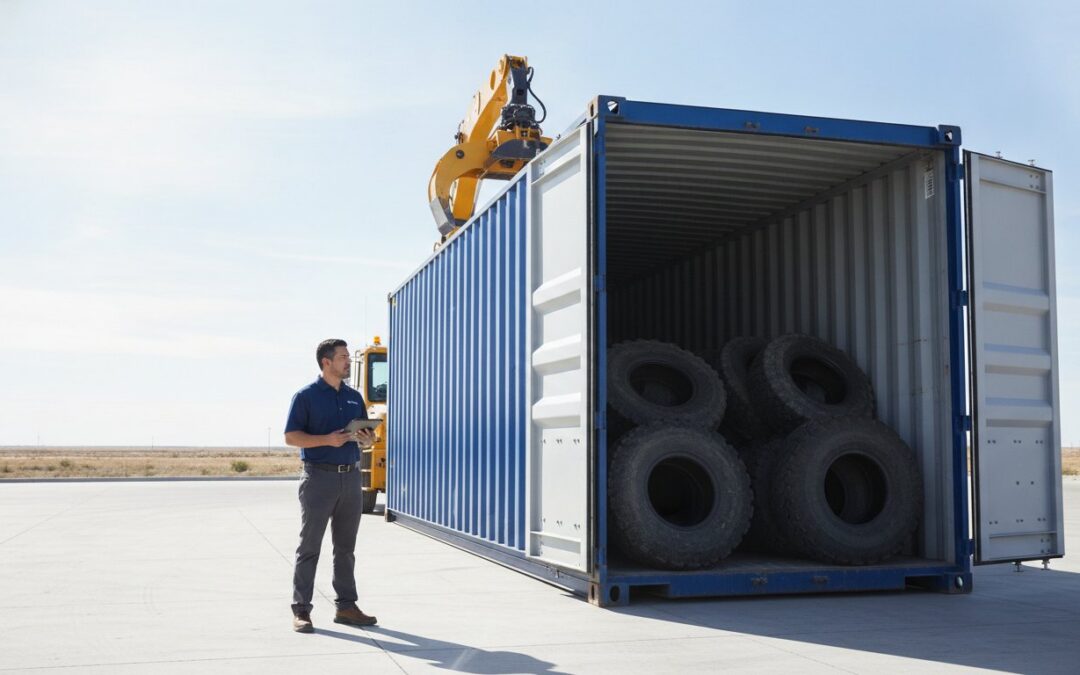
Did you know that improper scrap tire storage can lead to TCEQ penalties as high as $25,000 per violation, per day? In the Permian Basin, a growing pile of rubber isn’t just an eyesore; it’s a significant financial and regulatory liability. If you’ve tried to clear out your yard recently, you already know that the City of Midland landfill won’t accept whole tires, and local trash services will simply leave them behind. This guide covers everything you need to know about setting up a commercial tire pickup schedule Midland fleet managers and facility owners can use to reclaim their space and protect their bottom line.
It’s frustrating to watch your facility footprint shrink because of waste that’s difficult to move. You need a solution that handles the heavy lifting while keeping your paperwork in order for state inspectors. We’ll show you how to transform that pile of scrap into a seamless, scheduled operation that runs in the background. This article previews the essential steps for maintaining compliance with state-approved manifests, managing specialized industrial rubber like skid steer tracks, and ensuring your business stays ahead of stringent West Texas environmental enforcement.
Key Takeaways
- Understand why municipal services in Midland won’t handle commercial rubber and how a proactive schedule prevents massive regulatory fines.
- Learn the step-by-step process for setting up a commercial tire pickup schedule Midland fleet managers use to keep their facilities clear.
- Discover how to properly document every haul using state-approved TCEQ manifests to protect your business during audits.
- Find out how to categorize diverse waste streams, including OTR tires, agricultural rubber, and industrial scrap like conveyor belts.
- Determine the ideal collection frequency for your site to eliminate safety hazards and maximize operational space.
Why Businesses Need a Dedicated Commercial Tire Pickup Schedule in Midland
Many businesses in the Permian Basin treat scrap tires as a problem for “later.” This reactive approach often backfires when a facility runs out of space or faces a surprise inspection. Setting up a commercial tire pickup schedule Midland companies can trust is the only way to move from crisis management to smooth operations. Proactive scheduling ensures your yard stays clear, allowing your team to focus on their actual work rather than maneuvering around stacks of old rubber. It’s about maintaining a professional site and a safe environment for your staff.
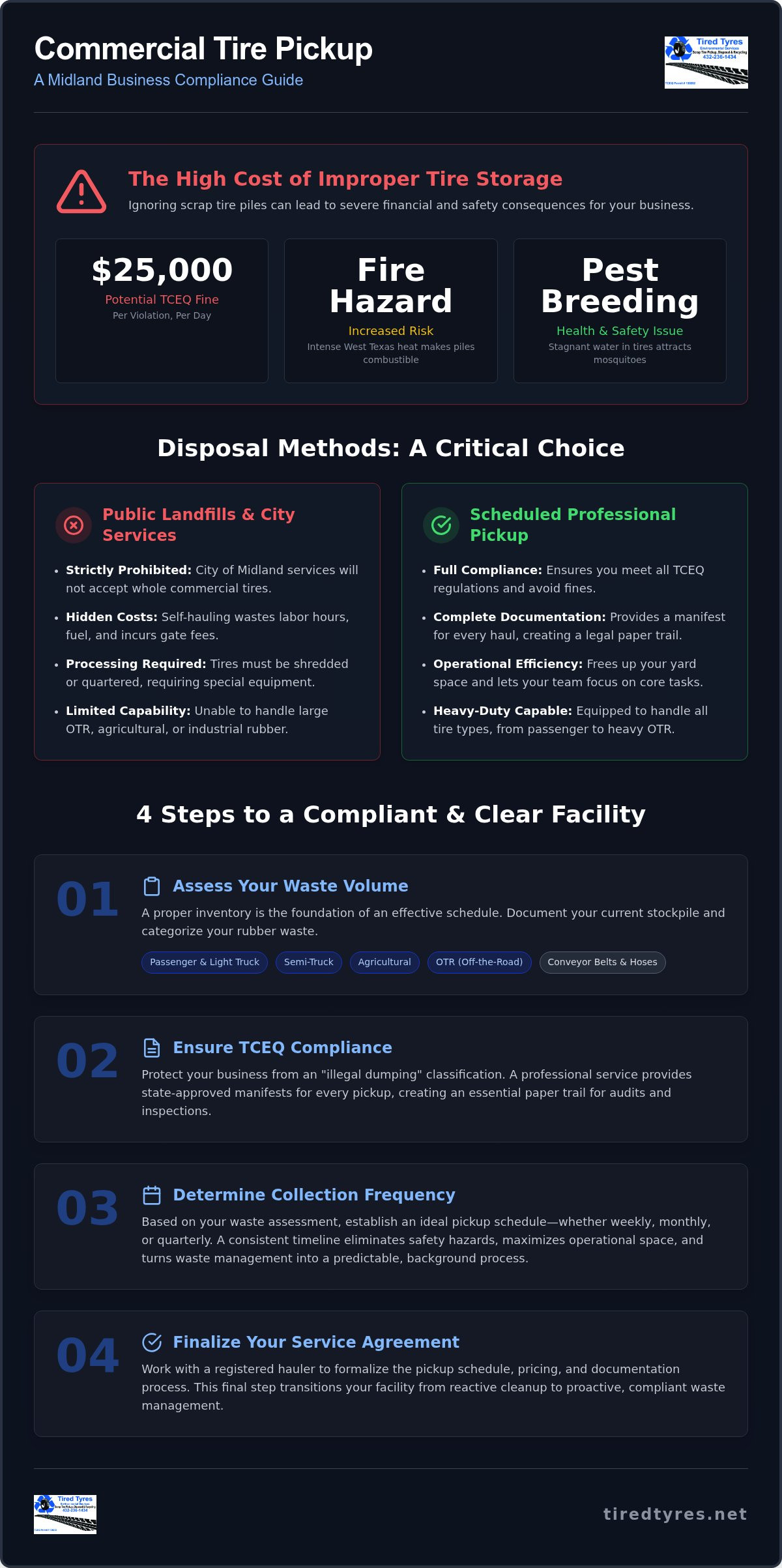
West Texas conditions add unique pressure to this issue. The intense summer heat increases the risk of tire fires, which are notoriously difficult to extinguish. Stagnant water trapped inside tires also creates the perfect breeding ground for pests like mosquitoes. By removing these hazards on a fixed timeline, you protect your employees and your property from preventable risks. A reliable schedule turns a potential fire hazard into a managed waste stream.
The Limitations of Public Landfills and City Services
The City of Midland Solid Waste Division is designed for residential needs, not industrial volumes. Their services strictly prohibit commercial tire disposal. Many business owners think they can save money by self-hauling to the landfill, but the hidden costs add up quickly. You’ll deal with several bottlenecks if you go this route:
- Labor hours spent loading, driving, and waiting in line.
- High fuel consumption for hauling heavy loads.
- Gate fees and access charges for vehicles without specific permits.
- Strict requirements for tires to be shredded or quartered before arrival.
Standard municipal stations also lack the equipment to handle OTR (Off-the-Road) or heavy agricultural tires. Trying to force these into public waste streams usually leads to rejected loads and wasted time. Professional collection services are equipped for these heavy-duty items, ensuring they enter the tire recycling process without causing operational delays for your business.
Avoiding the Financial Trap of “Illegal Dumping”
Under TCEQ guidelines, storing too many tires without a permit or using an unregistered hauler can qualify as illegal dumping. In 2025, the state issued over $2.4 million in penalties for these violations. Fines can reach $25,000 per day for every day the violation continues. It’s a massive financial risk that can be easily avoided with a documented waste management plan.
A recurring schedule provides a consistent paper trail. Every haul generates a manifest that proves you followed the law. This documentation is your best defense during an audit or inspection. Understanding the nuances of Texas tire disposal regulations is vital for any business operating in the Midland area. It’s not just about getting rid of trash; it’s about protecting your company’s legal standing.
Step 1: Assessing Your Commercial Tire and Rubber Waste Volume
Before you can clear your yard, you must understand exactly what is in it. Effective waste management starts with a baseline inventory. Walk your facility and document the current size of your stockpile. You aren’t just looking for a total count; you’re looking at the physical footprint. Is the pile encroaching on fire lanes or property lines? This initial audit is the foundation for setting up a commercial tire pickup schedule Midland businesses use to maintain professional, hazard-free sites. It helps determine if you need a one-time bulk cleanup before starting a recurring service.
Categorizing Your Inventory
Not all rubber waste is handled the same way. Logistically, picking up 200 passenger tires is a different operation than hauling five massive OTR tires. Group your inventory into specific categories: Passenger and Light Truck, Semi-Truck, Agricultural, and OTR. This step ensures the hauler brings the right equipment and trailers for the job. It prevents situations where a truck arrives but cannot physically load your largest items.
Don’t forget to account for industrial rubber that often gets mixed into tire piles. Many Permian Basin operations accumulate scrap conveyor belts, skid steer tracks, and industrial hoses. These items are frequently rejected by standard waste services but can be managed through a dedicated schedule. You should also identify “contaminated” rubber. Tires filled with mud, water, or concrete are significantly heavier and require different handling than clean scrap. If you have a diverse mix of materials, it’s helpful to request a site assessment to ensure your categorization is accurate.
Calculating Accumulation Rates
Knowing your current volume is only half the battle. You also need to project how fast that pile will grow back. Review your maintenance records or disposal receipts from the past year to find your average monthly output. Most fleet managers find that their volume fluctuates. For instance, local trucking companies often see spikes during quarterly fleet inspections, while agricultural businesses experience heavy volume during harvest cycles.
Identifying these patterns helps you avoid the “tipping point.” This is the moment when your stockpile becomes a safety risk or a violation of storage limits. If your facility generates 40 semi-truck tires a month but only has safe storage for 20, a monthly pickup won’t be enough. You’ll need a bi-weekly arrangement. Calculating these rates accurately is the most critical part of setting up a commercial tire pickup schedule Midland operators rely on to stay ahead of regulatory requirements and operational bottlenecks.
Step 2: Ensuring TCEQ Compliance and Manifest Documentation
Compliance is the backbone of any industrial operation in the Permian Basin. When you are setting up a commercial tire pickup schedule Midland inspectors expect to see a clear paper trail for every scrap tire that leaves your property. This isn’t just about getting rid of waste; it is about proving the waste reached a legal destination. The Texas Commission on Environmental Quality (TCEQ) requires specific documentation for the transport and disposal of all “split, whole, or scrap” tires. Working with a permitted tire hauler in Texas ensures that your business stays on the right side of these regulations.
The most critical document in this process is the scrap tire manifest. This form tracks the journey of the rubber from your facility to the final processing site. A valid manifest must include the hauler’s TCEQ registration number, the exact count or weight of the tires, and the signatures of both the generator and the transporter. Under Texas law, you must retain these records for a minimum of three years. In the event of an audit, these papers are your only proof that you didn’t engage in illegal dumping. An automated schedule simplifies this by creating a predictable, recurring cycle of documentation that fits naturally into your monthly bookkeeping.
The Manifest Workflow for Scheduled Pickups
A recurring schedule removes the “emergency” feel from waste management. When your hauler arrives for a scheduled pickup, the manifest process should be quick and precise. The driver counts the inventory, fills out the manifest, and provides you with a generator copy immediately. Modern transporters often use digital manifests, which are harder to lose and easier to archive than traditional carbon copies. Once the tires reach an authorized recycling or disposal facility, the hauler obtains a final signature. You should receive the completed copy, confirming the tires were legally disposed of, within a few weeks. Always verify your hauler’s permit status through the TCEQ’s central registry before your first haul to ensure they are authorized to operate in Midland County.
Audit Protection for Your Business
Surprise inspections are a reality for Midland businesses. Whether it’s a local fire marshal or a state environmental officer, they will ask to see your waste management plan. A documented pickup schedule serves as powerful evidence of a “good faith” compliance effort. It shows that you have a proactive system to prevent stockpiling and environmental hazards. Using unpermitted “junk haulers” might seem cheaper upfront, but it leaves you legally responsible if those tires end up in a ditch or an alley. If the hauler doesn’t have a permit, the TCEQ considers you the responsible party for any illegal disposal. A professional schedule with a permitted partner is the most cost-effective insurance policy against $25,000-per-day fines.
Step 3: Determining Your Ideal Collection Frequency and Site Logistics
A schedule only works if it matches the reality of your operations. If your frequency is too low, your yard becomes cluttered and unsafe. If it’s too high, you might pay for trucks that aren’t full. Finding the right balance is the core of setting up a commercial tire pickup schedule Midland businesses can maintain long-term. This step requires looking at your storage space and the speed at which your technicians generate waste rubber. Getting this right from the start prevents logistical headaches and keeps your facility footprint optimized for actual work.
Choosing Your Frequency
Your collection interval depends on your volume and available storage space. High-volume tire retailers and large fleet maintenance centers usually require a weekly service. This keeps inventory moving and prevents scrap from interfering with daily shop tasks. For smaller industrial yards or construction firms, a monthly schedule often provides the best balance of cost and convenience. Many businesses also find success with a bi-weekly approach, which offers a safety net for seasonal spikes in fleet maintenance.
Sometimes, a recurring schedule isn’t enough to handle inherited waste. If you’ve recently moved into a new facility with a pre-existing stockpile, you may need to start with bulk site remediations. Clearing out the old rubber first allows you to establish a clean, manageable baseline for your ongoing service. Once the initial backlog is gone, your “set it and forget it” schedule can take over, ensuring the pile never returns and your compliance remains flawless.
Site Preparation and Accessibility
Midland’s industrial zones present unique logistical challenges. From sandy oilfield pads to tight warehouse alleyways, your site must be accessible for heavy collection trucks. These vehicles require significant clearance and a solid turning radius to operate safely. Setting up a commercial tire pickup schedule Midland drivers can easily service means ensuring your scrap pile is located in an area where a trailer can back in without blocking critical fire lanes or loading docks. If you are managing heavy OTR or large agricultural tires, they must be placed on level ground where specialized loading equipment can reach them without risk of tipping.
Proper stacking also makes a difference in your efficiency. While loose piles are easier to create, they are much harder to load. Organized stacking, such as “lacing” tires together, significantly reduces the time a crew spends on your site. This efficiency helps keep your service on track and avoids potential labor surcharges for disorganized waste. If you are unsure if your yard is truck-ready, the best move is to book a site logistics review to optimize your pickup point before your first haul.
Step 4: Finalizing Your Service Agreement with Tired Tyres
The final stage of setting up a commercial tire pickup schedule Midland operators can rely on involves formalizing the partnership. Once you have assessed your volume and determined your frequency, it’s time to lock in a service agreement. This document isn’t just a contract; it’s a roadmap for your facility’s cleanliness and regulatory safety. Unlike national waste brokers who often outsource to unvetted third parties, a local partner understands the specific logistical challenges of the Permian Basin. You need a team that knows the difference between a standard shop pickup and a remote oilfield site collection.
The onboarding process is designed to be efficient. It typically begins with a review of your needs and, if necessary, an initial site assessment. This allows the hauler to confirm truck access and loading requirements. Once the terms are set, you’ll receive your first scheduled haul date. From that point forward, the process becomes “set it and forget it.” Your only responsibility is ensuring the tires are accessible on your designated day. The hauler handles the heavy lifting, the loading, and the generation of the required TCEQ manifests.
What to Include in Your Quote Request
To get an accurate and competitive tire pickup quote in Midland, you must be specific about your waste stream. Vague estimates can lead to logistical delays or incorrect equipment arriving at your site. When you reach out, provide the following details:
- Specific Counts: Estimate the number of passenger, semi-truck, and OTR tires currently on-site.
- Rubber Type: Identify if you have non-tire items like scrap hoses, conveyor belts, or skid steer tracks.
- Contamination Levels: Note if tires are mounted on rims or filled with debris like mud or water.
- Site Access: Mention if the pickup location is in a tight industrial alley or an open yard with plenty of trailer clearance.
Providing photos of your stockpile can also help planners determine the right trailer size. This transparency ensures that the quoted price remains accurate and that your first haul goes off without a hitch.
The Tired Tyres Advantage for Midland Businesses
Choosing a local specialist offers several advantages over a general waste management company. We focus exclusively on rubber waste, which means our equipment is tailored for the job. While standard trash services might struggle with a heavy agricultural tire, our specialized trailers handle OTR and industrial rubber with ease. We understand the local routes through Midland, Odessa, and Lubbock, allowing us to maintain a dependable schedule even during peak seasons.
Most importantly, we prioritize 100% legal disposal and full TCEQ compliance. Every haul is backed by professional documentation that protects your business from the risk of illegal dumping penalties. We aren’t just hauling trash; we’re providing a sustainable solution that keeps the Permian Basin clean and your operations running smoothly. When you’re ready to clear your yard, we’re here to take that weight off your shoulders.
Reclaim Your Space and Secure Your Compliance
Transitioning from a reactive pile of scrap to a proactive management system is the smartest move for any Permian Basin operation. By understanding your volume and maintaining strict TCEQ documentation, you eliminate the threat of heavy fines and environmental hazards. Setting up a commercial tire pickup schedule Midland businesses can trust ensures that your facility remains clean, organized, and ready for inspection at any time. It’s a “set it and forget it” solution that lets you focus on your core business instead of managing rubber waste.
Tired Tyres is a TCEQ Permitted Hauler serving Midland, Odessa, and Lubbock. We specialize in heavy-duty OTR and industrial rubber waste, ensuring every haul is handled with professional equipment and legal manifests. Don’t let scrap tires become a liability for your team. Request Your Custom Commercial Tire Pickup Quote Today and experience a seamless waste management process. We’re ready to help you clear the way for your next project.
Frequently Asked Questions
Does the City of Midland pick up tires for businesses?
No, the City of Midland Solid Waste Division does not collect tires from commercial properties. Placing tires in curbside or alley trash containers is considered illegal dumping under the Midland Municipal Code. Businesses are responsible for arranging their own disposal through a registered transporter. This is often the primary reason for setting up a commercial tire pickup schedule Midland companies can rely on for legal removal and site maintenance.
How often should a tire shop in Midland schedule a pickup?
How often should a tire shop in Midland schedule a pickup?
Most high-volume tire shops in Midland, including professional operators like Mobile Tyre Service, benefit from a weekly pickup schedule to keep their work areas clear and prevent safety hazards. If your shop processes fewer vehicles, a bi-weekly or monthly arrangement might be more efficient. The goal is to ensure your stockpile never exceeds your safe storage capacity or regulatory limits. We recommend reviewing your monthly waste output to determine the most cost-effective interval for your specific location.
Yes, you can include industrial rubber items like scrap conveyor belts, hoses, and skid steer tracks in your collection. Many standard waste services refuse these items because they require specialized handling and processing. By including them in your recurring schedule, you can manage all your rubber waste through a single partner. This simplifies your logistics and ensures that even non-tire rubber is disposed of in accordance with environmental standards.
What documentation do I need for commercial tire disposal in Texas?
You must use a state-approved TCEQ scrap tire manifest for every haul. This document tracks the rubber from your site to the final disposal facility and must include the hauler’s permit number and the count or weight of the tires. Texas law requires businesses to keep these records for at least three years. These manifests serve as your legal proof of compliance during audits by state inspectors or local Midland County officials.
Is there a minimum number of tires required for a scheduled pickup?
While there isn’t a state-mandated minimum, most professional haulers require a baseline volume to make a scheduled stop logistically feasible. This is typically around 25 to 50 passenger tires or a smaller number of larger semi-truck tires. If you have a very low volume, we can help you determine a frequency that allows you to reach a full load before the truck arrives. This approach maximizes your budget and reduces the carbon footprint of the collection.
How do I handle OTR tire disposal on a recurring basis?
Handling OTR (Off-the-Road) tires requires specialized heavy-duty equipment and trailers due to their extreme size and weight. When you include these in your recurring schedule, we ensure the right machinery is dispatched to your site for safe loading. It’s important to place these tires on level ground with clear access for a large trailer. Regular collection prevents these massive items from becoming permanent fixtures that block your facility’s operational flow.
What happens if I miss a scheduled pickup day?
If you miss a scheduled pickup due to site access issues or unexpected closures, you should contact your hauler immediately to reschedule. Keeping your yard clear is a priority to avoid safety hazards and potential fines. We work with our clients to find the next available window in our Midland routes to get your waste removed. Maintaining open communication helps ensure that your facility stays within its storage limits and remains compliant with local regulations.
Are there fines for storing too many tires at my Midland business location?
Yes, the TCEQ can issue significant penalties for improper tire storage or exceeding registration thresholds. Businesses storing more than 500 tires on the ground must register as a generator. Fines for violations can reach up to $25,000 per day. This financial risk makes setting up a commercial tire pickup schedule Midland fleet managers use a critical part of their risk management strategy. Regular removal keeps your inventory well below these dangerous legal thresholds.