
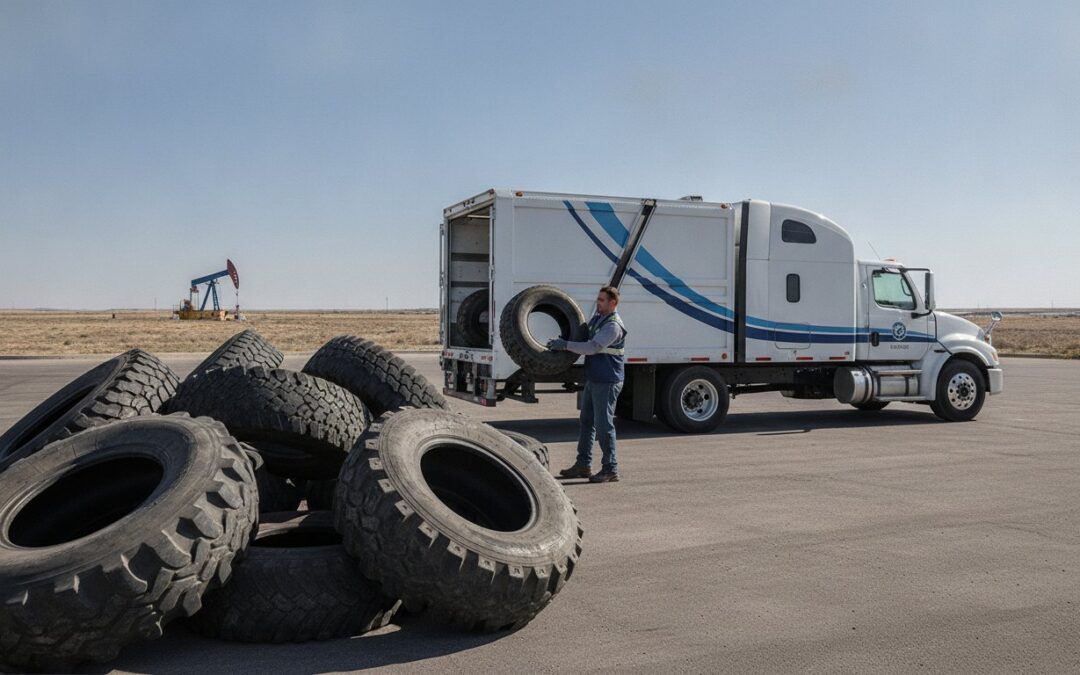
In 2025, the TCEQ issued over $2.4 million in penalties for improper scrap tire management. If you’re searching for tire disposal near me in Midland, Odessa, or Lubbock, you’re likely feeling the pressure of these strict environmental regulations. It’s frustrating to see a growing pile of scrap tires taking up space in your shop, especially when you know that improper storage can lead to daily fines as high as $25,000. Most West Texas business owners want to follow the law, but the difficulty of transporting large OTR or semi-truck tires often makes compliance feel like an uphill battle.
This article will show you exactly how to safely and legally dispose of passenger, commercial, and industrial tires while staying compliant with current state rules. You’ll discover the specific landfill policies in Lubbock, the latest 2026 reporting requirements for generators, and how to find a permitted hauler to handle the heavy lifting. By the end of this guide, you’ll have a clear plan to clear your yard quickly and protect your business from costly environmental violations.
Key Takeaways
- Learn the 2026 TCEQ manifest requirements to keep your West Texas business compliant and avoid heavy environmental penalties.
- Understand the specific tire disposal policies for Midland and Lubbock landfills, including rules for splitting or quartering tires.
- Evaluate the logistical challenges of self-hauling versus choosing professional tire disposal near me for large-scale semi-truck or OTR pickups.
- Discover specialized solutions for industrial rubber waste, such as scrap conveyor belts and skid steer tracks common in the Permian Basin.
- Identify the key differences between municipal drop-off events and scheduled commercial collection services to save time and yard space.
Where to Get Rid of Old Tires in West Texas
Tire disposal is the strictly regulated process of removing scrap rubber from your property to a permitted facility. This system exists to prevent significant environmental hazards. Abandoned tires often become breeding grounds for mosquitoes or fuel for toxic, hard to extinguish fires. If you’re searching for tire disposal near me in the Permian Basin or South Plains, you’ll find that options vary significantly based on whether you’re a homeowner or a business operator. While residential “free” events are helpful for cleaning out a backyard, they rarely accommodate the bulk quantities generated by commercial shops or oilfield sites.
Tire stockpiles are a growing problem across the Permian Basin. Rapid industrial activity means more heavy equipment and more scrap rubber. Leaving these piles to sit isn’t just an eyesore; it’s a legal liability. Texas law limits how many tires you can store without a specific permit. Proper management through the Tire recycling process ensures these materials are eventually repurposed into roads or fuel instead of becoming a permanent environmental burden. For businesses, the goal is to move these items off-site before they trigger a TCEQ inspection.
Midland and Odessa Landfill Rules
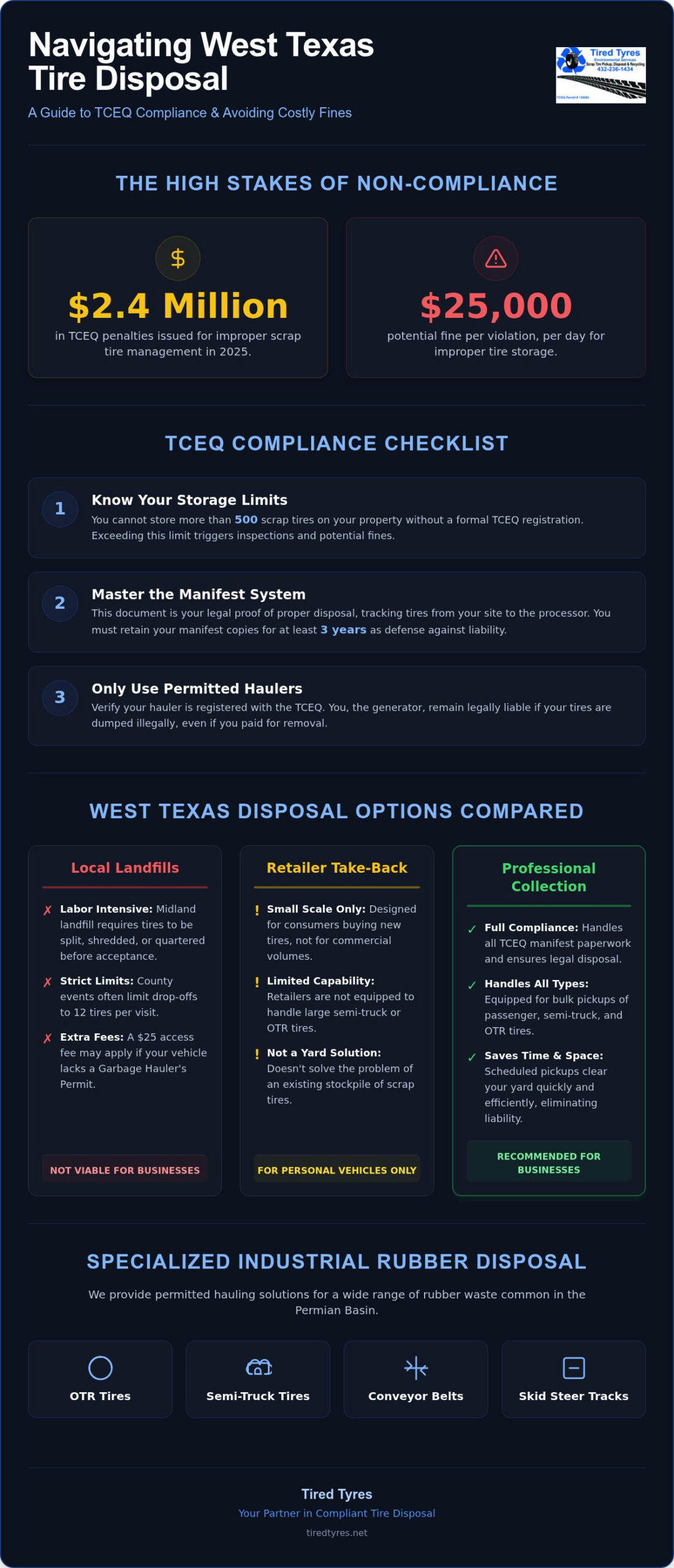
Local landfill policies in Midland are quite restrictive. The City of Midland landfill does not accept whole tires. To dispose of them there, you must split, shred, or quarter them first. This requirement adds a massive labor burden to any business trying to manage its own waste. Residents can look for periodic county events at the Road and Bridge department, which have collected over 24,000 tires to date. These events usually limit drop-offs to 12 tires per visit. If you arrive at the landfill with a vehicle lacking a Garbage Hauler’s Permit, expect to pay a $25 access fee on top of any other costs.
Retailer Take-Back Programs
In cities like Lubbock, retail tire shops are a common choice for single-set replacements. These shops are generally required to accept your old tires when you buy new ones. They charge a small environmental fee to cover their own collection costs. This works well for a personal truck, but it isn’t a viable solution for businesses with large fleets or heavy industrial equipment. Retailers aren’t equipped to handle OTR (Off-the-Road) tires or bulk quantities from commercial operations. If you have a yard full of agricultural or semi-truck tires, searching for tire disposal near me will lead you toward professional collection services rather than a local retail counter.
Understanding Texas Tire Disposal Regulations
The TCEQ doesn’t take scrap tire management lightly. In 2025, the agency issued over $2.4 million in penalties for improper waste handling across the state. If you’re a business owner in Midland or Odessa, searching for tire disposal near me is the first step in protecting your company from these costs. Under Texas law, specifically 30 TAC Chapter 328, you can’t store more than 500 scrap tires on your property without a formal registration. Exceeding this limit without the right paperwork puts you at risk of daily fines that can range from $10,000 to $25,000 per violation.
The core of Texas regulation is the manifest system. This multi-part document tracks every tire from the point of generation to its final destination. It’s your primary proof that you followed the law. Even if you pay someone to haul your tires away, you’re still legally liable if they dump them in a Lubbock canyon or behind an Odessa warehouse. This paper trail ensures that scrap rubber ends up in authorized facilities that leverage tire-derived fuel benefits or other recycling pathways. Using a professional service ensures this documentation is handled correctly every time.
The Role of Permitted Haulers
A permitted hauler is more than just a contractor with a trailer. They must be registered with the TCEQ and carry a specific hauler identification number. You should always verify this registration status before any tires leave your site. Once the tires are collected, you’re required to keep your copies of the manifests for at least three years. These records are your only defense during a surprise state inspection. Beyond the legalities, professional hauling prevents unmanaged tire piles from leaching chemicals into local groundwater, a major concern for Permian Basin communities. For a deeper look at your specific responsibilities, read our Texas Tire Disposal Regulations: A 2026 Guide for West Texas Businesses.
Avoiding Illegal Dumping Fines
Many property owners mistakenly believe they can use tires as “clean fill” for erosion control or to level out a low spot on private land. In Texas, this is considered illegal dumping unless you have a specific permit for a Land Reclamation Project Using Tires. Illegal piles are a major fire risk and a public health hazard. If you see illegal dumping in your area, you can report it to local code enforcement in Lubbock or Odessa. Staying compliant doesn’t have to be a headache; you can schedule a professional collection to handle the logistics and paperwork for you.
Tire Pickup vs. Local Recycling Centers: Which is Better?
Deciding between a DIY drop-off and a professional collection service comes down to a simple calculation of time and risk. For a local resident with four old tires, a trip to a Lubbock convenience station is the logical choice. However, for a commercial shop or a ranching operation, self-hauling is rarely as cheap as it looks. When you search for tire disposal near me, the results might show local landfills, but they don’t always show the hidden costs of getting your scrap there. You have to account for staff labor, fuel, and the potential for vehicle damage when loading heavy, dirty rubber.
The hidden logistics of transporting semi-truck or OTR tires are significant. These items are bulky, heavy, and often require specialized equipment to load safely. Most standard trailers aren’t designed to handle the weight of multiple agricultural tires, and improper loading can lead to safety hazards on West Texas highways. To see how professional recovery teams maintain safety standards during vehicle transport and roadside incidents, you can visit RoadRide Recovery. Beyond the physical labor, there’s the issue of landfill limits. As mentioned previously, Midland’s landfill requires tires to be split or quartered before arrival. This means your team spends hours on prep work instead of focusing on billable repairs or field operations.
Centralized processing through a collection service also offers better environmental outcomes. Instead of taking up space in a local landfill where they might eventually surface or trap methane, collected tires are often sent to specialized facilities. This supports the regional economy by feeding industrial recycling streams. For businesses in the Permian Basin, the time saved by outsourcing this task often outweighs the service fee, especially when you consider the peace of mind that comes with professional manifest handling.
When to Use a Collection Service
A scheduled pickup is the most efficient choice if your business generates more than a dozen tires a month. If your yard is starting to look like a storage site, or if you’re struggling to keep up with the labor required to quarter tires for the Midland landfill, it’s time for a professional solution. Bulk quantities frequently exceed the daily limits set by municipal drop-off points. To understand how to streamline your operations, check out our Reliable Tire Disposal in Midland, Odessa & Lubbock: The 2026 West Texas Guide.
Residential vs. Commercial Disposal Needs
Homeowners should continue to utilize municipal events. Lubbock residents, for example, can drop off up to four tires per year at citizen convenience stations without rims. This keeps the city clean and is cost-effective for individuals. Commercial disposal operates on a different scale entirely. High-volume generators need the reliability of a permitted hauler to ensure they don’t hit the 500-tire storage limit that triggers TCEQ registration. Professional collection keeps your shop floor clear and ensures your business supports a sustainable, compliant disposal network in West Texas.
Disposing of OTR, Agricultural, and Industrial Rubber
Industrial operations in the Permian Basin and South Plains face a waste challenge that goes far beyond standard passenger vehicles. If you manage an oilfield site or a large scale farm, searching for tire disposal near me often reveals services that only handle car or light truck tires. This leaves a significant gap when you need to clear out massive OTR (Off-the-Road) tires or worn out agricultural equipment rubber. These industrial items are significantly heavier and more difficult to process than standard tires, requiring specialized handling to ensure they don’t sit in your yard as a permanent liability.
Mining and oilfield sites in Midland and Odessa produce some of the largest scrap rubber in the world. Similarly, Lubbock warehouses frequently deal with solid rubber tires and scrap skid steer tracks that are notoriously difficult to move. Agricultural operations on the South Plains also generate large volumes of scrap from tractors and harvesters. Managing these isn’t just about the tires themselves; it includes industrial hoses and scrap conveyor belts that standard waste companies often refuse to touch. These materials require a specific approach to ensure they are removed without disrupting your daily operations.
Managing Bulk Industrial Rubber Waste
Most standard waste management providers aren’t equipped to handle non tire rubber waste like conveyor belts or heavy duty industrial hoses. These materials are often reinforced with steel or synthetic fibers, making them impossible to process with standard shredding equipment. Steel reinforced rubber tracks from skid steers present a similar problem, as the metal content requires specific recycling pathways. If you’re dealing with these materials, it’s essential to work with a provider that understands the nuances of Commercial Tire Disposal in Midland, Odessa & Lubbock: The 2026 Guide. Proper sorting and processing ensure these high density materials are handled in compliance with state environmental goals.
Specialized Equipment for Heavy Rubber Removal
The physical scale of OTR and agricultural tires requires more than a simple pickup truck. Heavy duty trailers and specialized cranes are often necessary to lift and transport these items safely. Professional haulers must carefully manage weight limits to stay within Texas Department of Transportation regulations while moving industrial loads across the Permian Basin. This specialized approach ensures site safety during large scale removal projects, protecting your employees and your property from the risks associated with moving multi ton rubber components. If you have a backlog of industrial rubber, you can request a specialized industrial pickup to clear your site efficiently.
Reliable Scrap Tire Collection with Tired Tyres
Tired Tyres bridges the gap between generating scrap rubber and achieving total regulatory compliance. For businesses across Midland, Odessa, and Lubbock, finding tire disposal near me isn’t just about clearing space; it’s about finding a partner who understands the local landscape. We focus specifically on the needs of West Texas, providing a reliable collection service that keeps your operations running smoothly while ensuring every tire is accounted for through proper TCEQ manifests. Our team handles the complexities of documentation so you don’t have to.
The legal liability for scrap tires remains with the generator until they reach a permitted facility. By choosing a professional collection service, you ensure that your business is protected by a clear paper trail. We provide customized collection schedules tailored to the unique rhythms of auto shops, agricultural operations, and industrial sites. This consistency ensures that scrap piles never reach the 500-tire limit that triggers additional state oversight or registration. We make it easy to maintain a clean, safe, and compliant shop floor regardless of your volume.
Our Permian Basin and South Plains Coverage
Local expertise is critical when navigating the logistics of West Texas. We understand the distance between sites in the Permian Basin and the specific challenges of the South Plains agricultural regions. Our coverage areas include the heart of the Texas oilfield, where we manage high-volume OTR and industrial rubber removal. Whether you’re operating a fleet of semi-trucks in Odessa or a cotton farm near Lubbock, we have the equipment and the local knowledge to handle your waste efficiently. For a more localized look at requirements, see our guide on Tire Disposal in Midland, TX: The Complete Guide to Legal Scrap Removal.
Scheduling Your Bulk Rubber Pickup
Finding reliable tire disposal near me shouldn’t be a complicated task. Clearing your yard is a straightforward process designed to save you time. You can secure a professional solution in three simple steps. First, reach out to identify your location and the types of rubber you need removed. Second, provide an estimated count of your scrap, whether it’s passenger tires, agricultural equipment rubber, or industrial hoses. Finally, we’ll coordinate a pickup time that fits your schedule, ensuring a fast and professional removal.
When you’re ready to request a quote, have your estimated counts and tire types ready. This helps us dispatch the right equipment, from standard trailers for light truck tires to heavy-duty setups for OTR collections. Don’t let scrap rubber become a legal or safety risk for your business. Get a professional quote for your tire disposal needs and ensure your site stays clean and compliant throughout 2026.
Secure Your Business Compliance for 2026
Managing scrap rubber in the Permian Basin doesn’t have to be a source of stress for your operation. You’ve seen how strict TCEQ regulations have become and why local landfills often aren’t a viable option for commercial volume. By choosing a professional service, you eliminate the labor of quartering tires and the legal risk of improper documentation. Whether you’re dealing with standard passenger tires or heavy-duty OTR and agricultural rubber, the right partnership keeps your shop clean and your manifests in order.
Stop letting old inventory take up valuable space or risk heavy fines from unmanaged stockpiles. If you’ve been looking for reliable tire disposal near me, it’s time to transition to a scheduled collection plan that fits your specific needs. Tired Tyres brings specialized industrial expertise and a commitment to 100% compliance directly to your site in Midland, Odessa, or Lubbock. We handle the paperwork and the heavy lifting so you can focus on your core business goals.
Request a Bulk Tire Pickup Quote from Tired Tyres today and experience a cleaner, more efficient workspace.
Frequently Asked Questions
Where can I legally dump tires for free near me?
Free disposal is generally limited to residential programs. Midland County residents can take up to 12 tires to the Road and Bridge department at 2435 E. Highway 80 during specific drop-off events. In Lubbock, residents can dispose of up to four passenger tires per year at any of the four citizen convenience stations. Businesses and commercial shops don’t have free options and must pay for disposal through a permitted facility or hauler.
How many tires can I transport in Texas without a permit?
You can transport up to five scrap tires in your own vehicle without a TCEQ hauler registration. If you’re a business owner searching for tire disposal near me, it’s vital to remember that hauling more than five tires requires a formal permit. Transporting bulk quantities without the proper registration can lead to significant state penalties, so most businesses choose to hire a professional collection service instead.
Does the Midland landfill accept whole tires?
No, the City of Midland landfill does not accept whole tires under any circumstances. All scrap tires must be split, shredded, or quartered before they’ll be accepted for disposal. Additionally, vehicles without a Garbage Hauler’s Permit are subject to a $25 access fee. This labor-intensive requirement is why many local shops prefer scheduled pickups over self-hauling their inventory.
How do I get rid of large OTR or tractor tires in Odessa?
Large-scale industrial rubber requires specialized equipment for safe removal. Standard municipal services and local landfills aren’t equipped to handle the weight or size of OTR or agricultural tires. You’ll need to coordinate with a permitted hauler that uses heavy-duty trailers and cranes. These professionals ensure the tires are moved safely and that all required TCEQ documentation is completed for your records.
What is a scrap tire manifest and why does my business need one?
A scrap tire manifest is a multi-part legal document that tracks tires from your business to their final disposal site. It’s your primary proof of compliance with Texas environmental laws. You’re legally required to keep copies of these manifests for at least three years. If a hauler dumps your tires illegally, the manifest is the only document that protects your business from being held liable for the cleanup costs.
Can I dispose of industrial conveyor belts with regular trash?
Industrial conveyor belts and hoses are typically rejected by standard waste management companies. These materials are often reinforced with steel or synthetic fibers, making them difficult to process in a standard landfill. They require specialized handling at authorized facilities that can manage high-density rubber waste. Professional collection services are the most reliable way to clear these items from your oilfield or mining site.
How much does a professional tire pickup service cost in Lubbock?
Service costs are determined by several factors, including the type of tire, the total count, and your specific location. Most providers calculate fees per unit for passenger tires or by weight for larger agricultural and OTR loads. Because prices fluctuate based on disposal facility fees and logistics, you’ll need to provide your estimated counts to a permitted hauler to get an accurate quote for your tire disposal near me.
What happens to the tires after Tired Tyres picks them up?
Tires are transported directly to permitted processing facilities where they’re prepared for recycling or energy recovery. This often involves converting the rubber into tire-derived fuel or shredding it for use in civil engineering projects. This professional pathway ensures that your scrap rubber stays out of illegal stockpiles and doesn’t become a breeding ground for pests or a fire hazard in the West Texas heat.