

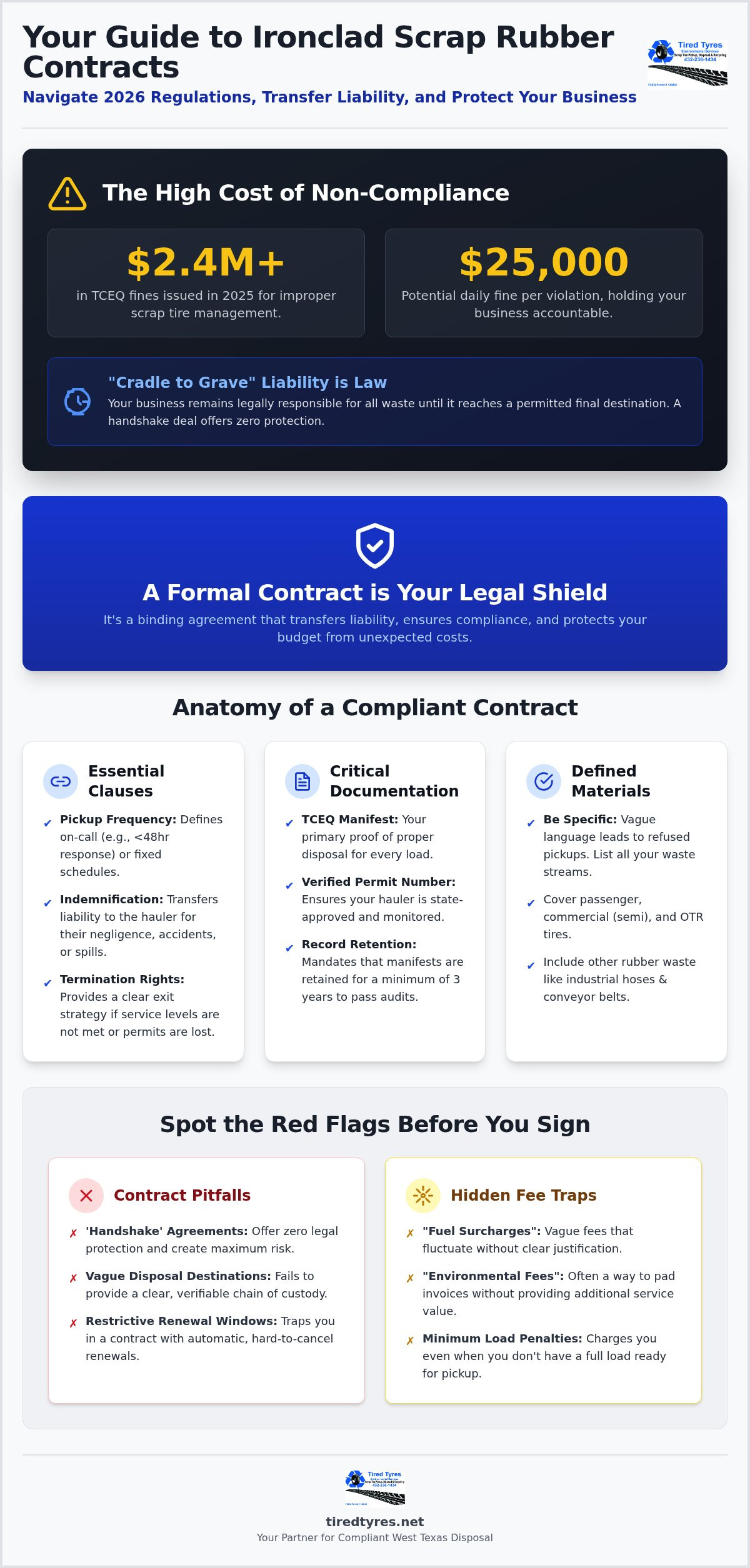
In 2025, the TCEQ issued over $2.4 million in penalties for improper scrap tire management, with daily fines reaching as high as $25,000 per violation. It’s a sobering reminder that your business remains legally responsible for waste long after it leaves your facility. You likely already feel the pressure of rising disposal costs and the constant worry that a missed manifest or an unreliable hauler could trigger an expensive environmental audit. Managing industrial rubber waste shouldn’t feel like a legal gamble.
Knowing what to look for in a scrap rubber contract is the most effective way to transfer environmental liability and stabilize your waste management budget. This 2026 guide provides a clear path through the latest regulatory shifts, including the EPA’s proposed rule changes and TCEQ’s mandatory “cradle to grave” tracking requirements. You’ll learn how to identify essential protective clauses, spot hidden fees before signing, and ensure your documentation stands up to any inspection. We’ll break down the specific compliance markers and reliability standards that turn a simple service agreement into a robust legal shield for your business.
Key Takeaways
- Learn how a formal contract transfers environmental liability from your business to the hauler, providing a necessary legal shield.
- Discover exactly what to look for in a scrap rubber contract to ensure full compliance with 2026 TCEQ manifest and tracking regulations.
- Master pricing structures to avoid hidden billing surprises like unexpected stop fees or minimum load penalties.
- Identify contract red flags, including restrictive renewal windows and vague disposal destinations that create long-term risks.
- Verify that your service agreement covers specialized industrial materials like OTR tires, hoses, and conveyor belts to prevent site clutter.
Why a Formal Scrap Rubber Contract is Essential for Your Business
A scrap rubber contract is more than just a schedule for pickups. It’s a binding legal agreement that defines disposal methods, frequency of service, and the specific transfer of liability. When you’re determining what to look for in a scrap rubber contract, the primary focus must be on how it shields your company from legal risk. Without a written agreement, you’re essentially trusting a third party with your company’s reputation and bank account.
The concept of “cradle to grave” liability is central to waste management. In the eyes of the law, you own your scrap tires and industrial rubber until they reach a permitted facility. If a hauler dumps your waste in a field, the state will hold your business responsible for the cleanup and the fines. A formal contract ensures that your materials enter a legitimate Tire recycling process. This provides the necessary proof of proper disposal that environmental auditors demand. Beyond legal safety, these contracts protect your budget. They prevent the sudden “environmental fees” or “fuel surcharges” that often appear on invoices from uncontracted service providers.
The Legal Risks of ‘Handshake’ Agreements
Handshake deals are common in the Permian Basin, but they offer zero protection. Informal haulers often operate without the necessary state permits for transporting scrap rubber. If they’re caught, your business is part of the investigation. A formal contract establishes a verifiable chain of custody. It ensures you have a paper trail for every pound of material that leaves your yard. This documentation is essential for passing environmental inspections without a hitch. It’s the difference between a routine visit and a costly legal battle.
TCEQ Compliance in West Texas
Local enforcement in Midland, Odessa, and Lubbock has become more stringent in 2026. The Texas Commission on Environmental Quality (TCEQ) requires strict adherence to Texas tire disposal regulations. A key part of what to look for in a scrap rubber contract is a requirement for the hauler to provide a state-approved manifest for every load. Always verify the hauler’s permit number before signing anything. This number is your guarantee that the company is authorized to handle your waste and that they’re being monitored by the state. In West Texas, compliance isn’t optional; it’s a requirement for staying in business.
Essential Clauses Every Rubber Disposal Contract Must Include
Identifying what to look for in a scrap rubber contract requires a focus on the mechanics of the service. Pickup frequency is a primary concern. Your agreement should specify whether pickups happen on a fixed schedule or on-call. If you choose an on-call arrangement, the contract must define a maximum response time, such as 48 hours. This prevents waste from accumulating and creating a fire hazard. Indemnification is another non-negotiable clause. It ensures that if the hauler’s negligence leads to property damage or environmental accidents, your business isn’t held financially liable. Finally, ensure you have clear termination rights. You need a way to exit the agreement if the hauler fails to maintain service levels or loses their state permits.
The Importance of Scrap Tire Manifests
A manifest is the birth certificate of a waste tire. It provides a documented trail from your facility to the recycling plant. In 2026, TCEQ compliance requires businesses to retain copies of these manifests for a minimum of three years. These records are your only defense during a state audit. They verify that your waste followed EPA scrap tire regulations. A valid manifest must include the hauler’s permit number, the exact count or weight of the rubber, and the signature of the receiving facility. Don’t let a hauler leave your site without giving you a signed, legible copy of this document.
Defining Accepted Materials
Vague language regarding rubber waste can lead to service refusals. Your contract should list specific categories like passenger tires, agricultural tires, and scrap hoses. Knowing what to look for in a scrap rubber contract means ensuring all your specific waste streams are covered. If your yard contains heavy equipment waste, verify the agreement includes commercial tire disposal for OTR and semi-truck tires. Industrial items like conveyor belts and skid steer tracks often require specialized equipment for handling. If these aren’t explicitly listed, they may be left behind. Pay close attention to clauses about contaminated rubber. This usually refers to tires filled with water, dirt, or oil. Understanding these definitions upfront helps you avoid surprise surcharges during pickup.
Finding a disposal partner that understands these nuances is essential for West Texas operations. If you’re looking for a team that handles specialized industrial waste and provides full documentation, Tired Tyres can help secure your compliance.
Evaluating Pricing Structures and Service Level Agreements (SLAs)
Cost predictability is the backbone of a sustainable waste management strategy. When analyzing what to look for in a scrap rubber contract, pricing transparency is just as critical as legal compliance. Most providers offer either flat-rate or per-unit pricing. Flat-rate models work well for businesses with consistent, high volumes, as they provide a stable monthly line item. Per-unit pricing is often more efficient for smaller shops where volume fluctuates seasonally. Beyond the base rate, you must clarify stop fees and minimum load requirements. These charges apply if a hauler arrives but there isn’t enough material to justify the trip. A well-structured contract defines these thresholds clearly to prevent billing disputes.
Service Level Agreements (SLAs) are the teeth of your contract. They guarantee specific pickup windows and define how the hauler handles emergency removal requests. You should also confirm who provides the collection equipment. Reliable partners often supply the bins, trailers, or collection racks needed to keep your site organized. This reduces your upfront capital expenditure and ensures the equipment is compatible with the hauler’s trucks. Without these specific metrics, you have little recourse if your yard becomes cluttered with uncollected waste.
Hidden Fees to Watch Out For
Hidden costs can quickly erode the benefits of a low base rate. Fuel surcharges are common in the Permian Basin due to long travel distances, but they should be capped or tied to a transparent index. Some haulers also add environmental compliance fees. While these sound official, they are often just markups unless the contract specifies which regulatory cost they cover. For remote industrial sites in the Midland or Odessa area, difficult access fees can apply if the pickup location requires specialized navigation or extra time. Always insist on a comprehensive list of all potential surcharges before signing. If you are also looking to manage other financial complexities like multi-state and local tax compliance, visit 4-D Services LLC.
Volume-Based Negotiations
High-volume generators have significant leverage during contract talks. If your operations produce large quantities of heavy equipment waste, you can often negotiate better rates for OTR tire collection. Consolidating different types of rubber waste under one agreement can also lead to bulk discounts. Frequency of service is another lever. Moving from an on-call basis to a scheduled weekly or bi-weekly service helps the hauler optimize their routes. This efficiency can result in lower costs for you. Comparing these service levels allows you to find reliable tire disposal partners who offer a balance of price and performance.
Contract Red Flags and Common Pitfalls in Waste Rubber Removal
Recognizing what to look for in a scrap rubber contract often involves spotting what is missing. One of the most common pitfalls is the automatic renewal clause. These provisions often lock businesses into multi-year agreements with no clear opt-out window. If a hauler’s service declines, you could be stuck with uncollected waste and no legal way to switch providers. Another major red flag is the lack of a specific disposal or recycling destination. A legitimate contract should name the permitted facility where your rubber will be processed. Without this, you have no way to verify that your waste isn’t being stockpiled or dumped illegally.
Ownership and risk transfer language must be precise. Vague terms regarding when the hauler takes full responsibility for the material can leave you liable for accidents or environmental spills long after the truck leaves your property. Ensure the contract explicitly states that ownership transfers to the hauler the moment the material is loaded. If a company cannot provide a valid TCEQ registration number directly in the agreement, don’t sign it. This registration is the only proof that the state recognizes them as a legal waste transporter.
The ‘Fly-by-Night’ Hauler Warning
Low-cost, cash-only operators represent a significant danger to your business. These haulers often lack the infrastructure to manage waste properly, which frequently leads to illegal tire dumping in Texas. When the state discovers an illegal dump site, they trace the waste back to the generator. You will be the one paying for the cleanup, regardless of what you paid the hauler. Always verify that your partner is fully insured and bonded. This provides a layer of financial protection if the hauler causes property damage or fails to meet their contractual obligations. Vague ‘disposal’ terms are another warning sign; professional contracts will specify the recycling or energy-recovery methods used.
Ambiguous Liability Language
Watch out for phrases like ‘best efforts’ regarding pickup schedules or compliance. In legal terms, ‘best efforts’ is often a loophole that allows a hauler to bypass their responsibilities when it becomes inconvenient. Understanding what to look for in a scrap rubber contract helps you avoid these vague commitments. Your agreement should instead use ‘guaranteed’ or ‘shall’ to define their obligations. The risk of loss transfer should be triggered by a specific event, such as the signing of the manifest. Price should never outweigh the cost of a legal fine. Saving a few dollars on a cheap hauler is a poor trade-off for a $25,000 daily penalty from the TCEQ.
To avoid these common pitfalls and ensure your waste is handled by a fully permitted team, contact Tired Tyres today for a transparent service agreement.
Partnering with Tired Tyres for Compliant West Texas Disposal
Tired Tyres understands that for West Texas businesses, a disposal agreement isn’t just a service; it’s a primary liability management tool. We’ve built our entire operational model around the exact criteria discussed in this guide. Our commitment is to provide 100% legal, manifest-backed disposal for the Permian Basin. We maintain a fleet of specialized equipment to handle materials that standard haulers often refuse, taking the stress out of your waste management. Our core service list includes:
- OTR Tire Collection and Semi-Truck Tire Collection
- Agricultural Tire Collection and Passenger & Light Truck Tire Collection
- Scrap hose collection and Scrap conveyor belt collection
- Scrap skid steer track collection and Scrap solid tire collection
Why Local Expertise Matters in the Permian Basin
The Permian Basin and South Plains present unique waste management hurdles. Oil and gas operations in Midland and Odessa often generate bulky, difficult-to-transport rubber waste like skid steer tracks and solid tires. We provide prompt, reliable service that respects the fast-paced nature of these industrial sectors. By staying ahead of local regulations in Lubbock, Midland, and Ector counties, we help our clients avoid the common waste tire problems that lead to costly TCEQ scrutiny. Our local presence means we’re directly familiar with the specific environmental audits and site requirements typical for West Texas industrial yards.
Getting Started with a Compliant Contract
Transitioning to a professional, contracted service shouldn’t be a hurdle for your team. We’ve simplified the onboarding process to ensure your business is fully compliant from the very first pickup. When you’re deciding what to look for in a scrap rubber contract, transparency and operational reliability should be your top priorities. Our contracts are designed for the reality of West Texas business: no-nonsense, clear, and legally robust. We handle the complex manifest system and mandatory documentation retention requirements on your behalf. This ensures you always have audit-ready proof of proper recycling without having to manage the paperwork yourself. We provide the predictable costs and reliable schedules your facility needs to stay organized, safe, and focused on production.
Contact Tired Tyres for a transparent scrap rubber quote today.
Secure Your Operations with a Compliant Disposal Strategy
A well-structured scrap rubber contract is your first line of defense against environmental liability and unpredictable waste management costs. By prioritizing legal manifest tracking and clear indemnification clauses, you protect your company from the severe financial penalties associated with improper disposal. Understanding exactly what to look for in a scrap rubber contract allows you to move away from risky handshake deals and toward a partnership built on transparency and accountability. You now have the tools to evaluate pricing structures and avoid the common pitfalls that trap many West Texas businesses in inefficient service agreements.
As a TCEQ Permitted Hauler serving Midland, Odessa, and Lubbock, Tired Tyres specializes in managing the most challenging waste streams. We bring expert knowledge to OTR and industrial rubber collection, ensuring your facility remains organized and compliant with all 2026 regulations. Our team is ready to provide the professional documentation and reliable service your site requires.
Get a Compliant Scrap Rubber Quote for Your West Texas Business. We look forward to helping you simplify your disposal process and secure your facility’s environmental standing.
Frequently Asked Questions
Is a written contract legally required for tire disposal in Texas?
Texas law doesn’t mandate a specific contract format, but it does require you to ensure your waste is handled by a permitted hauler. A formal agreement is the best way to guarantee you’re meeting TCEQ standards for manifest generation and liability transfer. Without one, you’re relying on verbal promises that won’t hold up during a state environmental audit. A contract provides the legal proof of your due diligence.
What is a waste tire manifest and why do I need to keep it?
A waste tire manifest is a state-approved document that tracks scrap rubber from your site to a permitted recycling facility. You’re legally required to keep copies of these for at least three years. These records prove you didn’t dump tires illegally. When evaluating what to look for in a scrap rubber contract, ensure the provider guarantees a signed manifest for every single load they collect from your yard.
How do I verify if a tire hauler is permitted by the TCEQ?
You can verify a hauler’s status by asking for their TCEQ registration number and checking it against the state’s active database. Legitimate haulers will have this number clearly displayed on their vehicles and included in their service agreements. It’s a critical step to take before signing any paperwork. If a hauler hesitates to provide this information, they’re likely operating illegally and could expose your business to heavy fines.
Can I be fined if my contracted hauler dumps tires illegally?
Yes, you can be held responsible for the full cost of cleanup and state penalties if your waste is dumped illegally. Under Texas law, “cradle to grave” liability means the generator is responsible until the rubber reaches a permitted facility. This is why price shouldn’t be your only concern. Your contract must include indemnification clauses that protect you if the hauler fails to follow environmental regulations after leaving your property.
What should I do if a hauler refuses to provide a signed manifest?
If a hauler refuses to provide a signed manifest, don’t allow them to remove the material from your site. A missing signature means the chain of custody is broken, leaving you legally liable for that waste. You should immediately report the incident to the TCEQ and terminate your agreement with that provider. Professional contracts should explicitly state that a signed, legible manifest is a requirement for every pickup they perform.
Are there different contract requirements for industrial rubber like conveyor belts?
Industrial rubber items like conveyor belts, hoses, and skid steer tracks often require different handling than standard passenger tires. Your agreement should specifically list these materials to ensure the hauler has the right equipment for the job. Knowing what to look for in a scrap rubber contract means verifying that specialized industrial waste is covered under the same liability and manifest protections as your scrap tires to prevent site clutter.
How long should a standard scrap rubber disposal contract last?
Most professional disposal agreements last between one and three years. This timeframe provides price stability while allowing you to re-evaluate the service level periodically. You should avoid long-term contracts that lack a clear “out” clause for poor performance. Always check for automatic renewal windows that require you to cancel months in advance, as these can trap you into unfavorable terms if the hauler’s service quality declines.
Can I include multiple business locations under one disposal agreement?
Yes, you can consolidate multiple sites in Midland, Odessa, and Lubbock under a single master service agreement. This often allows for better volume-based pricing and simplifies your administrative work. Each location will still receive its own manifests for tracking purposes, but the billing and service standards remain consistent across your entire operation. It’s a highly efficient way to manage waste for regional industrial or agricultural businesses with several yards.