
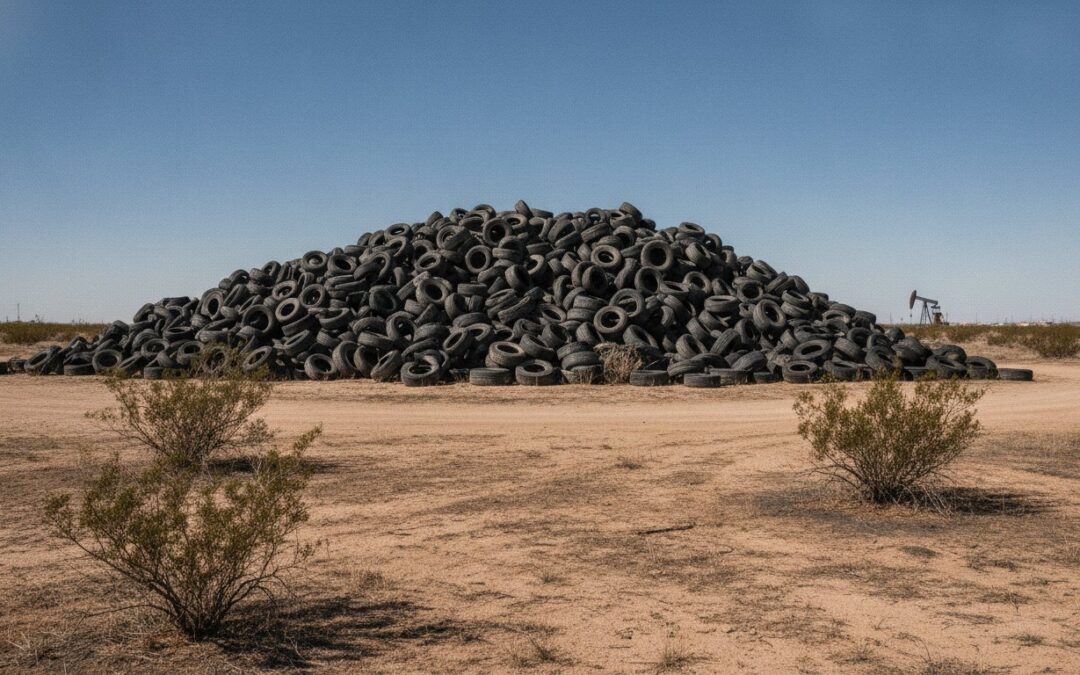
Last Tuesday, a landowner in Odessa discovered over 200 scrap tires dumped in a drainage ditch on his property, facing an immediate cleanup bill he didn’t authorize. It’s a common and stressful scenario for West Texas property owners who find themselves liable for waste they didn’t create. You’re likely concerned about the health risks of mosquito breeding or the complexity of TCEQ manifest requirements. Understanding the specific penalties for improper tire disposal texas is the only way to shield yourself from these liabilities and ensure your business stays compliant.
This guide explains exactly what you need to know about the legal consequences of illegal dumping and the steps to report violations in Midland, Odessa, and Lubbock. You’ll learn the difference between misdemeanor fines and state jail felonies, which can carry penalties of up to $10,000 and significant jail time depending on the weight and volume of the waste involved.
We’ll provide a clear overview of the current penalty ranges, explain how to contact the TCEQ Region 7 office, and show you how to partner with a permitted hauler. By following these steps, you can resolve existing issues and prevent future violations from affecting your bottom line.
Key Takeaways
- Understand how tires are classified as ‘Special Waste’ under Texas law to prevent accidental landfill violations.
- Learn how waste weight determines the penalties for improper tire disposal texas, which can escalate to state jail felonies for commercial-scale dumping.
- Follow a clear protocol for documenting illegal dumping safely and reporting violations to the TCEQ Region 7 office in Midland.
- Protect yourself from cleanup liability by filing an immediate police report if tires are illegally abandoned on your private property.
- Maintain perfect compliance records using a permitted hauler for passenger, OTR, and agricultural tire collection.
Understanding Illegal Tire Disposal Laws in Texas
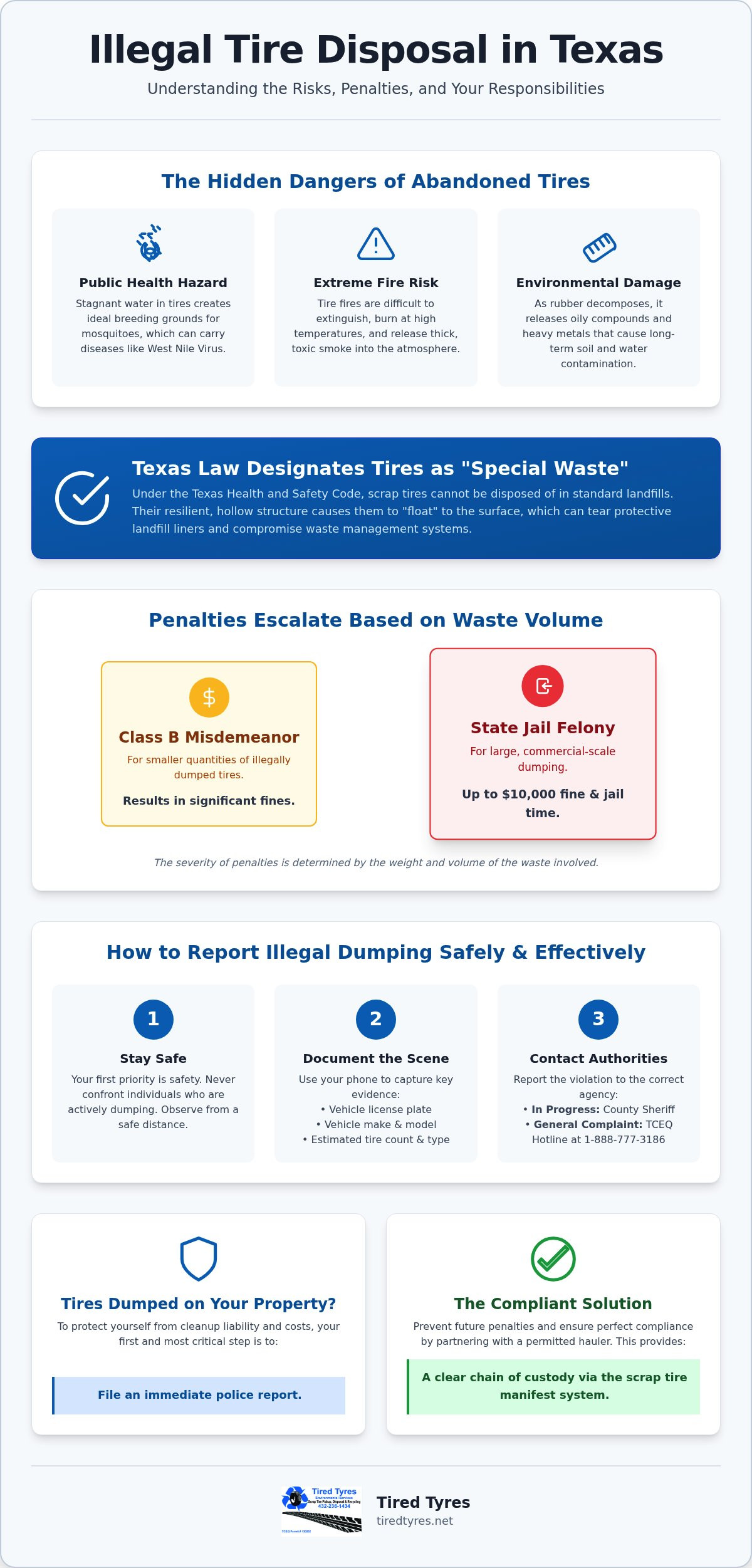
Illegal tire disposal is the unpermitted abandonment of scrap tires on any public or private land. Under the Texas Health and Safety Code Chapter 365, this act is a serious violation of state environmental standards. Texas law classifies tires as “Special Waste,” a designation that separates them from standard household or commercial trash. You cannot simply toss scrap rubber into a standard landfill. Because tires are hollow and resilient, they don’t compact easily. They have a tendency to “float” to the surface of landfill cells over time, which can tear protective liners and disrupt waste management systems. In the arid West Texas climate, these stockpiles create significant risks that local authorities take very seriously.
The Illegal dumping laws in our state are designed to prevent the accumulation of rubber piles that scar the landscape. When tires are left in the sun, they don’t just sit there; they become a liability for the landowner and the community. Understanding the specific penalties for improper tire disposal texas starts with recognizing that the state views every unrecorded tire as a potential environmental threat. Whether you’re managing a fleet in Midland or a farm in Lubbock, the law requires a clear chain of custody for every tire that leaves your possession.
The Role of the TCEQ in Enforcement
The Texas Commission on Environmental Quality (TCEQ) acts as the primary watchdog for tire movement. They maintain a rigorous oversight program that focuses on transporters and processors. For businesses, the most critical tool for staying compliant is the scrap tire manifest system. This document tracks tires from the point of generation to the final disposal site. If a TCEQ inspector visits your facility in Ector County and you can’t produce these records, you’re at risk. Enforcement is particularly aggressive regarding “midnight dumping” in rural areas surrounding Lubbock. Authorities use these manifests to ensure that OTR and agricultural tires don’t end up in unauthorized ravines or backlots.
Public Health and Safety Hazards
Abandoned tires are perfect incubators for disaster. In the Permian Basin, even a single rain event can turn a tire pile into a primary breeding ground for mosquitoes carrying the West Nile Virus. The shape of a tire casing traps stagnant water and protects larvae from the wind. Beyond disease, fire is a constant worry. Tire fires are notoriously difficult to extinguish. They burn at extremely high temperatures and release thick, toxic smoke that can settle over nearby residential areas. As the rubber breaks down, it releases oily compounds that cause long-term soil contamination. These chemicals, combined with the corrosion of metal rims, can ruin the ground’s productivity for years. Avoiding penalties for improper tire disposal texas isn’t just about following rules; it’s about protecting the local environment from these preventable hazards.
Step-by-Step: How to Report Illegal Dumping in Texas
Reporting an illegal dump site requires a balance of caution and precision. If you witness someone actively discarding scrap rubber, your first priority is safety. Never confront the individuals. Instead, document the scene from a safe distance using your smartphone. Authorities need specific details to build a case that leads to the penalties for improper tire disposal texas mandates for violators. High-quality evidence is the most effective way to ensure that the responsible parties are held accountable for their actions.
Capture the vehicle’s license plate number and a clear description of the make and model. Try to estimate the tire count and note the types of tires being dumped. Are they standard passenger tires or heavy-duty OTR and agricultural tires? This information helps investigators determine the severity of the crime. Once you have these details, call the TCEQ Environmental Complaint Hotline at 1-888-777-3186. For local issues within city limits, use the “Lubbock 311” app or Midland’s “Report a Concern” tool to alert municipal code enforcement quickly.
Identifying the Correct Authority
Choosing who to call depends on the situation’s urgency. If you catch someone in the act on your property, contact the County Sheriff immediately. For existing dump sites or ongoing commercial violations, the TCEQ regional offices are the better choice. In the Permian Basin, contact Regional Office 7 in Midland. If you’re in the South Plains, reach out to Regional Office 2 in Lubbock. If you prefer to stay anonymous, most West Texas counties participate in Crime Stoppers programs. These allow you to submit tips without revealing your identity while still providing the information needed to trigger an investigation.
Essential Evidence for Investigations
Rural dump sites in the South Plains can be difficult to locate without exact data. Use your phone to pin GPS coordinates while at the site. This ensures investigators don’t waste time searching vast acreage. Categorizing the waste is also vital. A pile of semi-truck tires or scrap skid steer tracks suggests a commercial violator. This often triggers harsher penalties for improper tire disposal texas than a few abandoned passenger tires. If you notice dumping happens at specific times, document this frequency. Establishing a pattern of behavior makes it much easier for state officials to secure a conviction. If you find yourself needing to clear a site that was targeted by dumpers, professional tire collection services can help you restore your property while staying in full compliance with the law.
Penalties and Fines for Improper Tire Disposal
Texas doesn’t treat all waste violations the same. The severity of the penalties for improper tire disposal texas depends heavily on the weight and volume of the rubber involved. While dumping a single tire might result in a citation, larger quantities quickly escalate into serious criminal territory. The state uses a tiered system to categorize these offenses, ranging from minor misdemeanors to state jail felonies that carry permanent criminal records and significant jail time.
For individuals, the 500-pound threshold is the critical tipping point. This weight represents roughly 20 to 25 standard passenger tires. Crossing this line moves the offense from a Class B to a Class A misdemeanor. If the pile exceeds 1,000 pounds or 200 cubic feet, the violator faces a State Jail Felony. Businesses face even stricter standards. Commercial dumping of more than five pounds is automatically a Class A misdemeanor, and anything over 200 pounds is a felony. This “Deep Pockets” liability means you’re legally responsible for the waste until it reaches a permitted site, even if you paid someone else to haul it away.
Criminal vs. Civil Consequences
The legal fallout goes far beyond flat fines. While a Class C misdemeanor for a few pounds of waste might only cost up to $500, a State Jail Felony can result in fines up to $10,000 and two years of confinement. Repeat offenders or those creating large, hazardous piles that threaten public health face the highest end of these ranges. Often, the court-ordered remediation is the most expensive part of the process. You may be forced to pay for professional cleanup, soil testing, and site restoration, which frequently costs significantly more than the initial criminal fine.
The Risk of Using Unpermitted Haulers
In cities like Odessa and Midland, “cheap” tire pickup services often operate without the necessary state credentials. These haulers frequently dump tires in rural ditches to avoid paying legitimate disposal fees. If their vehicle is traced back to your business, you’re the one facing penalties for improper tire disposal texas. You must verify that you’re working with a permitted tire hauler in Texas before any rubber leaves your property. The scrap tire manifest is your only legal shield. It proves you handed the waste to a licensed professional and that it reached a legitimate destination. Without that paper trail, you have no defense if those tires are discovered in a South Plains canyon or an abandoned lot.
What to Do if Tires Are Dumped on Your Private Property
Finding a pile of abandoned tires on your land is a frustrating and potentially expensive discovery. In Texas, property owners face a difficult reality often called the “Innocent Landowner” dilemma. Under state law, you are generally responsible for any waste found on your property, regardless of how it got there. If you ignore the pile, you could inadvertently become the target of the penalties for improper tire disposal texas. Proactive action is your only defense against being misidentified as a violator during a state or local inspection.
Your first step must be filing a formal police report. This document creates a vital legal distinction between you as a victim and someone who is actively dumping waste. After filing the report, notify your local code enforcement officer in Midland or Odessa. Keeping these authorities informed prevents secondary environmental fines from being levied while you arrange for a professional cleanup. You should also take immediate steps to secure your perimeter to prevent repeat offenses. Install high-visibility fencing and motion-activated lighting. Modern solar-powered cameras are an effective and affordable way to capture license plates in remote areas of the South Plains.
Victim Advocacy and Liability Protection
A documented police report acts as a shield during TCEQ enforcement actions. It provides the necessary evidence to show that you didn’t generate the waste or authorize its disposal. Check your commercial insurance policy immediately. Some property owners find that “illegal dumping remediation” is a covered or add-on benefit that helps offset the costs of site restoration. Additionally, keep an eye out for municipal “Amnesty Days” in West Texas. These events occasionally allow for reduced-cost disposal, though they usually have strict limits on the volume and type of tires they will accept from a single resident.
Professional Remediation for Bulk Piles
Standard municipal trash services will not remove bulk piles of semi-truck or OTR tires. These items require specialized heavy equipment and permitted transport to a registered processing facility. The process of professional tire dump cleanup involves sorting the waste, loading it safely, and providing you with a completed manifest. Keep these records in a secure file for at least three years. They serve as your proof of legal compliance during future property inspections or land sales. If you have been targeted by illegal dumpers, contact Tired Tyres to schedule a professional removal and clear your liability today.
Preventing Penalties with Professional Collection
Proactive management is the most effective way to avoid the legal headaches discussed in this guide. When scrap rubber accumulates on your property, it creates what authorities call an “attractive nuisance.” These piles signal to “midnight dumpers” that your site is unmonitored, which quickly leads to unauthorized additions to your waste. By the time an inspector arrives, the volume might have crossed the threshold into felony territory. Implementing a scheduled collection service removes this magnet for illegal activity. It ensures your business never faces the penalties for improper tire disposal texas regulators use to punish negligence.
Professional collection provides a continuous chain of custody. Every pickup generates a TCEQ-compliant manifest. This document is your ultimate defense during an audit or property inspection. It proves that your semi-truck, agricultural, and OTR tires were handled by a permitted professional rather than an unlicensed hauler. Maintaining these records is a simple step that provides long-term peace of mind for business owners across the South Plains.
Specialized Waste Solutions for the Permian Basin
Industrial sectors in Midland, Odessa, and Lubbock require more than just standard tire removal. Many operations also need to dispose of specialized rubber waste, such as scrap skid steer tracks, industrial hoses, and conveyor belts. These materials are often rejected by municipal landfills but still fall under strict environmental oversight. Investing in compliant specialized waste disposal is essential for protecting your commercial reputation. It demonstrates a commitment to the local community and ensures your facility remains a safe, compliant workplace.
Get a Professional Disposal Quote
Transitioning from unmanaged piles to a recurring, compliant schedule is the best way to secure your operations. A customized plan replaces the constant worry of surprise inspections with a predictable, efficient system. If you need commercial tire disposal in Midland, we can design a solution that fits your specific volume and waste type. Reach out to Tired Tyres today for a compliance-first consultation. We take the burden of waste management off your shoulders, handling everything from OTR tire collection to manifest filing so you can focus on your core business.
Securing Your Business Against Environmental Liability
Staying ahead of state regulations is the most effective way to protect your West Texas business from the severe penalties for improper tire disposal texas. By maintaining a strict manifest system and securing your property against unauthorized dumpers, you eliminate the legal and financial risks associated with scrap rubber. Compliance isn’t just a hurdle; it’s a shield that keeps your operations running smoothly without the threat of surprise inspections or heavy fines. Understanding how weight thresholds impact your liability allows you to manage waste more strategically.
Tired Tyres is a TCEQ Permitted Hauler specializing in OTR and industrial rubber waste. We serve the industrial hubs of Midland, Odessa, and Lubbock with professional collection services tailored to your specific volume. Our team handles the logistics and documentation, ensuring every scrap tire is accounted for legally. Don’t let abandoned piles become a magnet for illegal activity or a liability for your land. We’re ready to provide a compliance-first consultation to resolve your waste challenges and keep your facility safe.
Get a Compliant Tire Disposal Quote for Your West Texas Business and ensure your operations remain 100% compliant with state law today.
Frequently Asked Questions
How do I report illegal tire dumping anonymously in Texas?
You can report illegal dumping anonymously through the Texas Crime Stoppers program or by using the TCEQ’s online environmental complaint form. Local programs in Midland and Lubbock allow you to submit tips without providing your name. These reports are forwarded to investigators who look for physical evidence at the site. Providing specific details like vehicle descriptions or GPS coordinates helps authorities build a case while keeping your identity protected from the violators.
Am I liable if someone dumps tires on my property in Lubbock?
Yes, Texas law generally holds landowners responsible for any waste found on their property. If tires are abandoned on your Lubbock land, you’re responsible for the cleanup costs. To protect yourself from being cited as a violator, you must file a police report immediately. This documentation proves you were a victim of a crime rather than an active participant. It helps shield you from state enforcement actions while you arrange for professional removal.
What is the TCEQ phone number for reporting waste violations?
The primary contact for reporting environmental waste violations is the TCEQ Environmental Complaint Hotline at 1-888-777-3186. For specific regional issues in the Permian Basin, you can contact the Regional Office 7 in Midland directly. If you’re located in the South Plains, reach out to Regional Office 2 in Lubbock. These offices manage local investigations and can provide guidance on the necessary steps to document and clear unauthorized dump sites safely.
Is tire dumping a felony in the state of Texas?
Tire dumping becomes a state jail felony in Texas if the waste weighs 1,000 pounds or more or exceeds 200 cubic feet in volume. For commercial businesses, the threshold is even lower; dumping more than 200 pounds of rubber is a felony offense. These penalties for improper tire disposal texas can include fines up to $10,000 and up to two years in jail. Authorities take these cases seriously due to the high environmental and fire risks.
Can I take old tires to the Midland or Odessa landfill?
Most standard landfills in Midland and Odessa won’t accept whole tires because they’re classified as “Special Waste.” Tires don’t compact well and tend to rise to the surface of landfill cells, which can damage expensive liners. While some municipal sites may take a limited number of passenger tires for a fee during special events, they won’t accept bulk OTR or agricultural tires. You must use a state-permitted hauler to transport these items to a registered processing facility.
How can I check if a tire hauler is legally permitted by the TCEQ?
You can verify a hauler’s status by searching the TCEQ Central Registry database for their specific registration or permit number. Every legitimate transporter must carry a state-issued certificate and use a manifest system to track every tire they collect. Tired Tyres is a fully permitted hauler serving the Midland and Lubbock areas. Working with a registered professional ensures that you’re protected from liability and that your scrap rubber is disposed of according to state environmental laws.
What should I do if I witness someone dumping tires right now?
If you witness someone dumping tires right now, your first priority is to stay safe and avoid any confrontation. Document the scene from a distance by taking photos or videos of the vehicle, the individuals, and the license plate. Note the exact time and location. Once you have this information, call the local County Sheriff or the police immediately. Reporting the crime while it’s in progress significantly increases the chances that the violators will face the full legal consequences.
Why won’t the city pick up tires left in the alley in Lubbock?
The City of Lubbock’s standard waste services won’t pick up tires left in alleys because they require specialized handling and processing. Tires are prohibited from regular trash bins and curbside pickup due to their classification under the Texas Health and Safety Code. Leaving them in a public alley is considered illegal dumping. To avoid the penalties for improper tire disposal texas, you should contact a permitted collection service that handles passenger, semi-truck, and heavy-duty agricultural tires.