
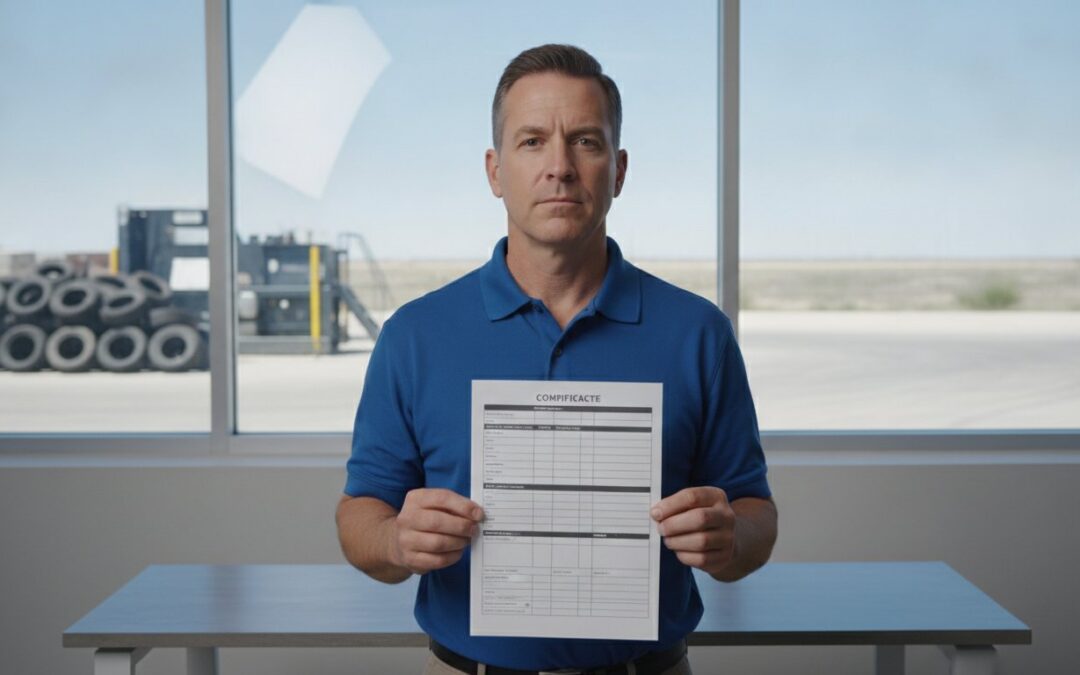
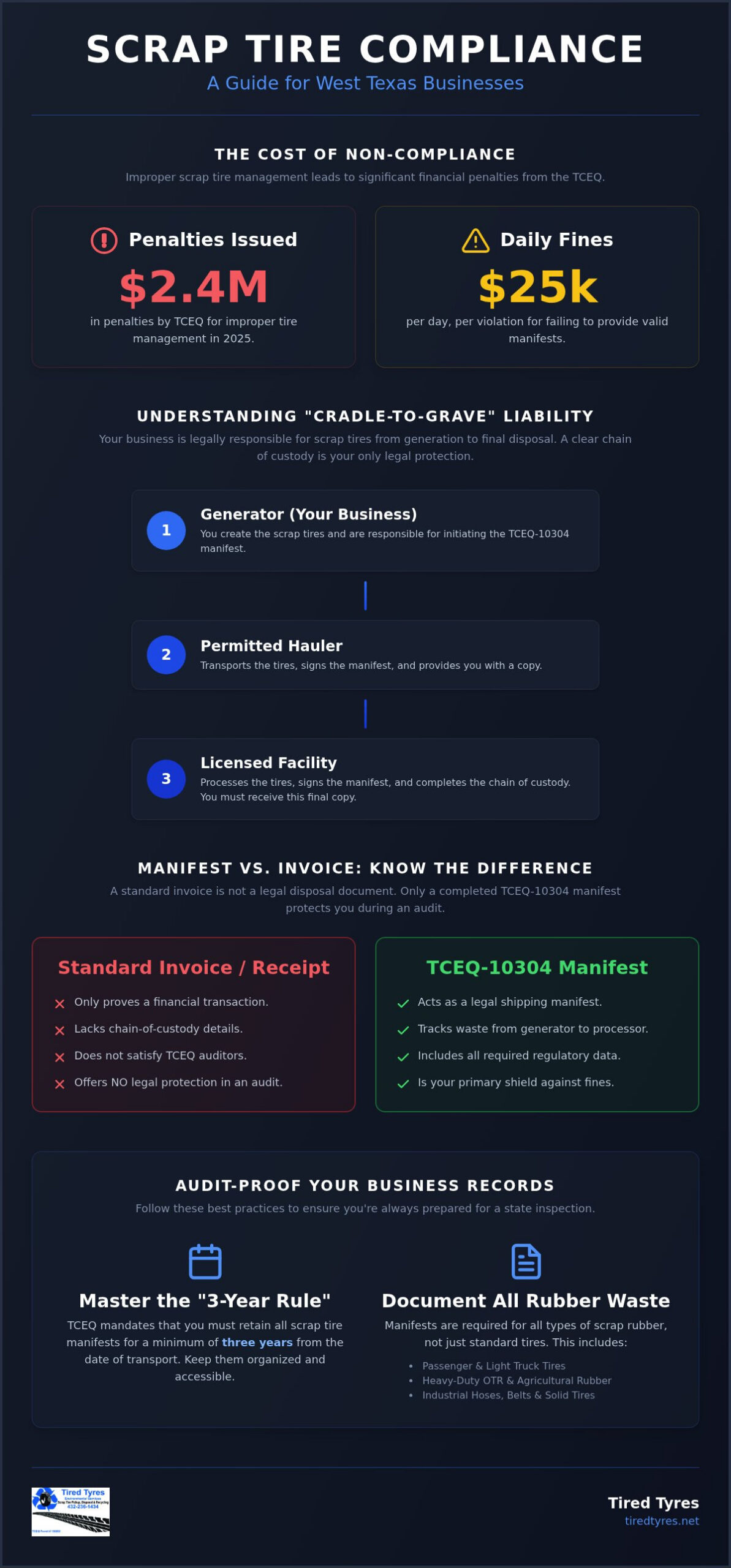
Did you know the TCEQ issued over $2.4 million in penalties for improper scrap tire management in 2025? For many West Texas business owners, the fear of an unexpected environmental audit is a constant source of stress. You likely understand that simple receipts aren’t enough to satisfy a state inspector, yet keeping track of waste disposal certificates for business records often feels like a disorganized paper trail waiting to fail. It is a common frustration, but in the eyes of the law, a missing document is just as bad as a missed disposal.
It’s true that the legal burden of proof falls entirely on your shoulders. If a hauler mishandles your waste, the state looks at your records first to determine liability. This guide is designed to remove that weight from your business. You’ll learn exactly how to manage your documentation to protect your company from fines and ensure total TCEQ compliance. We’ll walk through the specific requirements for the TCEQ-10304 manifest, explain the mandatory three year record retention period, and show you how to build a foolproof filing system. By the end, you’ll have the peace of mind that comes from knowing your operations are fully protected.
Key Takeaways
- Understand the “cradle-to-grave” liability principle and why your legal responsibility continues even after scrap tires leave your facility.
- Identify the specific mandatory fields on Form TCEQ-10304 to ensure your documentation meets 2026 Texas environmental standards.
- Master the “3-year rule” for organizing waste disposal certificates for business records to protect your company during surprise state inspections.
- Learn how to distinguish between a simple hauling receipt and a legally valid manifest to avoid fines that can reach $25,000 per day.
- Discover how partnering with a permitted West Texas hauler ensures your industrial rubber waste is handled with full regulatory transparency.
What Are Waste Disposal Certificates and Why Do They Matter?
A waste disposal certificate is more than a simple receipt. It is a formal document proving that your scrap rubber was transferred to a facility permitted by the Texas Commission on Environmental Quality (TCEQ). In the waste management industry, we follow the “cradle-to-grave” principle. This means your business remains legally responsible for scrap tires from the moment they are taken off a vehicle until they are fully processed at a licensed facility. Compliance isn’t optional. If your waste is discovered at an illegal dump site, the TCEQ will look for the original generator. Without valid waste disposal certificates for business records, you have no legal shield against heavy fines.
Many business owners mistakenly believe a standard invoice is sufficient for an audit. It isn’t. An invoice only documents a financial transaction. A legal disposal document functions as a shipping manifest. It provides a clear chain of custody by recording the quantity of waste, the date of transport, and the signatures of everyone involved in the process. This document is your proof that you fulfilled your environmental duties.
The Legal Burden on West Texas Businesses
Industrial hubs like Midland and Odessa face unique pressures. Auto shops, oilfield services, and fleet managers in the Permian Basin handle massive volumes of rubber waste, making them frequent subjects of state inspections. The TCEQ actively monitors the movement of scrap tires across Texas to prevent environmental hazards. Hiring an unpermitted hauler might save a few dollars today, but it creates a dangerous gap in your records. If an unregistered transporter dumps your tires, the state will hold your business accountable for the cleanup costs and penalties.
Types of Rubber Waste Requiring Certification
Different types of waste require specific handling, but the need for documentation remains constant. Maintaining waste disposal certificates for business records is essential for the following categories:
- Passenger and light truck tires: These are the most common items collected from local repair shops and commercial fleets.
- Heavy-duty OTR and agricultural rubber: Massive tires from oilfield machinery and tractors require specialized transport and strict manifest tracking.
- Industrial rubber waste: This includes scrap hoses, solid tires, and old conveyor belts that are common in West Texas industrial sites.
Every piece of rubber that leaves your property should be accounted for. Proper documentation ensures that your business stays protected during a surprise inspection.
The Scrap Tire Manifest: The Essential Texas Document
The document that keeps you compliant in Texas is the Scrap Tire Manifest, specifically Form TCEQ-10304. While generic waste disposal certificates for business records are often used in other industries, the TCEQ requires this specific tracking form for all scrap tire movements. As the generator, your business is the first link in the chain. You are responsible for initiating the manifest and ensuring the data accurately reflects the load being hauled away. This document tracks the journey of your waste from your shop floor in Midland or Lubbock to its final destination at an authorized processing facility.
Every manifest serves as a legal receipt of transfer. When the hauler picks up your scrap, they must sign the document and leave a copy with you. This initial copy proves you handed the waste to a registered professional. However, the process is only complete when you receive the final version signed by the disposal facility. This confirms the tires reached their intended, legal destination. Without that final signature, the “cradle-to-grave” loop remains open, leaving your business vulnerable to liability.
Key Information Required on a Texas Manifest
A manifest is only as strong as the data it contains. To survive an audit, every field must be completed with precision. The TCEQ looks for three main components on these documents:
- Generator Information: Your business name, physical address, and TCEQ registration number. If you generate more than 500 tires a year, you must have a generator ID on file.
- Hauler Details: You must verify that you are using a permitted tire hauler Texas. The manifest must include their specific registration number and vehicle information.
- Waste Description: A precise count or weight of the tires or rubber materials being removed. This includes specifying if they are passenger, semi-truck, or OTR tires.
Compliance here aligns with Federal Waste Recordkeeping Requirements, which mandate that generators maintain these records for at least three years to prove the waste was handled legally. Accurate data entry today prevents legal headaches tomorrow.
Authorized Signatures and Verifications
Signatures are the legal weight behind the manifest. When a hauler arrives, they must sign the document to acknowledge receipt of the waste. Never accept an incomplete or blank form. A common mistake is assuming the process ends when the truck leaves your lot. It doesn’t. You need the final copy of the manifest, which includes the signature of the authorized disposal facility. This third signature confirms the tires actually reached a legal destination and weren’t dumped in a West Texas field.
Before any rubber is loaded, ask to see the hauler’s current TCEQ pocket card. A legitimate partner will always have this permit ready for inspection. If you want to ensure your paperwork is handled correctly from the start, working with a professional collection service can eliminate the guesswork. Keeping accurate waste disposal certificates for business records is the only way to prove you’ve done your part in protecting the Texas environment.
Essential Elements of a Valid Certificate for Audit Protection
An environmental audit isn’t a conversation; it’s a data review. When a TCEQ inspector visits your Lubbock or Midland facility, they don’t want to hear about your good intentions. They want to see waste disposal certificates for business records that contain specific, verifiable data points. A document that lacks detail is essentially a blank sheet of paper in the eyes of the law. To ensure your documentation provides a bulletproof defense against liability, it must include several non-negotiable elements that link your specific waste to a legal end-point.
Every valid certificate or manifest should clearly state the following information:
- Date and Location: The exact date the service occurred and the specific address of the pickup. This is crucial for businesses with multiple sites across the Permian Basin.
- Unique Tracking Number: A manifest or transaction ID number that allows the TCEQ to cross-reference the load with the receiving facility’s records.
- Final Destination: The name and physical address of the permitted shredding or processing facility where the rubber was delivered.
- Precise Quantities: Clear weights or tire counts. Vague estimates won’t help you if your internal inventory records are being scrutinized during an inspection.
Digital vs. Paper Certificates
As of 2026, the TCEQ has increasingly moved toward supporting electronic manifest systems. This shift, driven by legislative updates like the proposed HB 1463, aims to streamline tracking and reduce the “lost paperwork” excuse. For West Texas industrial clients, digital waste disposal certificates for business records offer a significant advantage: searchability. You can pull up three years of history in seconds. However, the burden of accessibility remains yours. If you choose digital records, you must ensure they are backed up and instantly accessible during an unannounced inspection. A dead tablet or a forgotten password isn’t a valid legal excuse for missing documentation.
Red Flags in Disposal Documentation
You must be vigilant when a driver hands you a document. Some unpermitted haulers use generic “work orders” that mimic legal forms but lack the necessary authority. One major red flag is a missing or expired hauler registration number. If the hauler can’t provide a current TCEQ permit number, the certificate they give you is worthless. Another warning sign is vague language. Descriptions like “one load of rubber” or “miscellaneous scrap” are audit magnets. Finally, if the document doesn’t list a specific, permitted destination facility, you have no proof the waste wasn’t dumped illegally. Protecting your business means rejecting any paperwork that doesn’t meet these professional standards.
Best Practices for Maintaining Your Waste Records
Organizing waste disposal certificates for business records doesn’t have to be a complicated chore. The most effective approach is to create a dedicated “Environmental Compliance” folder immediately. Whether you prefer a physical filing cabinet or a cloud-based system like Google Drive or Dropbox, consistency is what saves you during an audit. Every document related to rubber waste removal should be filed chronologically the moment the truck leaves your lot. This prevents the “lost receipt” panic that often leads to avoidable fines.
Texas law is very specific about how long you must hold onto these documents. You’re required to keep all scrap tire manifests for a minimum of three years (36 months). We recommend keeping them for four years to provide a safety buffer. During this time, it’s vital to match your service invoices to the corresponding manifests. If your accounting department has an invoice for a pickup but your compliance folder is missing the signed manifest, you have a liability gap. An inspector will treat that missing paperwork as a violation of the “cradle-to-grave” responsibility.
Set a recurring calendar reminder to conduct a quarterly self-audit. Review your files to ensure every manifest has the required three signatures: yours, the hauler’s, and the final disposal facility’s. Catching a missing signature or an incomplete field now is much cheaper than having a state official find it during an unannounced visit. It shows that you’re running a tight ship and take your environmental duties seriously.
Organizing Records for Multi-Site Operations
For businesses managing fleets or shops across Midland, Odessa, and Lubbock, record-keeping needs a clear, standardized structure. Centralized filing at a corporate office is great for high-level management, but it can cause problems during a local spot check. Each branch location must keep its own copy of a commercial tire disposal manifest to ensure immediate availability if a health department official walks in. This hybrid approach ensures the main office has the data for annual reporting while the local shop stays audit-ready at a moment’s notice.
Preparing for a TCEQ or Local Health Department Audit
Inspectors usually ask to see your tire disposal logs as soon as they arrive. They aren’t looking for a perfect history; they’re looking for a continuous, unbroken chain of custody. If you can present a neat, chronological binder of waste disposal certificates for business records, the inspection will likely be shorter and smoother. Common mistakes that trigger fines include missing signatures from the processing facility or having gaps in the pickup dates. Even if you disposed of the tires correctly, the state views a lack of paperwork as a failure to comply.
If you want to ensure your paperwork is handled correctly from the very first signature, schedule your next collection with Tired Tyres. We provide the precise documentation you need to stay protected and compliant in the Permian Basin.
How Tired Tyres Simplifies Compliance in West Texas
Managing environmental regulations shouldn’t distract you from running your business. Tired Tyres operates as a professional partner for commercial entities across the Permian Basin, ensuring that every collection is backed by the necessary legal paperwork. We provide the waste disposal certificates for business records that state inspectors require, giving you a clear defense against liability. Our team understands that for a West Texas shop or industrial site, a missed signature is a risk you can’t afford to take.
Choosing a permitted hauler is the first step in securing your company’s future. When you work with us, you aren’t just getting a waste removal service; you’re getting insurance against the “cradle-to-grave” liability discussed earlier in this guide. We handle the heavy lifting and the heavy paperwork. This specialized focus on tire disposal Midland TX ensures that your scrap never ends up in an unauthorized dump site that could lead back to your doorstep.
Professional Collection for Specialized Rubber
Industrial sites often struggle with rubber waste that doesn’t fit into standard categories. We specialize in the collection of OTR (Off-the-Road) tires and large-scale agricultural rubber that many general haulers won’t touch. Our services extend to industrial rubber waste like scrap conveyor belts and hoses. For every load, we provide detailed tire recycling reporting. These documents help your business meet corporate sustainability goals while maintaining a flawless compliance record. We ensure that even the most complex industrial waste is tracked with the same precision as a single passenger tire.
Get Started with a Compliant Disposal Plan
Setting up a legal disposal route is straightforward and efficient. We serve businesses in Odessa, Lubbock, and the surrounding areas with customized collection schedules that match your specific volume. High-volume auto shops often require weekly pickups, while industrial sites might need on-call service for large OTR removals. We adapt to your needs without sacrificing the quality of our documentation. Your waste disposal certificates for business records will be delivered promptly after every service, ensuring your files are always audit-ready.
Don’t wait for a TCEQ inspector to find a gap in your paperwork. Contact Tired Tyres today for a transparent quote and a disposal plan that prioritizes your legal safety. We take the burden of environmental compliance off your shoulders so you can focus on your customers.
Secure Your Permian Basin Business Against Liability
Managing environmental compliance doesn’t have to be a source of constant stress for your operation. By maintaining accurate waste disposal certificates for business records and following the mandatory three year retention rule, you create a solid legal defense against state inspections. A valid TCEQ-10304 manifest is your primary proof that you’ve fulfilled your “cradle-to-grave” responsibilities. This simple habit protects you from fines that can reach $25,000 per day for improper storage or disposal.
Tired Tyres is here to take the complexity out of your hands. As a permitted TCEQ tire hauler, we specialize in OTR, semi-truck, and industrial rubber waste removal across Midland, Odessa, and Lubbock. We ensure every single pickup includes the precise, signed documentation you need to stay compliant and audit-ready. Secure your business with compliant tire disposal—Contact Tired Tyres today for a transparent quote. Taking these proactive steps now ensures your West Texas business remains protected and productive for years to come.
Frequently Asked Questions
How long does a business need to keep waste disposal certificates in Texas?
In Texas, you must retain all scrap tire manifests for a minimum of three years (36 months) from the date of service. This requirement ensures you can provide a clear chain of custody during a surprise TCEQ or local health department inspection. While three years is the legal minimum, many West Texas fleet managers keep these waste disposal certificates for business records for four years to provide a safety buffer against potential audit discrepancies.
Is a simple receipt from a hauler enough for an environmental audit?
No, a standard financial receipt or invoice isn’t sufficient for a state environmental audit. The TCEQ specifically requires Form TCEQ-10304, which tracks the movement of scrap tires from your facility to a permitted disposal site. A valid manifest must include the hauler’s registration number and the signatures of the generator, the transporter, and the final processing facility. Without these specific details, you have no legal proof of compliant disposal.
What happens if I lose my scrap tire disposal manifest?
Losing a manifest creates a serious liability gap in your compliance history. If you discover a missing document, you should immediately contact your permitted hauler or the final disposal facility to request a duplicate copy. Keeping your records organized in a central folder helps prevent these losses. If an inspector finds a gap in your records that you can’t explain, your business could face significant fines even if the waste was handled correctly.
Can I store my waste disposal certificates digitally?
Yes, you can store your waste disposal certificates for business records digitally as of 2026. The TCEQ accepts electronic manifests and scanned copies, provided they are legible and immediately accessible during an unannounced inspection. Many industrial clients in Midland and Odessa use cloud storage to ensure their records are backed up and searchable. You must be able to present these files on a screen or print them instantly if a state official requests them.
Does the hauler or the business owner fill out the manifest?
The responsibility for the manifest is shared between the generator and the hauler. As the business owner or generator, you’re responsible for initiating the document and ensuring your company information and tire counts are accurate. The hauler then signs the form to acknowledge they’ve taken possession of the waste. Finally, the disposal facility signs the manifest upon delivery. You must ensure you receive the completed copy with all three signatures for your files.
What are the penalties for not having proper tire disposal records in Texas?
The penalties for record-keeping failures are severe. The TCEQ can issue fines of up to $25,000 per day for improper scrap tire management. Using an unregistered transporter can result in fines of up to $500 per tire. Beyond the immediate financial cost, a lack of proper documentation leaves your business vulnerable to liability if your tires are ever found at an illegal dump site in the Permian Basin.
Do I need a certificate for industrial rubber like conveyor belts?
Yes, obtaining a certificate for industrial rubber waste like conveyor belts, skid steer tracks, and hoses is a best practice for liability protection. While the TCEQ focus is heavily on scrap tires, industrial rubber waste removal still requires a clear paper trail to prove the material reached a legal facility. These records are also essential for corporate sustainability reporting and internal inventory audits, ensuring your industrial site in Odessa or Lubbock remains compliant.
How can I verify if my tire hauler is properly permitted by the TCEQ?
You should always ask to see the hauler’s current TCEQ pocket card before any waste is loaded. A legitimate hauler will have a registration number that you can verify through the TCEQ Central Registry database. In West Texas, professional partners like Tired Tyres are transparent about their permitted status. Verifying this information upfront is the only way to ensure the documents you receive are legally valid and will protect your business during a state audit.