
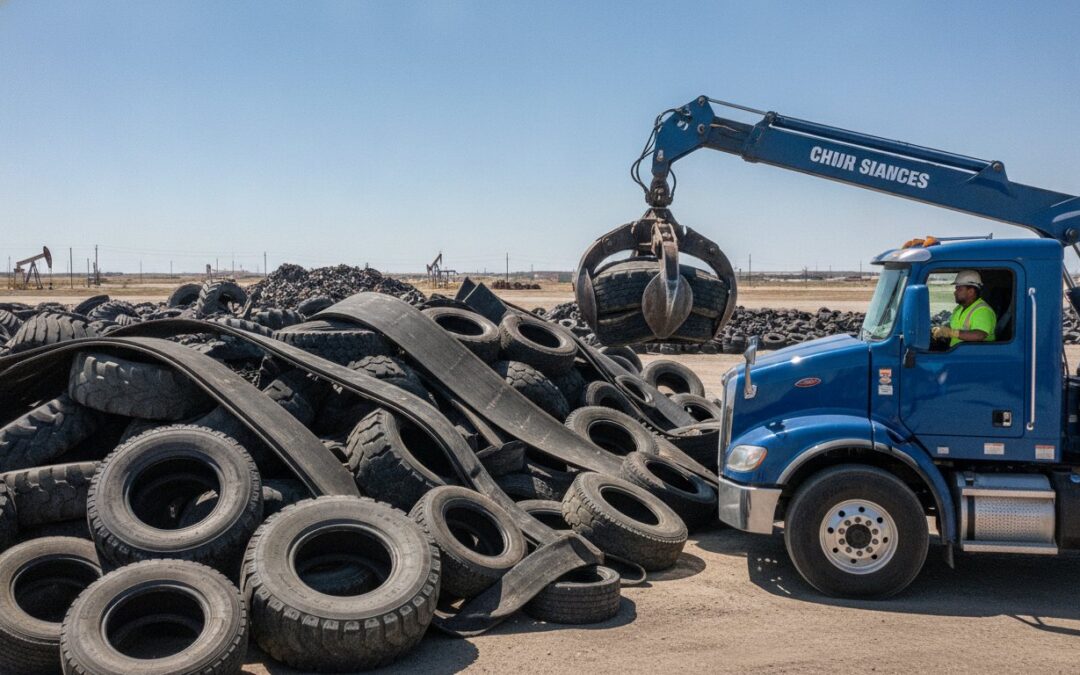
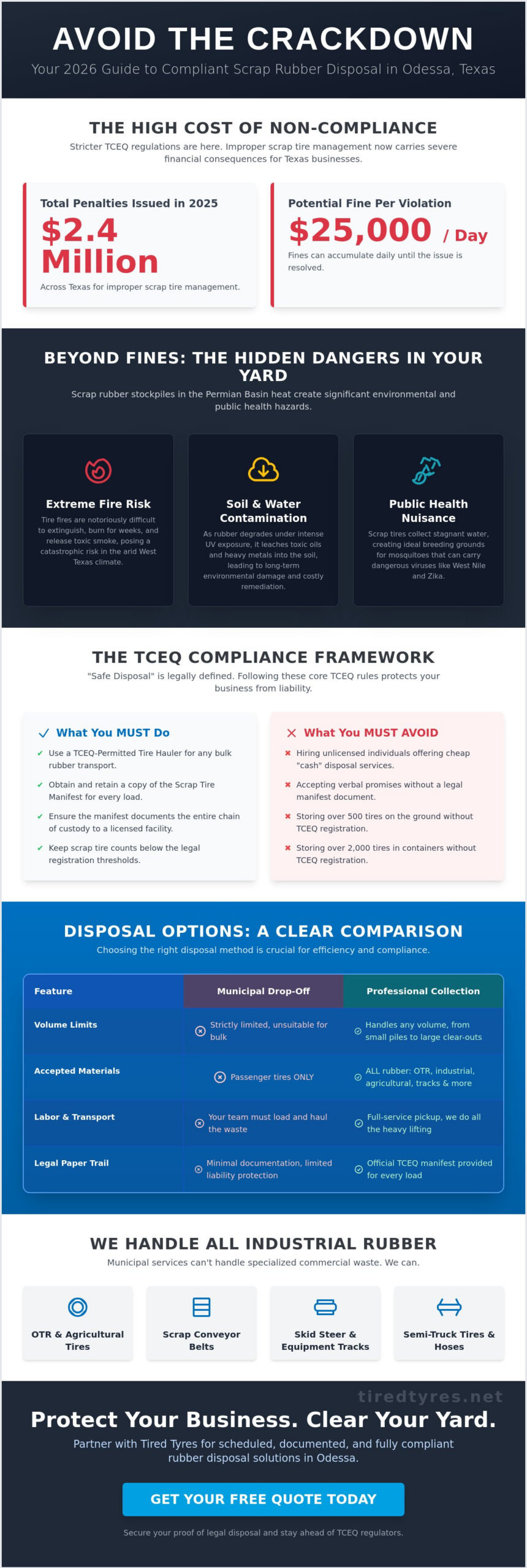
In 2025, the TCEQ issued more than $2.4 million in penalties for improper scrap tire management across Texas. If your Odessa facility handles bulk waste, you’re likely feeling the pressure of stricter 2026 regulations. Managing scrap conveyor belts, OTR tires, or agricultural rubber isn’t just about clearing yard space anymore. It’s about protecting your business from fines that can reach $25,000 per day. Finding safe rubber disposal solutions Odessa companies can trust is the only way to ensure your worksite stays clean and legally compliant.
We understand that navigating TCEQ manifest requirements and storage limits feels like a full-time job. You want a clear, documented path from your yard to a permitted facility without the administrative headache. This guide provides the essential 2026 framework for managing industrial rubber waste safely. You’ll learn how to handle bulk pickups for semi-truck tires and specialized scrap materials like hoses or tracks while securing the proof of legal disposal your business needs to stay protected.
Key Takeaways
- Understand the legal necessity of TCEQ-compliant manifests to avoid massive daily fines for improper rubber storage or transport.
- Learn how to manage specialized industrial waste like scrap conveyor belts, skid steer tracks, and OTR tires that municipal facilities won’t accept.
- Identify the environmental risks of rubber stockpiles in the Permian Basin heat, including mosquito breeding and fire hazards.
- Discover professional safe rubber disposal solutions Odessa businesses can use to clear yard space while maintaining a perfect regulatory paper trail.
- Compare the strict volume limitations of municipal drop-off sites against the efficiency of scheduled professional collection services.
The Risks of Improper Rubber Waste in the Permian Basin
The West Texas sun is relentless. For business owners in the Permian Basin, leaving a pile of scrap rubber in the yard is more than just a clutter issue. It’s a significant risk to your property and your bottom line. When temperatures climb, those stockpiles of agricultural tires and scrap conveyor belts become heat sinks. They don’t just sit there; they degrade, leaching chemicals into the soil and creating a massive fire risk. Finding safe rubber disposal solutions Odessa can rely on is the first step in protecting your commercial assets.
Many managers view stockpiling as a temporary convenience. They think they’ll deal with it when the yard gets too full. However, the hidden costs are steep. Every square foot taken up by scrap rubber is space that isn’t generating revenue. More importantly, those piles attract the attention of regulators. If you’re storing more than 500 tires on the ground, you’ve already crossed the TCEQ registration threshold. Ignoring these limits leads to liabilities that far outweigh the cost of professional collection.
Fire Hazards and Soil Contamination
In our arid climate, a rubber fire is a catastrophic event. These fires are nearly impossible to extinguish because the internal structure of a tire pile traps heat and repels water. A single spark from a nearby welding job or a brush fire can ignite a blaze that burns for weeks. Beyond the immediate smoke, the long-term damage is often invisible. As industrial rubber degrades under UV exposure, it releases toxic oils and heavy metals. This runoff contaminates the soil, leading to remediation costs that can reach six figures. Understanding the mechanics of Tire recycling shows that processing these materials is the only way to neutralize these environmental threats.
Public Health and Local Regulations
Public health is another major concern for the Ector County health department. Even in West Texas, small amounts of rain can collect inside scrap tires. These pockets of stagnant water are perfect breeding grounds for mosquitoes that carry West Nile and Zika viruses. Because of these risks, local authorities don’t wait for a fire to take action. Improper disposal or unauthorized storage can lead to immediate municipal citations and heavy fines. For a deeper look at these local impacts, you can review our analysis of waste tire problems in the region. Using safe rubber disposal solutions Odessa providers offer ensures you stay ahead of health inspectors and keep your worksite compliant with both local and state laws.
Defining ‘Safe’ Disposal: TCEQ Regulations and Compliance
In Texas, “safe” has a specific legal definition. It means following the Texas Commission on Environmental Quality (TCEQ) rules from the moment a tire or rubber component is removed until it reaches a licensed processing facility. This isn’t just bureaucracy; it’s liability protection. If you’re looking for safe rubber disposal solutions Odessa regulators will respect, you need to look beyond the price tag. Many businesses get caught in the “free disposal” trap. When an unlicensed individual offers to take your scrap for a low cash fee, they often dump it in rural areas. Because the waste can be traced back to your business, you’re the one facing the $25,000 per day fine.
Storage is equally regulated. As of February 2026, any site storing more than 500 scrap tires on the ground or 2,000 in lockable containers must register with the state. Registered facilities must also submit annual reports on their tire management activities. Staying under these limits or having a plan for regular removal is essential for avoiding site inspections and costly penalties. If your yard is currently over these limits, clearing it through a legal channel is your top priority.
The Importance of a Permitted Tire Hauler
A TCEQ permit isn’t just a piece of paper. It signifies that the company has undergone a background check, carries necessary insurance, and follows strict environmental protocols. Hiring an unlicensed person with a trailer might seem like a quick fix for a pile of scrap solid tires or agricultural rubber, but it’s a massive legal gamble. If that waste ends up in a ditch, the manifest trail breaks, and the legal liability stays with you. A permitted hauler is the only legal way to move bulk rubber in Texas.
Understanding the Manifest System
The scrap tire manifest is your insurance policy. It’s a multi-part document that tracks the waste through the entire chain of custody. The system works through a simple three-step verification:
- The generator (your business) signs the form upon pickup.
- The hauler signs to take possession and legal responsibility for transport.
- The processing facility signs once the load is delivered and processed.
Texas law requires businesses to keep these records for three years. Without them, you have no documented proof of legal disposal during an audit. For a full list of documentation requirements and compliance checklists, check our guide on Texas tire disposal regulations. Choosing safe rubber disposal solutions Odessa experts provide ensures every manifest is completed correctly every time. If you’re ready to clear your yard without the risk, schedule a compliant pickup with a professional team today.
Odessa Disposal Options: Municipal Drop-off vs. Professional Collection
Choosing the right disposal path depends on your volume and your business type. For a resident with four old car tires in the garage, the local municipal options are often the first stop. However, for commercial operations in the Permian Basin, the city’s infrastructure often falls short. Businesses must weigh the convenience of local drop-off sites against the comprehensive protection of a professional hauler. Finding safe rubber disposal solutions Odessa companies can rely on means looking at the total cost of the operation, not just the gate fee.
Logistics play a major role in this decision. Hauling your own bulk rubber waste requires dedicated equipment, trailers, and employee labor. If your facility is located in a rural area outside the Odessa city limits, you might find that municipal services won’t accept your waste at all. Professional collection services bridge this gap by coming directly to your worksite, whether you’re in the heart of town or at a remote industrial yard.
When to Use the Keep Odessa Beautiful Facility
The Keep Odessa Beautiful (KOB) facility and the local Household Hazardous Waste (HHW) center are designed primarily for residential use. They are excellent for small-scale needs, but they come with strict limitations. These sites typically require proof of residency and often have a “Citizen Only” policy that excludes commercial businesses. Most municipal centers will reject heavy-duty items like OTR tires or industrial scrap skid steer tracks. Additionally, their operating hours are often limited to standard business windows, which can conflict with your own operational schedule. If you have a single set of light truck tires, the city center is a viable choice. For anything more, it’s usually a dead end.
The Benefits of Professional On-Site Pickup
For shops and industrial sites, professional collection is the most efficient choice. It eliminates the hidden costs of DIY hauling, such as fuel, vehicle wear, and the risk of employee injury during loading. Expert haulers have the specialized equipment to safely handle heavy OTR, agricultural, and semi-truck tires that your team shouldn’t be wrestling with. This service also ensures you stay compliant with the manifest requirements discussed earlier.
Partnering with a specialist allows for tailored scheduling. You don’t have to wait in line at a landfill or work around city holidays. Instead, you can set up a recurring pickup that keeps your yard clear and your worksite safe. Providing reliable tire disposal for local businesses is about more than just moving rubber; it’s about providing a seamless extension of your own operations. When you choose safe rubber disposal solutions Odessa experts provide, you’re investing in a clean, compliant, and professional environment.
Managing Industrial Rubber: From Conveyor Belts to OTR Tires
General waste management services often struggle with the sheer weight and composition of industrial rubber. While passenger tires are common, the Permian Basin’s economy runs on heavy-duty equipment that produces specialized waste. Disposing of a scrap skid steer track or a massive OTR tire requires more than just a large truck; it requires a processing partner equipped for high-density materials. Finding safe rubber disposal solutions Odessa industrial sites can rely on means choosing a provider that understands the difference between a standard tire and a steel-reinforced industrial component.
The complexity of these materials often leads to disposal bottlenecks. Many local landfills refuse to accept whole OTR tires or reinforced belts because they can’t be easily compacted or shredded by standard equipment. This leaves businesses with growing stockpiles that create safety hazards and regulatory risks. Professional collection ensures these materials reach facilities capable of handling the toughest rubber waste in the oilfield and construction sectors.
Oilfield and Construction Rubber Waste
Permian Basin oilfield service companies face unique challenges with scrap hose collections and steel-reinforced conveyor belts. These items are designed to be indestructible, which makes them incredibly difficult to process once they reach the end of their service life. Steel-reinforced conveyor belts, in particular, can damage standard shredders and are often rejected by municipal waste streams. Solid tires also require specialized shredding equipment not found in standard landfills. Without a dedicated partner, these heavy items often sit for years, taking up valuable yard space and increasing fire risks. If you need to clear out heavy-duty scrap, you can request a specialized industrial pickup to handle these difficult materials safely.
Specialized Agricultural and OTR Disposal
Large-scale farming operations in the Odessa area deal with tires that can weigh hundreds of pounds. Removing a single agricultural tire is a two-person job at minimum, and hauling a dozen requires heavy-duty trailers. Proper commercial tire disposal supports local industry growth by keeping operational areas clear and safe. To ensure your next pickup is as efficient as possible, follow this preparation checklist:
- Separate tires by type (e.g., OTR, agricultural, or passenger) to speed up loading.
- Ensure all tires are free of heavy mud, rocks, or standing water.
- Stack materials in an area accessible by a large truck and trailer.
- Verify that all rims have been removed, as most haulers only accept the rubber components.
By following these steps and utilizing safe rubber disposal solutions Odessa professionals provide, you protect your workers and your compliance record. Whether you’re clearing out a stack of scrap solid tires or a pile of industrial hoses, professional collection is the most direct path to a clean worksite.
Partnering with Tired Tyres for Compliant Disposal in Odessa
Managing a high-volume worksite in West Texas is challenging enough without worrying about environmental audits. As we’ve explored, the risks of improper storage and the complexity of TCEQ manifests make professional handling a necessity rather than an option. Tired Tyres provides a seamless, legal solution for all bulk rubber waste, ensuring your business stays on the right side of the law. We don’t just pick up tires; we provide a complete chain of custody for your peace of mind. Finding safe rubber disposal solutions Odessa managers can rely on ends with a partner who knows the Permian Basin.
Our team is equipped to handle everything from standard passenger and light truck tires to massive OTR tires used in oilfield operations. We understand that every business has different needs. An auto shop on 42nd Street requires a different schedule than an industrial plant near the loop. We offer customized collection schedules that fit your operational flow, preventing rubber from ever piling up to dangerous or illegal levels. Every pickup is backed by full TCEQ compliance and accurate manifest documentation.
Why Permian Basin Businesses Trust Us
Our roots are in West Texas, and we’re committed to the environmental health of our local communities. We specialize in the “unusual” rubber waste that municipal sites and general haulers often reject. This includes scrap hose collection, scrap skid steer tracks, and steel-reinforced conveyor belts. We offer a “done-for-you” service that takes the burden off your staff. You won’t need to dedicate employees to loading trailers or driving to a landfill. We handle the heavy lifting, the loading, and the legal paperwork. This efficiency allows your team to focus on their primary jobs while we maintain your site’s cleanliness and safety.
Get Started with a Safe Disposal Plan
Starting your journey toward a cleaner, more compliant worksite is a straightforward process. We’ve stripped away the complexity to provide a service that’s as efficient as it is reliable. When you reach out to us, the process follows three simple steps:
- Request a Quote: Tell us about the volume and type of rubber waste you have, from semi-truck tires to industrial hoses.
- Schedule Your Pickup: Choose a time that works for your operations. We arrive with the right equipment for your specific load.
- Receive Documentation: Once the job is done, we provide the manifest documentation you need for your three-year record-keeping requirement.
Don’t let a growing pile of scrap rubber become a legal or safety liability for your company. Whether you’re dealing with agricultural tires or specialized industrial tracks, we have the expertise to handle it. Contact Tired Tyres today for a professional rubber disposal quote in Odessa.
Secure Your Compliance and Clear Your Yard Today
Maintaining a compliant yard in the Permian Basin doesn’t have to be a source of constant stress. By moving away from risky stockpiles and embracing the manifest system, you protect your business from the TCEQ’s heavy penalties. Whether you’re managing a fleet of semi-trucks or an industrial site with scrap conveyor belts, the key is a reliable chain of custody. Implementing safe rubber disposal solutions Odessa businesses can depend on ensures your worksite remains productive and environmentally sound.
Tired Tyres is your local, TCEQ-permitted hauler servicing Midland, Odessa, and Lubbock. We take the administrative burden off your shoulders by providing full manifest documentation for every pickup, from passenger tires to massive OTR units. Our customized collection schedules mean you don’t have to worry about exceeding storage limits or failing an audit. Our team handles the heavy lifting so you can focus on your core operations.
Ready to clear your yard? Request a Compliant Rubber Disposal Quote for Your Odessa Business today and get the professional support your operations deserve. Stay safe, stay legal, and keep your business moving forward.
Frequently Asked Questions
Is it illegal to put tires in a standard dumpster in Odessa?
Yes, it’s illegal. Texas law prohibits whole tires from being disposed of in landfills because they don’t compact and can trap gases or pose fire risks. Most municipal waste services will refuse to empty a dumpster if it contains rubber tires. Violating these ordinances can lead to immediate municipal citations and heavy fines from the city.
How much does professional rubber disposal cost in Ector County?
Costs for professional disposal are determined by the volume and the specific type of material being collected. For example, hauling passenger tires involves different logistics than moving massive OTR or agricultural units. While we don’t provide fixed pricing here, professional hauling is a strategic investment that prevents the $25,000 daily penalties associated with illegal dumping or improper storage.
What is a TCEQ tire manifest and why does my business need one?
A TCEQ manifest is a state-required document that tracks the movement of scrap tires from the generator to the processor. It serves as your legal proof that the waste was handled by a permitted hauler and delivered to a licensed facility. You’re required to keep these records for three years to protect your business during environmental audits or inspections.
Can you dispose of steel-reinforced conveyor belts?
Yes, we handle steel-reinforced conveyor belts and other heavy industrial rubber. These materials are incredibly durable and often rejected by standard landfills because they require specialized shredding equipment. Our industrial collection service is designed specifically for these high-density materials, ensuring they’re processed according to state environmental standards.
Do you provide tire pickup services for rural locations outside Odessa?
Yes, we service rural sites throughout the Permian Basin, including locations well outside the Odessa city limits. Many municipal drop-off sites only serve city residents or have strict volume limits. Our mobile collection team provides safe rubber disposal solutions Odessa businesses can utilize regardless of their distance from the city center.
What happens to the rubber after it is collected by Tired Tyres?
All collected rubber is transported directly to a TCEQ-permitted processing facility. Once there, the material is shredded or recycled for use in various industrial applications. This ensures the waste is managed in a way that eliminates fire hazards and prevents the piles from becoming breeding grounds for mosquitoes or other pests.
How many tires can I store on my property before needing a permit?
In Texas, you can store up to 500 scrap tires on the ground or up to 2,000 in enclosed, lockable containers before you’re required to register with the TCEQ. Staying below these thresholds is essential for avoiding complex registration and annual reporting requirements. Scheduling regular pickups is the most effective way to maintain a clean, permit-free worksite.
Does Tired Tyres handle scrap skid steer tracks and solid tires?
Yes, we collect scrap skid steer tracks and solid rubber tires as part of our specialized industrial services. These items are often too heavy or dense for standard trash collectors to manage. We have the necessary equipment to load and transport these reinforced components, providing a safe rubber disposal solutions Odessa industrial plants can rely on for all their heavy-duty waste.