
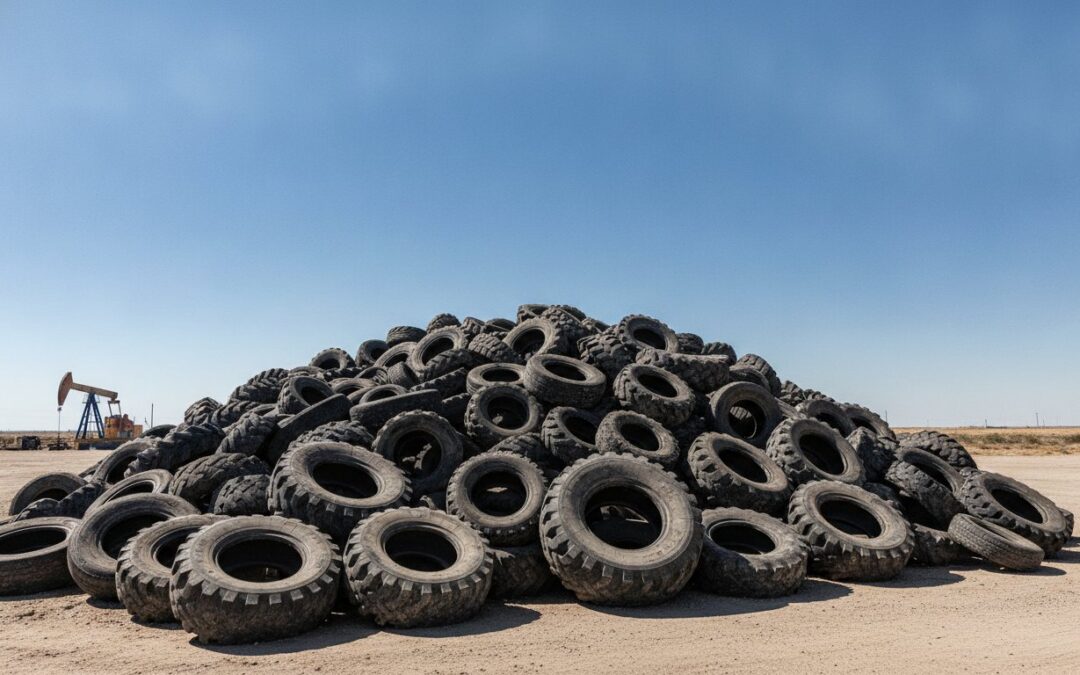
Could that stack of rubber in your yard be the most expensive asset on your property? Many West Texas business owners view old tires as a “later” problem, but the truth is that every day of delay creates a growing financial drain. Understanding the hidden costs of scrap tire piles is essential for protecting your bottom line from unexpected hits that can appear without warning.
We understand that managing a facility is a constant balancing act, and it’s tempting to let a small pile grow until it’s convenient to dispose of. However, this article will help you discover the regulatory, health, and liability risks that make scrap tire piles a significant financial burden for West Texas businesses. We’ll look at how TCEQ fines of up to $25,000 per day, mandatory bi-weekly vector control for mosquito infestations, and surging liability insurance premiums can turn a simple storage issue into a serious fiscal crisis. Taking care of the problem now is the only way to ensure your assets and your budget stay in safe hands.
Key Takeaways
- Learn how scrap tires act as a liability that lowers property value and deters potential commercial tenants.
- Understand the hidden costs of scrap tire piles related to mandatory mosquito control and health risks in the West Texas heat.
- Navigate the “cradle-to-grave” liability rules to avoid TCEQ fines that can reach up to $25,000 per day.
- Discover why the unique chemistry of rubber makes tire fires a financial catastrophe that water alone cannot solve.
- Compare the financial logic of scheduled removals for passenger or OTR tires versus the high cost of emergency site remediation.
The Visible vs. Invisible Costs: Why Scrap Tire Piles Are Financial Liabilities
Some operators fall into what we call the “intelligence trap.” They leave tires in a heap to eventually analyze wear patterns or manufacturer defects. While data is valuable, letting a pile grow for months while waiting for an audit is a risky financial gamble. The small insights gained from a worn tread rarely offset the mounting liability of a growing stockpile. Waiting too long often leads to regulatory disasters as the pile quickly exceeds legal storage limits.
Depreciating Property and Aesthetic Costs
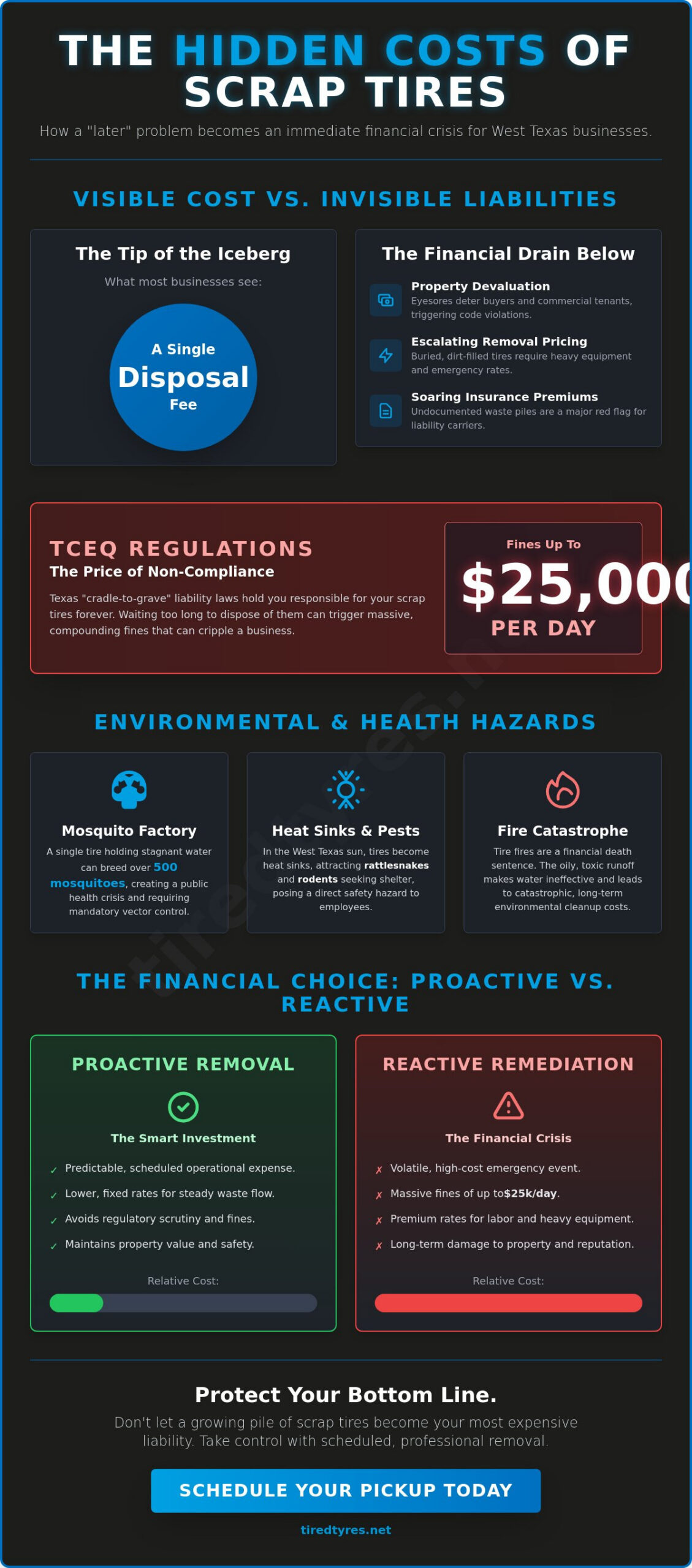
In competitive markets like Midland and Odessa, the appearance of your facility matters. A large tire pile is an immediate red flag for neighboring businesses and potential commercial tenants. These “eyesores” often trigger unwanted attention from city code enforcement officers, leading to citations that could’ve been avoided with a simple pickup. Failing to account for the hidden costs of scrap tire piles often leads to significant property value decay. Selling or leasing commercial land becomes harder when there’s an undocumented accumulation of waste. Buyers see these piles as a future expense and a sign of poor maintenance, which often results in lower offers. To understand the broader impact, consider the Environmental and Health Hazards of Scrap Tires, which can turn a simple property into a documented liability.
The Escalation of Removal Pricing
The price of clearing a site isn’t static. It’s much more cost-effective to manage a steady flow of waste than to deal with a crisis. Tires that’ve been left to the elements for years often become partially buried or filled with West Texas dirt and caliche. This adds significant weight and requires specialized heavy equipment for removal, which drives up the final bill. Choosing a scheduled commercial tire disposal service is a predictable operational expense. In contrast, emergency remediation after a TCEQ citation is a volatile, high-cost event. Proactive removal ensures you aren’t paying a premium for emergency services or extra labor to dig tires out of the ground.
Environmental and Health Hazards: Mosquitoes, Pests, and West Texas Heat
The relentless West Texas sun does more than just fade paint; it turns rubber into a powerful heat sink. Tires are designed to absorb and hold energy, which creates a specific thermodynamic problem when they’re stacked in an open yard. During a 100-degree Midland summer, the internal temperature of a tire stack can climb significantly higher than the ambient air. This creates localized micro-climates that don’t just radiate heat back into your facility, but also attract cold-blooded pests. Rattlesnakes and rodents frequently seek out these dark, temperature-stable cavities for shelter, creating a direct safety hazard for your employees. These biological risks are often overlooked, yet they represent some of the most immediate hidden costs of scrap tire piles for local businesses.
As the rubber breaks down under intense UV exposure, it undergoes a process of chemical leaching. The polymers begin to degrade, potentially releasing zinc, heavy metals, and oily compounds into the surrounding soil. In the porous caliche common in our region, these contaminants can migrate quickly. Cleaning up a site where rubber has been allowed to rot for a decade is far more expensive than the cost of timely disposal. Scheduling a professional scrap rubber collection is the most effective way to eliminate these biological and chemical risks before they become a permanent mark on your property’s environmental record.
The Mosquito Breeding Factory
Water is a rare commodity in the South Plains, but it only takes one Lubbock rainstorm to turn a tire pile into a public health crisis. The unique shape of a tire is a perfect trap for stagnant water, and the black rubber keeps that water at an ideal temperature for larvae development. According to industry data, a single scrap tire can become a breeding ground for over 500 mosquitoes in just one week of holding water. This isn’t just a nuisance; it’s a liability. The Permian Basin is a known area for West Nile Virus, and the TCEQ mandates that stockpile owners apply vector control measures at least every two weeks. If you aren’t actively treating every tire in your pile, you’re potentially violating state health mandates.
Soil and Groundwater Contamination
Long-term storage leads to structural breakdown. When tires sit in the dirt for years, they don’t just stay on the surface; they settle and bond with the earth. The heavy metals used in tire manufacturing, such as lead and zinc, can leach into the soil during this time. If these chemicals reach the local water table, the remediation costs can easily reach six figures. Texas law often holds the current property owner responsible for environmental cleanup, even if the tires were left by a previous tenant. Proactive disposal is the only way to ensure these environmental liabilities don’t stay buried on your land for decades.
TCEQ Regulations and the Legal Price of Non-Compliance in Texas
The Texas Commission on Environmental Quality (TCEQ) maintains strict oversight because scrap tires represent a significant environmental risk. One of the most dangerous hidden costs of scrap tire piles is the legal liability that follows a business owner even after the rubber leaves their property. Texas law operates on a “cradle-to-grave” principle. This means you’re legally responsible for every tire your business generates until it reaches a permitted processing facility. If you hire an unpermitted hauler who dumps those tires in a West Texas canyon, the state can trace that waste back to you. Under new regulations effective September 1, 2025, counties can now impose fines of up to $500 per tire on generators who use unregistered transporters.
Daily penalties for improper storage or undocumented disposal are high. The TCEQ can issue administrative penalties ranging from $10,000 to $25,000 per day for certain violations. These aren’t just empty threats; in 2025, the agency issued over $2.4 million in penalties for improper scrap tire management. Using a professional service ensures you aren’t gambling with your company’s future to save a few dollars on hauling fees. Staying compliant is much cheaper than defending your business against a state-level enforcement action.
The Importance of the Scrap Tire Manifest
A scrap tire manifest is your only legal shield during a state audit. This tracking document is required for any business transporting more than five tires at once. It proves the tires were handed off to a legitimate transporter and delivered to an authorized site. You must keep these records for at least three years to satisfy Lubbock and Odessa inspectors. Before you hand over a single tire, you should verify that you’re working with a permitted tire hauler in Texas. Without a valid manifest, you have no proof of legal disposal, leaving you wide open to fines during routine inspections.
Criminal vs. Civil Penalties
When does a pile stop being a nuisance and start being a crime? In Texas, exceeding storage thresholds without a permit is a serious violation. A facility must register as a storage site if it has more than 500 scrap tires on the ground or 2,000 tires in trailers. Crossing these limits without TCEQ approval can move a case from a civil matter to a criminal environmental violation. Local law enforcement task forces in the Permian Basin are increasingly active in pursuing illegal dumping cases. These investigations can lead to personal liability for business owners and corporate officers, meaning your personal assets could be at risk for company-level environmental failures.
The Fire Liability Factor: Why Tire Fires Are a Financial Death Sentence
While fines and pests are expensive, a fire is the ultimate financial catastrophe for any business. Tires are essentially solid fuel. Once they ignite, the internal structure of the pile creates a chimney effect. This allows the fire to burn from the inside out, shielded from water by the outer layers of rubber. Standard firefighting methods are often useless against these blazes. One of the most devastating hidden costs of scrap tire piles is the environmental cleanup required after the flames are out. The intense heat causes tires to melt into a toxic pyrolytic oil. This liquid is laden with hazardous materials like lead and arsenic. It quickly seeps into the soil and can contaminate groundwater, turning a localized fire into a multi-million dollar environmental remediation project.
Local fire departments in Midland and Odessa often lack the specialized equipment needed for a massive rubber fire. Extinguishing a stockpile requires expensive firefighting foam and heavy earth-moving equipment to smother the flames with dirt. Most municipalities will bill the property owner for the full cost of this emergency response. These costs are separate from the massive air quality fines the TCEQ issues when toxic black smoke blankets the region. To protect your business from these catastrophic risks, you should arrange for a professional Semi-Truck Tire Collection or regular site clearing before a single spark changes your financial future.
The Difficulty of Extinguishment
Tires contain high amounts of petroleum. Because of their shape, stacks are filled with oxygen pockets that allow a fire to burn for weeks or even months. Even if the surface appears extinguished, deep-seated embers can reignite the pile days later. This long-term emergency requires constant monitoring, which adds to the labor costs billed to the property owner. Local fire marshals in the Permian Basin are increasingly strict about storage because they know how easily these piles can become uncontrollable. They have the authority to shut down operations if a stockpile represents an immediate threat to public safety.
Insurance and Civil Liability
Your commercial liability insurance is designed to protect you from accidents, but it has limits. If an investigation finds that you were in violation of storage regulations, your carrier may classify the event as “negligent storage.” This can void your coverage, leaving you personally responsible for all damages and cleanup. You also face significant civil liability from neighboring businesses. Toxic smoke plumes can force evacuations and cause business interruptions for blocks, leading to massive third-party lawsuits. The long-term damage to your business’s reputation and insurability is often permanent. Once you’ve had a documented tire fire, securing affordable premiums or getting bonded becomes nearly impossible. Understanding the hidden costs of scrap tire piles means recognizing that a single pile can end a business’s viability overnight.
Proactive Removal: Saving Money with Tired Tyres
Managing a business in the Permian Basin requires total focus on your core operations. The most effective way to eliminate the hidden costs of scrap tire piles is to shift from a reactive mindset to a proactive one. Many operators wait until a pile is unmanageable or a citation is issued before calling for help. However, bulk site remediation is significantly more expensive than scheduled maintenance. We provide a predictable, professional service that keeps your facility clean and your liability low. By removing tires as they are generated, you avoid the compounding risks of pests, fire hazards, and property devaluation described in this article.
Our team brings local expertise to Midland, Odessa, and Lubbock. We understand the specific regulatory landscape of Texas and the logistical challenges of the South Plains. We don’t just haul rubber; we provide a compliance-focused solution that protects your business from the “cradle-to-grave” liability rules enforced by the TCEQ. Every pickup is backed by professional documentation, ensuring your records are audit-ready at all times.
Our Comprehensive Collection Capabilities
We handle the full spectrum of rubber waste, from standard passenger tires to massive OTR models. Industrial sites often accumulate more than just tires, which is why we also remove scrap conveyor belts and industrial rubber. Our inventory of specialized equipment is designed to handle the weight and bulk of the Agricultural Tire Collection and heavy OTR (Off-the-Road) Tire Collection units that standard haulers often refuse. We also provide:
- Semi-Truck Tire Collection for fleet operators and logistics hubs.
- Scrap skid steer track collection for construction and earth-moving companies.
- Scrap hose and solid tire collection to keep industrial yards clear of debris.
We offer flexible scheduling tailored to your volume. Whether you need a one-time clearing of a legacy pile or a recurring monthly pickup for an auto shop, we adapt to your workflow. This consistency prevents the hidden costs of scrap tire piles from ever taking root on your property.
Get Your Liability Off the Books
The true value of professional removal is the peace of mind that comes with a completed manifest. When Tired Tyres handles your disposal, you’re no longer responsible for the “what ifs” of environmental contamination or fire risk. Our commitment to TCEQ-approved processing means your waste is handled correctly from the moment it leaves your yard. This proactive approach significantly improves your waste tire problems profile, making your business more attractive to insurers and potential partners.
Don’t let a static pile of rubber become a growing financial drain on your West Texas business. Taking action today is the only way to ensure your assets stay protected and your regulatory record remains clean. Contact Tired Tyres for a pickup quote today and let our experts take the weight of scrap rubber off your shoulders.
Secure Your Facility and Your Bottom Line
A scrap rubber pile is more than just an eyesore; it’s an active financial threat. The hidden costs of scrap tire piles extend from daily TCEQ fines to the catastrophic environmental remediation expenses following a fire. By choosing proactive removal, you protect your property value and eliminate the health risks associated with West Texas pests. It’s the most straightforward way to ensure your business remains compliant and your insurance premiums stay manageable.
Our team has served Midland, Odessa, and Lubbock since inception, bringing the specialized equipment needed for OTR and industrial rubber disposal. We provide TCEQ-compliant manifesting with every haul, ensuring your legal liability is fully documented and closed. Don’t wait for a citation or a summer storm to turn your storage area into a crisis. Get a Professional Tire Removal Quote for Your Business today. We’re ready to take this burden off your shoulders so you can focus on what you do best.
Frequently Asked Questions
Why is it so expensive to dispose of tires legally in Texas?
Legal disposal involves high transportation costs, specialized processing equipment, and strict environmental compliance fees. Texas doesn’t have a state-mandated scrap tire fund, so businesses must cover the full cost of recycling or landfill disposal themselves. Local landfill fees in cities like Midland often range between $3.00 and $7.00 per tire. These rates reflect the high operational overhead required to manage rubber waste without damaging shredding equipment.
Can I just bury scrap tires on my own property in Midland or Odessa?
No, burying scrap tires on private property is illegal in Texas without a specific Land Reclamation Project permit. Illegal burial leads to soil contamination and severe TCEQ penalties. If discovered, you’ll be forced to excavate the tires at a much higher cost than the original disposal fee. This makes illegal burial one of the most significant hidden costs of scrap tire piles for property owners.
What happens if the TCEQ finds an unpermitted tire pile on my land?
The TCEQ can issue administrative penalties ranging from $10,000 to $25,000 per day for certain violations. You’ll receive a formal notice of violation and a strict deadline to clear the site using permitted haulers. Failure to comply can lead to civil or criminal lawsuits. In extreme cases, the state may place a lien on your property to cover the costs of a state-funded cleanup.
How do I know if my tire hauler is actually taking them to a permitted facility?
You must request a completed scrap tire manifest that includes the hauler’s TCEQ registration number. A legitimate transporter provides a document signed by the receiving facility, proving the tires reached an authorized destination. You can also verify a hauler’s status directly through the TCEQ’s online registration database. This step ensures you aren’t held liable for illegal dumping committed by a third party.
Are there any free tire disposal events in Lubbock County?
Lubbock County and the City of Lubbock occasionally host community cleanup events where residents can drop off a limited number of tires for free. These events are usually restricted to residential waste and don’t apply to commercial businesses or fleet operators. Businesses should check the city’s official calendar or contact local waste management for current schedules, as these events are not held on a fixed weekly basis.
What are the specific fire safety requirements for storing scrap tires outdoors?
The TCEQ requires specific buffer zones and pile size limits to prevent uncontrollable fires. Piles must be separated by at least 40 feet from buildings and other flammable materials to create a fire break. Additionally, you must monitor for pests and apply mosquito control measures every two weeks. These requirements help manage the hidden costs of scrap tire piles by reducing the risk of a catastrophic fire event.
Can I be held liable for tires I inherited when I bought a commercial property?
Yes, the current property owner is generally held responsible for any environmental hazards or illegal stockpiles on their land. Texas law often treats these piles as a continuing violation, meaning you assume the liability the moment you take ownership. It’s essential to conduct thorough environmental due diligence before closing on a commercial property in the Permian Basin to avoid inheriting a major financial burden.
How does the “cradle-to-grave” law apply to my auto shop?
Your auto shop is the generator, meaning you’re legally responsible for the tires until they are fully processed or recycled. Even if you pay a third party to haul them away, you remain liable if they are dumped illegally. Maintaining accurate manifests for at least three years is your only legal protection. This documentation proves you’ve fulfilled your obligations under Texas environmental law and protects your shop from fines.