
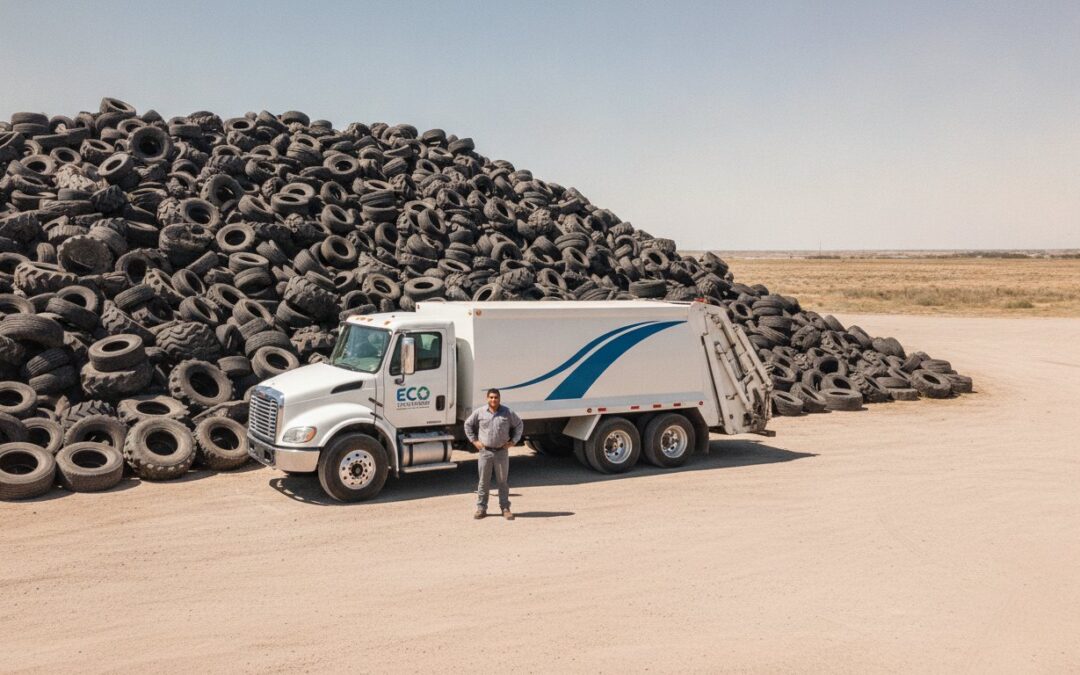
Did you know that leaving a pile of bulk rubber on your property in the Permian Basin could cost you more in TCEQ fines than the tires were ever worth? It’s a common headache for local businesses and landowners. You want the waste gone, but Midland landfills have stopped accepting whole tires. The labor involved in hauling them yourself is often prohibitive. Beyond the cost, stagnant water inside those casings can breed over 500 mosquitoes in just one week, creating a health hazard alongside a legal one.
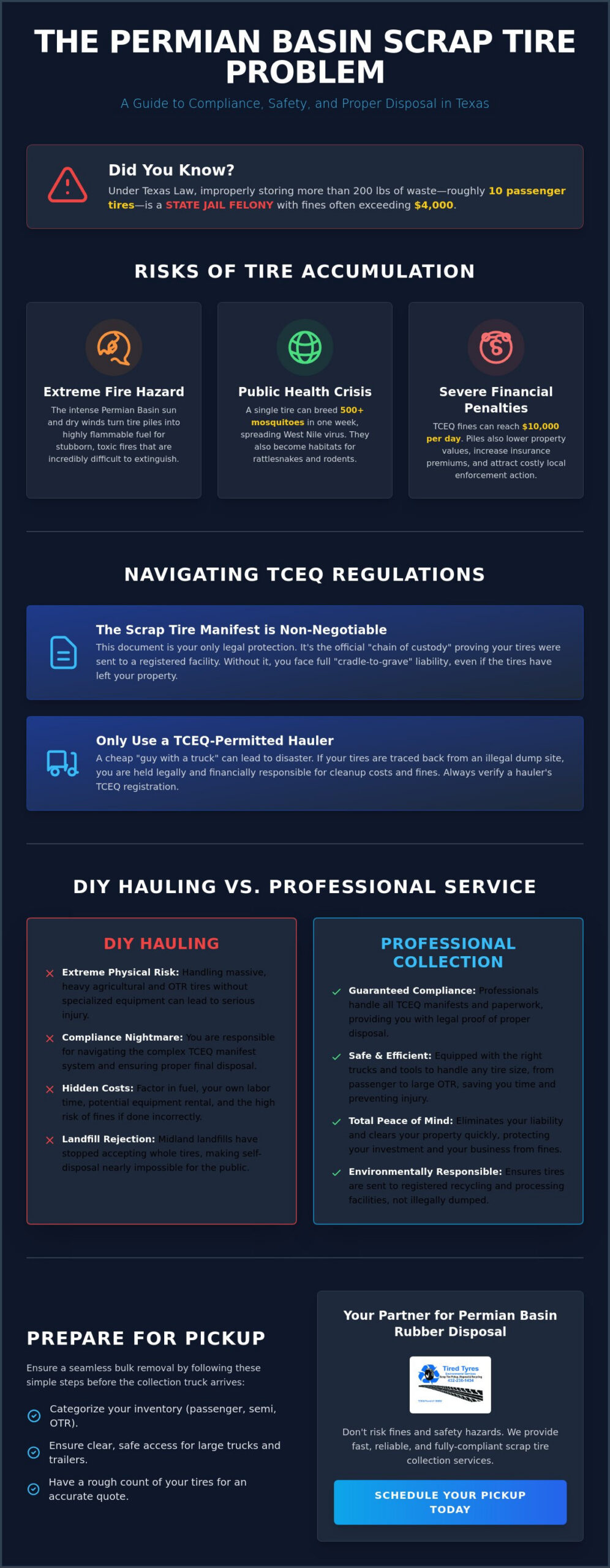
If you’re feeling overwhelmed, you aren’t alone. It’s difficult to keep up with shifting Texas environmental laws and the manifest systems required for transport. This guide explains exactly what to do when you have too many scrap tires Midland to ensure you stay compliant and avoid state jail felonies that carry fines exceeding $4,000. We’ll walk through the latest 2026 disposal regulations, the risks of improper storage, and the most efficient paths to clearing your site of everything from semi-truck tires to scrap agricultural rubber.
Key Takeaways
- Learn why holding a valid TCEQ Scrap Tire Manifest is your only legal protection against environmental liability and heavy state fines.
- Understand exactly what to do when you have too many scrap tires Midland by categorizing your inventory into passenger, semi, and OTR collections for faster removal.
- Discover the hidden costs of DIY hauling, including the physical risks of handling massive agricultural and OTR tires without specialized equipment.
- Identify the specific Permian Basin fire and health hazards that make immediate rubber waste disposal a priority for local property owners.
- Prepare your site for a seamless bulk pickup by ensuring clear access for professional collection trucks and trailers.
The Risks of Scrap Tire Accumulation in the Permian Basin
In the arid climate of West Texas, a growing pile of rubber isn’t just an eyesore. It’s a significant liability. When property owners aren’t sure what to do when you have too many scrap tires Midland, they often let the pile sit, hoping for a future solution. This delay creates a dangerous environment. The intense sun and dry winds of the Permian Basin turn tire stockpiles into fuel for stubborn fires. Once a tire fire starts, it’s incredibly difficult to extinguish. It produces toxic smoke that threatens local air quality and puts a massive strain on our first responders. Professional tire recycling and disposal are the only ways to mitigate these thermal risks effectively.
Health and Safety Hazards of Tire Stockpiles
While West Texas is known for its dry heat, even a small amount of rain can cause major health issues. A single scrap tire can hold enough stagnant water to breed over 500 mosquitoes in just seven days. In Midland County, this isn’t just a nuisance; it’s a direct link to the West Nile virus. These piles also provide the perfect habitat for other unwelcome guests. From rattlesnakes seeking shade to rodents looking for a nesting site, an unmanaged tire collection quickly becomes a pest infestation hub. Waiting to clear the waste only increases the chance of a dangerous encounter on your property.
The Legal Burden of ‘Too Many’ Tires
The Texas Commission on Environmental Quality (TCEQ) doesn’t take improper storage lightly. Under Texas Health and Safety Code §365.012, dumping or improperly storing more than 200 pounds of waste is classified as a state jail felony. For reference, that is only about 10 standard passenger tires. Fines for these violations often exceed $4,000 per occurrence. If the TCEQ identifies specific environmental violations, those penalties can climb as high as $10,000 per day, per violation.
Beyond government fines, “waiting it out” hits your bottom line in other ways. Large rubber stockpiles can lead to several complications:
- Lower property values: Prospective buyers see tire piles as a costly cleanup project that they don’t want to inherit.
- Increased insurance premiums: Many commercial insurers will raise rates or deny coverage if they identify a fire hazard on-site.
- Heightened local enforcement: Midland and Ector County law enforcement now use trail cameras to monitor and prosecute illegal dumping.
Taking action early is the only way to protect your business and your wallet from these compounding costs.
Understanding Texas Tire Disposal Regulations for 2026
Staying compliant with Texas environmental law is a full-time job for many Permian Basin business owners. Under the Texas Commission on Environmental Quality (TCEQ) guidelines, scrap tires are classified as “special waste.” This means they can’t be treated like standard trash. If you’re wondering what to do when you have too many scrap tires Midland, the first step is realizing that your standard dumpster is off-limits. Placing whole tires in residential or commercial trash bins is illegal in Midland. Because tires don’t compact and can damage landfill liners, state law requires them to be split, quartered, or shredded before they ever reach a permitted landfill. For most businesses, this makes professional collection the only viable path forward.
The backbone of legal disposal is the Scrap Tire Manifest. This document acts as a formal chain of custody. It tracks the movement of tires from your property to a registered processing facility. As a commercial tire generator, you’re required to maintain these records to prove that your waste was handled responsibly. By law, scrap tire transporters and storage facilities must submit an annual activity report to the TCEQ by March 1 each year. If you can’t produce a manifest during an inspection, your business could be held liable for “cradle-to-grave” environmental damage, even if the tires left your property months ago. To ensure your paperwork is in order, it’s best to work with a professional tire collection service that prioritizes transparency.
The Importance of Using a Permitted Hauler
A permitted tire hauler is a business specifically registered with the TCEQ to transport scrap rubber. You should never trust your inventory to a “guy with a truck” who offers a cheap, cash-only price. If that individual dumps your tires in a West Texas field or an alleyway, the authorities can often trace those tires back to your business. You remain legally and financially responsible for the cleanup costs and associated fines. Always verify a hauler’s TCEQ registration status before allowing them to load your Passenger & Light Truck Tire Collection or heavy equipment tires.
Midland and Odessa Local Ordinances
Local rules in the Permian Basin are becoming increasingly strict. As of 2026, Midland landfills have implemented tighter restrictions on “rim-on” tires and often refuse whole tires entirely from commercial entities. While individuals might pay between $3.00 and $7.00 per tire for self-hauling at authorized points, businesses with bulk stockpiles face much higher hurdles. Zoning restrictions in Midland and Ector counties also limit how long you can store scrap rubber outdoors before it’s considered an illegal dump site. For a deeper dive into these specific requirements, review our guide on Texas Tire Disposal Regulations: A 2026 Guide for West Texas Businesses.
DIY Hauling vs. Professional Tire Collection Services
Many property owners and business managers initially believe they can save money by loading up a trailer and heading to the local landfill. However, when you’re deciding what to do when you have too many scrap tires Midland, the hidden costs of the DIY route often outweigh any perceived savings. Self-hauling is rarely as simple as a single trip. It involves significant logistical planning, physical labor, and a clear understanding of local facility restrictions that can change without notice.
Analyzing the Costs of Self-Disposal
To find the true cost of DIY disposal, you have to look beyond the gate fee. You must account for the fuel consumed by a heavy-duty truck and the accelerated wear on your trailer’s tires and suspension. Then there’s the labor cost. Pulling your staff away from their primary responsibilities to load, transport, and unload heavy rubber waste is an expensive use of company time. Local collection points in the Permian Basin typically charge between $3.00 and $7.00 per tire for passenger sizes. When you multiply that by dozens of units, the bill grows quickly. There’s also a high risk of vehicle damage. Scrap tires are heavy, dirty, and awkward. They often lead to scratched truck beds or damaged trailer gates during the loading process.
When Professional Collection Becomes Essential
For a small stack of four or five tires, a DIY trip might be manageable. Once your accumulation exceeds 50 tires, professional intervention becomes a matter of safety and efficiency. Managing an OTR (Off-the-Road) Tire Collection or an Agricultural Tire Collection requires specialized equipment that most businesses simply don’t have. These tires can weigh hundreds of pounds. Attempting to lift them manually into a pickup or a standard utility trailer is a recipe for back injuries and workplace accidents.
Landfill limitations in Midland and Odessa add another layer of frustration for the DIYer. Many facilities have strict daily caps on how many tires a single person or business can drop off. They may also refuse specific types of waste entirely, such as solid tires or tires still mounted on rims. A professional service brings the right trailers and loaders directly to your site. This eliminates the need for multiple, exhausting trips to a facility that might turn you away at the gate. By choosing a professional collection, you ensure your site is cleared in one visit, allowing you to focus on your core operations while staying fully compliant with state regulations. It’s a more predictable, safer, and ultimately more professional way to handle your bulk rubber waste.
How to Prepare for a Bulk Scrap Tire Pickup in Midland
Preparation is the key to a smooth and cost-effective removal process. When you’re deciding what to do when you have too many scrap tires Midland, efficiency starts well before the collection truck arrives. A disorganized pile slows down the loading crew and can lead to unnecessary labor delays. By following a structured staging process, you ensure that your site is cleared quickly and that your TCEQ compliance records remain accurate from the moment the rubber leaves your property.
The first step is to categorize your inventory into distinct groups. We recommend separating your Passenger & Light Truck Tire Collection from larger commercial units. Keeping your Semi-Truck Tire Collection away from specialized Agricultural Tire Collection or OTR (Off-the-Road) Tire Collection items allows the hauler to use the most efficient loading equipment for each category. If you have other rubber waste, such as a Scrap conveyor belt collection or a Scrap skid steer track collection, keep these in their own designated stack to avoid confusion during the count. For a seamless experience, contact our team to schedule a professional scrap tire collection today.
Site accessibility is equally important. Large collection trailers require a wide turning radius and firm, level ground to operate safely. In the Permian Basin, unpaved lots can become soft or muddy, so try to stage your tires on a gravel or concrete pad if possible. Ensure there are no low-hanging wires, narrow gates, or parked vehicles obstructing the path to the stockpile. Before the pickup, take the time to remove rims from the tires. Most facilities in Midland have strict policies regarding “rim-on” tires or charge a premium for the extra handling required. Finally, clear out any mud, water, or debris from inside the casings. This ensures an accurate weight for your manifest and keeps the loading process clean and professional.
Sorting Your Scrap for Efficient Removal
Efficient removal depends on clear organization. Handling specialized rubber like a scrap hose collection or scrap solid tire collection requires different disposal paths than standard tires. If you have tires that are still on the rim, identify them clearly during your initial inventory count. This transparency helps your hauler prepare the right tools for de-rimming or specialized transport, preventing delays on the day of the pickup.
Ensuring Site Accessibility
Heavy-duty collection vehicles need significant clearance to maneuver. Avoid staging tires in areas with deep sand or soft dirt, which are common in rural Midland County. During the loading process, establish a clear safety perimeter. Keeping the area free of non-essential personnel and equipment ensures the job is completed without accidents, protecting both your staff and the collection crew.
Tired Tyres: Your Partner for Permian Basin Rubber Disposal
Tired Tyres understands the specific challenges of the Permian Basin. Managing bulk rubber waste requires more than just a truck; it requires a commitment to local environmental health and strict legal compliance. If you’ve been searching for what to do when you have too many scrap tires Midland, our team provides a streamlined, professional path to clearing your property. We don’t just handle standard passenger vehicles. Our expertise extends to the heavy industries that power West Texas, offering specialized removal for everything from a Semi-Truck Tire Collection to massive OTR (Off-the-Road) Tire Collection units.
We also offer solutions that go beyond standard tires. Our “Beyond Tires” advantage means we can clear your site of other industrial rubber waste that many haulers refuse. This includes a Scrap conveyor belt collection, Scrap hose collection, and even a Scrap skid steer track collection. By consolidating all your rubber disposal needs with one trusted partner, you simplify your logistics and ensure every piece of waste is tracked through a proper TCEQ manifest. We stay current with all 2026 environmental standards so you don’t have to worry about the legal details.
Specialized Solutions for Industry and Agriculture
Different sectors have different needs. Midland auto shops often require predictable, customized collection schedules for their Passenger & Light Truck Tire Collection to keep their service bays clear. Meanwhile, ranchers and landowners in the Lubbock area often face bulk site remediation challenges after years of accumulation. We provide the heavy equipment and trailers necessary to handle an Agricultural Tire Collection or a Scrap solid tire collection efficiently. For more details on these industry-specific services, read our Commercial Tire Disposal in Midland, Odessa & Lubbock: The 2026 Guide.
Getting Started with Your Cleanup
Reclaiming your space and protecting yourself from liability starts with a simple conversation. To provide an accurate estimate, we’ll need to know the approximate count and type of tires in your inventory. Whether you have a small pile of light truck tires or a massive OTR equipment graveyard, we’ll provide a fast, transparent quote. Contact us today to discuss what to do when you have too many scrap tires Midland and let us handle the heavy lifting. We’ll help you clear your site, stay compliant, and get back to business without the stress of bulk waste accumulation.
Take the Next Step Toward a Compliant Property
Tired Tyres is a TCEQ Permitted Hauler servicing Midland, Odessa, and Lubbock. We specialize in OTR and industrial rubber waste, including hoses, belts, and tracks. We’ll handle the logistics and paperwork so you can focus on your core business operations. Don’t let your liability grow another day. Get a Professional Scrap Tire Pickup Quote in Midland and reclaim your space. We’re ready to provide the efficient, professional solution your property deserves.
Frequently Asked Questions
Is it illegal to keep a large pile of tires on my property in Midland?
Yes, storing bulk tires without a permit is a violation of both local ordinances and state law. The TCEQ requires specific registrations for any site storing more than 500 scrap tires. For smaller piles, you can still face local fines if the tires create a fire hazard or a health nuisance. Texas law is strict; dumping or improperly storing over 200 pounds of rubber can be prosecuted as a state jail felony.
How many tires can I take to the Midland landfill at once?
Midland landfills have stopped accepting whole tires from commercial businesses and have strict caps for residential haulers. Most local facilities require tires to be split or quartered before arrival. While individuals might be able to drop off a few tires for a fee, bulk loads are generally turned away at the gate. It’s always best to call ahead, as “rim-on” restrictions tightened significantly in 2026.
Does Tired Tyres pick up OTR or tractor tires?
Yes, we’re equipped to handle the largest tires used in the Permian Basin. Our services include specialized OTR Tire Collection and Agricultural Tire Collection for tractors and heavy machinery. These massive tires are impossible for DIY hauling and require the heavy-duty loaders and trailers we bring to your site. We handle the entire loading process to keep your staff safe and your operations moving.
What is a scrap tire manifest and do I need one?
A scrap tire manifest is a mandatory chain-of-custody document used in Texas. It tracks tires from your property to a permitted recycling or disposal facility. If you’re a business owner, you need this document to prove you’ve followed state environmental laws. It acts as your primary legal defense if tires from your inventory are ever discovered in an illegal dump site after they’ve left your care.
Can you dispose of old conveyor belts and skid steer tracks?
Yes, our team handles a wide variety of industrial rubber waste. We provide removal for your Scrap conveyor belt collection, Scrap skid steer track collection, and even Scrap hose collection. Many standard haulers only want passenger tires, but we understand the diverse needs of Midland’s industrial and oilfield sectors. We’ll clear your entire site of rubber waste in one efficient visit.
How much does professional tire collection cost in West Texas?
The cost of collection depends on your volume, the tire types, and your location. For example, an OTR Tire Collection requires different equipment than a Passenger & Light Truck Tire Collection. We provide transparent, volume-based quotes rather than a one-size-fits-all price. This ensures you only pay for the specific services you need when figuring out what to do when you have too many scrap tires Midland.
Do I need to remove the rims before you pick up the tires?
Removing rims is recommended because it lowers your total disposal costs. Most processing facilities charge a higher rate for “rim-on” tires due to the extra labor and specialized machinery needed to separate them. If you don’t have the tools to de-rim your inventory, we can provide that service as part of your pickup. Just let us know the count of rim-on tires when you request your quote.
How do I know if a tire hauler is legally permitted in Texas?
A legal hauler must be registered with the TCEQ and have a valid hauler number. You can verify a company’s status through the TCEQ’s online database or ask them to produce their current registration documents. Legitimate professionals will always provide a completed manifest. Never trust your waste to an unpermitted hauler; you remain legally responsible for those tires until they reach a registered processing site.