
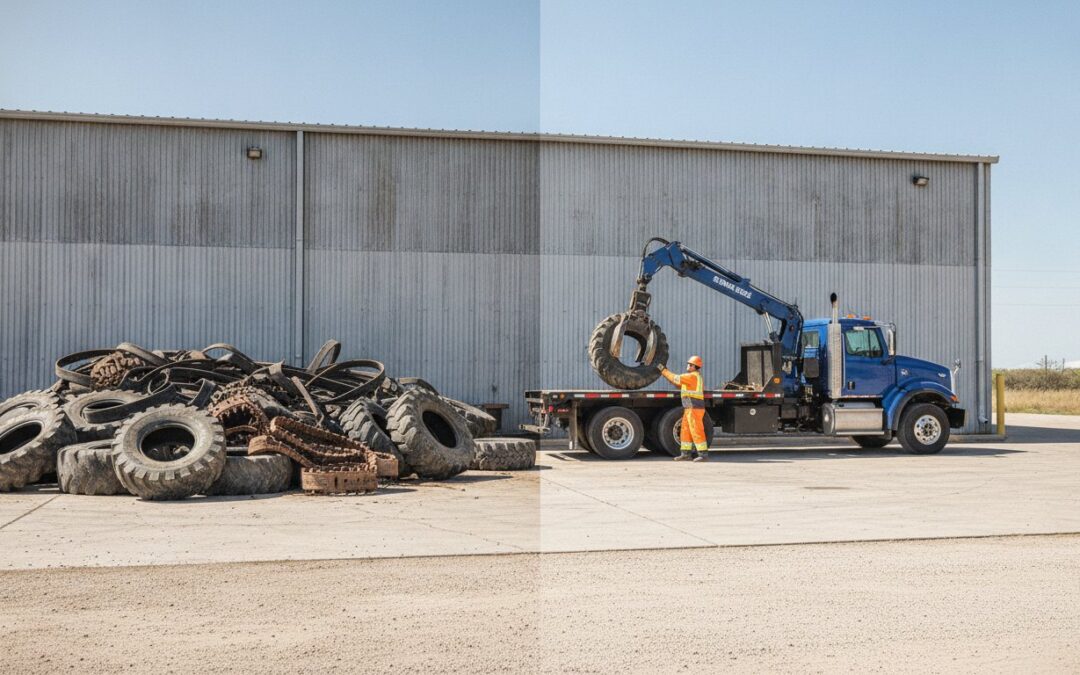
What if that growing pile of scrap tires in your yard isn’t just an eyesore, but a “space thief” actively draining your company’s productivity? It’s a common frustration for local owners who watch valuable warehouse or yard space disappear under stacks of heavy OTR tires, tangled conveyor belts, and old skid steer tracks. Achieving true Lubbock business space recovery from rubber waste is about more than just a simple cleanup. It’s about reclaiming your property’s potential while protecting your business from fire hazards and mosquito infestations.
You likely already know that managing these materials is a logistical nightmare. Heavy industrial rubber is nearly impossible to move without specialized equipment, and the complexity of TCEQ manifest requirements can feel like a full-time job. We agree that your time is better spent running your business than worrying about environmental compliance or storage limits. In this guide, you’ll learn how to efficiently clear industrial rubber waste and scrap tires to restore your commercial space and ensure total TCEQ compliance. We will look at the best practices for handling massive OTR tires, how to navigate state regulations, and the steps to turn a hazardous waste pile back into profitable square footage.
Key Takeaways
- Stop letting scrap tires steal your square footage and learn how clearing rubber waste restores your property’s operational value.
- Understand the limitations of Lubbock landfills and why specialized equipment is necessary for heavy OTR and agricultural tire disposal.
- Achieve Lubbock business space recovery from rubber waste by removing bulky items like skid steer tracks and conveyor belts that municipal services often reject.
- Stay ahead of 2026 TCEQ regulations to avoid heavy fines and ensure your business remains fully compliant with state waste manifest requirements.
- Streamline your cleanup with scheduled pickup services that take the logistical burden of heavy lifting and transport off your team’s shoulders.
Reclaiming Your Lubbock Business Space from Rubber Waste Accumulation
Every square foot of your property in Lubbock represents a significant investment. When scrap rubber starts piling up, it doesn’t just sit there; it actively consumes your operational capacity. This “space theft” creates friction in your daily workflow. It forces drivers to take longer routes around piles and prevents you from storing high-value inventory where it belongs. Lubbock business space recovery from rubber waste is the process of identifying these bottlenecks and clearing them to restore your property’s full earning potential.
Delaying this process only makes the eventual cleanup more expensive. Rubber doesn’t get lighter or easier to move as it ages. In the West Texas sun, it becomes brittle and can sink into the soil, making it much harder to extract. Proactive removal prevents these long-term remediation costs from ballooning. It’s a matter of protecting your asset before the problem grows out of control.
Identifying the ‘Space Thieves’ in Your Yard
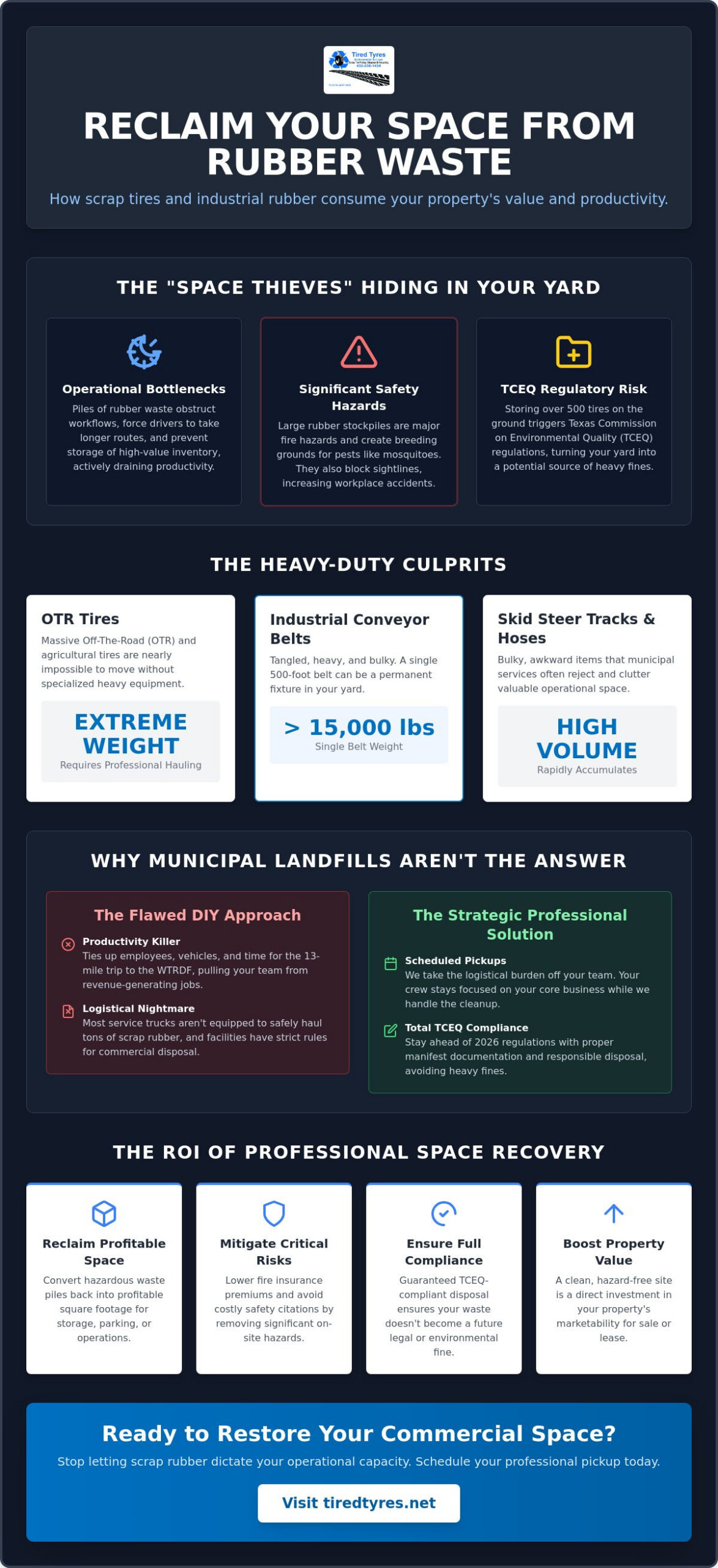
OTR tires, scrap hoses, and heavy conveyor belts are the most common culprits. A single 500-foot industrial conveyor belt can weigh more than 15,000 pounds, making it a permanent fixture if you don’t have the specialized equipment to haul it away. There’s a tipping point where a small pile becomes a major problem. Once you exceed 500 tires stored on the ground, TCEQ regulations kick in, turning your yard into a regulatory liability. Beyond the legal risks, these piles impact vehicle maneuverability and employee safety. They block sightlines for drivers and create unnecessary hazards in high-traffic areas.
The ROI of Professional Rubber Hauling
Many managers focus on the cost of disposal without considering the value of the reclaimed space. If you clear 1,000 square feet of yard space, you’ve essentially expanded your warehouse capacity without a construction project. This move also has a direct impact on your bottom line through risk mitigation. Large rubber stockpiles are significant fire hazards. By clearing them, you’re in a better position to negotiate fire insurance premiums and avoid costly safety citations. Tire recycling and responsible disposal ensure that your waste doesn’t come back to haunt you as a legal or environmental fine. Space recovery is a strategic business move for 2026 that prioritizes property value and operational agility over simple junk storage.
Why Municipal Landfills Aren’t the Answer for Industrial Recovery
While the City of Lubbock provides reliable waste management services, relying on municipal landfills for industrial cleanup is often a losing game for local companies. These facilities are designed for residential convenience, not for the heavy-duty demands of industrial property restoration. If you’re attempting Lubbock business space recovery from rubber waste on your own, you’ll quickly encounter logistical hurdles that outweigh the perceived savings of a DIY approach. Municipal disposal is a reactive fix, whereas professional recovery is a proactive business strategy.
Logistics of the West Texas Regional Disposal Facility
The West Texas Regional Disposal Facility (WTRDF) is located about 13 miles north of the city near Abernathy. Navigating Frankford Avenue or FM 2528 with a trailer full of heavy agricultural tires or massive OTR tires is a slow, grueling task. Most business service trucks aren’t built to haul several tons of scrap rubber safely or efficiently. You also have to factor in the “wait time” at the scale house and the transit time. Tying up two employees and a primary vehicle for half a day kills productivity elsewhere in your operation. When your crew is stuck in a landfill line, they aren’t finishing the jobs that actually generate revenue for your company.
Commercial vs. Residential Disposal Rules
There’s a significant difference between a resident dropping off a few passenger tires and a business trying to clear a yard. Lubbock’s Citizen Convenience Stations are strictly off-limits for industrial volumes and commercial waste. Businesses must follow specific TCEQ requirements for scrap tire facilities, which include strict manifest tracking and registration for large stockpiles. Simply “dumping” waste doesn’t provide the legal paper trail you need to prove compliance during a state audit. For a business, the lack of a proper manifest is a major liability that no landfill receipt can fix.
Beyond the $41.94 per ton disposal fee at the WTRDF, there are hidden drains on your budget. Fuel costs for hauling heavy loads, the risk of a $15.00 unsecured load fee, and the accelerated wear on your fleet’s transmissions and tires add up quickly. For companies focused on corporate sustainability, certified recycling is a much better path than landfilling. It ensures the material is repurposed rather than buried in a hole. Choosing a professional scrap rubber collection service allows you to bypass these logistical nightmares entirely while ensuring your property is cleared according to state law. This approach keeps your team focused on their actual work while we handle the heavy lifting and the paperwork.
Comprehensive Rubber Waste Removal: From OTR Tires to Conveyor Belts
Standard waste services often stop at the curb. For industrial facilities, the real challenge lies in the items that are too heavy or too awkward for a standard garbage truck to handle. Effective Lubbock business space recovery from rubber waste requires a partner who understands the difference between a passenger tire and a ten-ton industrial stockpile. We specialize in the materials that other haulers leave behind, ensuring your yard is completely cleared of all rubber-based debris. This comprehensive approach is what separates a simple trash run from a professional property restoration.
Managing industrial waste isn’t just about hauling; it’s about having the right tools for the job. Many businesses find themselves stuck with massive rubber components because they don’t have the machinery to move them. We focus on these “hard to move” items, taking the logistical burden off your shoulders so you can focus on your core business operations.
Heavy-Duty Tire Collection: Semi-Truck and Agricultural
Lubbock serves as a major logistics hub for West Texas, which means local businesses generate a high volume of scrap semi-truck tires. When these start to pile up on loading docks, they create immediate safety risks and slow down shipping times. We provide efficient removal for these fleets, keeping your docks clear and your drivers safe. We also support the South Plains farming community by handling agricultural tire disposal. From tractors to heavy sprayers, these large-format tires are essential for work but a nightmare to move once they reach the end of their life. OTR tire removal requires specialized lifting equipment to ensure the job is done safely without damaging your property.
Beyond Tires: Industrial Rubber Components
True industrial recovery isn’t limited to tires alone. Many manufacturing and processing plants in Lubbock struggle with scrap conveyor belt collection. These belts are incredibly heavy and difficult to roll or cut without the proper equipment. We also manage scrap hose collection and solid rubber waste from various industrial operations. Whether you have a pile of scrap skid steer tracks or a collection of solid industrial tires, these items shouldn’t be allowed to collect dust and take up space. For a deeper look at the regulations and logistics involved in our region, see our Commercial Tire Disposal in Midland, Odessa & Lubbock: The 2026 Guide. We handle the materials that municipal services simply aren’t equipped to touch, providing a total solution for your entire site.
Clearing out scrap solid tires and industrial hoses does more than just clean up your yard. It eliminates hiding places for pests and removes potential fire fuel from your property. By addressing every type of rubber waste on your site, we help you reclaim every available inch of your commercial real estate.
Navigating TCEQ Compliance and Avoiding Fines in Lubbock County
Ensuring your property is physically clear is only half the battle. To achieve full Lubbock business space recovery from rubber waste, you must also clear your company of legal liability. In 2026, the Texas Commission on Environmental Quality (TCEQ) maintains strict oversight on how scrap tires and industrial rubber are stored and transported. If you have more than 500 scrap tires on the ground or 2,000 in lockable containers, state law requires you to register your site. These registrations stay valid for 60 months, but they require annual reporting and a renewal application submitted at least 60 days before the expiration date. Ignoring these timelines can lead to unexpected inspections and heavy penalties.
The biggest legal trap for Lubbock businesses is the “generator liability” rule. If you hire an unpermitted hauler because they offer a lower price, you aren’t off the hook once the rubber leaves your yard. If those tires are later found in a ditch or an illegal dump site, the TCEQ and Lubbock County authorities will trace them back to your facility. As the generator of the waste, you remain legally and financially responsible for the cleanup costs and any associated fines. Proper documentation through the scrap tire manifest system is your only real defense during a state audit. It proves exactly where your waste went and who took it there.
The Permitted Hauler Advantage
Working with a permitted hauler like Tired Tyres shifts the burden of compliance from your shoulders to ours. When you review a 2026 Texas tire disposal contract, look for explicit mentions of manifest tracking and state-approved disposal sites. A legitimate partner will always provide you with a completed manifest that proves your waste was handled according to state law. For a deeper dive into these rules, read our Texas Tire Disposal Regulations: A 2026 Guide for West Texas Businesses. This paper trail is essential for protecting your business from the “illegal dumping” fines that Lubbock County aggressively pursues to keep our region clean.
Environmental Hazards of Rubber Stockpiles
Beyond the legal paperwork, accumulated rubber poses immediate physical risks to your property. Tire piles are notorious breeding grounds for mosquitoes, which can trigger inspections and citations from the Lubbock Health Department. These pests aren’t just a nuisance; they’re a public health liability that can lead to forced remediation orders. Fire hazards are an even greater concern in our dry climate. Tire fires are notoriously difficult to extinguish and can lead to massive remediation costs and environmental damage. Meeting local fire code requirements is simple: don’t let the fuel accumulate. Most processing facilities are only allowed to store an approved 30-day supply of material for a reason. By maintaining a regular removal schedule, you keep your site safe and your business in the clear.
If you’re ready to secure your property and eliminate these regulatory risks, request a quote for professional rubber waste removal to ensure your business stays fully compliant with state and local laws.
Partnering with Tired Tyres for Scheduled Professional Space Recovery
Reclaiming your yard isn’t a one-time chore; it’s an ongoing commitment to operational excellence. We understand that Lubbock business space recovery from rubber waste requires a partner who shows up on time and handles the heavy lifting without disrupting your workflow. Tired Tyres provides a direct, objective service designed to take the complexity out of waste management. We don’t just haul tires; we restore your property and provide the professional documentation required to keep your business running smoothly in 2026.
For high-volume generators, a “wait and see” approach leads to the very stockpiles that trigger TCEQ inspections. We offer customized collection schedules that prevent rubber from accumulating in the first place. Whether you need a monthly sweep of your logistics hub or a quarterly cleanup of agricultural equipment tires, we adapt to your specific volume. This proactive management turns your yard from a liability back into a functional asset. Once the rubber is gone, you can finally use that space for high-value inventory, new equipment storage, or expanded parking for your fleet.
Our Process: Efficient and Transparent
Our workflow is built for speed and accuracy. We respect your time and aim to make the transition from a cluttered yard to a clear space as seamless as possible. The process follows three simple steps:
- Step 1: Professional Assessment. We begin with an on-site visit or a photo-based review of your rubber waste. This allows us to provide an accurate quote and determine the specific equipment needed for the job.
- Step 2: Specialized Pickup. We deploy the right machinery to handle bulk loads, OTR tires, and heavy industrial components like scrap conveyor belts. Our team manages the loading and transport so your crew doesn’t have to.
- Step 3: Compliance Documentation. Once the site is clear, we provide the necessary TCEQ manifests. This documentation is your proof of legal disposal and is essential for any future audits or inspections.
Service Areas and Contact Information
We maintain consistent, reliable routes across West Texas, serving the industrial and agricultural cores of Lubbock, Midland, and Odessa. Our local presence means we understand the specific challenges of the South Plains and the Permian Basin. If you’re ready to restore your property’s potential, getting started is simple. A clear yard means more room for inventory, better vehicle maneuverability, and a safer environment for your employees. For more details on our regional operations, see our Reliable Tire Disposal in Midland, Odessa & Lubbock: The 2026 West Texas Guide. Contact us today for a fast, professional quote and take the first step toward total property recovery. We’re ready to help you take your space back.
Secure Your Property’s Future and Reclaim Your Space
Your commercial yard should be an asset, not a liability filled with fire hazards and regulatory risks. Successful Lubbock business space recovery from rubber waste happens when you stop managing piles and start managing your property’s potential. By choosing a professional path over the logistical nightmare of self-hauling to landfills, you ensure your business remains fully compliant with state laws while gaining back every square foot of usable space.
Tired Tyres is a TCEQ Permitted Hauler specialized for OTR and industrial rubber removal. We bring the specialized equipment needed to handle what municipal services leave behind. We’ve been serving the Permian Basin and South Plains since our inception, providing the reliable manifests and efficient service local businesses need to stay productive. Don’t let scrap tires or heavy conveyor belts dictate how you use your land anymore.
Get a Professional Quote for Your Lubbock Business Space Recovery
Taking the first step toward a clear yard is the best way to protect your investment and prepare your business for its next phase of growth. We’re ready to help you take your property back.
Frequently Asked Questions
Is it illegal to keep a large pile of tires on my business property in Lubbock?
Storing more than 500 scrap tires on the ground without a TCEQ registration is a violation of Texas state law. If you store more than 2,000 tires in enclosed, lockable containers, you’re also required to register your site with the state. These regulations exist to prevent fire hazards and public health risks like mosquito breeding. Keeping unauthorized stockpiles can result in heavy fines from both state and local authorities.
Does the City of Lubbock pick up commercial rubber waste or industrial tires?
The City of Lubbock doesn’t provide curbside pickup for commercial rubber waste or industrial tires. While residents can use Citizen Convenience Stations for very small volumes, businesses must manage their own disposal. This usually involves hauling the waste to the West Texas Region Disposal Facility in Abernathy or hiring a state-permitted service to handle the transport and documentation for you.
What are the TCEQ requirements for business tire disposal in 2026?
In 2026, the TCEQ requires businesses storing large volumes of tires to maintain a valid registration that must be renewed every 60 months. You must submit annual management reports and apply for renewal at least 60 days before your current permit expires. Utilizing a permitted hauler is essential for Lubbock business space recovery from rubber waste because it ensures you receive the manifests required for legal compliance.
Can Tired Tyres handle large OTR tires from mining or construction equipment?
Yes, we have the specialized lifting equipment required to handle massive OTR tires from mining, construction, and agricultural operations. These tires are often too heavy and bulky for standard trailers or city disposal vehicles. We manage the entire loading process to clear your yard safely, ensuring that even the largest industrial rubber components are removed without damaging your property or equipment.
How much does professional rubber waste removal cost in Lubbock?
The cost of professional removal depends on the volume, weight, and type of material you need cleared from your site. Factors such as the size of OTR tires or the total poundage of scrap conveyor belts influence the final price. We provide transparent, site-specific assessments rather than a one-size-fits-all rate. This ensures you only pay for the specific logistical needs of your property restoration project.
What happens to the rubber waste after it is picked up from my site?
After collection, your scrap rubber is transported to state-permitted facilities for recycling, energy recovery, or legal disposal. This process ensures the material is handled in an environmentally safe manner that fully complies with all TCEQ standards. You receive a completed manifest as proof that the material was disposed of correctly and didn’t end up in an illegal dump site.
Do I need to prepare the tires or conveyor belts in a specific way for pickup?
You don’t need to cut or process the material, but we ask that you make it accessible for our heavy equipment. Ensuring that piles are located on stable ground and clear of low-hanging wires or narrow gates helps us work faster. If you’re dealing with bulk hoses or conveyor belts, having them in a central location speeds up the Lubbock business space recovery from rubber waste process.
How quickly can Tired Tyres clear a commercial yard in Lubbock?
We aim for maximum efficiency and can often clear a standard commercial yard within a single scheduled visit. The total time depends on the volume of material and the size of the items being moved. We prioritize a quick turnaround to minimize disruption to your daily business operations. Our goal is to get your property back to a functional state as fast as possible.