
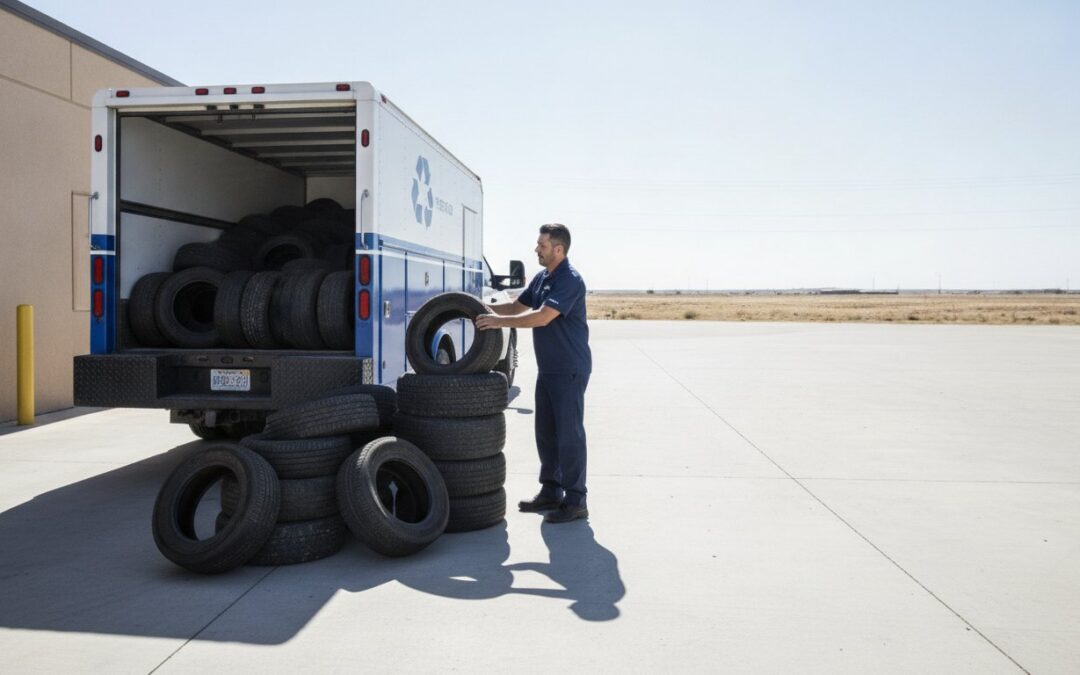
How much time does your team lose every week just managing the “tire mountain” behind your shop? It’s easy to think that calling for a truck only when the rack is full saves money, but the reality of moving from on-demand to scheduled tire pickup is often the difference between a chaotic workflow and a streamlined operation. In West Texas, where the intense heat turns scrap piles into fire hazards and pest magnets, waiting until the last minute is no longer a sustainable way to do business.
We know that your priority is keeping customers on the road, not chasing down drivers or stressing over whether your manifest documentation will pass an inspection. This guide explains how transitioning to a scheduled collection model can stabilize your monthly costs and keep you on the right side of Texas Commission on Environmental Quality (TCEQ) regulations. We’ll look at how routine service helps you comply with new mandates like House Bill 1463, while finally clearing the clutter that disrupts your shop’s productivity.
Key Takeaways
- Reclaim your shop floor by eliminating the “space tax” of uncollected scrap that eats into your revenue-generating square footage.
- Ensure total TCEQ compliance with a steady, predictable stream of documented manifests that protect your business from heavy regulatory fines.
- Discover how moving from on-demand to scheduled tire pickup transforms unpredictable waste management into a manageable, budget-friendly operational routine.
- Learn to right-size your collection frequency by conducting a simple 30-day volume audit to match service stops with your shop’s actual output.
- Partner with local West Texas experts who provide comprehensive handling for everything from passenger tires to scrap conveyor belts and agricultural rubber.
The Hidden Costs of On-Demand Tire Disposal in West Texas
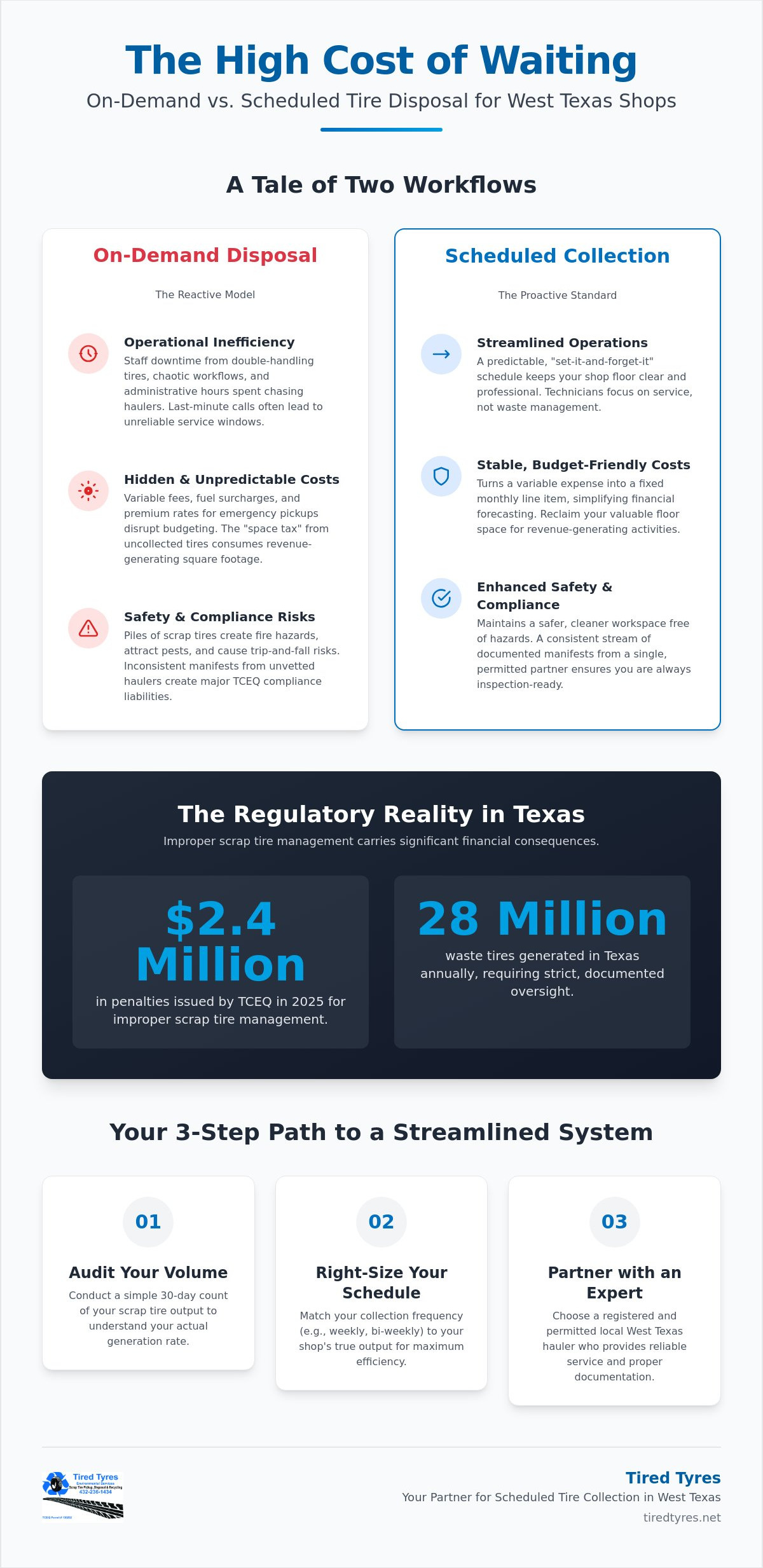
In the commercial waste world, “on-demand” service means you call a hauler only when your scrap pile becomes unbearable. It feels flexible, but it’s actually a reactive strategy that creates hidden bottlenecks. Moving from on-demand to scheduled tire pickup shifts your business into a proactive rhythm. Instead of waiting for a crisis, you have a standing appointment that keeps your facility clear. In West Texas, where logistics can be spread thin across the Permian Basin, relying on a “call as needed” basis often results in long wait times and inconsistent service.
One of the most overlooked expenses is the “space tax.” Every square foot of your shop should be generating revenue. When scrap tires sit in a bay or occupy a corner of your lot for weeks, they’re costing you money. That’s real estate that could hold a new lift, a parts storage rack, or an extra vehicle. Uncollected tires are essentially non-performing inventory that clogs your workflow and limits your shop’s daily capacity.
Operational Friction and Staff Downtime
Technicians are paid for their mechanical expertise, not for playing Tetris with scrap rubber. When pickups are erratic, your team often has to move old tires multiple times just to clear a path or make room for a customer’s vehicle. This double or triple handling is pure labor loss. Additionally, the administrative burden is significant. Your service manager shouldn’t spend an hour every week calling different haulers, checking prices, and wondering when a truck will actually show up. Emergency pickups booked at the last minute often come with premium fees or unreliable windows that disrupt your entire afternoon schedule.
Environmental and Regulatory Risks in Texas
The West Texas climate introduces specific liabilities for standing scrap piles. Intense heat and occasional heavy rains create the perfect environment for mosquito breeding and significant fire hazards. Storing too many tires for too long can also trigger a compliance trap. Following Texas tire disposal regulations is mandatory to avoid heavy fines from the TCEQ. If you use an unvetted, on-demand hauler who cuts corners, your business could be held legally liable for illegal dumping. A professional service ensures that the tire recycling process is handled correctly from the moment the rubber leaves your lot. Regular, scheduled stops provide a consistent paper trail of manifests, proving you are managing your waste responsibly and legally.
Why Scheduled Pickups are the Standard for Modern Auto Shops
A clean shop sells. High-end automotive customers expect a professional environment when they drop off their vehicles. If your storefront is crowded with stacks of scrap rubber, it sends the wrong message about your attention to detail. Moving from on-demand to scheduled tire pickup ensures your property remains an asset rather than a liability. When you transition to a recurring service, you replace guesswork with a calendar. This predictability allows you to plan your inventory and bay usage with much higher precision.
Budget stability is another major advantage for West Texas businesses. On-demand fees can fluctuate based on urgency or fuel surcharges. By establishing a route, you turn a variable, unpredictable expense into a steady monthly line item. This makes financial forecasting easier for shop owners in Midland, Odessa, and Lubbock. You no longer have to wonder if a sudden surge in tire sales will lead to an unbudgeted disposal crisis at the end of the month. This focus on predictability is a core principle shared by professional freight brokers like Tranzit Express Inc., who help businesses manage complex shipping and logistics with reliability.
Streamlined Manifest and Record Keeping
Texas generates approximately 28 million waste tires every year. To manage this volume, the TCEQ maintains strict oversight. In 2025, the agency issued over $2.4 million in penalties for improper scrap tire management. A regular schedule automates the paper trail required for reliable tire disposal. Instead of scrambling to find a manifest from a one-off hauler, you maintain a chronological file of pickups from a single, permitted partner. If an inspector makes a surprise visit, you can quickly prove that every tire leaving your shop is accounted for and handled by a registered transporter.
Enhancing Shop Safety and Aesthetics
Safety is a practical concern for any busy garage. “Tire walls” often block emergency exits or create trip hazards for technicians carrying heavy equipment. By clearing your scrap weekly or bi-weekly, you maintain a safer workspace and reduce the risk of spontaneous tire fires. These fires are notoriously difficult to extinguish and can lead to total property loss. Keeping your exterior clear also removes the “junkyard” look that can attract illegal dumping from passersby. If you are ready to clean up your lot, consider switching to professional route management to keep your operations running smoothly. A tidy shop exterior builds immediate trust with new customers and reinforces your reputation as a top-tier service provider.
Comparing the ROI: On-Demand vs. Scheduled Collection
Calculating the true return on investment for waste management requires looking beyond the invoice. While on-demand service feels flexible because you only pay when you call, it’s often the most expensive way to handle scrap. Moving from on-demand to scheduled tire pickup allows you to capture “wholesale” logistical efficiency. When a hauler can plan their route weeks in advance, they save on fuel and time, and those savings are passed down to you through more competitive, stable rates.
Labor savings represent a massive part of this ROI equation. Consider the billable hours lost when your lead technician has to stop mid-job to help an unscheduled driver load a messy pile of tires. If your team spends just two hours a month managing tire logistics or re-stacking piles to keep bays open, that’s hundreds of dollars in lost revenue. A scheduled stop happens at a set time, allowing your team to prepare the load during slow periods rather than interrupting active service work.
Risk mitigation also carries a heavy dollar value. With the TCEQ issuing over $2.4 million in penalties in 2025 for improper tire management, a single compliance error can wipe out a year’s worth of profit. A scheduled service ensures you aren’t holding more than your permitted limit of scrap rubber, which is a common trigger for audits. It’s essentially an insurance policy against regulatory scrutiny and environmental hazards like tire fires or pest infestations.
The Efficiency of the Route System
Local haulers in West Texas optimize their fleet performance when stops are pre-planned. This optimization eliminates the “minimum load” fees or “trip charges” that often plague on-demand bookings. When you’re part of a route, the truck is already in your neighborhood, which lowers the overhead for every stop. By consolidating pickups into a pre-planned route, high-volume shops benefit from a significantly lower cost-per-tire compared to the premium rates charged for one-off, emergency collections.
Long-term Business Sustainability
Proper commercial tire disposal planning is a hallmark of a scaling business. As your shop grows, the volume of scrap rubber grows with it. Relying on “calls as needed” becomes a full-time administrative headache that distracts you from higher-level management tasks. A scheduled partnership means you have a provider who understands your specific volume fluctuations and can adjust frequencies as your business expands. This peace of mind allows you to focus on customer service and technician training rather than worrying about the state of your back lot.
How to Transition Your Business to a Scheduled Pickup Model
Success in moving from on-demand to scheduled tire pickup depends on a few weeks of careful observation. You can’t set a reliable schedule without knowing your true output. Start by tracking every tire your shop pulls for 30 days. This audit gives you the data needed to choose a service frequency that prevents overflows without paying for empty truck stops. Most shops find that a bi-weekly or monthly rhythm works best, but high-volume centers often require weekly visits to keep their bays clear.
Training your team is just as vital as the schedule itself. Ensure your technicians understand where scrap rubber goes and how to stack it safely. When everyone follows the same process, the pickup happens faster and with fewer errors. You should also finalize a clear service level agreement (SLA) with your hauler. Look for specific details on pickup windows, manifest delivery, and how they handle unexpected volume spikes. Clear expectations from day one prevent friction later.
Volume Auditing and Frequency Selection
Don’t treat all rubber the same during your audit. Separate your counts into categories like passenger, semi-truck, and OTR tire collection needs. Agricultural cycles in West Texas or seasonal tire sales can cause massive volume swings. We recommend the “80% Rule” for your first few months. Schedule your next pickup for when your storage area is roughly 80% full. This buffer accounts for busy days and ensures you never cross the line into a cluttered, unsafe workspace.
Setting Up Your Collection Point
Logistics in West Texas often involve tight alleys or shared lot spaces. Designate a “Clear Zone” specifically for your hauler. This area must have enough clearance for heavy trailers and loading equipment, especially in the narrow access points common in Midland and Odessa. Keeping your scrap rubber types separated is another efficiency win. If you have scrap skid steer tracks or old hoses, keep them in a distinct pile from standard tires. This organization speeds up the loading process and ensures accurate manifest documentation. If you’re ready to professionalize your waste management, you can set up a recurring pickup schedule today. Providing after-hours access via a gate code or key can also minimize disruptions to your daily customer service flow.
Tired Tyres: Your Partner for Scheduled Tire Collection in West Texas
Moving from on-demand to scheduled tire pickup is a strategic decision that pays off in cleaner lots and lower daily stress. At Tired Tyres, we specialize in making this transition seamless for businesses across West Texas. We aren’t just a hauling service. We are a local partner that understands the specific logistical challenges of the Permian Basin. Our team handles the heavy lifting and the complex paperwork, which allows you to focus on your core business operations without distraction.
We provide a comprehensive range of rubber collection services tailored to your specific needs. Whether you manage a small auto shop or a large industrial yard, we have the equipment and permits to handle the job. Our confirmed collection services include:
- Passenger & Light Truck Tire Collection
- Semi-Truck and OTR Tire Collection
- Agricultural Tire Collection
- Scrap skid steer tracks, hoses, and conveyor belts
Reliable Service Across the Permian Basin
Punctuality is the foundation of our scheduled routes. When we promise a stop in Midland, Odessa, or Lubbock, we show up. This reliability prevents the “tire mountain” from returning to your property. We serve a diverse range of industries, from local tire retailers to oilfield equipment yards and family farms. As a permitted and locally owned business, we take pride in keeping our Texas communities clean and compliant. Our drivers are trained to handle manifests with precision. This ensures your records are audit-ready at all times, removing the compliance burden from your service managers.
Get Started with a Custom Pickup Plan
The switch begins with a simple conversation. Our team can perform a site audit to assess your typical volume and storage capacity. We don’t believe in one-size-fits-all solutions. Instead, we’ll help you determine if a weekly, bi-weekly, or monthly stop fits your shop’s rhythm. The onboarding process is straightforward. We’ll help you clear your final on-demand pile and then establish your first recurring date. Contact us today for a tire pickup quote in Midland. Let’s build a plan that grows alongside your business while keeping your lot professional, safe, and organized.
Streamline Your Shop Operations Today
Transitioning your waste management strategy is one of the most effective ways to improve your shop’s daily flow. By reclaiming valuable square footage and automating your manifest record-keeping, you eliminate the constant stress of managing overflowing scrap piles. Moving from on-demand to scheduled tire pickup replaces reactive chaos with a predictable, budget-friendly routine that protects your business from TCEQ scrutiny and environmental hazards. It’s a simple change that yields long-term operational benefits for any West Texas automotive business.
We’ve served the Midland, Odessa, and Lubbock communities since our inception, providing the specialized equipment needed for everything from passenger tires to heavy OTR and industrial rubber removal. As a permitted TCEQ scrap tire hauler, we ensure your disposal process is professional, legal, and efficient. Switch to a reliable scheduled pickup plan with Tired Tyres today and focus on what you do best: keeping your customers on the road. A cleaner, safer, and more professional shop is within reach.
Frequently Asked Questions
Is there a minimum number of tires required for a scheduled pickup?
We establish minimum thresholds based on your specific location and the category of tires you generate. For most shops in Midland and Odessa, we set a threshold that ensures our trucks are utilized efficiently without letting your scrap pile become a safety hazard. This balance helps keep your monthly costs predictable while maintaining a clean, professional lot for your customers.
Can I change my pickup frequency if my business volume changes?
Yes, your service frequency is fully adjustable to match your shifting business cycles. Many West Texas shops increase their stops during peak tire sale seasons or agricultural harvest periods to prevent overflow. Moving from on-demand to scheduled tire pickup doesn’t mean you’re locked into a rigid plan that no longer fits your actual shop volume.
What happens if I have an unusually large load of OTR or semi-truck tires one week?
Simply notify our dispatch team 24 to 48 hours in advance if you anticipate a sudden surge in heavy rubber. We can often reroute a larger trailer or schedule an additional stop to ensure your bays stay clear. Our specialized equipment is designed to handle heavy industrial and agricultural tires, so we can accommodate larger loads with proper notice.
Do I need to be present when the Tired Tyres truck arrives for a scheduled stop?
You don’t need to be present for the collection as long as we have clear access to your designated “Clear Zone.” Many of our clients provide gate codes or keys for after-hours service to minimize disruption to their daily customer operations. As long as the scrap is in the agreed-upon area, our team will handle the loading and leave the required documentation.
How do scheduled pickups help with my TCEQ manifest compliance?
Scheduled stops create a consistent, chronological paper trail that is essential for passing TCEQ audits. Because we are a permitted hauler, every pickup generates a valid manifest that proves your waste is being handled legally and responsibly. This systematic approach is much more reliable than trying to track down disparate records from various one-off providers.
Is it more expensive to have a scheduled service than calling on-demand?
Scheduled service is typically more cost-effective because it eliminates emergency booking premiums and the “minimum load” fees often found in on-demand calls. When you’re part of a pre-planned route, we optimize our fuel and labor, which allows us to offer more stable rates. It also removes the hidden labor costs of your technicians constantly managing a growing scrap pile.
Can you pick up other rubber waste, like scrap conveyor belts, on the same schedule?
Yes, we can collect scrap conveyor belts, hoses, and skid steer tracks during your regular scheduled stop. We recommend keeping these items slightly separated from your standard passenger tire piles to speed up the loading and documentation process. This comprehensive rubber handling ensures all your industrial waste is managed through a single, permitted partner.
What areas of West Texas do you cover for scheduled routes?
Our scheduled routes primarily cover the Midland, Odessa, and Lubbock areas, including the surrounding Permian Basin communities. If your business is located outside these main hubs, contact our team to see if we can integrate your location into an existing route. We are committed to providing reliable, professional service to the diverse industries that power West Texas.