
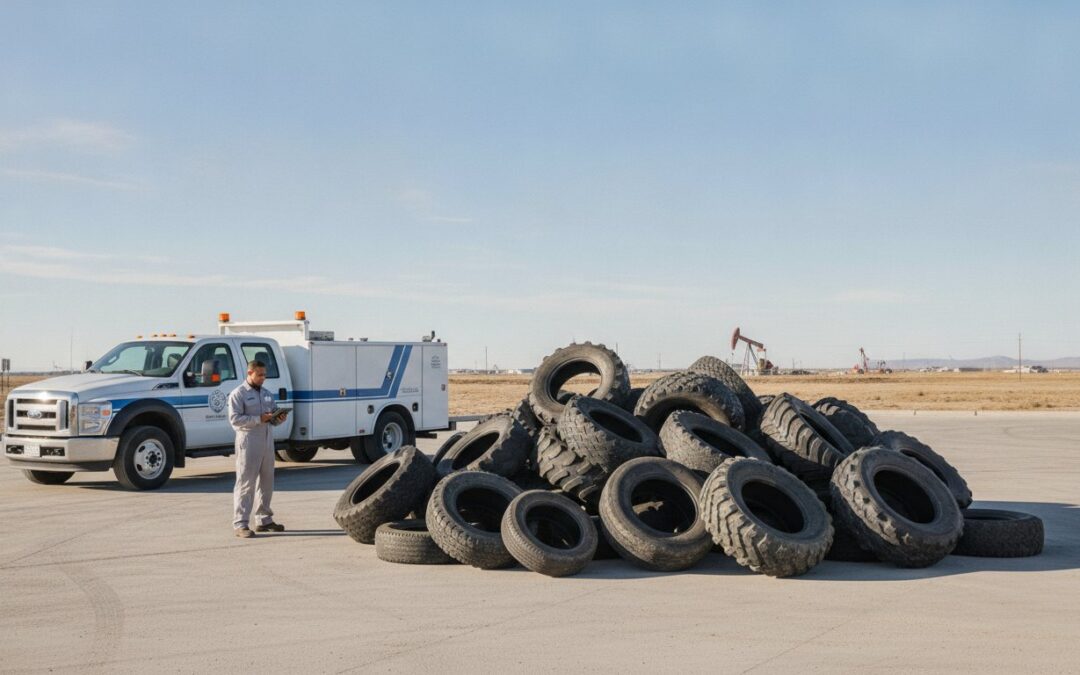
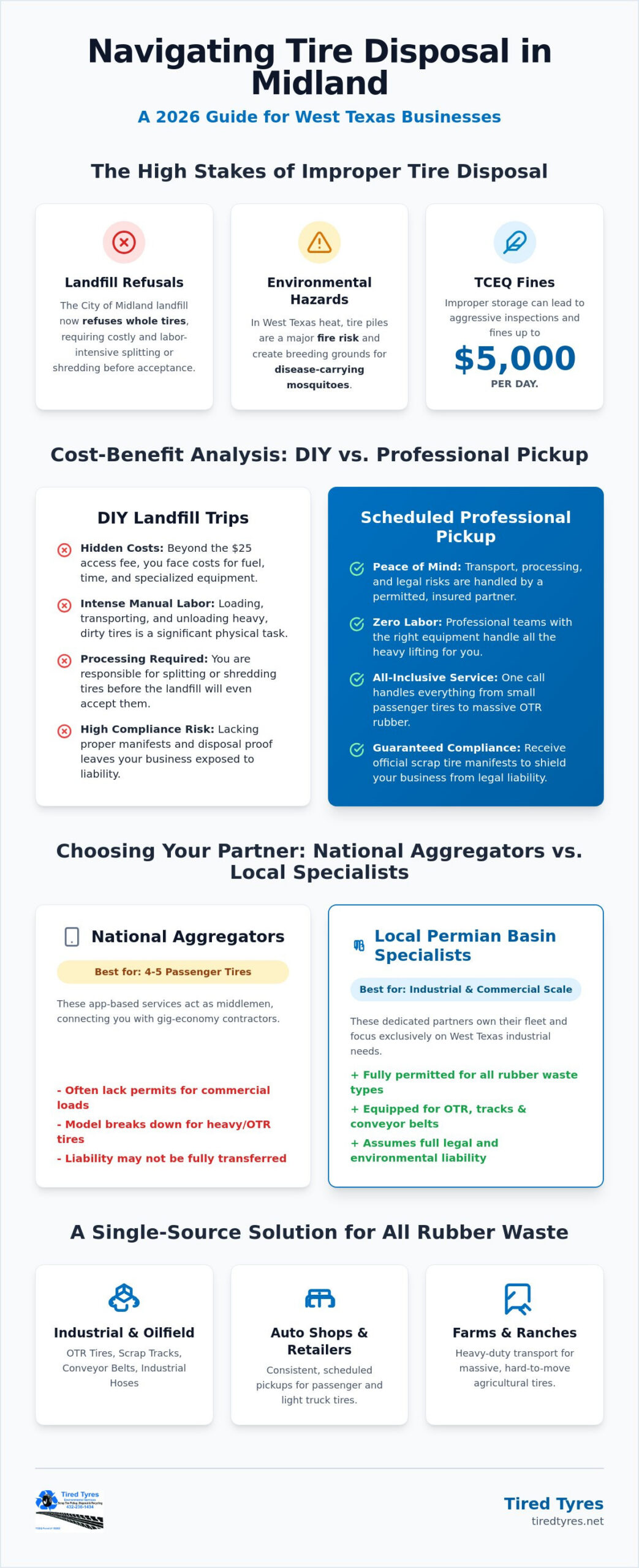
The most cost-effective way to handle scrap rubber in West Texas isn’t actually a DIY trip to the landfill. While it might seem cheaper to load up the truck yourself, the City of Midland landfill now refuses whole tires, requiring them to be split or shredded before they’re accepted. When you compare tire disposal services Midland businesses rely on in 2026, you’ll see that the real value lies in avoiding the manual labor and the $25 access fees. It’s about finding a solution that works for your specific inventory without the headache of transport.
We understand that managing a growing pile of OTR or agricultural tires is more than just an eyesore; it’s a major liability. Between rising tipping fees and the risk of TCEQ fines that can reach $5,000 per day for improper storage, the pressure to stay compliant is higher than ever. This guide will help you find a reliable partner that handles all rubber types, including scrap tracks and conveyor belts. We’ll examine the local market to ensure you choose a service that takes the weight of transport and legal risk off your shoulders for good.
Key Takeaways
- Understand the hidden costs of DIY landfill trips, including specialized labor and the requirement to shred tires before disposal.
- Use this guide to compare tire disposal services Midland businesses use to find the best balance of price and reliability.
- Learn how to verify TCEQ compliance and the importance of scrap tire manifests in shielding your company from legal liability.
- Discover why local Permian Basin specialists are better equipped than national aggregators to handle heavy OTR and agricultural tires.
- Identify a single-source partner that manages all rubber waste, including industrial hoses, skid steer tracks, and conveyor belts.
The Landscape of Tire Disposal Services in Midland (2026)
The Permian Basin is currently facing a significant challenge with industrial and commercial rubber waste. As of 2026, the volume of scrap tires generated by oilfield activity and local transportation has reached record levels. Most traditional waste management companies in Midland simply aren’t equipped to handle these materials. Tires don’t compress in standard garbage trucks. They take up too much space in landfills and can even “float” back to the surface over time. This has led to a major shift toward specialized tire haulers who understand the specific logistics and environmental demands of West Texas.
When you compare tire disposal services Midland providers offer, you’ll see a clear divide between general junk removers and dedicated rubber specialists. General haulers might take a few passenger tires, but they often lack the permits or equipment for bulk commercial loads. Staying compliant means ensuring your waste enters the proper tire recycling process rather than ending up in an illegal dump site. Local regulations have tightened this year, making it harder for businesses to store more than a handful of tires on-site without facing aggressive inspections and potential fines.
Common Disposal Challenges in West Texas
Disposing of tires in Midland isn’t just a matter of space. The environmental risks are unique to our region. In the intense West Texas heat, large tire piles become significant fire hazards. These fires are notoriously difficult to put out and release toxic smoke into the atmosphere. Additionally, the “Mosquito Factor” remains a primary concern for Midland County health officials. Stagnant water collects easily inside tires, creating a breeding ground for mosquitoes that carry West Nile and other viruses. Because of these risks, waste tire problems have become a focal point for inspectors who are now conducting more frequent site visits to industrial and commercial properties.
Who Needs Professional Disposal Services?
Professional disposal isn’t just for large corporations. It’s a necessity for any operation that generates rubber waste. Auto repair shops and tire retailers in Midland need consistent, scheduled pickups to keep their bays clear and their properties safe. Industrial sites often deal with more than just tires; they have scrap conveyor belts, heavy-duty hoses, and worn-out skid steer tracks that require heavy-duty equipment to move. Even local farms and ranches struggle with heavy agricultural tires. These massive tires are nearly impossible to transport without a professional service that has the right trailers and loading tools. By taking the time to compare tire disposal services Midland businesses can find a reliable partner that handles everything from light truck tires to massive OTR rubber, taking the labor and liability off their hands.
National Aggregators vs. Local Specialists: Which Model Fits?
When you compare tire disposal services Midland businesses use, you’ll find two distinct paths. On one side, you have national aggregators who operate through apps and gig-economy contractors. On the other, you have local specialists who own their fleet and focus exclusively on the Permian Basin. Choosing between them depends on the scale of your operation and the specific types of rubber you need to remove.
National aggregators are often fast for small, residential-style pickups. They offer simple online booking and upfront pricing for a few passenger tires. However, their model often breaks down when it comes to industrial needs. Many of these contractors lack the specialized trailers required for OTR (Off-the-Road) tires or the expertise to handle scrap conveyor belts and industrial hoses. In the eyes of the law, simply hiring a ‘junk remover’ doesn’t always satisfy your liability. If the contractor isn’t properly permitted to manifest tires, you could still be held responsible for where those tires end up.
The National Aggregator Experience
The main draw of an aggregator is the user interface. It’s convenient for a shop that has four or five car tires sitting in a corner. But for bulk commercial loads, the fees often skyrocket. These platforms act as middlemen, taking a cut of the price while outsourcing the actual labor to general laborers. These workers might not be familiar with TCEQ requirements or the proper way to secure a heavy industrial load. This gap in expertise can lead to delays or, worse, incomplete legal documentation for your records.
The Local Specialist (Permian Basin) Advantage
The local specialist model is built for the industrial reality of West Texas. These providers focus on commercial tire disposal for trucking fleets, construction companies, and agricultural operations. According to the latest tire recycling report, the efficiency of end-of-life tire management is heavily dependent on regional infrastructure. Local specialists provide that infrastructure. They handle the logistics for semi-truck tires and massive machinery rubber that national apps simply won’t touch.
Beyond just tires, local experts fill a critical gap by accepting industrial rubber waste. This includes scrap skid steer tracks, worn-out conveyor belts, and industrial hoses. This comprehensive approach is vital for oilfield and construction sites that need a single-source solution. If you’re managing a high-volume site, a local scrap rubber collection partner provides the legal documentation and heavy-duty equipment necessary for a worry-free operation. While national apps offer convenience for the individual, the local specialist offers the reliability and legal protection required by a professional business.
DIY Landfill Trips vs. Scheduled Pickup: A Cost Comparison
Many business owners assume that hauling their own scrap rubber to the City of Midland Landfill is the cheapest route. At first glance, the per-tire fees might seem manageable. However, the math changes quickly when you look at the total operational impact. To accurately compare tire disposal services Midland companies provide, you have to look past the invoice and account for the hidden drain on your resources. DIY disposal isn’t just about the tipping fee; it’s about the hours your team spends away from billable work.
The City of Midland Landfill currently charges $10 for passenger tires and $30 for commercial or heavy equipment tires. There’s also a $25 access fee for vehicles without a specific permit. Most importantly, the landfill refuses whole tires. This means your staff must spend time splitting or shredding every single tire before you even leave your lot. If you show up with whole tires, you’ve wasted the fuel and the labor for the entire trip. When you factor in these requirements, the true tire disposal cost Midland businesses face is often much higher than a professional pickup fee.
Calculating the ‘Total Cost of Disposal’
Consider the man-hours lost during a single run. It takes time to load a trailer, drive to the facility, wait in line, and unload the rubber. If you’re sending two employees to help with heavy OTR or tractor tires, you’re doubling that labor cost. You also have to account for vehicle maintenance. Heavy rubber hauls put significant stress on truck transmissions and trailer tires. For an auto shop owner, opportunity cost is the revenue lost from a billable repair while a mechanic is stuck in a landfill line. Every hour spent at the dump is an hour that could have been spent finishing a customer’s vehicle.
When is DIY Worth It? (And When It’s Not)
DIY disposal is usually only practical for residents with one or two tires. For any Midland, Odessa, or Lubbock business handling 20 or more tires, professional collection is almost always the more profitable choice. Beyond the financial math, there’s the issue of safety. Manually loading dozens of heavy truck tires is a primary cause of back injuries and workers’ comp claims. Professional haulers use specialized equipment like lift gates and heavy-duty trailers designed for these loads. By choosing a scheduled service, you eliminate the physical risk to your team and ensure your shop stays focused on its core business. When you compare tire disposal services Midland offers, the convenience of on-site pickup typically pays for itself through increased shop productivity and reduced liability.
Compliance & Capability: Evaluating Midland Disposal Providers
Choosing a hauler based solely on the lowest quote is a risky strategy in the Permian Basin. While price is important, compliance and physical capability should be your primary metrics. When you compare tire disposal services Midland providers offer, you must look for a valid TCEQ registration number. A legitimate provider will be transparent about their permits and insurance coverage. If a hauler seems hesitant to provide documentation, they likely lack the legal standing to manage your waste properly. Protecting your business starts with vetting the people who enter your property.
The Legal Burden: Manifests and Records
The legal burden on your business is significant. Under the current “cradle-to-grave” liability system, you’re responsible for the final destination of every tire you generate. This is why the Scrap Tire Manifest is vital. This multi-part form tracks the tires from your property to the registered processor. Without it, you have no defense against illegal dumping claims. Spotting a ‘rogue hauler’ is usually simple. They often operate out of unmarked trucks, offer “cash-only” deals, and fail to provide any paperwork. Following the Texas tire disposal regulations for 2026 is the only way to shield your shop from fines that can devastate a small business. These administrative penalties can reach $5,000 per day for manifest errors, so your record-keeping must be flawless.
Industrial Capability Checklist
Capability is about more than just having a truck. It’s about having the right tools for the industrial environment of West Texas. Many businesses in Lubbock and Midland require reliable tire disposal for items that aren’t even tires. Can your current provider handle a 600-foot scrap conveyor belt? Do they have the winch systems to load steel-reinforced skid steer tracks? If you’re managing an oilfield site or a large farm, generic junk removal won’t work. You need a partner that handles everything from passenger tires to 1,000lb OTR rubber. Verifying this capability upfront prevents your team from being left with half a pile of debris that the hauler couldn’t move. Additionally, ensure your provider carries adequate liability insurance to cover any on-site loading accidents.
Ensure your business stays on the right side of the law. Partner with Tired Tyres to secure a compliant, professional rubber waste solution that covers your entire inventory and provides the legal documentation you need.
Why Tired Tyres is Midland’s Preferred Rubber Waste Partner
After you take the time to compare tire disposal services Midland has to offer, the choice often comes down to who can handle the most difficult materials without adding administrative stress. Tired Tyres isn’t just a hauling service. We’re a local specialist deeply rooted in the Permian Basin and South Plains. Our team understands that a pile of scrap rubber is a liability that needs to disappear quickly and legally. We’ve built our reputation on being the one-stop-shop for West Texas industries, ensuring that every load is handled with precision and professionalism.
We pride ourselves on transparent, volume-based pricing. You won’t find hidden fees or surprise surcharges on your invoice. Whether you’re a small auto shop in Midland or a large-scale industrial operation in Lubbock, we scale our services to fit your specific needs. Our commitment to the region means we’re always nearby, ready to provide the reliable service that national aggregators often struggle to maintain in our unique climate and geography.
Beyond Tires: Our Full Industrial Rubber Scope
Most providers stop at passenger tires. We don’t. Our capability extends to the heavy-duty materials that keep the oilfield and agricultural sectors running. We provide specialized collection for scrap conveyor belts, solid tires, and industrial hoses. These items are often rejected by standard waste management, but they’re a core part of our service. Whether you’re dealing with steel-reinforced rubber tracks for oilfield equipment or massive OTR tires, we have the specialized trailers and loading equipment to move them safely. This versatility is why we’re the primary choice for tire disposal Midland TX businesses trust. We handle the physical weight so your crew can stay focused on their billable tasks.
How to Schedule Your First Pickup
We’ve designed our process to be as efficient as possible for busy business owners. It starts with a simple request for a personalized bulk disposal quote. For high-volume auto shops in Odessa or Midland, we can set up custom scheduling to ensure your lot never gets overcrowded with scrap. Once you approve the quote, our team arrives on-site with the appropriate equipment. We handle all the heavy lifting, loading, and transport. Most importantly, we provide the final manifest delivery for your permanent records. This document is your proof of compliance and ensures you’re fully protected under TCEQ guidelines. Reclaiming your yard space is easy when you have a partner that handles the labor and the liability in one seamless motion.
Reclaim Your Workspace and Secure Your Compliance
Managing scrap rubber in the Permian Basin doesn’t have to be a source of constant stress. By choosing a specialized local hauler over a national app or a risky DIY trip, you protect your business from unnecessary labor costs and severe legal penalties. When you compare tire disposal services Midland businesses rely on, the most effective partners are those that offer full transparency and the heavy-duty equipment needed for OTR and agricultural tires.
Tired Tyres is a local, family-owned and operated partner dedicated to the West Texas industrial community. We provide a TCEQ-compliant manifest with every load, ensuring your records are always audit-ready. From passenger tires to scrap conveyor belts and industrial hoses, we have the specialized equipment to handle your entire rubber waste inventory in one visit. We understand the unique demands of the local oilfield and agricultural sectors because we live and work here too.
Don’t let scrap piles become a liability for your shop or job site. Get a Reliable Tire Pickup Quote for Your Midland Business today and let our experts handle the heavy lifting. We’re ready to help you keep your operations running smoothly, safely, and fully compliant.
Frequently Asked Questions
How do I know if a tire disposal service in Midland is legal?
A legal service must have a valid registration number from the Texas Commission on Environmental Quality (TCEQ). When you compare tire disposal services Midland haulers provide, always ask for their registration credentials and proof of commercial liability insurance. Legitimate companies will always provide official paperwork for every load. If a provider only accepts cash or refuses to sign a manifest, they aren’t a professional service.
What is a scrap tire manifest and why does my business need one?
A scrap tire manifest is a legal document that tracks tires from your property to a registered processing facility. Your business needs this document to prove that you disposed of the waste legally and didn’t contribute to illegal dumping. Under Texas law, you’re liable for the tires even after they leave your property. Keeping these records is your only defense against potential TCEQ fines.
Can I dispose of OTR or agricultural tires at the local landfill?
You cannot dispose of whole OTR or agricultural tires at the City of Midland landfill. The facility requires all tires to be split, shredded, or quartered before they’re accepted for disposal. Because of the extreme size and weight of industrial rubber, most businesses find it’s more cost-effective to hire a professional hauler with specialized loading equipment and trailers.
Does Tired Tyres pick up scrap skid steer tracks and conveyor belts?
Yes, Tired Tyres collects scrap skid steer tracks, industrial hoses, and worn-out conveyor belts. We’re one of the few specialists in the Permian Basin equipped to handle non-tire rubber waste alongside traditional tires. This allows Midland and Odessa industrial sites to manage all their rubber disposal needs through a single, compliant partner without hiring multiple contractors.
How much does tire disposal typically cost for a Midland auto shop?
When you compare tire disposal services Midland auto shops use, costs typically vary based on the volume and the specific size of the tires. Factors like whether the tires are still on the rims and the frequency of your pickups will also influence your final rate. Most professional services offer volume-based pricing that helps eliminate the hidden costs of staff labor and landfill fees.
What happens to the tires after they are collected in West Texas?
Tires collected in West Texas are transported to a registered processing facility for recycling. They’re often shredded and repurposed into materials like rubberized asphalt for roads, tire-derived fuel, or powder for products like horse stall mats. This recycling process keeps rubber out of landfills and reduces the environmental risks associated with large tire piles.
Do you offer scheduled weekly or monthly tire pickups in Odessa?
Yes, we provide scheduled weekly, bi-weekly, or monthly pickups for businesses in Odessa and the surrounding South Plains. This service is especially helpful for high-volume auto shops that need to keep their bays clear and stay within legal storage limits. We’ll work with you to create a custom schedule that matches your shop’s specific inventory turnover.
Is there a limit to how many tires I can store on my property in Texas?
Texas law generally limits businesses to storing 500 scrap tires on-site without a specific TCEQ permit. Exceeding this limit can result in significant daily administrative penalties and increased scrutiny from local inspectors. It’s best to schedule regular removals to ensure your property stays compliant, safe from fire hazards, and free of mosquito breeding grounds.