
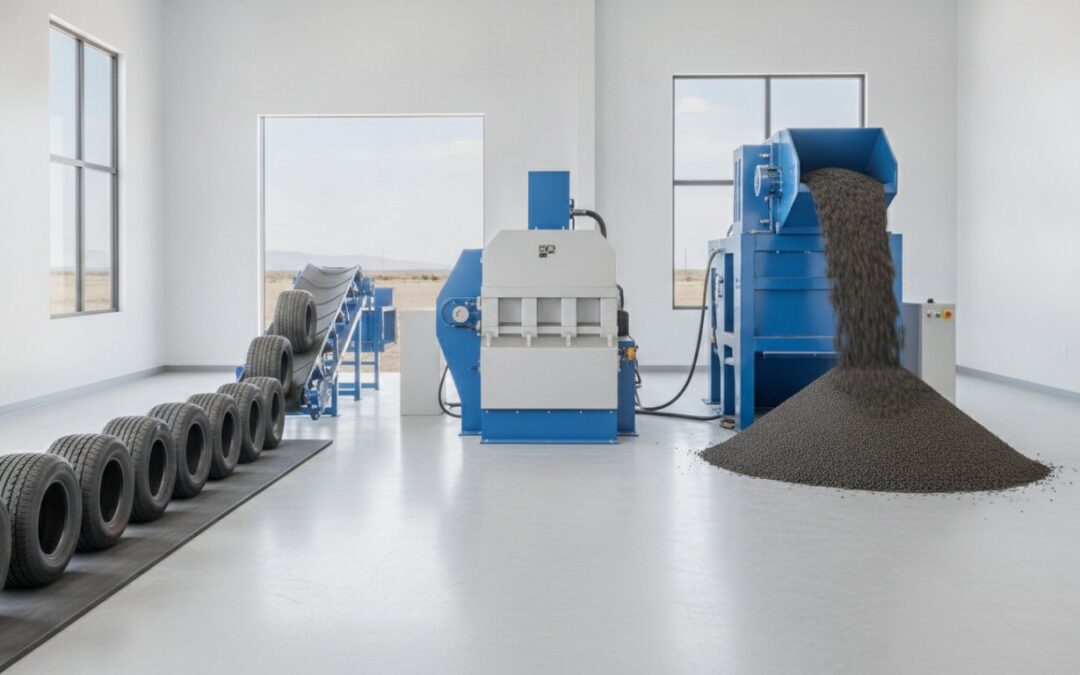
Did you know that while the U.S. generates over 250 million end-of-life tires every year, nearly 79% of them are now repurposed as fuel or recycled materials? Despite this progress, many West Texas business owners still feel a sense of guilt or confusion when they look at a growing stockpile of rubber. You might worry about the environmental impact or struggle to keep up with the latest TCEQ manifest requirements. Understanding the lifecycle of a recycled tire is the first step toward turning that burden into a benefit for the community.
We’re here to show you that your scrap tires aren’t just waste; they’re the start of a fascinating circular journey. In this 2026 guide, you’ll learn how professional collection acts as a vital bridge between the road and innovative new resources. We’ll explore the entire process from the initial pickup in Midland, Odessa, or Lubbock to the final transformation into high-value products like crumb rubber or tire-derived fuel. You’ll gain the confidence that your passenger, agricultural, or OTR tires are being handled legally and efficiently.
Key Takeaways
- Understand the complex mix of natural rubber and polymers that initiate the tire’s journey from the factory to the road.
- Discover how the lifecycle of a recycled tire transforms environmental hazards into functional materials for the circular economy.
- Learn why secure collection in West Texas is the essential link for maintaining regulatory compliance and preventing illegal stockpiles.
- Identify the innovative applications for recycled rubber, from energy-efficient fuel sources to quieter, more durable road infrastructure.
The Birth of a Tire: Raw Materials and Manufacturing
The lifecycle of a recycled tire actually begins in the soil and the laboratory. Most modern tires are a sophisticated blend of natural rubber, harvested from the Hevea brasiliensis tree, and synthetic polymers derived from petroleum. This combination provides the elasticity and grip required for safe driving. However, raw rubber alone isn’t enough to handle the weight of a commercial semi-truck or the rugged demands of an OTR vehicle. Industry leaders are increasingly shifting toward sustainable sourcing to reduce the energy footprint of manufacturing, but the core materials remain energy-intensive to produce.
Sourcing the Building Blocks
Manufacturers use natural rubber for its superior heat-resistance properties, while synthetic rubber offers better aging and abrasion resistance. To ensure structural integrity, engineers integrate high-tensile steel belting and textile fibers like nylon or polyester. This reinforcement is especially critical for heavy-duty OTR and agricultural tires used in West Texas, where the terrain is unforgiving. Extracting these materials carries a significant environmental footprint, as the tire industry accounts for a massive portion of global natural rubber consumption. This high demand is why Tire recycling is so essential for a sustainable future. We must find ways to recover these valuable resources once the tire’s first life ends.
The Vulcanization Process
The real transformation happens during vulcanization. This chemical process involves heating the rubber with sulfur and carbon black. The sulfur creates cross-links between the polymer chains, turning the soft, tacky material into a durable, heat-resistant, and road-ready product. Carbon black is added to reinforce the rubber and provide UV protection. This permanent chemical bond is exactly why tires are so difficult to “un-make” or break down later in the lifecycle of a recycled tire. It’s a design meant for extreme durability, not easy disposal.
Engineers design specific tread patterns to handle the unique challenges of the Permian Basin. Deep grooves and reinforced sidewalls are standard for local industrial tires to resist punctures from rocky soil and manage the intense heat of Texas summers. While this engineering ensures safety and longevity on the job site, it also adds layers of complexity to the eventual recycling process. Tires are built to last. When they finally reach the end of their functional life, that same durability requires specialized professional collection to ensure they don’t become a permanent environmental burden.
The Use Phase: Wear, Tear, and the End-of-Life Decision
A tire’s active life is a constant battle against friction and heat. In the Permian Basin, this battle is especially intense. Asphalt temperatures in Midland and Odessa often soar, accelerating the degradation of the rubber compounds we discussed in the manufacturing phase. Constant road friction thins the tread, while the dry West Texas air can lead to dry rot. These environmental factors eventually push a tire toward its “End-of-Life” (EOL) state. At this point, the tire is no longer a functional tool; it becomes a liability that must enter the lifecycle of a recycled tire to avoid becoming a permanent waste product.
Why Tires Can’t Stay on the Road Forever
Vehicle safety depends heavily on tread depth. When treads wear down below 2/32 of an inch, your vehicle loses the ability to grip the road, especially during those sudden West Texas thunderstorms. Worn tires also decrease fuel efficiency because the engine has to work harder to maintain traction. In industrial and agricultural settings, premature tire death often happens due to sidewall punctures or structural failures from heavy loads. Once these structural issues appear, the law requires immediate replacement. Continuing to use a compromised tire isn’t just inefficient; it’s a significant safety risk for your operators and other drivers.
Transitioning from a consumer product to “scrap tire” status happens the moment the tire is removed from the rim without the intent of being put back into service. This is a critical juncture. Choosing the right path here determines whether the rubber contributes to sustainable and circular end-use markets or ends up in a harmful stockpile.
The Problem with Stockpiling
It’s tempting to stack old tires behind a shop and deal with them later. However, these piles quickly become environmental hazards. In Lubbock and surrounding areas, stagnant water trapped inside tires serves as the perfect breeding ground for mosquitoes. These pests can carry diseases like West Nile virus, posing a direct health threat to your employees and neighbors. Beyond pests, large piles are a severe fire risk. Tire fires are notoriously difficult to extinguish, often burning for weeks and releasing toxic smoke into the atmosphere. For a deeper look at these risks, read our guide on Waste Tire Problems in Midland, Odessa, and Lubbock.
Managing your inventory doesn’t have to be a headache. If you’re dealing with a growing pile of industrial or OTR scrap, you can rely on a professional tire collection service to handle the logistics and ensure you stay compliant with state regulations.
The Collection Bridge: Moving Scrap from Midland to the Processor
The most overlooked stage in the lifecycle of a recycled tire is the journey from your facility to the processing center. Many people assume that once tires leave their lot, the work is finished. However, this transition is the most critical hurdle for West Texas businesses. Without a reliable collection partner, scrap rubber often ends up in local landfills or illegal dumpsites. Professional pickup ensures that bulk rubber waste stays within the circular economy instead of becoming a permanent blight on the Permian Basin landscape.
Handling the logistics of bulk removal requires specialized equipment and planning. Moving standard passenger tires is relatively straightforward, but transporting massive OTR or agricultural tires demands heavy-duty machinery and experienced operators. We focus on providing this essential bridge across Midland, Odessa, and Lubbock. By managing the pickup of everything from light truck tires to industrial-sized rubber, we prevent overcrowding in municipal waste streams and keep your operations running smoothly.
Legal Requirements for West Texas Businesses
Texas has strict rules for handling scrap tires. Every business must maintain a clear paper trail through scrap tire manifests. This documentation proves that your waste was handled by a permitted hauler and delivered to a legitimate facility. Record-keeping isn’t just a suggestion; it’s a legal necessity for shops and industrial sites. Using unpermitted “tire jockeys” might seem like a quick fix, but it exposes your business to massive fines and legal liability if those tires are found dumped in a canyon or field. For a complete breakdown of what you need to track in 2026, see our guide on Texas Tire Disposal Regulations.
Specialized Collection for Industrial Rubber
Not all rubber waste comes in a round shape. Industrial sites often generate items that are traditionally difficult to recycle, such as scrap conveyor belts, hydraulic hoses, and skid steer tracks. Most standard trash services won’t touch these materials. Tired Tyres bridges this gap by offering Commercial Tire Disposal in Midland, Odessa & Lubbock that includes these specialized industrial items. We ensure that your scrap rubber collection is comprehensive. This helps you maintain a clean and compliant job site while supporting the next vital phase of the lifecycle of a recycled tire.
The Transformation: Mechanical Recycling and Steel Extraction
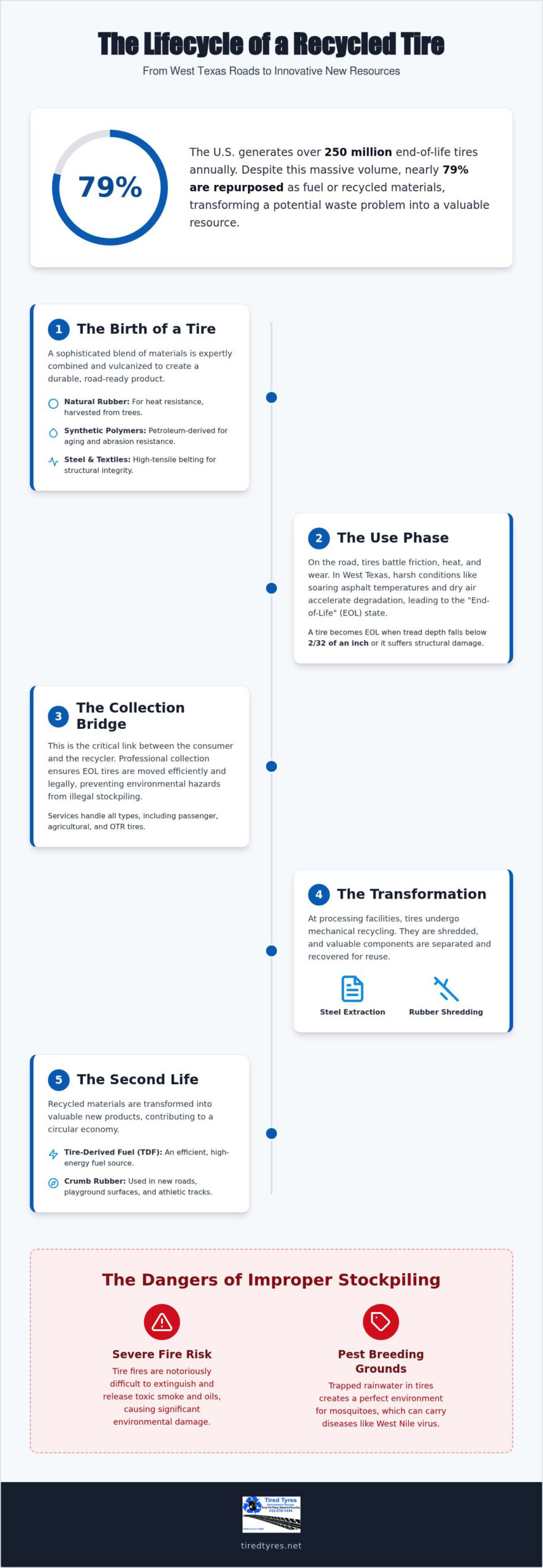
Once the tires reach a processing facility, the physical transformation begins. This is the most mechanical stage in the lifecycle of a recycled tire. It isn’t just about destroying a product; it’s about carefully deconstructing it to recover every valuable raw material we discussed in the manufacturing phase. Modern facilities use a multi-stage approach to ensure nothing goes to waste.
- Primary Shredding: Massive industrial shredders reduce the tires to 2-inch “rough shreds.” This initial breakdown makes the material easier to handle and prepares it for separation.
- Magnetic Separation: As the shreds move along a conveyor, powerful magnets pull out the steel wire used in the tire’s bead and belts. This steel is highly valuable and is sent to smelters for metal recycling.
- Granulation: The remaining rubber is processed through secondary granulators. This further reduces the size into “crumb rubber” or even a fine powder, depending on the intended end-use.
- Fiber Removal: Sophisticated air separators, often called cyclones, pull out the textile fibers like nylon and polyester. These fibers are light and must be separated to create a clean rubber product.
Mechanical vs. Chemical Recycling
Most tires in West Texas undergo ambient mechanical shredding. This process happens at room temperature and preserves the rubber’s physical properties, making it ideal for products like playground surfaces or rubberized asphalt. Another emerging method is pyrolysis. This chemical process uses heat in the absence of oxygen to break the rubber down into oil, gas, and a carbon-rich char. While pyrolysis is growing in popularity for its ability to recover fuel, mechanical shredding remains the standard for the majority of scrap tires collected in the Permian Basin.
Recovering Valuable Byproducts
The goal of a modern processor is a “zero waste” operation. The steel recovered during the magnetic separation phase is a significant byproduct. As of March 2026, scrap steel recovered from tires fluctuates in value between $100 and $200 per ton. Even the textile fibers find a second life as industrial fillers or insulation materials. By deconstructing the tire into its original building blocks, we ensure that every ounce of the material is diverted from the landfill. If you have a stockpile of industrial or OTR rubber that needs to enter this process, you can schedule a bulk tire pickup today to ensure your waste is handled by professionals.
The Second Life: Innovative Uses for Recycled Rubber
The final stage of the lifecycle of a recycled tire is where waste truly becomes a resource. After the mechanical deconstruction we discussed in the previous section, the recovered rubber enters a variety of high-value markets. It isn’t just about finding a place to hide old rubber; it’s about utilizing its unique physical properties to solve modern engineering and consumer challenges. Today, approximately 79% of end-of-life tires are successfully diverted from landfills into these sustainable applications.
Energy recovery remains the largest segment of the recycling market, accounting for 37.63% of the total share. Tire-derived fuel (TDF) is a primary example. Tires have a higher heating value than coal, making them an efficient fuel source for cement kilns and paper mills. As of August 2026, the EPA’s proposed rule to classify scrap tires as “non-waste fuel” for cement kilns continues to encourage this transition. In the civil engineering sector, tire shreds are used for lightweight embankment fill and septic fields. These materials provide superior drainage and vibration dampening compared to traditional soil or gravel. Buyers in this sector typically pay between $50 and $80 per bale for these specialized materials.
Rubberized Asphalt and Texas Infrastructure
Recycled rubber is playing a massive role in paving the roads of the future across the Permian Basin. When crumb rubber is mixed with traditional asphalt, it creates a “rubberized” binder that is exceptionally durable. This material is perfect for the extreme Texas heat because it’s more resistant to thermal cracking and rutting than standard pavement. It also provides a quieter ride for drivers and shorter braking distances. By choosing these materials, the state can build highways that last longer and require less frequent maintenance. For more on how these processes impact our local community, see our guide to Tire Recycling in Midland, Odessa, and Lubbock.
Sustainable Landscaping and Paving
You don’t have to look far to see the circular economy in action. Recycled rubber is frequently used in consumer products like playground mulch and floor mats. Unlike wood mulch, rubber doesn’t rot, attract pests, or wash away during heavy rains. It also offers superior impact absorption, which is vital for playground safety. Another growing trend is porous paving. This solution uses recycled rubber to create driveways and walkways that allow water to filter through into the ground, reducing runoff and helping with flood resistance. It’s a practical way to close the loop on the lifecycle of a recycled tire, ensuring that the rubber from your industrial or passenger vehicles eventually provides a benefit right back in your own backyard.
Securing the Future of West Texas Rubber
We’ve traced the journey of rubber from raw polymers to the innovative products paving our highways. You now understand that professional collection is the only way to ensure your scrap doesn’t become an environmental hazard. By choosing a partner who understands the lifecycle of a recycled tire, you protect your business from legal liability and support the local circular economy. Whether you’re managing a few passenger tires or a massive fleet of OTR equipment, reliable disposal keeps our communities clean and safe.
Tired Tyres has provided specialized, TCEQ-compliant hauling across Midland, Odessa, and Lubbock since our inception. We handle everything from standard light truck tires to industrial agricultural models with precision. Don’t let old rubber pile up behind your shop and attract pests. Schedule your scrap tire collection in West Texas today to ensure your waste is handled legally and effectively. Together, we can keep the Permian Basin moving forward toward a more sustainable future.
Frequently Asked Questions
How many times can a tire be recycled?
Rubber can be repurposed into a second-life product, but it isn’t infinitely recyclable back into new tires. Once the vulcanization process is complete, the chemical bonds are permanent and difficult to reverse. However, the crumb rubber used in the lifecycle of a recycled tire can often be reclaimed from old asphalt or mats and used again in lower-grade industrial applications.
Is it better to burn tires for fuel or recycle them into crumb rubber?
Both methods play a vital role in the circular economy, though they serve different needs. Energy recovery through Tire-Derived Fuel (TDF) is currently the largest market segment, accounting for 37.63% of end-of-life tires. While burning for fuel is highly efficient for cement kilns, mechanical recycling into crumb rubber is considered a higher-value use because it keeps the material in a solid, reusable state for infrastructure.
What is the most common use for recycled tires in Texas?
Energy recovery and rubberized asphalt are the most frequent applications for scrap rubber in the state. Texas utilizes millions of tires annually to power industrial facilities and create durable, heat-resistant highways. These civil engineering projects are specifically engineered to withstand the intense thermal stress and heavy traffic loads common in the Permian Basin and High Plains regions.
Can OTR and agricultural tires be recycled the same way as passenger tires?
Yes, OTR and agricultural tires undergo the same mechanical shredding and separation processes as standard passenger tires. The primary difference lies in the specialized logistics required for the lifecycle of a recycled tire at this scale. Because these tires are significantly larger, they require heavy-duty equipment for initial collection and primary shredding before they can enter the standard granulation stream.
Why can’t I just take my old tires to the local landfill in Midland?
Most municipal landfills in Midland and Odessa don’t accept whole scrap tires because they don’t compact and take up excessive space. Tires also have a tendency to trap methane gas and “float” to the surface over time, which can damage landfill liners. Texas state regulations strictly manage tire disposal to prevent these operational issues and encourage more sustainable recycling alternatives.
What happens to the steel wire found inside tires during recycling?
Steel wire is extracted using powerful magnetic separators during the secondary shredding phase. This recovered metal is a high-quality scrap material that is cleaned and sold to smelters for metal recycling. As of March 2026, this steel byproduct is quite valuable, with market prices fluctuating between $100 and $200 per ton, ensuring that almost no part of the tire is wasted.
Is recycled rubber safe for use in playgrounds and gardens?
Recycled rubber is safe for these applications provided it has been processed to remove all steel wire and textile reinforcements. Modern granulation facilities use multi-stage cleaning to ensure the final crumb rubber is free of sharp contaminants. In playgrounds, this material offers superior impact absorption compared to wood chips, and it doesn’t attract pests or rot in the West Texas heat.
How does tire recycling help reduce the mosquito population in Lubbock?
Recycling removes the primary breeding grounds for mosquitoes by eliminating the stagnant water traps found in tire stockpiles. In Lubbock and surrounding areas, even a small amount of rain trapped inside a discarded tire can produce thousands of larvae. By moving scrap rubber into a professional recycling stream, you directly reduce the local risk of West Nile virus and other mosquito-borne illnesses.