
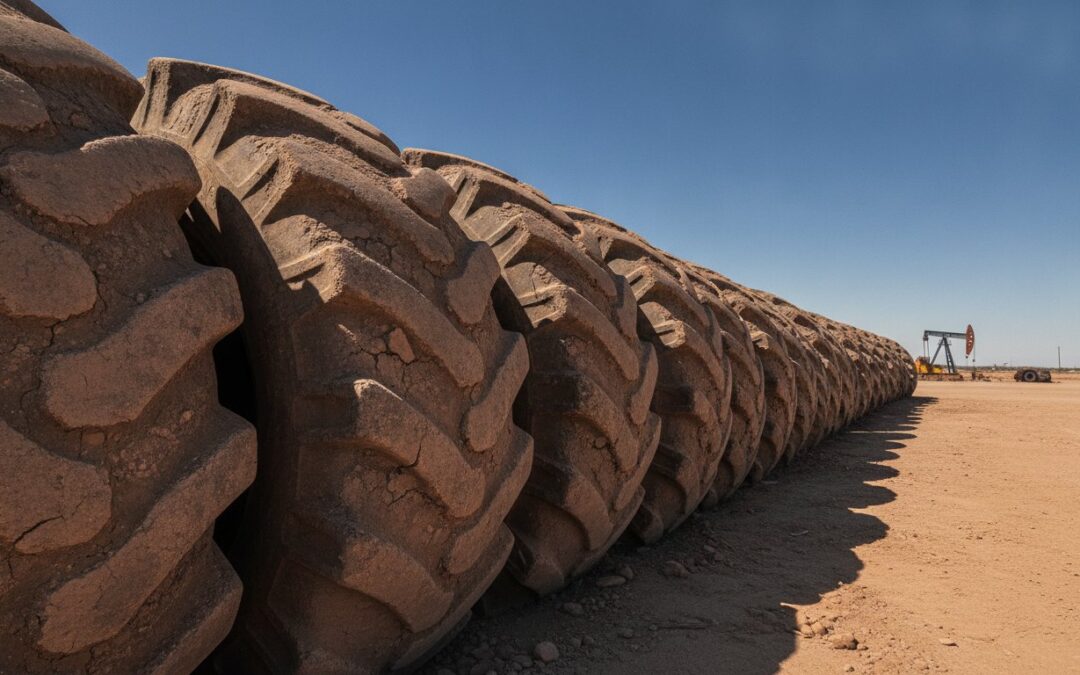
Storing just five unregistered off-the-road tires on your property in Odessa can trigger TCEQ fines exceeding $25,000 during a 2026 site inspection. It’s a staggering figure, but it reflects a reality where environmental oversight is tighter than ever. You likely already know that managing oversized rubber is a logistical headache. Between the high costs of specialized transport and the constant fear of an unannounced audit, it’s easy to see why stockpiles grow in the corners of your yard.
However, ignoring these piles creates more than just an eyesore. The risks of improper OTR tire disposal now include daily penalties that can reach $25,000 per day for unauthorized dump sites and severe fire risks. We’ll help you discover the environmental, legal, and financial dangers of mishandling OTR tires and how to protect your West Texas business. This guide provides a clear understanding of Texas compliance, helps you avoid “cradle to grave” legal liability, and outlines the best practices for the efficient removal of bulk rubber waste.
Key Takeaways
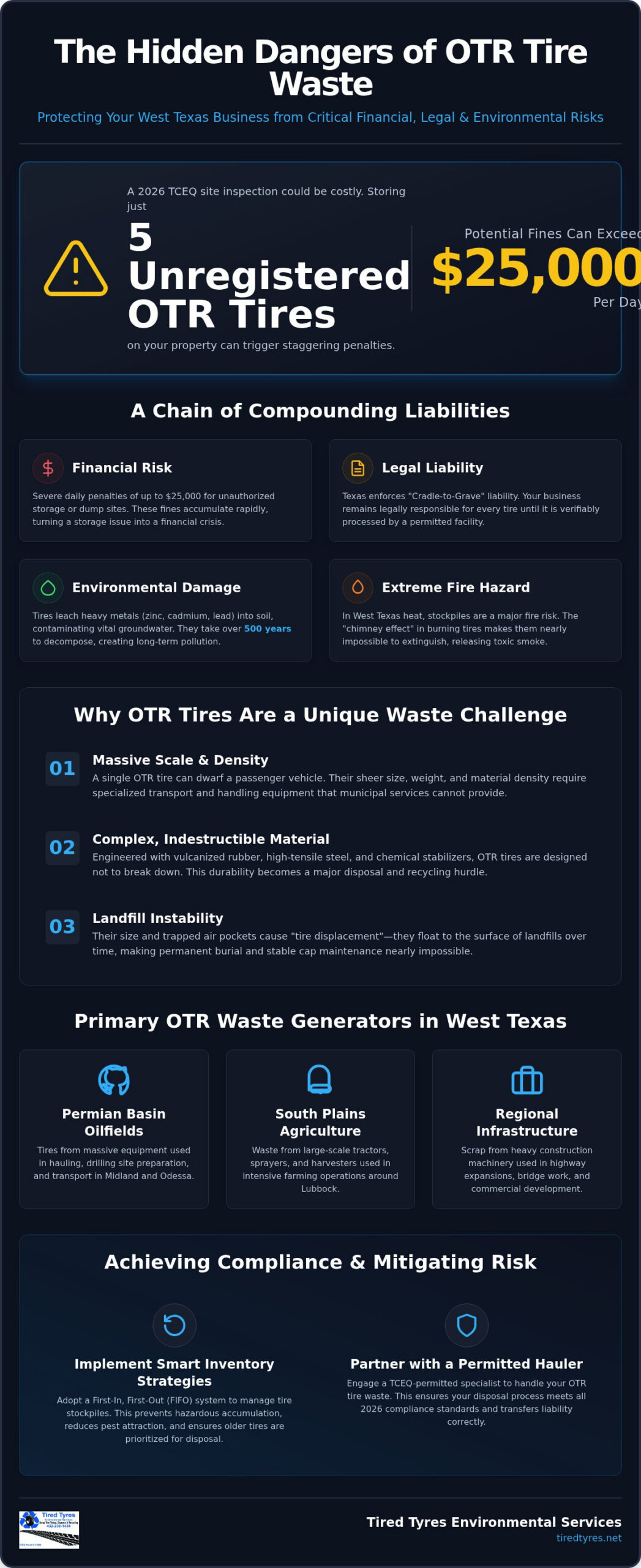
- Understand the severe financial impact of TCEQ enforcement, where unauthorized storage can lead to daily fines of up to $25,000.
- Learn how the risks of improper OTR tire disposal extend beyond fines to include groundwater contamination and toxic fire hazards in West Texas.
- Discover why “cradle-to-grave” liability means your business remains legally responsible for every tire until it is officially processed.
- Identify practical inventory strategies, like the FIFO system, to prevent hazardous stockpiles from attracting pests or becoming liabilities.
- Find out how partnering with a permitted hauler in the Permian Basin ensures your large-scale rubber waste meets all 2026 compliance standards.
Defining the Scale: Why OTR Tire Waste is a Unique Challenge
Off-the-Road (OTR) tires are the heavyweights of the industrial world. These specialized units support the machinery that drives West Texas, from massive mining trucks to heavy construction loaders and agricultural tractors. Unlike standard tires, OTR models are engineered with complex vulcanized rubber, high-tensile steel reinforcement, and chemical stabilizers designed to withstand extreme heat and pressure. This durability is a blessing on the job site but a significant burden once the tire reaches its end of life.
Standard municipal waste services in Midland and Odessa are not equipped to handle these massive units. A single OTR tire can dwarf a passenger vehicle in both size and weight. Because of their sheer volume and material density, they require specialized handling that goes beyond what a local garbage truck or city landfill can manage. Understanding the risks of improper OTR tire disposal starts with recognizing that these are not just larger tires. They are complex industrial waste that demands professional oversight.
The Massive Footprint of Industrial Rubber
Stockpiling even a small number of OTR tires creates immediate logistical issues. Storing just 10 units can consume a vast amount of yard space, often interfering with daily operations and creating safety hazards. In a landfill setting, these tires present a unique problem known as tire displacement. Their size and trapped air pockets often cause them to float to the surface over time. This movement makes it nearly impossible to bury them permanently or maintain a stable landfill cap.
The environmental impact is equally long-lasting. Heavy-duty rubber compounds are designed to be nearly indestructible, leading to a decomposition timeline that can exceed 500 years. Without professional Tire recycling solutions, these tires remain in the environment for centuries. They slowly break down into microplastics and leach chemicals into the surrounding soil, making the risks of improper OTR tire disposal a multi-generational problem.
Common Sources of OTR Waste in West Texas
Our region is a primary generator of industrial rubber waste due to its core industries. You will find these tires across several key sectors:
- Permian Basin Oilfields: Massive equipment tires used for hauling, drilling site preparation, and transport in Midland and Odessa.
- South Plains Agriculture: Large-scale tractor, sprayer, and harvester tires from intensive farming operations around Lubbock.
- Regional Infrastructure: Heavy construction machinery tires used in highway expansions, bridge work, and large commercial development projects.
The volume of waste generated in these sectors can quickly overwhelm a business’s storage capacity. When storage space runs out, the temptation to mishandle disposal grows, but the legal and environmental consequences in Texas are far too high to ignore.
Environmental and Public Health Risks of Improper Disposal
The risks of improper OTR tire disposal extend far beyond the physical clutter on your job site. Chemical leaching is a slow but devastating process that begins the moment industrial rubber is left exposed to the elements. As these tires break down, they release heavy metals such as zinc, cadmium, and lead into the surrounding soil. In the Permian Basin, where groundwater is a vital resource for both industry and agriculture, this contamination can eventually reach local aquifers. This degradation of soil quality doesn’t just damage the environment; it can significantly lower the value of your industrial property and complicate future land use audits.
Federal initiatives focused on Protecting Public Health highlight the urgent need for professional cleanup of scrap tire piles. These piles are often identified as primary sources of long-term environmental harm. Leaving massive OTR units to rot in the West Texas sun creates a liability that grows with every rainfall and temperature spike.
The West Texas Tire Fire Threat
The semi-arid climate of Odessa and Midland makes any large rubber stockpile a volatile hazard. High summer temperatures combined with low humidity increase the risk of spontaneous combustion or lightning-strike fires. OTR tires are particularly dangerous in a fire scenario because their hollow, circular shape creates a “chimney effect.” This geometry draws in oxygen and feeds the core of the fire, making it nearly impossible to extinguish with standard water-based methods.
When these tires burn, they release a “toxic cocktail” of benzene, lead, and sulfuric acid. These emissions create a thick, black smoke that can settle over Permian Basin communities, causing long-term air quality issues and respiratory concerns for residents. The oily residue left behind after a tire fire is also highly acidic, further contaminating the ground and requiring expensive specialized remediation.
Pest Habitats and Public Health
Even in our dry climate, OTR tires are the ultimate breeding ground for disease-carrying pests. A single rain event can trap gallons of stagnant water inside the deep treads and inner cavities of a mining or tractor tire. This water is shaded from the sun and protected from the wind, providing the perfect nursery for mosquito larvae. These stockpiles are frequently linked to regional health concerns, including the spread of West Nile Virus.
Beyond insects, the massive scale of industrial tires provides ideal shelter for rodents and venomous snakes. These animals often nest within the tire stacks, creating a direct physical danger for employees who work in or near the storage yard; for those seeking comprehensive pest control strategies in arid environments, Goat Pest Solutions provides professional solutions to mitigate these risks.
Beyond insects, the massive scale of industrial tires provides ideal shelter for rodents and venomous snakes. These animals often nest within the tire stacks, creating a direct physical danger for employees who work in or near the storage yard. Scheduling a professional pickup through Tired Tyres helps you eliminate these biological hazards before they result in a workplace injury or a public health citation. Professional removal is the only way to ensure these risks of improper OTR tire disposal are fully mitigated.
Legal Liabilities and TCEQ Compliance in Texas
The Texas Commission on Environmental Quality (TCEQ) enforces some of the nation’s strictest scrap tire management rules. At the heart of these regulations is the “Cradle-to-Grave” liability principle. This legal framework dictates that the generator of the waste remains responsible for the tire’s final destination. Even after a tire leaves your yard in Lubbock or Midland, your business is legally tied to its fate until it reaches a permitted processing facility. If those tires end up in a ravine or an unregistered dump, the TCEQ looks to the original owner for restitution.
The risks of improper OTR tire disposal are now tied to a manifest system that tracks every unit. In 2025, the TCEQ issued over $2.4 million in penalties for mismanagement, signaling a zero-tolerance approach. If an inspector finds a single abandoned tire on your property flagged as an unauthorized dump site, you could face fines of up to $25,000 per day. These are not empty threats; in April 2026 alone, the TCEQ approved more than $1.4 million in fines against 88 different entities for environmental violations.
The Role of the Permitted Tire Hauler
Hiring a permitted tire hauler Texas is the only way to ensure your manifest is legally binding. A permit proves the hauler has the specialized equipment and state authorization to move heavy-duty rubber. Many businesses attempt to save money by using unpermitted labor for bulk rubber removal. This often leads to “fly-tipping,” where waste is dumped illegally. Under Texas law, you share “joint and several” liability for these actions. Verifying a hauler’s credentials is a critical step in protecting your company from the actions of third-party contractors.
Fines and Reputational Damage
The financial impact of non-compliance has reached new heights in 2026. Current site inspections in Odessa show that storing just five unregistered OTR tires can trigger fines exceeding $25,000. For larger stockpiles of 50 unregistered tires, the penalty can reach $10,000 per day. Proposed legislation like Texas SB 2917 aims to increase these penalties further, turning repeated illegal dumping into a Class A misdemeanor with fines up to $10,000 per offense.
Beyond the immediate financial hit, the reputational damage can be permanent. Oilfield and construction firms in the Permian Basin often conduct environmental audits before awarding contracts. A documented TCEQ violation can serve as an immediate disqualifier for lucrative regional projects. If a stockpile is declared a public nuisance, the cost of state-mandated site remediation can easily dwarf the original cost of proper disposal.
Actionable Guidance: Managing Your OTR Tire Inventory
Managing a fleet of heavy equipment means dealing with massive rubber waste on a regular basis. Proactive inventory management is the only way to mitigate the risks of improper OTR tire disposal. It isn’t just about keeping the yard clean; it’s about maintaining a paper trail that satisfies state auditors. By treating your scrap tires like any other hazardous industrial byproduct, you protect your bottom line from unexpected legal liability and environmental fines.
Proper On-Site Storage Techniques
Effective storage starts with location. You should establish a designated, secure area for temporary tire storage on a high, well-drained surface. Stacking tires in a “laced” pattern or covering them with heavy-duty tarps prevents rainwater from pooling in the deep treads. This simple step stops mosquito breeding cycles before they start and keeps your site compliant with local health ordinances.
Safety also requires maintaining clear fire breaks. Keep at least 50 feet of clear space between tire piles and any industrial structures, brush, or fuel tanks. Ensure the storage area remains easily accessible for heavy equipment. When pickup day arrives, our haulers need enough room to maneuver specialized loaders. If your site is cluttered or the tires are buried behind other equipment, it increases loading time and complicates the removal process.
The Manifest Checklist for Business Owners
The most critical part of your compliance workflow is the manifest log. Under Texas law, you must maintain a meticulous record of every tire that leaves your property. This document serves as your legal shield if a tire is ever found at an unauthorized site. A valid manifest must include the hauler’s name, their TCEQ permit number, the exact number of tires collected, and the name of the destination processing facility.
You’re required to keep copies of all tire manifests for at least three years. This archive is the first thing a TCEQ inspector will ask to see during a site visit in Midland or Odessa. Integrating this tracking into your standard commercial tire disposal workflow ensures you’re never caught without proof of compliance. We recommend digitizing these records to ensure they aren’t lost to weather or office accidents.
Finally, implement a strict ‘First-In, First-Out’ (FIFO) system for your rubber waste. Older tires that have been exposed to the West Texas sun for long periods are more prone to chemical degradation and fire risk. By moving older stock first, you significantly reduce the risks of improper OTR tire disposal and prevent stockpiles from reaching ‘nuisance’ levels that trigger mandatory state intervention.
If your yard is nearing capacity, don’t wait for a site audit to take action. Schedule a professional OTR pickup with Tired Tyres to clear your inventory and secure your compliance record.
How Tired Tyres Secures Your OTR Disposal Process
Tired Tyres operates as a permitted scrap tire hauler with a primary focus on the Permian Basin and South Plains. For mining, oilfield, and construction firms, managing large-scale rubber isn’t just about cleaning up a yard. It’s a critical part of your risk management strategy. We provide the specialized equipment and heavy-duty loaders needed to handle oversized agricultural and mining tires that standard haulers simply can’t move. By maintaining a strong local presence in Midland, Odessa, and Lubbock, we offer a rapid response that keeps your site clear and your operations running. You don’t have to worry about the logistical nightmare of moving massive industrial tires because our team handles the heavy lifting from start to finish.
Our commitment to legal, TCEQ-compliant disposal is the foundation of our service. We understand the “cradle-to-grave” responsibility that Texas law places on your business. When you partner with us, you’re hiring a team that stays updated on the latest 2026 regulations and manifest requirements. We ensure that every tire we collect is processed according to state standards, effectively eliminating the risks of improper OTR tire disposal for your company. This professional oversight is what separates a permitted hauler from a generic junk removal service.
Comprehensive Industrial Rubber Solutions
Many industrial sites in West Texas deal with a variety of rubber waste beyond just tires. Our collection capabilities are designed to be a total solution for your facility. We handle scrap skid steer tracks, conveyor belts, and scrap hose collections with the same precision we apply to OTR units. Using a single-source provider for all industrial rubber waste simplifies your vendor management and ensures a consistent paper trail for your environmental audits. We offer customized pickup schedules that adapt to the pace of high-volume industrial operations, preventing rubber waste from ever reaching “nuisance” levels on your property.
Protecting Your Business with Every Load
Every load we transport comes with a verified manifest and clear proof of legal disposal. This documentation is essential for your records and serves as your primary defense during a state inspection. We help regional businesses solve waste tire problems before they become expensive legal issues or public health hazards. Our process is transparent, direct, and designed to provide peace of mind to facility managers and business owners alike.
Don’t let a growing stockpile of industrial rubber put your company at risk of massive fines or environmental liability. Request a professional OTR collection quote today and let our experts handle your disposal needs with the speed and compliance your business deserves.
Protecting Your Business from Industrial Rubber Liabilities
Managing OTR tires in 2026 requires more than just finding a corner in the yard to stack them. The risks of improper OTR tire disposal include staggering TCEQ fines, severe fire hazards, and long-term environmental contamination. Leaving these massive units to degrade in the West Texas heat creates a liability that only grows over time. By implementing a strict manifest system and a FIFO inventory approach, you can turn a potential public nuisance into a managed industrial process.
You don’t have to navigate these complex regulations alone. As a TCEQ-permitted hauler with specialized heavy-duty OTR equipment, we serve the entire Permian Basin and South Plains. We take the burden of compliance off your shoulders by providing the verified documentation and professional removal your operations require. Secure your site and stay compliant-schedule your OTR tire pickup with Tired Tyres. Taking action today ensures your business remains focused on its core goals while we handle the heavy lifting and disposal with professional precision.
Frequently Asked Questions
Is it illegal to bury OTR tires on my own property in Texas?
Yes, burying whole tires on private property is illegal under Texas law. Whole scrap tires cannot be disposed of in landfills or on personal land unless they are first processed by splitting or shredding. Burying them without a permit classifies your property as an unauthorized dump site, which can trigger TCEQ fines of up to $25,000 per day until the site is remediated.
What is the maximum number of scrap tires I can store without a permit?
You may store up to 500 used or scrap tires on your property without a TCEQ registration. If you store the tires in enclosed and lockable containers, this limit increases to 2,000 units. Exceeding these numbers without proper state registration is one of the primary risks of improper OTR tire disposal and often leads to mandatory site inspections and penalties.
How much does OTR tire disposal typically cost in Midland or Odessa?
Disposal costs for OTR units depend on the specific size, weight, and total volume of the rubber waste. Unlike standard passenger tires, these massive industrial units require specialized heavy-duty loaders and transport equipment. To get an accurate figure for your site, you should request a quote from a permitted hauler who can account for the logistical challenges of your specific location.
Can OTR tires be recycled into other products?
Yes, OTR tires are recycled into several industrial and commercial materials. Once the heavy steel reinforcement is removed, the rubber is often processed into tire-derived fuel (TDF) or crumb rubber for asphalt and playground surfaces. New technologies like pyrolysis are also used to recover oil and carbon black from these dense rubber compounds, contributing to a more circular economy.
What happens if I hire a hauler who dumps my tires illegally?
You remain legally responsible for the tires even after they leave your property. Under the “cradle-to-grave” liability rule, the TCEQ can hold the original waste generator liable for cleanup costs and fines if a hauler engages in illegal dumping. This is why verifying a hauler’s permit and keeping a signed manifest is the only way to protect your business from third-party negligence.
Do I need a special manifest for agricultural tires versus OTR tires?
No, the TCEQ manifest system applies to all scrap tires regardless of their original use. Whether you are disposing of mining equipment rubber or large agricultural tires from South Plains farms, the documentation requirements are the same. You must record the hauler’s permit number, the total tire count, and the destination facility, then retain these records for at least three years.
How can I prevent water from pooling in my OTR tire stockpile?
Stacking tires in a “laced” pattern or covering the pile with heavy-duty, waterproof tarps is the best approach. Because OTR tires have such deep treads and large inner cavities, they can trap gallons of stagnant water after a single rain. This creates a nursery for mosquitoes and pests. Keeping the stockpile on a high, well-drained surface also prevents chemical leaching into the ground.
Are there specific landfill rules for tires in Lubbock County?
Most municipal landfills in Lubbock County do not accept whole OTR tires for disposal. Texas regulations generally require tires to be shredded, quartered, or split before they can be landfilled. Most businesses in the South Plains avoid these complications by using a permitted hauler who takes the rubber directly to an authorized processing facility that is equipped to handle industrial-scale waste.