
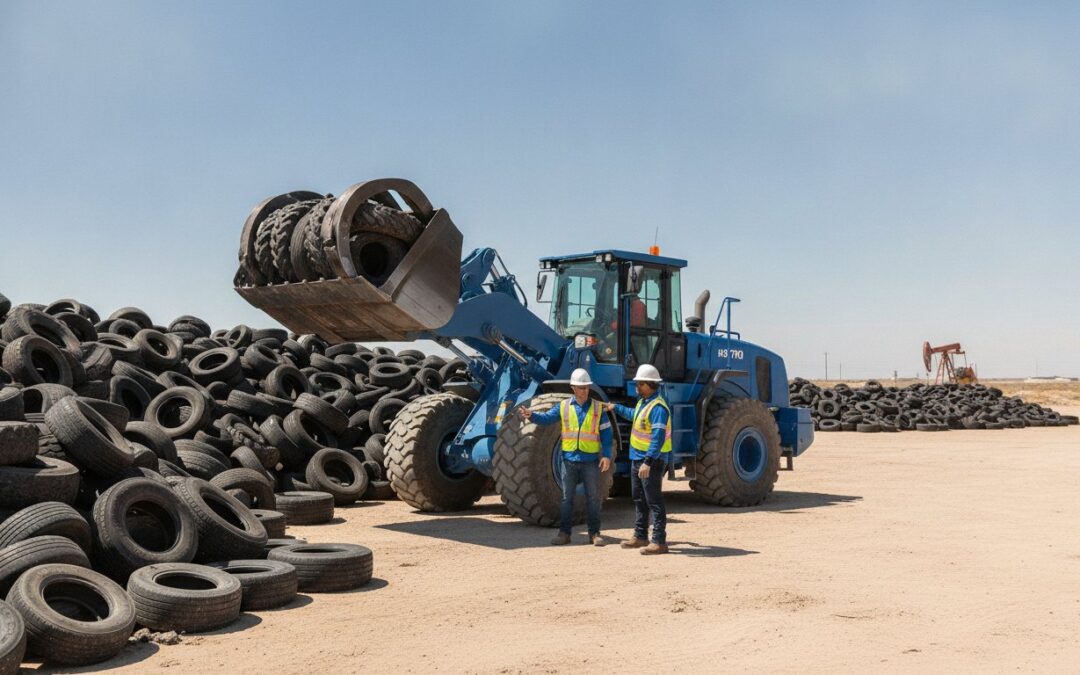
What if that pile of old tires on your ranch isn’t just an eyesore, but a financial ticking time bomb? In West Texas, property owners often find themselves inherited with legacy dumps or growing stockpiles that attract more than just local pests. Navigating farm tire disposal regulations Texas has become increasingly complex as state enforcement ramps up through high-resolution satellite monitoring and digital manifest tracking. Managing these materials correctly is no longer optional; it’s a vital step in protecting your land’s value and your business’s bottom line.
You probably want a clean, compliant property without the headache of deciphering technical state codes. We’ll show you how to legally and efficiently clear scrap tire stockpiles while staying fully compliant with the latest TCEQ regulations. This guide provides a clear roadmap for bulk removal, from estimating volume in the Permian Basin to securing the manifests that serve as your legal shield. By the end of this article, you’ll know exactly how to achieve a clean site with documented proof of disposal that stands up to any state audit.
Key Takeaways
- Understand the specific environmental and fire hazards associated with legacy tire dumps in the Permian Basin to mitigate long-term property risks.
- Navigate farm tire disposal regulations Texas to ensure your operation stays fully compliant with TCEQ manifest and reporting requirements.
- Master the logistics of bulk remediation, including how to accurately estimate tire volumes and identify the specialized equipment needed for heavy OTR removal.
- Follow a structured step-by-step process for identifying site hazards and securing a permitted West Texas hauler for legal disposal.
- Learn how professional collection services in Midland, Odessa, and Lubbock provide the documented proof needed for long-term liability protection.
The Hidden Risks of Legacy Tire Dumps in West Texas
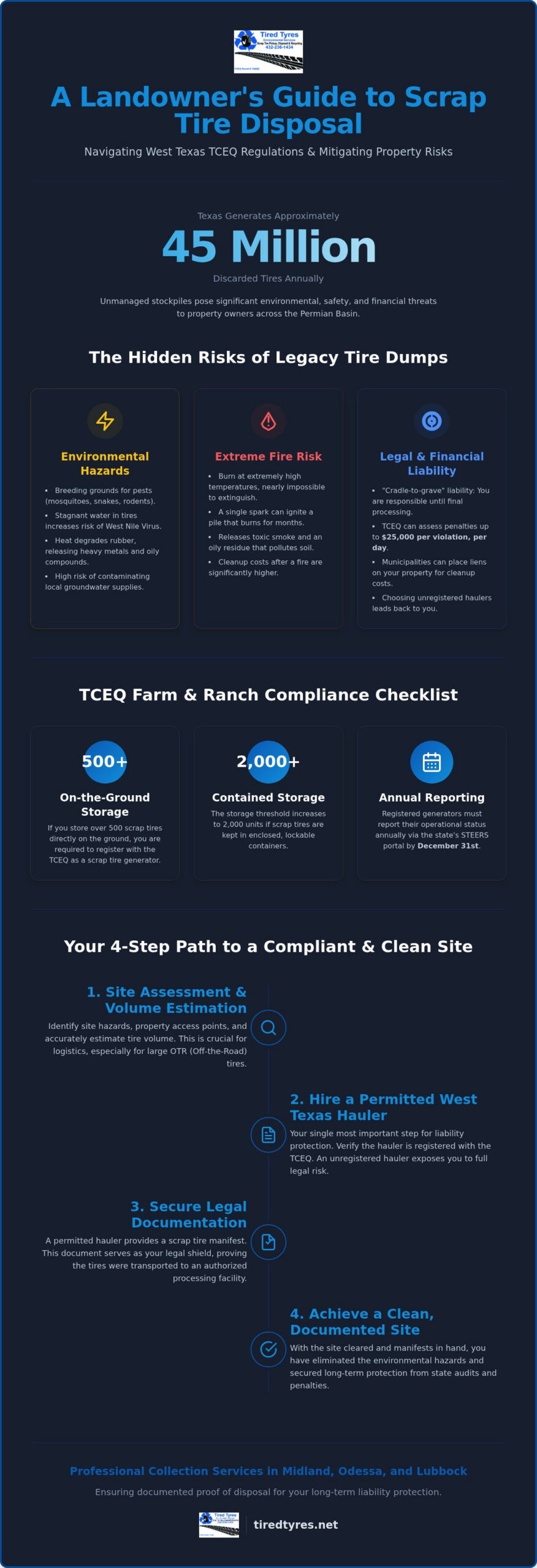
Legacy tire dumps represent more than just an eyesore on the West Texas horizon. In the Permian Basin, these stockpiles create unique environmental and safety challenges that can quickly spiral out of control. Texas generates approximately 45 million discarded tires annually. Many of these end up in unauthorized piles that threaten both the land and the community. When rubber is left to sit for years, it stops being a simple waste product and becomes a complex liability.
Tire piles are ideal breeding grounds for disease carrying pests. In the arid climate of Midland and Odessa, stagnant water trapped inside tire casings provides the perfect nursery for mosquitoes. These insects are known vectors for West Nile Virus, which remains a recurring concern in the South Plains. Beyond insects, the hollow spaces in a tire pile attract snakes and rodents. This creates a dangerous environment for anyone working near the site or managing livestock nearby.
The risk of a tire fire is perhaps the most severe threat to a property. These blazes are nearly impossible to extinguish using standard firefighting methods. Because of the shape of the tires and their petroleum based materials, they burn at extremely high temperatures. A single spark from a brush fire or a lightning strike can ignite a pile that may burn for months. These fires release toxic smoke and an oily residue that can penetrate deep into the soil, making the cleanup process significantly more expensive.
Tire Piles as a Liability for Landowners
Landowners often face legal responsibility for illegal dumping on their property even if they didn’t authorize the activity. Under current farm tire disposal regulations Texas, the TCEQ can assess administrative penalties of up to $25,000 per violation, per day. These fines are designed to encourage rapid cleanup, but they can easily exceed the value of the land itself. Municipalities may also place liens on the property to cover the costs of emergency remediation. Choosing professional removal early is always more cost-effective than facing the financial weight of non-compliance.
Environmental Impact in Arid Climates
The intense West Texas heat accelerates the chemical breakdown of rubber. As tires degrade under the sun, they release heavy metals and oily compounds. Understanding the environmental impact of legacy tires is crucial for preserving the long-term health of your acreage. Long-term stockpiling risks contaminating local groundwater, especially in areas with porous soil. For a deeper look at these specific regional challenges, you can read our Waste Tire Problems guide for the Midland and Lubbock areas. Proactive remediation ensures your land remains a productive asset rather than an environmental hazard.
Texas Scrap Tire Regulations & Farm Tire Disposal
Understanding the legal landscape is the first step in protecting your property and business interests. Under the Texas Health and Safety Code, any tire destined for disposal or recycling is legally classified as a scrap tire. The Texas Commission on Environmental Quality (TCEQ) oversees the management of these materials to ensure they don’t become environmental hazards. It’s a common misconception that once a tire leaves your property, it’s no longer your problem. In reality, Texas law follows a cradle-to-grave liability model. You’re responsible for those tires until they reach an authorized processing facility.
This liability makes choosing a registered and permitted tire hauler essential. Unregistered haulers might offer lower rates, but they lack the authority to provide the legal documentation you need. If those tires are found in a ditch or an illegal dump, the TCEQ will trace them back to the original generator. Working with professionals like Tired Tyres ensures that every load is handled according to state standards, shielding you from potential administrative penalties that can reach $25,000 per day.
Farm Tire Disposal Regulations in Texas
Agricultural operations often face unique challenges due to the sheer size of OTR (Off-the-Road) tires. Current farm tire disposal regulations Texas require businesses to register as a generator if they store more than 500 scrap tires on the ground. If you use enclosed, lockable containers, that threshold increases to 2,000 units. You’re also required to report your operational status annually through the state’s STEERS portal by December 31st. While OTR tires used on heavy machinery are exempt from the 90 day shredding requirement, standard semi-truck tires on the same farm are not. Keeping these distinctions in mind helps you avoid accidental non-compliance during routine cleanup.
The Anatomy of a Scrap Tire Manifest
The scrap tire manifest, specifically Form TCEQ-10304, is your primary legal defense. This five part document records the quantity of tires, the hauler’s permit number, and the final destination’s authorized status. You must receive a completed copy of this manifest from the disposal facility within 60 days of the pickup. If you don’t, you’re required to notify the TCEQ. For a detailed breakdown of these requirements, see our guide on Texas Tire Disposal Regulations. As of 2026, you should retain these manifests for at least three years to satisfy audit requirements. These records prove you followed the law and protect you during property inspections or commercial land transactions.
Logistics of Bulk Tire Remediation in the Permian Basin
Cleaning up a legacy tire dump in West Texas is an industrial project that requires more than just a flatbed truck. The first challenge is accurately assessing the volume. You can’t simply count the tires on the surface; piles often extend several feet underground or are tightly packed. We use weight-based estimation methods to determine the total tonnage. This data is critical for staying compliant with Texas scrap tire regulations and ensuring the right number of trailers are dispatched to the site.
Accessing remote locations in the Permian Basin adds another layer of complexity. Many sites are located down narrow ranch roads or across soft, sandy terrain. Standard waste haulers often lack the specialized equipment to reach these areas without getting stuck. Sorting tires at the source is also a requirement. We stage passenger tires, semi-truck tires, and OTR units separately. This organization streamlines the loading process and ensures that the manifest accurately reflects the load composition for the final processing facility.
Handling OTR and Agricultural Tires
OTR tires are the most difficult units to remove. Their massive weight and size mean they can’t be handled by hand. A single agricultural tire can weigh over 400 pounds; some industrial OTR units exceed 1,000 pounds. Removing these requires heavy-duty loaders or grapple attachments. Safety is the priority here. We follow strict loading protocols to prevent load shifts during transport. Understanding farm tire disposal regulations Texas helps you realize that these large units require specific handling to avoid property damage during the remediation process.
Industrial Rubber Waste Beyond Tires
Remediation projects in West Texas often uncover more than just tires. Mining and industrial sites frequently have stockpiles of scrap conveyor belts, heavy-duty hoses, and skid steer tracks. These materials are incredibly dense and difficult to cut or move. Most general waste companies won’t accept them. We provide a one-stop-shop approach, collecting industrial rubber waste alongside traditional tires. This ensures your entire site is cleared in one operation, leaving you with a clean property and a complete paper trail for all rubber materials removed.
Step-by-Step Guide to a Legal Tire Dump Cleanup
Executing a successful remediation project requires more than just calling a truck. It starts with a comprehensive walkthrough to identify the exact footprint of the dump. In the Permian Basin, old tires are often partially buried or obscured by desert scrub, making an accurate count difficult. Once you’ve mapped the area, your next step is securing a quote from a permitted hauler. This quote should account for the specific mix of passenger, semi, and OTR tires you have, as each requires different handling under current farm tire disposal regulations Texas.
After you’ve selected a partner, coordinate the timing to ensure weather conditions allow for heavy machinery to move on your land. On the day of the cleanup, your primary role is oversight. You’ll need to verify the equipment has clear access and that the staging area remains organized. As the trucks are loaded, keep a tally that matches the hauler’s records. This proactive approach ensures that when the final manifest is signed, it perfectly reflects the volume removed from your property.
Preparing Your Site for Professional Removal
The final step is the most critical for your legal protection. Before the hauler leaves, you must receive a copy of the multi-part manifest. This document serves as your official record of compliance with farm tire disposal regulations Texas. Within 60 days, ensure you receive the final signed copy from the processing facility, confirming the tires reached their authorized destination. Storing these records in a centralized file is vital for property audits or future real estate transactions. If you’re ready to clear your site and secure your compliance, schedule your professional site remediation with our team today.
Partnering with Tired Tyres for West Texas Site Remediation
Choosing a partner for remediation means finding a team that understands the specific geography of the Permian Basin. Tired Tyres operates with deep local roots in Midland, Odessa, and Lubbock. We don’t just haul away waste; we manage the entire lifecycle of industrial rubber to ensure your property remains a clean, compliant asset. Our team is equipped to handle everything from standard passenger tires to the massive OTR units that standard waste haulers often refuse. Staying current with farm tire disposal regulations Texas is a full-time job, which is why we handle the regulatory heavy lifting for our clients.
Our understanding of farm tire disposal regulations Texas ensures that every agricultural or industrial unit we collect is processed according to the latest 2026 standards. We provide the documented proof of legal disposal that protects your business from the heavy TCEQ penalties discussed in earlier sections. This commitment to transparency is why West Texas landowners trust us with their most challenging site remediation projects. We focus on getting the job done right the first time, so you can focus on your core operations.
Our Permian Basin Service Area
Efficiency is vital when dealing with bulk rubber. We offer fast response times for businesses in Midland and Odessa, ensuring that stockpiles don’t become long-term fire or health hazards. Our reach extends throughout the South Plains, serving the Lubbock industrial and agricultural sectors with the same level of precision. Whether you’re an auto shop owner needing a customized pickup schedule or a fleet manager overseeing semi-trucks, we adapt our logistics to fit your specific operational flow. We understand the local terrain and have the equipment necessary to access even the most remote ranch or industrial sites.
Specialized Rubber Remediation Solutions
Our expertise goes far beyond the wheel. We specialize in commercial tire disposal for industrial clients who face high volumes of heavy-duty waste. This includes the removal of scrap skid steer tracks, industrial conveyor belts, and heavy-duty hoses common in Permian Basin oilfield operations. These materials are incredibly dense and require specialized handling that general trash services don’t provide. By centralizing your rubber waste removal with us, you simplify your compliance and ensure every item is disposed of legally. If you’re ready to secure your property and clear your legacy piles, contact Tired Tyres for a cleanup quote and let our experts take the burden off your shoulders.
Secure Your Property and Compliance Today
Managing a legacy tire dump isn’t just about clearing space; it’s about eliminating long-term legal and environmental risks. By following farm tire disposal regulations Texas, you protect your land from the severe TCEQ penalties that can accumulate daily. As we covered, professional manifests serve as your primary defense, ensuring that every scrap tire and industrial belt reaches a permitted facility. This documentation is essential for any future property transactions or audits.
Don’t let old rubber piles threaten your property value or safety. As a TCEQ permitted hauler with a dedicated local presence in Midland, Odessa, and Lubbock, we specialize in the heavy-duty OTR and industrial rubber removal that standard services won’t touch. We make the remediation process straightforward, efficient, and fully documented.
Get a Professional Tire Cleanup Quote for Your West Texas Property
It’s time to reclaim your land and enjoy the peace of mind that comes with a clean, fully compliant property. We’re ready to help you get started.
Frequently Asked Questions
Is it illegal to have a tire pile on my property in Texas?
Storing scrap tires on your property becomes illegal when the pile creates a public health nuisance or exceeds registration thresholds. Texas law requires any business or landowner storing more than 500 tires on the ground to register as a scrap tire generator. Failing to manage these piles according to state standards can result in administrative penalties of up to $25,000 per violation, per day. Professional remediation is the only way to clear this liability.
How much does it cost to clean up a tire dump in Texas?
Cleanup costs depend on the total volume, tire types, and the difficulty of accessing the site. Removing massive OTR units requires different machinery than standard passenger tires, which influences the final quote. We provide customized pricing based on the specific logistics of your West Texas property. Using a permitted hauler ensures you aren’t hit with unexpected fines that far outweigh the cost of professional removal.
Can I take old tires to the Midland or Odessa landfill?
Most Texas landfills won’t accept whole tires for disposal. State law requires tires to be split, quartered, or shredded before they can be placed in a landfill. This prevents tires from “floating” to the surface and creating fire hazards. While some municipal sites in Midland or Odessa may accept a few passenger tires from residents, they aren’t equipped to handle bulk commercial or agricultural stockpiles.
What is a TCEQ scrap tire manifest and why do I need one?
A TCEQ scrap tire manifest is a legal document that tracks tires from your property to a permitted processing site. It’s your primary defense against “cradle-to-grave” liability. If your tires are found in an illegal dump, this paperwork proves you followed farm tire disposal regulations Texas. You must receive a completed copy within 60 days of the pickup and keep it for at least three years for audit protection.
Do you handle heavy-duty OTR and agricultural tires?
We specialize in the collection of heavy-duty OTR and agricultural tires across the Permian Basin. These units often weigh hundreds of pounds and require specialized grapple loaders for safe transport. Standard garbage trucks simply aren’t built for industrial rubber removal. Our team has the equipment and experience to clear large-scale tractor tires and industrial tracks that other waste companies leave behind.
What happens to the tires after you pick them up?
Tires are taken to authorized processing facilities where they are repurposed or recycled. Most units are shredded to create tire-derived fuel or used in civil engineering projects like road construction. This process ensures your waste stays out of illegal dumps and follows the strict farm tire disposal regulations Texas. Proper recycling reduces environmental impact while providing you with the documented proof of legal disposal required by the state.
Can I burn old tires to get rid of them on my ranch?
Burning tires is strictly prohibited under Texas environmental laws. Tire fires release toxic smoke and hazardous oils that contaminate both the air and your soil. These fires are also notoriously difficult to extinguish and can burn for weeks. Engaging in illegal outdoor burning can lead to criminal charges and massive TCEQ fines. Professional collection is the only safe and legal way to clear rubber from your ranch.
How do I know if a tire hauler is legally permitted in Texas?
A legal hauler will always have a valid TCEQ registration number and display a current decal on their vehicle. You can verify a company’s status through the TCEQ central registry or by asking to see their permit documentation. Registered haulers are the only ones authorized to issue the manifests you need for legal protection. Working with an unpermitted individual puts your business at risk for significant fines.