
What if a single mistake by your waste hauler cost your business $25,000 in a single day? In Ector County, that isn’t a hypothetical scare tactic; it’s the reality of 2026 TCEQ enforcement for improper rubber disposal. When you’re juggling daily operations in the Permian Basin, it’s easy to view waste management as a simple utility. However, a poorly drafted agreement leaves you liable for cradle-to-grave cleanup costs if your tires end up in a ditch instead of a permitted facility. Learning how to manage a rubber waste disposal contract Odessa regulators will respect is the only way to protect your bottom line from these predatory fines and unreliable service schedules.
We understand that you want a disposal partner who shows up on time without hiding extra fees in the fine print. This guide will show you how to secure a legally bulletproof contract that guarantees predictable pickups and full manifest compliance. We’ll walk through the specific Ector County storage thresholds for 2026, the essential components of a secure service agreement, and the red flags that signal an unreliable hauler. By the end of this article, you’ll have a clear roadmap to keep your facility clean, your records audit-ready, and your disposal costs transparent.
Key Takeaways
- Understand “cradle-to-grave” liability and why your business remains legally responsible for rubber waste even after it leaves your property.
- Learn how to manage a rubber waste disposal contract Odessa regulators will approve by including critical liability transfer and “Accepted Materials” clauses.
- Verify hauler credentials by checking Texas Scrap Tire Transporter permits to protect your company from illegal dumping penalties.
- Master the 3-part manifest system to ensure every load of OTR tires or conveyor belts is fully documented for potential TCEQ audits.
- Optimize your disposal costs by aligning pickup frequency with your actual scrap volume to eliminate hidden fees and missed schedules.
Navigating Rubber Waste Regulations in Odessa and Ector County
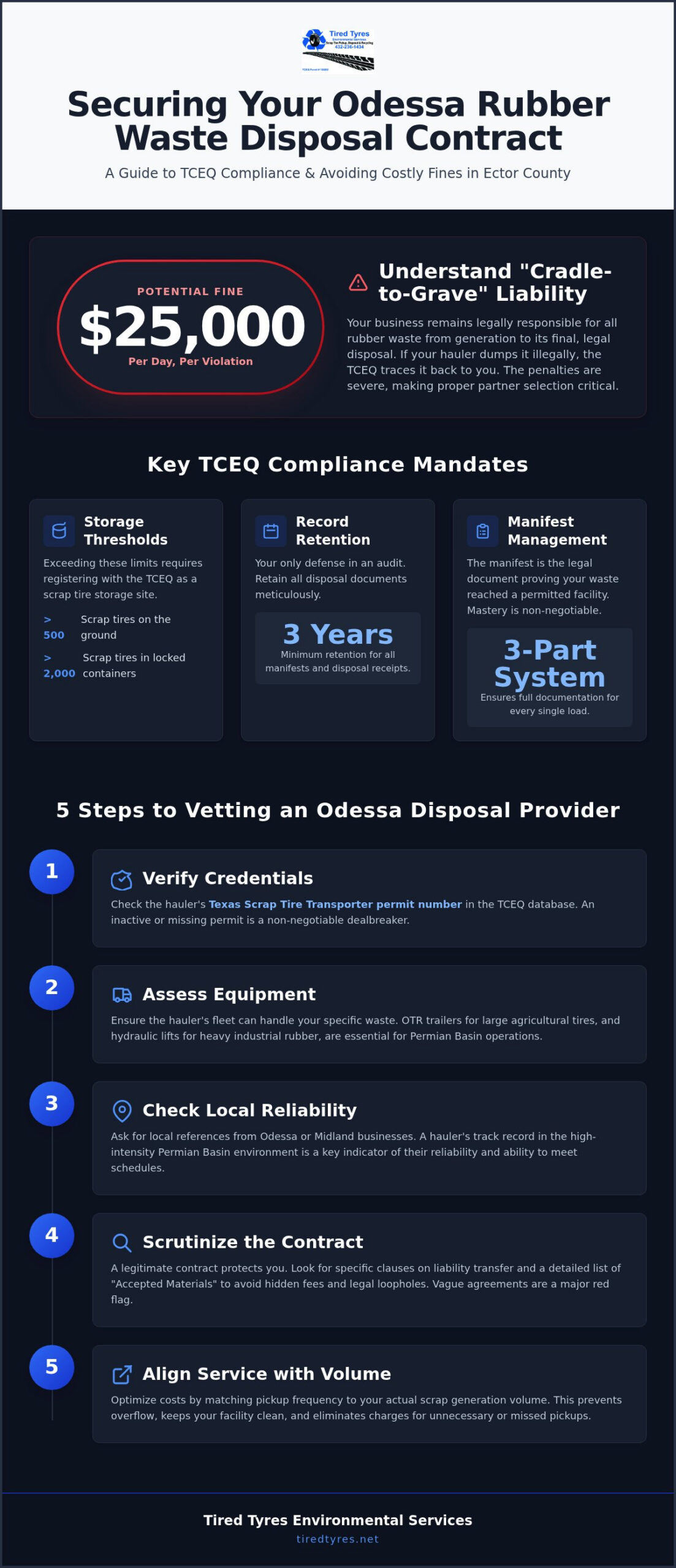
In 2026, commercial rubber waste liability in Odessa is defined by a single, uncompromising principle: the generator is responsible for the waste until it is legally processed or recycled. This means your business is never truly “done” with a scrap tire or a discarded conveyor belt just because it left your property. If a hauler dumps your materials in an Ector County alleyway, the Texas Commission on Environmental Quality (TCEQ) will trace those items back to your facility. Understanding how to manage a rubber waste disposal contract Odessa authorities will respect starts with acknowledging this “Cradle-to-Grave” responsibility. The TCEQ has intensified its enforcement in West Texas, frequently issuing penalties that can reach $25,000 per day for each violation of scrap rubber storage or disposal rules.
The City of Odessa Solid Waste department provides excellent residential services, but their infrastructure isn’t designed for bulk industrial rubber. City landfills often prohibit tires in standard garbage containers, and they lack the specialized equipment needed to handle OTR tires or heavy industrial hoses. Consequently, Permian Basin businesses must secure private, permitted disposal agreements to stay compliant. Relying on unpermitted “fly-by-night” haulers is a high-risk gamble that rarely pays off when the audit begins.
TCEQ Requirements for Odessa Businesses
According to 2026 Texas law, a scrap tire generator is any individual or entity whose business operations result in the creation of scrap tires, including retail dealers, fleet operators, and industrial facilities. If your Odessa site stores more than 500 scrap tires on the ground or 2,000 in locked containers, you must register with the TCEQ as a scrap tire storage site. Compliance also requires meticulous record-keeping. You’re legally obligated to retain copies of all scrap rubber manifests and disposal receipts for a minimum of three years. These documents are your only defense during a surprise inspection, proving that your waste reached a permitted processing facility rather than an illegal dump site.
Local Odessa Landfill Limitations
The City of Odessa landfill maintains strict restrictions on bulk rubber to preserve cell space and prevent environmental hazards. Specialized industrial rubber, such as scrap skid steer tracks and conveyor belts, requires a private disposal contract with a hauler equipped for heavy-duty collection. While global rubber waste recycling technology has improved the ability to repurpose these materials, the local logistics of moving them remains a challenge for most businesses. Using an unpermitted hauler to bypass these landfill limits exposes you to massive liability. Verified haulers provide the necessary TCEQ manifest numbers that shift the physical custody of the waste while maintaining the paper trail required by law.
5 Steps to Vetting an Odessa Rubber Disposal Provider
Vetting a hauler is about more than finding the lowest bid. It’s your first line of defense against state penalties. Understanding how to manage a rubber waste disposal contract Odessa professionals trust begins with a deep dive into five specific areas of compliance and logistics. You aren’t just hiring a truck; you’re hiring a compliance partner who will handle your legal documentation in the Permian Basin.
Step 1-2: Credentials and Equipment
Before signing any agreement, verify the Texas Scrap Tire Transporter permit number. You can easily do this through the TCEQ database. If a hauler can’t provide a current, active permit number, they aren’t legally allowed to touch your waste. This step is non-negotiable for protecting your business from liability. Once credentials are confirmed, you must assess their fleet. Truck capacity must match your specific volume. A standard box truck is fine for retail passenger tires, but industrial sites in Ector County often require OTR trailers for oversized agricultural tires or scrap skid steer tracks. Ensure your hauler has the hydraulic lift capacity to manage heavy industrial hoses and solid rubber without damaging your loading dock or creating a safety hazard for your staff.
Step 3-5: Reliability and Documentation
Experience in the Permian Basin matters. Managing rubber waste in a high-intensity industrial environment is vastly different from picking up tires at a suburban retail shop. Ask for local references from other Odessa or Midland businesses to confirm their pickup reliability. You don’t want a hauler who skips scheduled routes, leaving you with a mounting stockpile that could trigger a TCEQ inspection. You should also demand transparency regarding the final destination. A reputable provider will explain how your waste contributes to sustainable tire recycling markets, ensuring your rubber doesn’t sit in a local stockpile indefinitely.
Finally, insist on on-site manifest generation. You need a signed copy of the manifest the moment the rubber leaves your facility. This immediate documentation is a hallmark of reliable tire disposal in West Texas. If a hauler tells you they’ll “email it later,” they aren’t following best practices. If you’re ready to upgrade your service, you can request a site assessment from a local expert who understands these logistics and can tailor a plan to your specific industrial needs.
Key Contract Clauses to Protect Your Odessa Business
A well-drafted contract serves as your primary legal defense against environmental liability. When you’re learning how to manage a rubber waste disposal contract Odessa requires a focus on specific language that shifts risk away from your facility. The Liability Transfer Clause is the most vital component. It clearly states that once the hauler signs the manifest and removes the waste, they assume responsibility for the lawful transport and disposal of the materials. Without this clause, you remain vulnerable to cleanup costs and TCEQ penalties if a hauler decides to dump your rubber illegally in the Permian Basin. This clause doesn’t just protect your wallet; it protects your professional reputation.
Pricing transparency is another critical factor for Odessa industrial operations. The local market is often subject to volatile fuel surcharges and hidden stop fees that can inflate your monthly bill. Your agreement should define a transparent pricing structure that accounts for the specific types of rubber you generate. Service Level Agreements (SLAs) should also be included to guarantee pickup windows. If a hauler misses a scheduled collection, the SLA should outline the corrective actions or credits applied to your account. This ensures your yard doesn’t become a storage hazard due to an unreliable provider.
Defining the Scope of Rubber Waste
Vague language often leads to rejected loads and unexpected costs. Your contract must explicitly detail the types of commercial tire disposal services provided. This includes specific categories like OTR tires, agricultural tires, and semi-truck tires. It’s also vital to address contaminated rubber. In West Texas, tires often collect significant amounts of dirt, caliche, or water. You need to know exactly how these contaminants affect your pricing and whether the hauler has the equipment to process them. Clear language regarding scrap conveyor belts and industrial hoses will prevent disputes during the collection process and keep your operations moving.
Termination and Renewal Terms
Don’t let your business get trapped by evergreen clauses that automatically renew your contract without your consent. These clauses often lock you into outdated pricing or poor service levels. Instead, insist on a 30-day or 60-day notice period for termination. This flexibility is essential for Odessa businesses that experience seasonal volume shifts in their operations. Finally, ensure your contract grants you the right to audit the hauler’s disposal manifests. You should be able to verify that every load picked up from your site reached a permitted destination, providing the final link in your compliance chain and total peace of mind.
Best Practices for Manifest Management and TCEQ Compliance
Mastering the paperwork is a core part of how to manage a rubber waste disposal contract Odessa businesses can rely on during state audits. The manifest isn’t just a receipt; it’s a legal document that tracks every scrap tire and industrial hose from your site to its final destination. In Ector County, TCEQ inspectors look for a complete paper trail. If you can’t produce a manifest for a specific pickup, you’re technically in violation of texas tire disposal regulations, regardless of whether the hauler actually did their job. This is why daily oversight at your loading dock is non-negotiable.
The Manifest Workflow
The 3-part manifest system ensures accountability at every stage of the disposal process. It starts at your facility, where the Generator (your business) must accurately record the quantity and type of rubber being removed. Before the truck leaves your site, you must verify the Transporter’s signature and their active TCEQ registration number. After the load reaches the authorized facility, the Processor signs off on the delivery. The processor sends the final signed copy back to your Odessa office within 60 days of the pickup to confirm the waste reached its legal destination and close the tracking loop. If you don’t receive this return copy, you’re responsible for investigating the discrepancy to avoid being held liable for potential illegal dumping.
Audit-Proofing Your Files
Staying organized is your best defense against an Ector County inspection. You’re legally required to store all disposal records for a minimum of three years, but keeping them longer is often safer for long-term liability. Digital records are becoming the standard in 2026, yet many Odessa industrial yards still prefer physical paper files. Whichever method you choose, you must organize your records by date and volume for quick retrieval. A common mistake that triggers an audit is a mismatch between your disposal manifests and your hauler’s invoices. If your invoice says you paid for 200 tires but your manifest only shows 150, you’ve created a red flag for regulators.
Handling missing manifests requires a proactive contingency plan. If a hauler fails to provide paperwork, you should document the incident immediately and notify the TCEQ if the return copy doesn’t arrive within the legal timeframe. This proactive approach proves you’re acting in good faith. If you’re concerned about your current compliance status, you can request a manifest review with our team to ensure your files meet every 2026 state requirement.
Streamlining Your Odessa Rubber Disposal with Tired Tyres
Choosing a local partner who understands the specific waste dynamics of Ector County is the final step in mastering how to manage a rubber waste disposal contract Odessa industrial sites require for long-term success. Tired Tyres isn’t just a hauler; we’re a Permian Basin specialist dedicated to removing the regulatory burden from your shoulders. We focus exclusively on the collection and compliant transport of scrap rubber, ensuring your facility stays clean and your manifest trail remains unbroken. Because we’re based right here in the region, we provide the responsive, direct communication that national waste conglomerates often lack.
Our Odessa Service Capabilities
Our fleet is equipped to handle the heavy-duty demands of West Texas industrial yards and auto shops. We provide specialized collection for a wide range of materials, including:
- Passenger and Light Truck Tire Collection
- Semi-Truck Tire Collection
- Agricultural and OTR (Off-the-Road) Tire Collection
- Scrap skid steer tracks and solid tires
- Industrial scrap rubber, including conveyor belts and hoses
We’ve invested in the hydraulic equipment and high-capacity trailers necessary to move bulk industrial rubber safely. Our pricing is transparent and direct. We don’t hide Odessa-specific surcharges or “environmental fees” in the fine print. You’ll receive a clear, predictable cost structure based on your actual volume and material types. This clarity allows you to budget accurately while maintaining total TCEQ compliance for your scrap rubber collection needs.
Getting Started with a Compliant Contract
Onboarding with Tired Tyres is a straightforward process designed to get your facility compliant as quickly as possible. We start with a site assessment to determine your typical volume and the best pickup frequency for your operations. If you have accumulated piles of old rubber that have become a liability, we can handle the initial site cleanup to bring your facility back within TCEQ storage thresholds. This “reset” service is often the first step for Odessa businesses looking to escape the cycle of unreliable haulers and mounting fines.
Once your initial cleanup is complete, we’ll establish a recurring schedule that fits your workflow. Whether you need weekly pickups for a busy tire shop or monthly OTR removal for an oilfield service yard, we tailor the agreement to you. We also provide the same level of professional oversight for those seeking tire disposal Midland TX services, ensuring the entire Permian Basin has access to permitted, reliable scrap removal. Contact us today for a personalized quote and let a local expert take the guesswork out of your waste management strategy.
Secure Your Odessa Business Compliance Today
Securing your operations against Ector County waste penalties requires more than just a truck to haul away tires. It’s about building a framework of liability protection through airtight contracts and precise manifest tracking. By following the vetting steps and contract clauses outlined in this guide, you’ve learned how to manage a rubber waste disposal contract Odessa authorities will respect. Protecting your business from the cradle-to-grave liability of industrial rubber waste is a continuous process that demands local expertise and reliable documentation.
At Tired Tyres, we specialize in this complex landscape. As a TCEQ Permitted Transporter, we provide local Odessa and Midland service that national providers can’t match. We offer specialized industrial rubber handling for everything from OTR tires to scrap conveyor belts, ensuring every load is fully documented and legally processed. Don’t let compliance gaps threaten your bottom line or your reputation in the Permian Basin.
Get a Compliant Rubber Disposal Quote for Your Odessa Business and take the first step toward a worry-free waste management strategy today. We’re ready to help you clean up your facility and keep it that way.
Frequently Asked Questions
Do I need a special permit to dispose of tires in Odessa?
You don’t need a specific permit just to generate scrap tires, but you must register as a generator with the TCEQ if your Odessa business exceeds specific storage limits. For 2026, these thresholds are 500 tires on the ground or 2,000 in locked containers. Additionally, you are legally required to hire only haulers who hold a valid Texas Scrap Tire Transporter permit. Keeping your registration current ensures you remain compliant during local environmental inspections.
How much does a commercial rubber disposal contract cost in Odessa?
Costs for a commercial rubber disposal contract depend on your specific volume and the types of rubber you generate. While landfill tipping fees in the Texas region averaged $44.87 per ton in 2024, private hauler rates often use per-unit pricing for passenger, semi-truck, or OTR tires. Factors like pickup frequency and Permian Basin fuel surcharges also influence the total. Requesting a custom site assessment is the most accurate way to determine your monthly expenses.
Can I include scrap conveyor belts in my tire disposal contract?
Yes, you can include scrap conveyor belts, industrial hoses, and skid steer tracks in your agreement if your provider has the right equipment. Many standard tire haulers lack the hydraulic lift capacity for these heavy industrial items. When learning how to manage a rubber waste disposal contract Odessa plants require, ensure your Accepted Materials list explicitly mentions these bulk items. This prevents service delays and ensures all your industrial rubber waste is handled legally.
What happens if a hauler dumps my Odessa business tires illegally?
You are legally responsible for the waste from cradle to grave under Texas law. If your hauler dumps tires illegally, the TCEQ can hold your Odessa business liable for the full cleanup costs and administrative penalties. Fines in 2026 can reach $25,000 per day for each violation. This is why verifying transporter permits and maintaining a complete manifest trail is your only effective defense against the actions of an unreliable provider.
Does the City of Odessa pick up commercial tires?
The City of Odessa Solid Waste department does not provide collection services for commercial tires or industrial rubber waste. Their infrastructure is designed for residential trash and standard municipal waste streams. Commercial generators in Ector County must secure private contracts with permitted haulers to manage their scrap tires. Attempting to place tires in city dumpsters can lead to immediate fines and a refusal of service from municipal crews.
How often should I schedule rubber waste pickups for my Odessa shop?
Your pickup frequency should be based on your weekly generation rate and your available storage space. High-volume auto shops in Odessa often schedule weekly or bi-weekly pickups to stay below the 500-tire TCEQ registration threshold. Industrial yards with larger OTR tires might prefer an on-call system or monthly bulk removals. A consistent schedule prevents rubber from accumulating, which reduces fire hazards and keeps your facility looking professional for customers.
Is a manifest required for every single tire pickup in Ector County?
Yes, a state-approved manifest is mandatory for every load of scrap rubber transported from your site. This document serves as the official legal record of the transfer from the generator to the transporter. In Ector County, failing to produce a manifest for a pickup is a serious compliance gap. You must retain these records for at least three years to prove that your waste was handled according to current Texas environmental regulations.
What is the difference between a tire recycler and a tire hauler in Odessa?
A tire hauler is a permitted entity that physically collects and transports waste from your business to a processing site. A tire recycler is the facility that actually shreds, grinds, or repurposes the rubber into new materials. Understanding how to manage a rubber waste disposal contract Odessa businesses need involves knowing that your hauler must deliver your waste to a permitted recycler. Some companies, like Tired Tyres, manage the entire logistics chain to simplify your compliance.