

You’ve just finished a busy month at your Lubbock shop, but the moment you open your latest disposal bill, that sense of accomplishment vanishes. Between confusing surcharges and unexpected fees for different tire sizes, understanding your tire disposal invoice Lubbock can feel like trying to solve a puzzle without all the pieces. It’s a common frustration for business owners who want to keep overhead low but find themselves squinting at line items that don’t seem to match the work performed.
We agree that your billing should be as straightforward as the service itself. You shouldn’t have to guess why a medium-duty truck tire costs more to process than a passenger one or what the latest TCEQ surcharges actually cover. This guide provides the clarity you need to decode every line item on your bill to ensure price accuracy and total regulatory compliance. We want to take the guesswork out of your environmental documentation so you can focus on your customers.
We’ll walk you through the specifics of tire classification billing and explain how to verify that your invoice perfectly mirrors your scrap tire manifest. By the end of this article, you’ll have the confidence to spot errors, lower your disposal overhead, and stay prepared for any state audit. Let’s get your paperwork as organized as your shop floor.
Key Takeaways
- Your invoice serves as critical financial proof that you’ve legally transferred liability for scrap rubber to a TCEQ-permitted hauler.
- Improve your process for understanding your tire disposal invoice Lubbock by learning how PLT and semi-truck classifications impact your unit pricing.
- Ensure billing accuracy by matching manifest tracking numbers to your invoice using the standard 5-part documentation system.
- Learn to perform a quick two-step audit to catch discrepancies in tire counts and identify any hidden minimum load or stop fees.
- Utilize digital customer portals to maintain a transparent, searchable paper trail that makes TCEQ inspections stress-free.
Why Your Lubbock Tire Disposal Invoice Matters
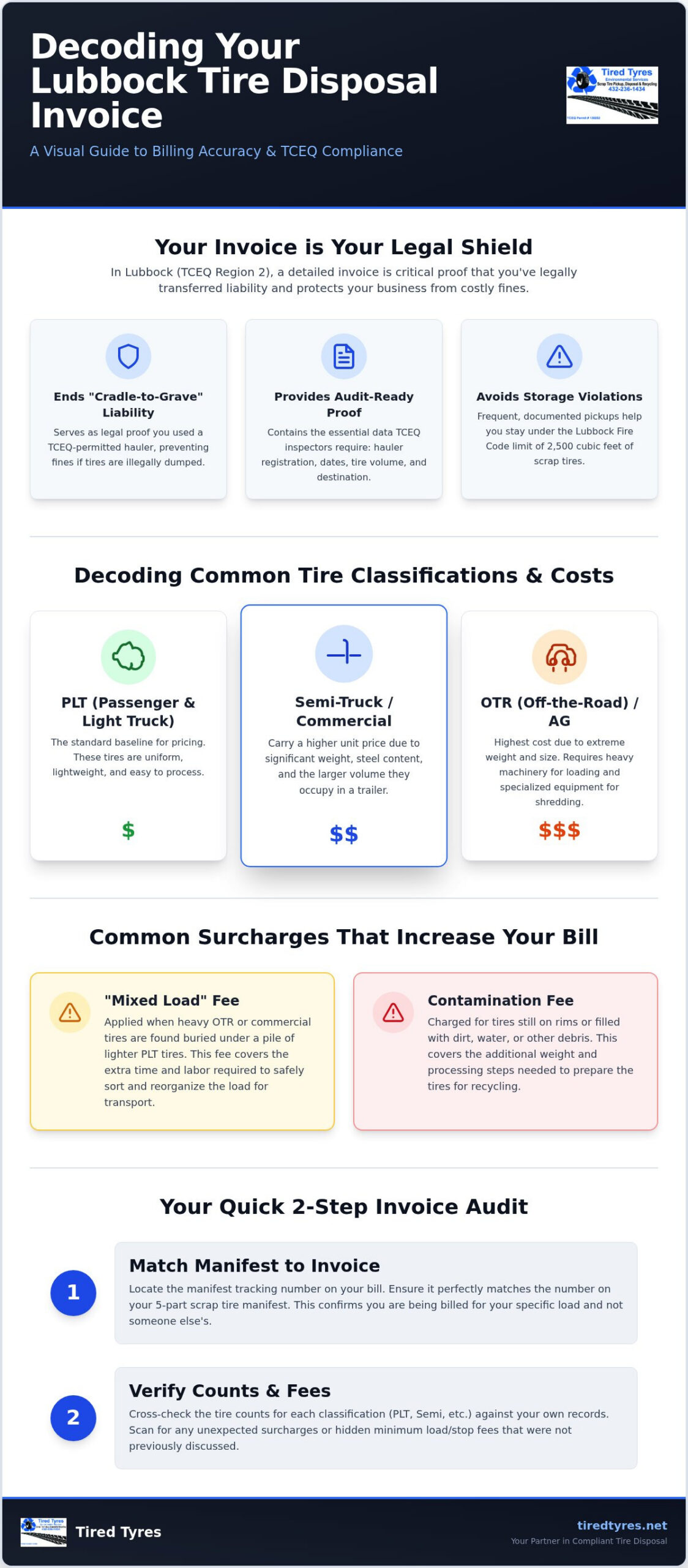
In Lubbock, a tire disposal invoice is far more than a simple request for payment. It’s your primary shield against environmental liability. When a hauler pulls away from your shop, you’re still legally responsible for those tires until you can prove they were handed off to a registered professional. This is why understanding your tire disposal invoice Lubbock is essential for any business handling scrap rubber. A standard credit card receipt doesn’t provide the data TCEQ inspectors look for during a surprise visit. Without a detailed invoice, you lack the paper trail needed to survive an audit.
The West Texas Region Disposal Facility in Abernathy handles the region’s waste, but commercial businesses face strict hurdles. With “Special Waste” fees reaching $78.61 per ton as of August 2026, many shops find that private collection is more efficient. However, that efficiency is only valuable if the documentation is flawless. An accurate invoice proves several key facts:
- The exact date and time of the transfer.
- The TCEQ registration number of the transporter.
- The volume and type of tires removed from your site.
- The intended destination for final processing or disposal.
The Role of TCEQ Region 2 in Local Billing
Lubbock falls under TCEQ Region 2 oversight. Inspectors here focus heavily on how tires are documented from the moment they leave a commercial lot. A “dumping fee” often implies a simple transaction at a landfill, but a professional collection invoice details the specific classifications and quantities required for state records. In 2026, local businesses face higher scrutiny regarding tire stockpiling. The Lubbock Fire Code requires specific permits for storing more than 2,500 cubic feet of scrap tires. Frequent, well-documented pickups aren’t just a convenience; they’re an operational necessity to stay under these limits.
Cradle-to-Grave Liability and Your Bottom Line
The concept of “cradle-to-grave” liability means you’re responsible for a tire’s environmental impact from the time it’s removed until it completes the tire recycling process. If an unpermitted hauler takes your cash and dumps your tires in a West Texas canyon, the state can trace those tires back to your shop. An accurate invoice serves as legal proof that you used a TCEQ-permitted hauler. It links your business to a legitimate processing facility, effectively ending your liability at the curb. Using unpermitted collectors might save a few dollars today, but the resulting fines for illegal dumping can easily bankrupt a small shop. Prioritizing the process of understanding your tire disposal invoice Lubbock is the smartest way to protect your bottom line from unexpected regulatory costs.
Decoding Common Line Items and Tire Classifications
Not every piece of rubber is treated equally on a bill. When you’re understanding your tire disposal invoice Lubbock, you’ll see that Passenger and Light Truck (PLT) tires are the standard baseline. These are easy to stack and process. Semi-truck and commercial tires, however, carry a higher unit price because of their significant weight and the volume they occupy in a collection trailer. Accurate classification is the first step in ensuring you aren’t overpaying for smaller units.
In the South Plains, agricultural and OTR (Off-the-Road) tires are a daily reality. These specialized units require heavy machinery for loading and specialized equipment for shredding. You’ll also see line items for industrial waste like scrap skid steer tracks or conveyor belts. These items don’t fit standard tire counts and are often billed based on weight or linear footage. Because these materials are more abrasive and difficult to handle, they require their own distinct categories on your invoice.
The “Mixed Load” Surcharge Explained
Sorting your scrap is the easiest way to keep your bill predictable. If a driver finds heavy OTR tires buried at the bottom of a passenger tire pile, it often triggers a “Mixed Load” surcharge. This covers the extra labor required to reorganize the truck for safe transport. Contamination is another factor that impacts understanding your tire disposal invoice Lubbock. Tires filled with dirt, water, or still mounted on rims require extra processing steps. These will appear as additional fees on your final total because they add weight and labor that isn’t part of a standard pickup.
Non-Tire Rubber Disposal Costs
Industrial clients in the Permian Basin often need to dispose of more than just tires. Scrap hoses and conveyor belts are common in local oilfield and agricultural operations. Invoicing for these items differs from pneumatic tires because they are solid rubber. Solid tires, for instance, are significantly more difficult to process than air-filled ones and require a different disposal rate. For businesses managing large volumes of agricultural or industrial waste, Tired Tyres provides specialized collection services that simplify the billing process through clear, itemized reporting. This transparency ensures that every piece of industrial rubber is accounted for without hidden costs.
Matching Invoices to Your Waste Tire Manifest
Every professional tire collection begins with a paper trail that must be airtight. When you’re understanding your tire disposal invoice Lubbock, the first thing you should look for is the unique manifest number. In the state of Texas, the 5-part manifest system tracks scrap tires from the generator to the final processor. Your invoice isn’t just a bill; it’s a financial mirror of that legal document. If the manifest number on your invoice doesn’t match the paperwork left at your shop during pickup, your records won’t hold up during a state inspection.
Verifying tire counts is where most billing discrepancies occur. It’s vital that the hauler’s count at the curb matches what eventually appears on the office bill. If your team counted 40 passenger tires but the invoice shows 45, you’re paying for phantom rubber. We recommend a quick “spot check” before signing the manifest. Ensure the driver records the exact quantities for each classification, as these numbers are the primary data source for your billing cycle. Accurate counts at the time of pickup prevent headaches when the invoice arrives weeks later.
Signatures and retention are the final pillars of a clean audit trail. The person who signs the manifest at your shop should be noted or referenced on the corresponding invoice. This confirms that an authorized employee verified the load. For businesses in Lubbock County, the law is clear: you must keep both the manifest and the invoice for at least three years. Storing these documents together simplifies the process of understanding your tire disposal invoice Lubbock and ensures you’re always prepared for a TCEQ Region 2 visit.
The 60-Day Return Rule and Billing Cycles
Texas law requires that a completed copy of the manifest be returned to the generator within 60 days of the tires being picked up. This final copy proves the tires actually reached a permitted processing facility. Sometimes your billing cycle might move faster than the mail, meaning you’ll receive an invoice before that final manifest copy arrives. Linking these documents is a core part of staying compliant with Texas tire disposal regulations. If 60 days pass and you don’t have that final signed copy, it’s time to call your hauler.
Hauler Registration Numbers
A legitimate invoice must display the hauler’s TCEQ registration number. On a Tired Tyres invoice, this number is prominently featured to ensure total transparency. For Lubbock businesses, an invoice missing this ID is a major red flag. It suggests the hauler might not be registered with the state, which puts the legal liability for any illegal dumping squarely back on your shop. You can easily cross-reference these IDs with the official state database to confirm your collector is authorized to handle scrap rubber in West Texas.
How to Audit Your Tire Disposal Bill for Accuracy
Auditing your bill shouldn’t feel like a chore. It’s the final check in a professional workflow that ensures your shop’s financial health. When you’re understanding your tire disposal invoice Lubbock, start by comparing the “Tire Units” count on your manifest to the invoice quantity. If you signed for 50 tires at the curb, that exact number should appear on the bill. Any discrepancy here suggests a clerical error that needs immediate correction before payment.
Next, look for “Stop Fees” or “Minimum Load” charges. These are common for smaller pickups where the hauler needs to cover the cost of the trip despite a low tire count. You should also review fuel surcharges. In West Texas, these vary based on current market rates. While surcharges are standard, they should remain consistent with local market trends. Finally, verify the disposal site. The destination listed on your invoice must match the manifest destination to ensure your legal paper trail is complete. Don’t overlook “Rim-On” fees, either. These should only apply to tires that still contain metal rims, as these require extra labor to remove. If you’re being charged this fee for rubber-only loads, your hauler’s count is inaccurate.
Identifying Hidden Fees in Waste Management
Many businesses get tripped up by an “Environmental Fee.” Is it legitimate? Often, it’s a flat fee used to cover regulatory paperwork and state reporting requirements. However, you should always know the difference between a “Pickup Fee” (the cost of the truck arriving) and a “Disposal Fee” (the per-unit cost of the rubber). Transparency is vital for your records. Many reliable tire disposal providers like Tired Tyres simplify their billing to avoid these confusing layers, ensuring you only pay for the services you actually received.
Negotiating Scheduled vs. On-Call Billing
Your billing frequency directly affects your bottom line. Scheduled routes in Lubbock often offer cost benefits over one-time emergency pickups because the hauler can optimize their travel. If you’re handling large-scale site remediations, ask how volume discounts are applied to your invoice. Be mindful of “Dry Run” fees, though. If a hauler arrives but can’t access your tire pile because of a locked gate or blocked driveway, you’ll likely still see a charge on your invoice. Keeping your pile accessible is the easiest way to avoid these unnecessary costs. If you’re ready for a more transparent billing experience, contact Tired Tyres today to review your current disposal needs.
Transparent Billing with Tired Tyres in Lubbock
Understanding your tire disposal invoice Lubbock doesn’t have to be a source of monthly stress. At Tired Tyres, we’ve built our reputation on a “No-Surprise” billing philosophy designed specifically for the South Plains business community. We know that shop owners and fleet managers need clear, itemized records to keep their operations running smoothly. Our invoices are designed to be intuitive, ensuring that every passenger tire, semi-truck unit, and OTR tire is accounted for without hidden surcharges or vague “administrative” fees.
We provide customized billing solutions that reflect the reality of your specific waste stream. Whether you’re clearing out a pile of scrap skid steer tracks or disposing of specialized industrial hoses from an oilfield site, our documentation remains consistent. Every line item is verified against the physical count performed at your location. This precision helps you stay compliant with commercial tire disposal standards, giving you the peace of mind that your environmental footprint is fully documented and legally sound.
Simplifying Your Paperwork Trail
One of the biggest hurdles in understanding your tire disposal invoice Lubbock is the sheer volume of paperwork required by the state. We simplify this by bundling your manifests and invoices together, making quarterly reporting a breeze. Instead of digging through stacks of paper, our clients can use our secure customer portal to access their entire history of collections. This digital record-keeping reduces office clutter and provides instant proof of compliance during Lubbock County environmental audits. If an inspector walks through your door, you can pull up every manifest-backed invoice in seconds.
Requesting a Transparent Quote
Accuracy starts long before the first truck arrives. To provide a clear estimate for your Lubbock site, we look at several factors:
- The estimated count of passenger and light truck tires.
- The volume of heavy-duty or agricultural tires.
- The presence of industrial rubber waste like conveyor belts or solid tires.
- The accessibility of the pile and the frequency of pickup needed.
For bulk OTR and agricultural collections, we often perform on-site assessments. This ensures that the quote you receive is the same price you see on the final bill. We don’t believe in low-balling an estimate only to add “difficult load” fees later. If you’re tired of confusing bills and want a partner who values transparency as much as you do, contact Tired Tyres for a clear, manifest-backed quote today.
Secure Your Compliance with Transparent Billing
Efficient tire disposal is about more than just clearing space; it’s about protecting your business from long-term legal risks. By matching your manifest counts to your billing and verifying hauler registration numbers, you ensure every dollar spent contributes to your environmental compliance. Mastering the process of understanding your tire disposal invoice Lubbock allows you to spot errors before they impact your bottom line. Whether you’re dealing with standard passenger tires or specialized OTR units, a clear paper trail is your best defense during a TCEQ audit.
As a West Texas owned and operated company, Tired Tyres specializes in transparent, manifest-backed billing. We’re a TCEQ permitted hauler with deep expertise in OTR and industrial rubber disposal. We don’t hide behind confusing surcharges or vague fees; we provide the professional documentation you need to stay compliant. Ready to simplify your shop’s paperwork? Get a Transparent Tire Disposal Quote for Your Lubbock Business today. We’ll help you keep your records as clean as your shop floor.
Frequently Asked Questions
Why is there a manifest fee on my tire disposal invoice?
The manifest fee covers the administrative labor required to process the mandatory 5-part state tracking documents. This fee ensures that your scrap rubber is correctly logged with the Texas Commission on Environmental Quality. While it may seem like an extra cost, it’s the price of maintaining a legal paper trail. Understanding your tire disposal invoice Lubbock requires recognizing that this fee protects your shop from the liability of undocumented waste.
Can I be fined if my hauler doesn’t provide a proper invoice?
Businesses are legally responsible for their waste from “cradle to grave.” If a hauler fails to provide a professional invoice and manifest, you have no proof of legal transfer. During a TCEQ audit, a lack of documentation can result in heavy fines for the generator, not just the hauler. Always insist on a formal record that includes the transporter’s registration number and the final disposal destination to avoid these risks.
How are OTR tire disposal costs calculated in Lubbock?
OTR tire disposal costs are typically calculated based on weight or specialized unit rates because of their massive volume. These tires require heavy machinery for loading and specialized shredders for processing. In the West Texas agricultural and industrial sectors, these costs reflect the extra labor and equipment wear involved. Your invoice will usually list these separately from standard passenger tires to ensure accurate billing for the specialized handling required.
What should I do if the tire count on my invoice is higher than what was picked up?
You should immediately cross-reference the invoice with the yellow copy of the manifest left at your shop during the pickup. If the counts don’t match, contact your hauler’s billing department before issuing payment. Discrepancies often happen during the manual counting process at the curb. Providing a photo of your signed manifest copy is usually the fastest way to resolve the error and get a corrected invoice for your records.
Do I need to keep my tire disposal invoices for tax purposes or environmental compliance?
You must retain all tire disposal records for at least three years to satisfy TCEQ Region 2 requirements. These documents serve as your primary defense during environmental inspections. Beyond compliance, they are essential for standard business tax deductions related to waste management expenses. Maintaining an organized digital or physical file of every invoice and manifest ensures you’re always prepared for both state audits and annual financial reviews.
Is there a difference in billing for tires with rims vs. tires without rims?
Tires with rims are significantly more expensive to process than those without. The metal must be mechanically removed before the rubber can enter the recycling stream, which adds labor and equipment costs. Your hauler will apply a “Rim-On” surcharge for these specific units. To keep your costs low, we recommend removing rims yourself whenever possible. This ensures your invoice only reflects the standard disposal rate for the rubber itself.
How does fuel pricing in West Texas affect my disposal invoice?
Fuel surcharges are a standard part of waste management in West Texas due to the long distances between collection sites and processing plants. Haulers adjust these fees based on the current market price of diesel. When understanding your tire disposal invoice Lubbock, you’ll see this charge fluctuate as fuel prices rise or fall. It’s a transparent way for haulers to cover transportation overhead without raising the base disposal rates for every tire.
What is a “TCEQ Registration Number” and should it be on my bill?
A TCEQ Registration Number is a unique ID issued by the state to authorized scrap tire transporters. It absolutely should be on your bill. This number proves that the hauler has the legal right to move your tires and is bonded and insured according to state standards. If an invoice is missing this number, it’s a major red flag. Using an unpermitted hauler can lead to fines for your business if the tires are dumped illegally.