
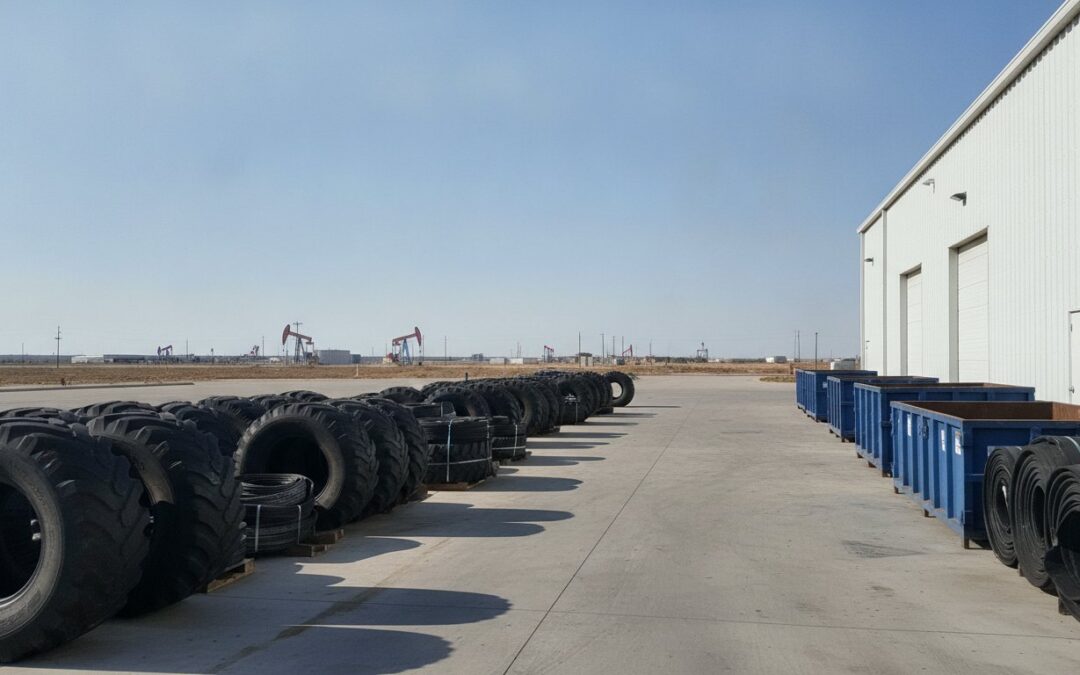
In 2025, the TCEQ issued over $2.4 million in penalties for improper waste management, proving that a stack of old tires in your yard is more than just an eyesore; it’s a financial ticking time bomb. If you’re managing an industrial site in the Permian Basin, finding a reliable partner for commercial rubber disposal Odessa is the only way to protect your bottom line from these aggressive enforcement trends. It’s frustrating when local landfills reject your bulk tires or when you’re staring at a growing pile of scrap hoses and belts without a clear way to move them. The mandatory 5-part TCEQ-10304 manifest requirements can feel like a full-time job on their own, especially when a single error can lead to heavy daily fines.
You don’t have to let industrial waste stall your operations. It’s entirely possible to clear your yard and achieve 100% regulatory compliance without the headache of navigating complex state codes alone. This 2026 guide breaks down the latest “cradle-to-grave” liability rules and shows you how to set up a scheduled pickup service that keeps your business audit-ready and your workspace clean. We’ll explore how to handle everything from standard passenger tires to heavy-duty OTR rubber while staying fully compliant with current Texas regulations.
Key Takeaways
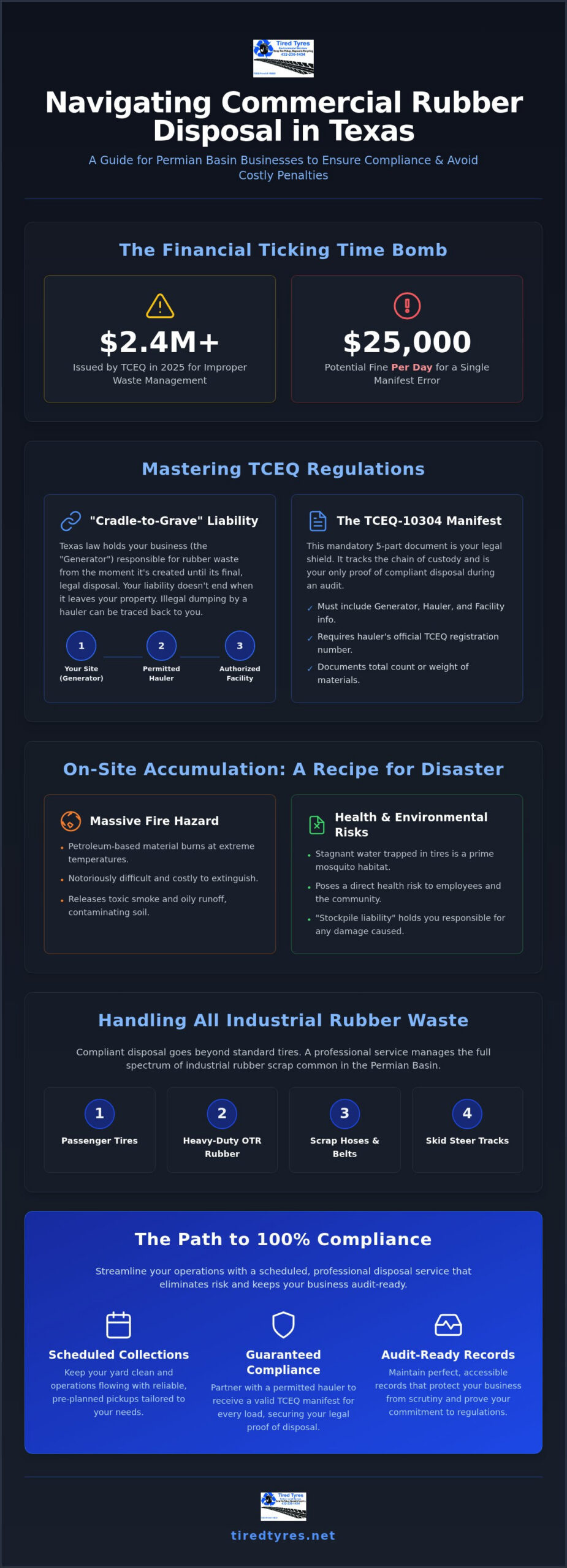
- Master the TCEQ-10304 manifest requirements to protect your business from penalties that can reach $25,000 per day.
- Navigate the specific challenges of commercial rubber disposal Odessa by understanding why municipal services often turn away industrial bulk waste.
- Identify the proper disposal paths for specialized industrial materials like scrap skid steer tracks and reinforced conveyor belts.
- Learn how “cradle-to-grave” liability laws mean you’re responsible for your waste even after it leaves your property.
- Streamline your operations with scheduled collection services that clear yard clutter while maintaining perfect record-keeping for future audits.
The Challenge of Commercial Rubber Disposal in Odessa, TX
Odessa businesses often discover that what works for household trash doesn’t apply to heavy-duty industrial waste. The city’s municipal solid waste division is designed for residential convenience, not the high-volume needs of oilfield service yards or agricultural operations. This gap creates a significant hurdle for commercial rubber disposal Odessa, as standard waste protocols simply aren’t equipped to handle the weight or volume of scrap tires and industrial belts. Instead of a simple drop-off, local businesses find themselves caught between strict landfill bans and growing piles of waste.
Why Local Landfills Reject Bulk Commercial Tires
Ector County landfill restrictions are clear. Whole tires and bulk rubber are prohibited from standard disposal. This isn’t just a local whim; it’s driven by Texas Commission on Environmental Quality (TCEQ) regulations. Rubber is incredibly resilient. It doesn’t compact. In a landfill setting, whole tires trap methane gas and eventually “float” back to the surface. This movement can puncture expensive landfill liners, leading to environmental leaks. Because of these risks, general dumpster rental companies often exclude rubber materials from their allowed items list. Businesses that try to hide scrap hoses or tires in general waste bins risk rejected loads and heavy surcharges.
Environmental and Safety Risks of On-Site Accumulation
Letting rubber waste pile up in a West Texas yard is a dangerous gamble. Industrial rubber stockpiles are massive fire hazards. Once a tire pile ignites, the petroleum-based material burns at extremely high temperatures and is notoriously difficult to extinguish. These fires release toxic smoke and oily runoff that can contaminate local soil. Beyond fire, stagnant water trapped inside scrap tires or curved conveyor belts creates a perfect breeding ground for mosquitoes and pests. This presents a direct health risk to your employees and the surrounding community. For an Odessa business owner, “stockpile liability” is the legal and financial responsibility for any environmental damage, fire, or health hazard caused by the accumulation of unregulated rubber waste on their property.
Effective management requires shifting your perspective. You aren’t just dealing with “trash” anymore. You’re managing industrial scrap that carries “cradle-to-grave” liability. This means your responsibility for the material doesn’t end when it leaves your gate. If a non-permitted hauler dumps your tires illegally, the TCEQ can trace those materials back to your business. Proper commercial rubber disposal Odessa requires a permitted hauler who understands these legal nuances. The Challenge of Commercial Rubber Disposal is navigating these shifting regulations while keeping your yard clear and your business compliant. Transitioning to a professional scrap management plan is the only way to eliminate these risks and ensure your operations remain uninterrupted by regulatory audits.
Navigating TCEQ Regulations and Manifest Requirements
Every business in the Permian Basin that produces scrap rubber is classified by the State of Texas as a “Generator.” This isn’t just a label; it’s a legal designation that carries significant weight. When you seek commercial rubber disposal Odessa, you aren’t just paying for a pickup. You’re initiating a chain of custody that must be documented perfectly to satisfy the Texas Commission on Environmental Quality (TCEQ). Failing to manage this process correctly can lead to catastrophic financial consequences for your company.
What is a Scrap Tire Manifest?
The Scrap Tire Manifest, specifically Form TCEQ-10304, is a mandatory 5-part document. It tracks rubber waste from the moment it leaves your yard until it reaches an authorized disposal or recycling facility. Think of it as your legal shield. To be valid, this form must include the generator’s information, the hauler’s TCEQ registration number, and the total count or weight of the materials. A signature from a permitted hauler is your only proof of legal disposal. Without this paper trail, you have no way to prove the waste was handled correctly during a state audit.
Avoiding Illegal Dumping Liability in Ector County
Liability doesn’t end at your property line. If an unauthorized hauler takes your tires and dumps them in the desert outside Odessa, the TCEQ can trace those materials back to your business. Texas law enforces “cradle-to-grave” responsibility. This means businesses are held liable for rubber found at illegal sites regardless of who physically dumped the material. The risks of cutting corners are extreme. In 2025, the TCEQ issued over $2.4 million in penalties for waste violations. Fines for manifest errors can hit $50,000 per day per violation, while illegal dumping can cost you $25,000 per day.
Verifying your hauler is the only way to mitigate this risk. Before any rubber leaves your site, follow this verification checklist:
- Ask to see their current TCEQ registration decal on their vehicle.
- Verify their registration number through the TCEQ online database.
- Ensure they provide the official 5-part manifest for every load.
The law requires you to keep all manifests on file for three years. If an auditor visits your office today, you must be able to produce every form from the last 36 months. Managing this level of detail is much simpler when you work with a permitted hauler in Odessa who prioritizes compliance and accurate record-keeping. This documentation isn’t just a chore; it’s the only way to prove you’ve done your part to keep West Texas clean and your business safe from regulatory action. Commercial rubber disposal Odessa is a matter of legal survival as much as it is a matter of yard maintenance.
Industrial Rubber Waste: Beyond Standard Tire Collection
Standard waste services often view rubber disposal as a simple task involving car tires. In the Permian Basin, the reality is much heavier. Oilfield service yards and industrial sites deal with complex materials like steel-reinforced tracks and high-pressure hydraulic lines. Finding a partner for commercial rubber disposal Odessa means choosing a hauler who can handle these specialized items without damaging equipment or violating state codes. Industrial equipment requires a disposal strategy that accounts for weight, reinforcement, and volume.
Scrap Conveyor Belts and Industrial Hoses
Bulk conveyor belts and scrap hoses are notoriously difficult to process. Standard recyclers often reject them. They’re reinforced with high-tensile steel or synthetic fibers that can gum up shredding machinery. These materials also present massive volume challenges. A single industrial hose reel or a pallet of worn conveyor belts can weigh thousands of pounds. Tired Tyres manages these non-standard items by providing dedicated scrap hose collection and scrap conveyor belt collection. We understand the specific weight and recycling requirements of these materials. This ensures they don’t sit in your yard as a liability or a fire hazard.
Industrial equipment also relies on solid rubber tires and skid steer tracks. These items are incredibly dense and often contain internal steel cables. Because of this, they’re frequently regulated under the same framework as scrap tires but require much more effort to recycle. We provide scrap skid steer track collection and scrap solid tire collection to ensure these heavy items are moved safely and legally. Our team handles the logistics of loading and transporting these high-density materials so your crew can focus on their primary tasks.
Heavy-Duty OTR and Agricultural Tire Disposal
Off-the-Road (OTR) and agricultural tires require heavy-duty equipment for safe removal. You can’t toss a tractor tire into a standard pickup truck. Our specialized approach includes OTR tire collection and agricultural tire collection designed for the massive scale of mining and farming machinery. Whether you’re clearing out a harvester tire or a fleet of earthmovers, we provide the logistics to move them efficiently.
While a standard passenger tire weighs roughly 20 pounds and is easily shredded, a single OTR tire can weigh over 2,000 pounds and requires specialized mechanical shearing and multi-stage processing to separate the thick rubber from the heavy internal steel bead. This difference in scale is why commercial rubber disposal Odessa requires a partner with the right equipment and permits. We serve the agricultural sector with tractor and harvester tire removal, ensuring that even the largest rubber waste is handled with professional precision.
Comparing Commercial Disposal Options in the Permian Basin
Odessa businesses face a clear choice when managing industrial waste: attempt a DIY approach or partner with a specialized hauler. While municipal drop-off points exist, they’re designed for residential use. Ector County frequently restricts these events to prevent commercial abuse. For high-volume commercial rubber disposal Odessa, relying on city services isn’t a scalable or legal solution. You need a system that matches the pace of your operations without creating a bottleneck at your yard gate.
DIY Hauling vs. Professional Collection Services
The true cost of self-hauling often surprises business owners. When you factor in labor hours for two employees, fuel costs for multiple trips, and the gate fees at authorized processing sites, the “cheap” DIY route becomes expensive. There’s also the physical risk to your fleet. Transporting heavy OTR tires or dense skid steer tracks in standard pickup trucks often leads to suspension damage or bed liners being torn. Professional collection eliminates these hidden overheads. Businesses in Odessa and Midland save significant operational time by outsourcing the heavy lifting. Instead of losing a crew for half a day to sit in line at a facility, you can keep your team focused on billable work.
The Value of a Permitted Partner
A permitted partner provides more than just a truck. They provide a guarantee of regulatory compliance. General waste firms often lack the specific TCEQ registrations required for bulk tire transport. If they don’t provide the mandatory 5-part manifest discussed earlier, your business remains legally exposed. Consistency is another major factor. Scheduled pickups prevent the “yard stockpiling” that leads to fire hazards and pest issues. You can find more details on regional compliance in our Commercial Tire Disposal in Midland, Odessa & Lubbock: The 2026 Guide.
Choosing a specialized hauler ensures that non-standard items like industrial hoses and conveyor belts are handled correctly from the start. General dumpster services usually reject these items or charge massive contamination fees. By working with experts, you secure a reliable, audit-ready paper trail for every pound of rubber that leaves your site. If you’re ready to clear your yard and protect your business from liability, you can schedule a commercial rubber pickup in Odessa to ensure your operations stay lean and compliant. Commercial rubber disposal Odessa is most effective when it’s treated as a professional service rather than a weekend chore.
Efficient Commercial Rubber Solutions with Tired Tyres
Tired Tyres operates as a dedicated partner for businesses throughout the Permian Basin and South Plains. We aren’t a tire retailer; we’re a permitted hauler focused on providing a transparent, legal outlet for industrial waste. Our service area covers Odessa, Midland, and Lubbock, ensuring that regional operations have a single point of contact for their disposal needs. Whether you’re an auto shop with a steady stream of passenger tires or an oilfield yard with bulky industrial scrap, we customize our pickup frequency to match your waste generation rate. This proactive approach prevents the stockpile liability discussed earlier in this guide.
Our Collection Process for Odessa Businesses
Our process is built on speed and compliance. It starts with a simple request to identify the types of rubber you need removed. We accept a wide range of materials, including Passenger & Light Truck Tire Collection, Semi-Truck Tire Collection, and heavy-duty OTR (Off-the-Road) Tire Collection. We also handle specialized industrial items like scrap skid steer track collection, scrap hose collection, and scrap conveyor belt collection. Once on-site, our team handles the loading and ensures every load is documented with the mandatory 5-part TCEQ manifest. You receive the final manifest copy immediately, providing the legal paper trail you need for your records. For a deeper look at our regional operations, read our guide on Reliable Tire Disposal in Midland, Odessa & Lubbock: The 2026 West Texas Guide.
Requesting Your Custom Disposal Quote
Every industrial yard has different requirements. When you request a quote for commercial rubber disposal Odessa, we look at three main factors: the type of material, the total volume, and your location. OTR tires and reinforced conveyor belts require different logistics than standard truck tires, so clear communication about your inventory helps us provide an accurate estimate. We can set up weekly, monthly, or on-call services depending on how quickly your scrap rubber accumulates. This flexibility helps you manage your budget while staying 100% TCEQ compliant.
To keep your costs low and our pickups efficient, we recommend preparing your site before our truck arrives. Consolidating your scrap into a single, accessible area ensures our team can load quickly and clear your yard without delays. Maintaining a clean, compliant facility shouldn’t be a logistical nightmare. By choosing a specialized hauler, you avoid the contamination fees and paperwork errors common with general waste firms. You can contact Tired Tyres for an Odessa commercial rubber pickup quote to start clearing your yard today. We’re here to take the burden of commercial rubber disposal Odessa off your shoulders so you can focus on your core business.
Move Beyond Stockpile Liability
Managing a clean and compliant industrial yard in West Texas doesn’t have to be a source of constant stress. By understanding the “cradle-to-grave” liability of your scrap materials and the strict TCEQ manifest requirements, you’ve already taken the first step toward protecting your business from heavy fines. Professional commercial rubber disposal Odessa ensures that everything from standard truck tires to reinforced conveyor belts and OTR rubber is handled legally. It’s about more than just clearing space; it’s about maintaining an audit-ready paper trail that proves your commitment to state regulations.
Tired Tyres is here to take the logistical weight off your team. We provide the specialized equipment needed for heavy industrial rubber and the TCEQ-compliant manifest documentation that serves as your legal shield. We serve the entire Permian Basin region, offering reliable, scheduled pickups that keep your operations moving forward. Don’t let scrap rubber become a fire hazard or a regulatory bottleneck. Schedule your commercial rubber pickup in Odessa today and get back to focusing on what your business does best. We’re ready to help you maintain a safer, more efficient workplace.
Frequently Asked Questions
Can I throw commercial tires in a standard roll-off dumpster in Odessa?
No, you cannot put commercial tires in a standard roll-off dumpster because local landfills prohibit them. Most dumpster rental companies in Ector County explicitly list rubber as a prohibited material to comply with state regulations. Attempting to hide tires in general waste bins often leads to rejected loads and high contamination fees. For legal commercial rubber disposal Odessa, you must use a permitted hauler who provides the necessary manifest documentation.
What is the penalty for illegal tire dumping in Texas?
The penalties for illegal tire dumping in Texas are severe, with fines reaching up to $25,000 per day per violation. Errors on your mandatory manifests can lead to penalties as high as $50,000 per day. These strict regulations ensure that businesses take full responsibility for their industrial scrap. In 2025, the TCEQ issued over $2.4 million in total penalties for various waste management violations across the state.
How many years must I keep scrap tire manifests for my business?
Texas law requires your business to keep all scrap tire manifests on file for three years. These documents must be available for inspection if the TCEQ conducts an environmental audit of your Odessa facility. Maintaining an organized filing system for these forms is your only legal proof that your waste was handled by a permitted hauler. This record-keeping is a mandatory part of professional commercial rubber disposal Odessa.
Does Tired Tyres handle industrial rubber like conveyor belts and hoses?
Yes, we specialize in handling non-standard industrial rubber waste, including scrap hose collection and scrap conveyor belt collection. We have the heavy-duty equipment necessary to manage the extreme weight and synthetic reinforcement found in oilfield materials. Many general waste services reject these items because they damage standard shredding equipment, but we provide a reliable, legal outlet for bulk industrial scrap throughout the Permian Basin.
Do you offer scheduled pickups for auto repair shops in Odessa?
We offer flexible, scheduled pickup services tailored to the needs of auto repair shops and industrial yards. Whether you generate a steady stream of passenger tires or a large volume of semi-truck rubber, we can set up weekly, monthly, or quarterly collections. This consistency helps you avoid the safety risks of yard stockpiling and ensures your waste is managed professionally without interrupting your daily business operations.
Is there a limit to the size of OTR tires you can collect?
We have specialized equipment designed to collect and transport OTR (Off-the-Road) and agricultural tires of almost any size. From standard tractor tires to massive earthmover rubber, we manage the logistics of loading and hauling these oversized items safely. Because OTR tires are significantly heavier than passenger tires, they require mechanical loading and specific processing. We serve the mining, construction, and farming sectors throughout the South Plains.
How do I verify if a tire hauler is permitted by the state of Texas?
You can verify a hauler’s status by asking to see their current TCEQ registration decal, which must be clearly displayed on their vehicle. You should also verify their registration number through the TCEQ online database before any rubber leaves your site. A legitimate hauler will always provide the mandatory five-part manifest form for every load. Never release your waste to a transporter who cannot prove they are currently permitted.
Can I drop off tires at your facility, or do you only provide pickup?
Tired Tyres is a professional hauler, so we focus exclusively on providing on-site collection and pickup services. We don’t operate a public drop-off facility for businesses or residents. Our goal is to save you time and labor by bringing our specialized loading equipment directly to your yard in Odessa, Midland, or Lubbock. This service includes the loading, transport, and legal documentation required for your scrap rubber disposal.