
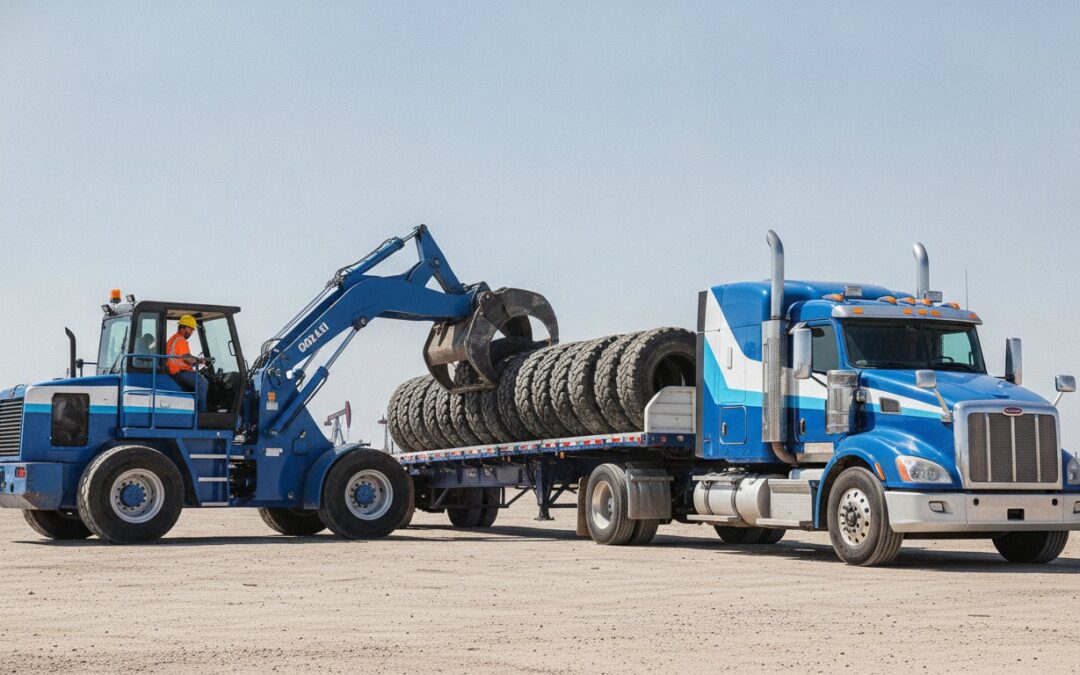
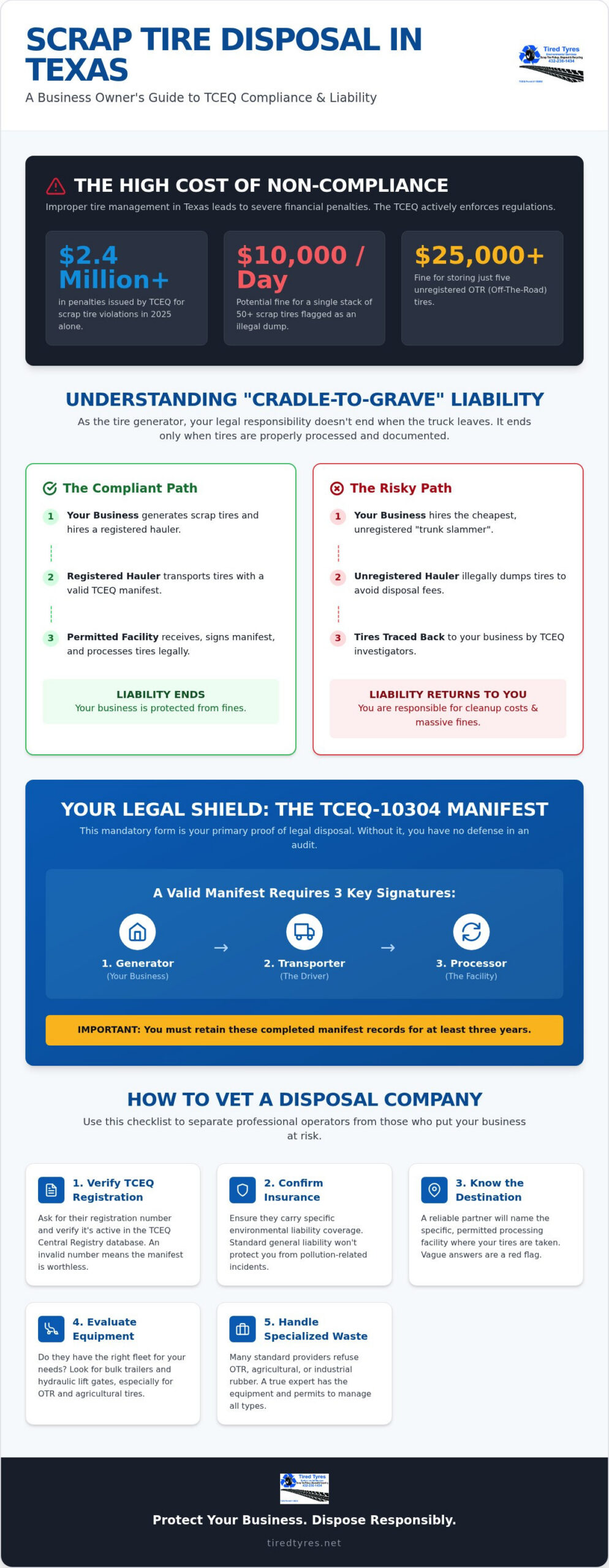
Did you know the Texas Commission on Environmental Quality (TCEQ) issued more than $2.4 million in penalties for improper scrap tire management in 2025 alone? For a West Texas business owner, a single stack of 50 scrap tires can be flagged as an illegal dump, triggering fines of $10,000 per day. This makes choosing a reliable commercial tire disposal company vital for protecting your business from massive regulatory exposure and environmental hazards.
We understand that managing industrial rubber is a constant headache. Between pests nesting in stockpiles and national providers failing to show up for scheduled pickups, the pressure to keep your site clean is immense. However, the biggest risk is the “cradle-to-grave” liability that stays with you even after the waste leaves your property. If your hauler doesn’t follow the law, the TCEQ will look to you for the cleanup costs and fines.
This 2026 guide will show you how to vet haulers for legal compliance and ensure every load is backed by a mandatory TCEQ-10304 manifest. We’ll cover specific requirements for OTR tires, explain how to avoid hidden fees for industrial rubber, and help you establish a predictable disposal schedule that keeps your Midland, Odessa, or Lubbock operations running smoothly and safely.
Key Takeaways
- Understand why “cradle-to-grave” liability means your business remains legally responsible for scrap rubber until it is fully processed and documented.
- Learn the five essential steps for choosing a reliable commercial tire disposal company, starting with the verification of active TCEQ hauler registration numbers.
- Identify the specialized equipment needed to safely manage OTR and agricultural tires that many standard providers refuse to collect.
- Discover the advantages of using local West Texas experts who understand Permian Basin regulations and offer more reliable pickup schedules than national firms.
- Get a checklist of the legally binding manifests and paperwork required to protect your business from massive state fines during an audit.
Understanding “Cradle-to-Grave” Liability for Texas Businesses
Texas law is clear: if you generate scrap rubber, you own it until it reaches a permitted processor. This is “cradle-to-grave” liability. It means your legal responsibility doesn’t end when a truck pulls away from your shop or job site. If a hauler dumps your tires in a West Texas canyon or abandoned lot, the TCEQ will trace those tires back to your business. You’ll be the one paying for the environmental cleanup and the state fines. This reality makes choosing a reliable commercial tire disposal company a matter of legal survival rather than just a routine maintenance task.
Understanding the entire tire recycling process helps you see why the state requires such strict documentation. Unpermitted haulers often offer lower prices because they skip registration fees and proper disposal costs. However, partnering with them is a massive gamble. Under the Texas Administrative Code, the generator is the primary responsible party. If your contractor disappears after an illegal dump, you’re left holding the bag for thousands in remediation costs and legal fees.
The Role of the TCEQ Scrap Tire Manifest
The TCEQ-10304 manifest is your primary legal defense. It’s a mandatory form that tracks the movement of scrap rubber from your site to a registered transporter and finally to an authorized disposal facility. When choosing a reliable commercial tire disposal company, you must verify they provide this document for every pickup. For a manifest to be valid, it requires a three-part signature process. You sign as the generator, the driver signs as the hauler, and the facility manager signs upon receipt. In 2026, West Texas businesses must retain these records for at least three years to stay prepared for an audit. Without these completed documents, you have no proof that you fulfilled your legal duty.
TCEQ Compliance and Potential Fines
The financial consequences of non-compliance are severe and immediate. In 2025, the TCEQ issued over $2.4 million in penalties for improper scrap tire management. Storing more than 500 scrap tires on the ground without a specific storage registration can trigger daily fines. For industrial operations in the Permian Basin, the stakes are even higher. Storing just five unregistered OTR tires can lead to fines exceeding $25,000. Local inspectors in Midland and Lubbock counties frequently conduct audits to ensure businesses aren’t bypassing the system. The TCEQ manifest is the only valid proof of legal disposal.
5 Criteria for Vetting a Commercial Tire Disposal Company
Vetting your hauler is the only way to satisfy the legal duty discussed earlier. Many businesses prioritize the lowest price, but a cheap quote often signals a provider that cuts corners on compliance or equipment. When choosing a reliable commercial tire disposal company, you need a checklist that separates professional operators from “trunk slammers” who risk your business’s reputation.
Verifying Registration and Insurance
The first step is checking the hauler’s active status in the TCEQ Central Registry database. Every legitimate transporter must have a current registration number. Don’t take their word for it; ask for their number and verify it yourself. If they aren’t registered, any manifest they sign is legally worthless. You should also look closely at their insurance policy. Standard general liability insurance rarely covers environmental accidents or pollution. A professional company carries specific environmental liability coverage to protect you if a fire or spill occurs during transport. Ask where the tires go after they leave your site. A reliable partner will name a specific, permitted processing facility rather than giving vague answers about “recycling centers.”
Evaluating Equipment and Manpower
A hauler’s fleet must match your site’s specific waste volume. If you manage a high-volume semi-truck tire shop in Odessa, a provider with only a small utility trailer will cause constant scheduling delays. Look for companies that utilize bulk trailers or trucks equipped with hydraulic lift gates. These tools aren’t just for efficiency; they are essential for safety. Choosing a reliable commercial tire disposal company means finding a team that can handle heavy OTR and agricultural tires without damaging your property or risking on-site injuries. Professional crews follow strict loading protocols, ensuring that scrap piles are cleared quickly and without leaving debris behind. If you need a partner that meets these high standards, consider reaching out for a professional scrap rubber collection quote.
Transparency in pricing is another vital marker of a professional. Some providers quote a low per-tire rate but add hidden surcharges for “non-standard” items like steel-reinforced tracks or oversized agricultural tires. A trustworthy company provides a clear fee schedule upfront. Finally, assess their communication. In the Permian Basin, where industrial schedules change fast, you need a hauler that answers the phone and sticks to a predictable pickup window. If a provider is hard to reach during the sales process, they’ll be impossible to find when your tire pile is attracting pests or creating a fire hazard.
Handling Specialized Waste: OTR, Agricultural, and Industrial Rubber
Standard haulers often refuse OTR or agricultural tires because their equipment can’t handle the physical load. These items are bulky, heavy, and difficult to stack. When choosing a reliable commercial tire disposal company, you must ensure they have the specialized machinery required for these non-standard loads. Leaving these items to sit on your property isn’t just an eyesore; it’s a liability. Large rubber piles trap heat and water, creating severe fire hazards and breeding grounds for West Texas pests.
A single-source provider for all rubber waste streamlines your operations. You won’t have to manage three different vendors for your passenger tires, OTR equipment, and scrap conveyor belts. Choosing a reliable commercial tire disposal company that handles the full spectrum of industrial rubber ensures your entire site remains compliant and clear of hazards. This holistic approach saves time and reduces the risk of a TCEQ inspector finding undocumented rubber waste tucked away in a corner of your yard.
OTR and Heavy Equipment Tire Disposal
Moving tires that weigh over 1,000 pounds requires more than just a strong back. In the Permian Basin, oil field and construction operations generate massive OTR waste that standard trucks simply cannot transport safely. These tires require specific recycling paths because they can’t be processed by typical passenger tire shredders. Agricultural tire collection also carries unique cost factors due to the soil and debris often embedded in the tread. A professional provider accounts for these variables during the initial quote, preventing surprise fees at the time of pickup.
Industrial Rubber: Tracks, Hoses, and Belts
Many businesses don’t realize that scrap skid steer tracks and conveyor belts are subject to the same strict disposal rules as traditional tires. Because these items are often reinforced with high-tensile steel cables, they are incredibly difficult to cut or shred. Most local landfills won’t accept them in their whole state. This is why effective commercial tire disposal must extend to all forms of industrial rubber waste. Proper management includes:
- Scrap Skid Steer Tracks: Documenting the removal of steel-reinforced tracks on a TCEQ manifest.
- Conveyor Belts: Coordinating bulk transport for long-form rubber waste from industrial sites.
- Scrap Hoses: Ensuring industrial hoses are bundled and processed according to environmental standards.
Managing these materials correctly protects you from the same “cradle-to-grave” risks associated with tires. If these industrial components are found illegally dumped, the lack of a manifest will lead investigators straight back to the generator.
National vs. Local Services in Midland, Odessa, and Lubbock
National waste management firms often treat the Permian Basin as a logistical afterthought. Their dispatch centers are frequently located in Dallas or Houston, leading to significant delays when you need a pickup in Midland or Odessa. When choosing a reliable commercial tire disposal company, proximity is your best defense against overflowing scrap piles. A local provider understands that a trip between Lubbock and Midland involves a two-hour drive across open highway. This regional awareness ensures that schedules are realistic and pickups actually happen as promised.
Local knowledge also extends to the specific rules of regional landfills and transfer stations. Every county in West Texas has different requirements for how scrap rubber must be prepared before it is accepted. A hauler based in the area knows these nuances, which prevents your waste from being rejected at the gate. This direct accountability is impossible to find with national providers who manage their West Texas clients through automated call centers and impersonal ticketing systems.
Logistical Advantages of Local Haulers
Operating in the Permian Basin requires more than just a truck; it requires an understanding of the region’s industrial rhythm. For oilfield sites in Odessa, this means knowing how to coordinate with gate security and handle the rugged terrain of a remote job site. In Lubbock, auto shops need predictable, recurring schedules that don’t disrupt their daily customer flow. Local haulers can pivot quickly when your volume suddenly increases. They don’t have to wait for approval from a corporate office hundreds of miles away to add an extra stop to their route.
The Problem with National Brokerage Models
Many national companies are actually brokers. They don’t own trucks or employ drivers in West Texas. Instead, they sell you a service and then sub-contract the work to the cheapest available local hauler. This model adds unnecessary costs without improving service quality. More importantly, it creates a massive compliance risk. If a broker hires an unpermitted sub-contractor, your “cradle-to-grave” liability is still active. If that sub-contractor dumps your tires illegally, you are the one the TCEQ will hold responsible.
These communication gaps become dangerous during emergency cleanups or when you are facing a looming state audit. When you work with a local expert, you have a direct line to the person responsible for your manifest. Supporting the West Texas regional economy also means your disposal fees stay within the community, helping maintain the infrastructure we all rely on. If you want to avoid the headache of national call centers, contact our West Texas tire collection team for direct, local service.
Streamlining Your Disposal with Tired Tyres
When choosing a reliable commercial tire disposal company, you need more than just a truck and a driver. You need a partner that understands the high-stakes regulatory environment of West Texas. Tired Tyres is built on a foundation of 100% TCEQ compliance, ensuring that every scrap tire or industrial rubber component we collect is handled with professional precision. We serve the heart of the Permian Basin, providing Midland, Odessa, and Lubbock businesses with a direct, local alternative to national brokerage models.
Our service covers the full spectrum of waste rubber. Whether you are managing a retail auto shop with passenger tires or a massive industrial site with OTR equipment and scrap conveyor belts, we have the specialized tools to clear your site. We don’t cherry-pick the easy loads. We provide comprehensive collection for agricultural tires, semi-truck tires, and even scrap skid steer tracks, ensuring your entire inventory of waste rubber is documented and removed according to state law.
Our Process: From Pickup to Manifest
We’ve designed our collection process to be as efficient as possible. It starts with a clear, transparent quote based on your specific volume and material types. Once on-site, our crew handles the heavy lifting, utilizing hydraulic equipment to load oversized OTR or agricultural tires safely. The most critical step happens before we leave your yard: the paperwork. We are an authorized TCEQ manifest provider. We generate the mandatory five-part TCEQ-10304 manifest on the spot, capturing the necessary signatures to transfer your liability immediately.
We take the burden of complex paperwork off your desk. By managing the tracking and documentation from start to finish, we ensure your business is always audit-ready. This commitment to reliable tire disposal is our core mission, protecting our West Texas neighbors from the risks of “cradle-to-grave” liability.
Custom Solutions for Industrial Clients
High-volume fleets and industrial operations require more than just a one-off pickup. We offer tailored scheduling to prevent scrap rubber from ever becoming a fire hazard or a pest magnet on your property. If you’ve inherited a site with existing stockpiles, we provide bulk remediation services to bring your property back into full compliance. Our team is experienced in navigating the rugged terrain of oilfield sites and the tight spaces of urban auto shops. Choosing a reliable commercial tire disposal company means finding a provider that adapts to your workflow. Contact us today for a tire pickup quote in Midland, Odessa, or Lubbock to see how we can simplify your scrap rubber management.
Protect Your West Texas Business with Proper Compliance
The “cradle-to-grave” liability established by the TCEQ means your business is only as secure as the hauler you hire. By choosing a reliable commercial tire disposal company that understands the unique logistics of the Permian Basin and South Plains, you eliminate the risk of surprise audits and massive fines. Remember that a completed manifest is your only valid defense if waste is ever found illegally dumped. Local expertise ensures your site stays clean, safe, and fully compliant with state regulations.
Tired Tyres operates as a dedicated TCEQ Permitted Hauler specializing in the specific needs of Midland, Odessa, and Lubbock. We don’t just handle passenger tires; we have the specialized equipment required for OTR and industrial rubber waste that many other providers reject. Don’t leave your regulatory standing to chance with national brokers or unpermitted haulers who might bypass critical paperwork requirements.
Get a Reliable Tire Disposal Quote for Your Business today. We’ll handle the heavy lifting and the manifest documentation so you can focus on running your operation with complete peace of mind. Keeping West Texas clean and your business protected is a goal we can achieve together.
Frequently Asked Questions
Is it illegal to store scrap tires on my commercial property in Texas?
Storing scrap tires on your property is illegal if you exceed specific state thresholds. According to TCEQ regulations, you cannot store more than 500 scrap tires on the ground or 2,000 in trailers without a formal scrap tire storage registration. Exceeding these limits without the proper permits can result in fines of $10,000 per day. Maintaining a clean site is also vital for preventing fire hazards and pest infestations in the West Texas heat.
What is a TCEQ scrap tire manifest and why do I need one?
A TCEQ scrap tire manifest is a mandatory five-part document used to track scrap rubber from the generator to the disposal site. You need one because it acts as your primary legal defense during an audit. Under Texas “cradle-to-grave” laws, you’re responsible for the tires until they reach a permitted processor. Without a signed manifest, you remain liable for any illegal dumping committed by a hauler after they leave your property.
Can I take commercial tires to the Midland or Odessa landfills?
You cannot take whole commercial tires to the Midland or Odessa landfills because they’re banned from landfill disposal in Texas. State law requires that scrap tires be shredded, split, or quartered before they can be accepted at a permitted facility. Most municipal landfills in the Permian Basin lack the equipment to process large OTR or agricultural tires. This is why choosing a reliable commercial tire disposal company with specialized processing capabilities is necessary.
How much does commercial tire disposal typically cost in West Texas?
Disposal costs depend on the tire size, the material type, and the total volume of the load. Standard passenger tires usually have a fixed per-unit rate, while oversized OTR or agricultural tires are often priced by weight or a combination of flat fees. Industrial rubber items like conveyor belts require custom quotes due to their steel reinforcement. Contact our Permian Basin specialists for a transparent, volume-based estimate that reflects current 2026 regional processing rates.
Do you dispose of skid steer tracks and industrial hoses?
Yes, we provide professional collection for scrap skid steer tracks, industrial hoses, and conveyor belts. These materials are regulated as scrap rubber waste by the TCEQ and require the same manifest documentation as standard tires. Because they often contain high-tensile steel cables, they’re difficult for many providers to process. We use specialized equipment to handle these heavy industrial materials, ensuring they’re disposed of legally and efficiently at an authorized West Texas facility.
How do I verify if a tire hauler is properly permitted?
You can verify a hauler’s permit by searching the TCEQ Central Registry database for their active transporter registration number. A legitimate provider will also carry specific environmental liability insurance, which covers risks that standard general liability policies exclude. When choosing a reliable commercial tire disposal company, you should always ask for their current permit number and proof of insurance before allowing them to load any rubber waste from your Midland or Lubbock location.
What happens if I use an unpermitted hauler and they dump the tires?
If an unpermitted hauler dumps your tires illegally, you’ll be held legally and financially responsible for the entire cleanup cost and state fines. Texas law places the primary burden of “cradle-to-grave” liability on the generator of the waste. If investigators find your tires in a field, they’ll trace them back to your business. Without a valid TCEQ manifest from a registered hauler, you have no legal way to prove that you fulfilled your duty.
Does Tired Tyres provide OTR tire collection for oilfield sites?
Yes, Tired Tyres provides specialized OTR tire collection for oilfield and construction sites throughout Midland, Odessa, and Lubbock. Our fleet utilizes the hydraulic tools necessary to move heavy-duty equipment tires that many standard haulers simply cannot manage. We provide full-service collection and all required TCEQ paperwork for every load, ensuring your remote sites remain clear of fire hazards and in total compliance with current Texas environmental laws and storage limits.