
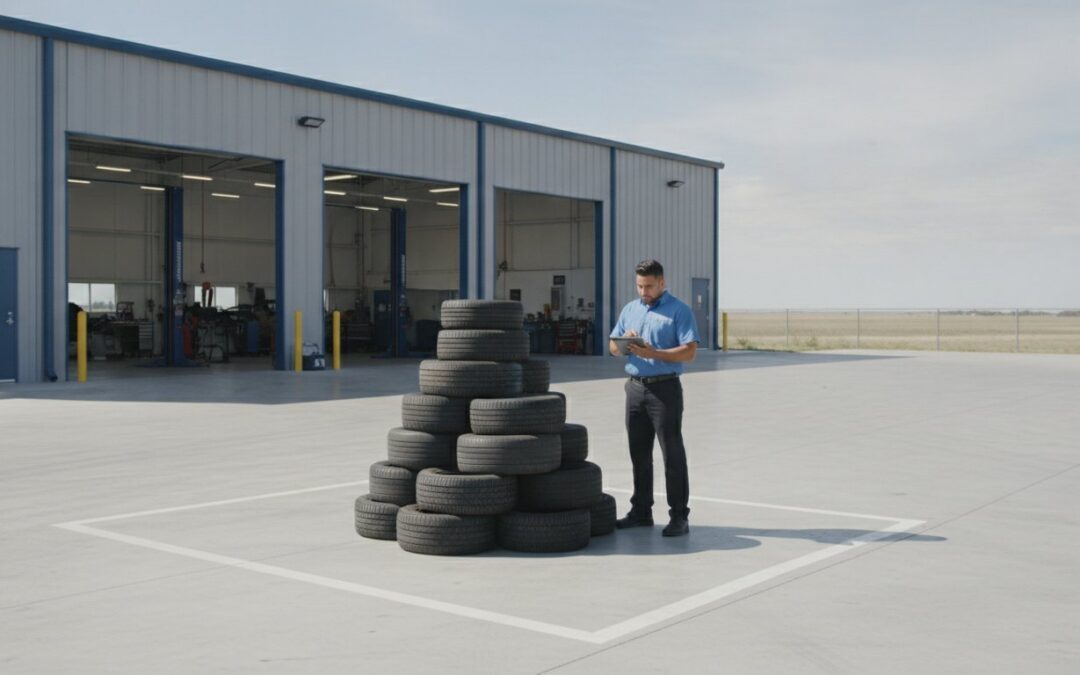
For a commercial business in West Texas, dumping just 200 pounds of scrap tires isn’t just a mess; it’s a felony offense. It’s a harsh reality that many shop owners face when their storage space disappears under a mountain of rubber. Managing tire disposal for auto repair shops often feels like a losing battle against accumulating piles and unreliable haulers who don’t show up on time. You want a clean yard and total compliance with the Texas Commission on Environmental Quality, but the paperwork is complex and the logistics are difficult.
We understand that your focus should stay on the vehicles in your bays, not the scrap in your yard. This guide will help you master the logistics and legal requirements of scrap tire management to keep your West Texas auto shop compliant and efficient. You’ll learn about the mandatory five-part manifest system, the new 2026 operational status report deadline on December 31, and how to establish a recurring pickup schedule. We’ll break down the storage limits and the documentation you must keep for three years to protect your business from liability.
Key Takeaways
- Learn how to navigate the latest TCEQ requirements, including the mandatory five-part manifest system and the 2026 annual reporting deadlines.
- Discover how to optimize tire disposal for auto repair shops by implementing a dedicated “Tire Zone” to reclaim valuable floor space.
- Identify the most efficient service level for your volume, ranging from recurring weekly pickups to trailer spotting for high-capacity fleet centers.
- Understand your legal responsibilities as a “Generator” to protect your business from the severe penalties associated with improper waste handling.
- Explore specialized collection solutions for OTR and agricultural tires designed specifically for the unique demands of West Texas industries.
Challenges of Scrap Tire Management for West Texas Auto Repair Shops
In the Permian Basin, high-volume shops can generate hundreds of scrap tires in a single month. This rapid accumulation quickly turns a manageable workspace into a cluttered hazard. Effective tire disposal for auto repair shops isn’t just about cleaning up; it’s a critical operational necessity. When standard municipal services in cities like Midland and Lubbock refuse to pick up bulk rubber, shop owners are left with growing piles that consume valuable real estate. These unmanaged stacks represent more than just an eyesore. They are hidden costs that impact your bottom line through reduced efficiency and increased liability.
The Impact on Shop Operations and Safety
A cluttered yard directly restricts technician movement and slows down vehicle flow. Every minute spent maneuvering around a tire pile is a minute lost on a billable repair. Beyond logistics, these piles create significant health and safety risks. Stagnant water trapped inside tires provides the perfect habitat for mosquitoes, which is a major concern for West Texas businesses. It’s a preventable nuisance that can quickly escalate into a public health issue for your team and neighbors.
Fire safety is perhaps the most pressing issue. In our dry West Texas climate, a tire fire is nearly impossible to extinguish once it starts. Fire departments in Odessa and Midland maintain strict oversight on how scrap rubber is stored because of the intense heat and toxic smoke these fires produce. Understanding the Tire recycling process helps shop owners realize why proper storage and quick removal are non-negotiable for a safe environment. Properly managed scrap keeps your shop in the good graces of local inspectors and protects your infrastructure.
Local Landfill Restrictions and Commercial Rejection
You can’t simply load up a truck and head to the local dump. Most landfills in West Texas have stringent rules regarding “Special Waste.” They often require tires to be quartered or shredded before they’ll even consider accepting them. Self-hauling bulk tires to regional facilities is a logistical nightmare. It drains your staff’s time and your shop’s fuel budget while providing no guarantee of acceptance at the gate.
Municipal waste services are designed for residential use, not industrial volume. If your shop generates more than 50 tires monthly, you’ve likely already hit the limit of what local services will tolerate. Commercial accounts are necessary for shops that prioritize a clean, professional appearance. Relying on a specialized partner ensures that your scrap is handled legally while you focus on serving your customers. Efficient tire disposal for auto repair shops requires a system that keeps pace with your growth rather than acting as a bottleneck for your daily operations.
Understanding TCEQ Compliance and the Scrap Tire Manifest System
The Texas Commission on Environmental Quality (TCEQ) oversees all tire disposal for auto repair shops to prevent illegal dumping and environmental hazards. In the eyes of the state, your shop is a “Generator.” This designation carries heavy legal weight. Texas operates under a “cradle-to-grave” liability model. This means your responsibility for a tire doesn’t end when it’s loaded onto a truck. You’re liable until that tire reaches an authorized processing facility. If an unpermitted hauler dumps your scrap in a Lubbock County field, the TCEQ can hold you accountable for the cleanup and legal fines.
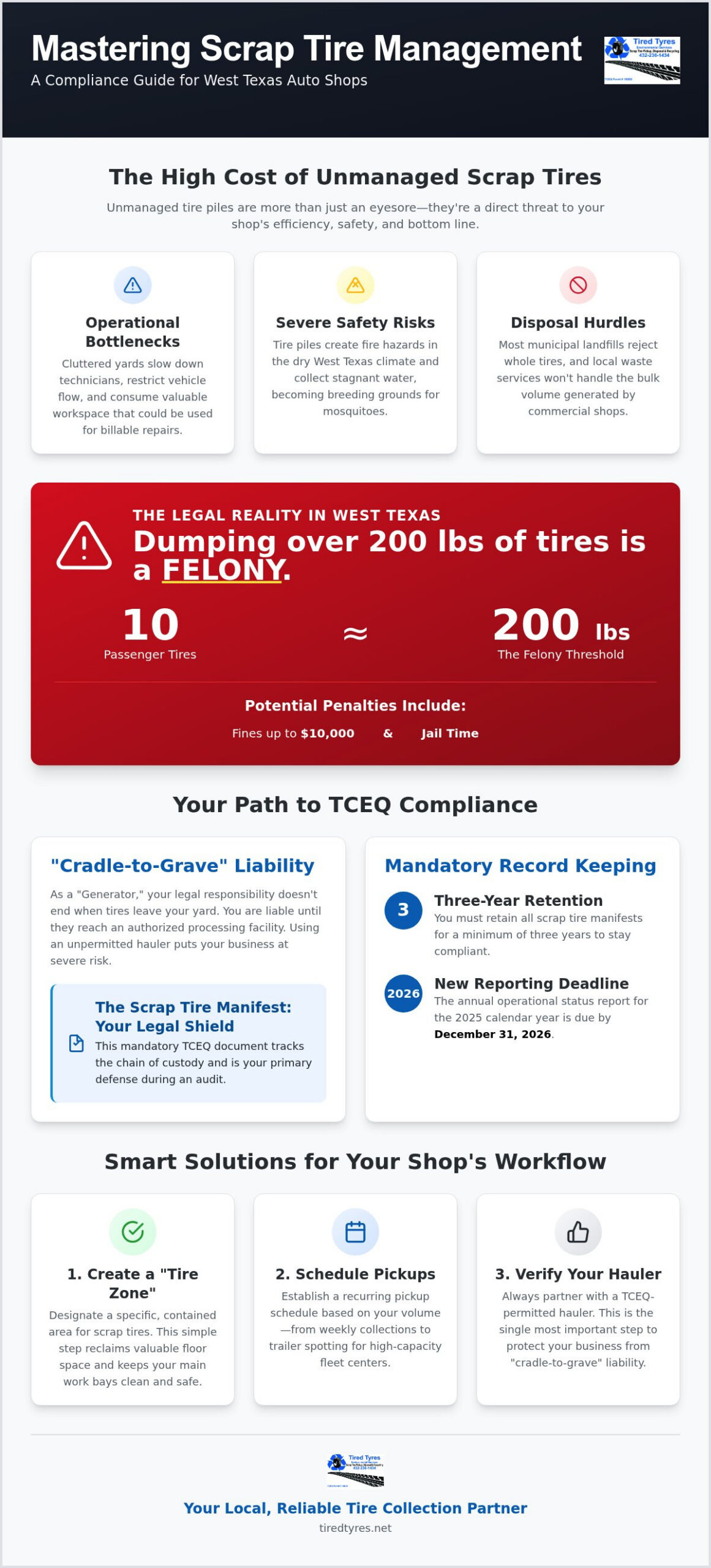
Commercial felony charges apply to any business dumping more than 200 pounds of tires. With a single passenger tire weighing about 20 pounds, it only takes ten tires to cross into felony territory. These penalties can include fines up to $10,000 and jail time. Staying compliant isn’t just about being a good neighbor; it’s about protecting your business license and your freedom. It’s vital to maintain a clear trail of where your waste goes.
The Scrap Tire Manifest: Your Legal Shield
The Texas scrap tire manifest is the mandatory tracking document for all commercial tire movements. This document creates a clear chain of custody that protects you during an audit. Every manifest must include your Generator ID, the hauler’s permit number, and the final destination’s information. For 2026, the TCEQ requires you to retain these manifests for three years. While many shops still use the traditional five-part paper forms, electronic manifest retention is increasingly encouraged to simplify the 2026 annual operational status report. This report is due by December 31, 2026, for the 2025 calendar year.
Verifying Your Hauler’s TCEQ Permit
Never take a hauler’s word for granted. You can verify any hauler’s status through the TCEQ’s central registry database. A common red flag is a hauler offering “free” or extremely cheap pickups. Proper disposal at a permitted facility costs money; if a hauler isn’t charging you, they’re likely cutting corners on the back end. For a deeper look at these requirements, read our guide on Texas tire disposal regulations. Working with a TCEQ-permitted hauler ensures your manifests are always accurate and your shop stays within the law.
Evaluating Tire Disposal Services: Scheduled Pickups vs. Bulk Removal
Every shop has a tipping point where ad-hoc pickups no longer make sense. Choosing the right frequency for tire disposal for auto repair shops depends on your monthly churn and available storage. If you’re processing 100 or more tires a month, waiting for a bulk cleanup isn’t practical. A weekly or bi-weekly schedule keeps your inventory moving and your yard clear. For high-volume fleet and truck centers in Midland and Odessa, trailer spotting is the most efficient choice. We drop a trailer at your site; you load it as you go, and we swap it out when it’s full. This eliminates double-handling and keeps scrap rubber entirely out of sight.
One-time bulk pickups are better suited for specific scenarios like shop acquisitions or site remediation. If you’ve just taken over a location with a legacy “tire graveyard,” an intensive cleanup is the first step toward TCEQ compliance. While one-time cleanups involve a larger single logistics effort, recurring service plans offer more predictable operational expenses. They also ensure you never exceed the storage limits of 500 tires on the ground, which is a common trigger for regulatory audits.
Specialized Services for Heavy Equipment Shops
Oil field service providers in the Permian Basin deal with more than just passenger tires. Managing OTR (Off-the-Road) tire disposal requires specialized equipment that standard haulers simply don’t have. These massive tires, along with agricultural tires from South Plains implement dealers, can’t be handled by hand. You need a partner with the cranes and heavy-duty trailers required to move these loads safely. Using a hauler equipped for OTR and semi-truck tires prevents damage to your yard and ensures the job gets done in one visit.
Beyond Tires: Handling Skid Steer Tracks and Hoses
A truly efficient waste management plan covers more than just rubber circles. Many West Texas shops also generate significant amounts of scrap skid steer tracks and hydraulic hoses. Consolidating your rubber waste with a single partner saves time and reduces the number of manifests you have to manage. We collect scrap conveyor belts, solid tires, and industrial hoses alongside our standard tire pickups. Choosing a single-source partner for all commercial tire disposal needs simplifies your 2026 annual reporting. It ensures every piece of industrial rubber leaving your facility is accounted for by a permitted professional.
How to Optimize Your Shop’s Tire Recycling Workflow
Efficiency inside the shop is just as important as the work happening under the hood. Implementing a professional system for tire disposal for auto repair shops requires more than just calling a hauler when the pile gets too high. It starts with a dedicated “Tire Zone.” By designating a specific area for scrap rubber, you keep your service bays clear and prevent technicians from tripping over waste. This zone should be easily accessible for your team but tucked away from customer view to maintain a professional shop appearance.
Staff training is the next step in optimization. Most shops simply toss tires into a heap, but this wastes valuable space. Train your team on proper stacking techniques, such as lacing. Lacing involves stacking tires at an angle so they nest into one another. This method can nearly double your storage capacity within the same footprint. Additionally, consider these workflow adjustments:
- Sort as you go: Separate passenger tires from semi-truck or OTR units immediately to speed up the loading process.
- Timing matters: Schedule your pickups during low-traffic windows, like mid-afternoon, to ensure the collection truck doesn’t block customer access to your bays.
- Dry storage: Keep tires covered or stacked to prevent water accumulation, which is a key TCEQ requirement for pest control.
Site Preparation and Accessibility
Heavy-duty collection trucks require significant space to maneuver, especially in the tight quarters of some Midland or Odessa industrial parks. Ensure the path to your tire pile is clear of customer vehicles, delivery vans, and loose equipment. We recommend maintaining at least 15 feet of vertical clearance for our trucks to operate safely. Safety protocols are also vital. Never store scrap rubber near welding stations, torch areas, or flammable chemicals. In the dry West Texas climate, a single spark can ignite a tire fire that is incredibly difficult to extinguish. Clear signage around your Tire Zone can help remind staff of these safety boundaries.
Financial Management of Tire Waste
Professional tire disposal for auto repair shops is a necessary overhead expense, but it shouldn’t drain your profits. Most successful shops in the Permian Basin pass this cost through to the consumer. Include a “Tire Disposal Fee” as a transparent line item on every invoice. According to 2026 industry standards in Texas, these fees typically range from $3 to $8 per tire depending on the size. This fee covers the cost of a TCEQ-permitted hauler and ensures you aren’t paying for waste management out of your labor margins.
Keep your disposal receipts and manifests organized in a dedicated file. These documents are essential for both tax deductions and state compliance audits. The long-term ROI of a clean, organized shop is significant. It improves employee morale, reduces the risk of workplace injuries, and projects a sense of order to your clients. If you’re ready to reclaim your shop floor, contact Tired Tyres to set up a recurring pickup schedule.
Partnering with Tired Tyres for Local, Reliable Tire Collection
Tired Tyres isn’t a national waste conglomerate with a distant call center. We’re a local team with deep roots in Midland, Odessa, and Lubbock. We understand the specific logistics of the Permian Basin and the South Plains. National companies often struggle with the vast distances and specialized equipment needs of West Texas shops. We focus on providing a direct, reliable solution for tire disposal for auto repair shops that value professionalism and punctuality. Our commitment to 100% legal disposal means you never have to worry about the accuracy of your TCEQ manifests or the final destination of your waste.
Local expertise matters when you’re dealing with the unique demands of our region. We’ve seen how quickly a shop can be overwhelmed by the rapid pace of the oil and gas industry or the seasonal shifts in agricultural work. Our customized pickup plans are designed to scale with your business. We don’t force you into a rigid schedule that doesn’t fit your actual needs. Instead, we offer the flexibility and accountability that only a local partner can provide.
Local Service for Midland, Odessa, and Lubbock
Being local allows us to offer faster response times for job site cleanups and emergency removals. If you’ve acquired a new property with an existing tire pile or have an unexpected surge in scrap inventory, we’re nearby and ready to help. Supporting a local business also keeps your dollars within the West Texas economy. We’ve built strong environmental partnerships across the region to ensure every tire we collect is processed according to state standards. For more details on our specific service areas, view our guide to Reliable Tire Disposal in Midland, Odessa & Lubbock.
Get Started with a Custom Pickup Quote
Setting up your first manifest-compliant pickup is a straightforward process. We don’t believe in one-size-fits-all contracts. Instead, we create customized plans tailored to your specific volume and tire types. To get started, we’ll need a few basic details:
- The types of tires you generate (passenger, semi-truck, or OTR units)
- Your estimated monthly volume or the current size of your stockpile
- Your shop’s exact location and accessibility for heavy-duty trucks
Our team will review this information to provide a transparent quote that reflects your actual needs. Once you approve the plan, we’ll handle the logistics of the first collection. We’ll walk your staff through the manifest process to ensure everything is documented correctly from day one. Whether you’re a small independent shop in Lubbock or a large fleet center in Odessa, we provide the same level of precision and care. Contact our local team today for a consultation in the South Plains. We’ll help you turn your tire disposal for auto repair shops into a streamlined, compliant workflow.
Reclaiming Your Shop Floor and Staying Compliant
Managing tire disposal for auto repair shops shouldn’t be a source of constant stress or legal risk. By implementing a dedicated Tire Zone and training your team on efficient stacking, you can maximize your available space and improve your daily workflow. Remember that the “cradle-to-grave” liability model means your documentation must be flawless; keeping your manifests for the required three years is your best defense during a TCEQ audit. Whether you’re handling passenger tires or massive OTR units, having a consistent plan in place ensures your shop remains professional and productive.
Tired Tyres is a TCEQ Permitted Hauler serving Midland, Odessa, and Lubbock with full manifest compliance guaranteed. We take the burden of waste management off your shoulders so you can focus on the vehicles in your bays. Get a reliable tire disposal quote for your West Texas shop today and experience the difference of a local partner who understands Permian Basin logistics. You’ve built a great business; don’t let scrap rubber piles slow your growth.
Frequently Asked Questions
Does my auto shop need a special permit to store scrap tires in Texas?
You don’t need a specific storage permit as long as you stay under the TCEQ threshold of 500 scrap tires on the ground or 2,000 in trailers. However, as a generator, you’re responsible for maintaining a clean site and ensuring all rubber waste is handled by a permitted hauler. Exceeding these limits can trigger the need for a scrap tire facility registration and more frequent state inspections.
How much does it cost for a commercial tire pickup in Odessa?
Pricing for tire disposal for auto repair shops in Odessa depends on your specific volume and the types of tires being collected. Factors like the size of the load, frequency of the schedule, and the mix of passenger versus commercial tires all influence the final rate. We provide customized quotes based on your shop’s unique needs to ensure you get a cost-effective solution for your recurring pickups.
Can I include skid steer tracks in my regular tire pickup?
Yes, we specialize in comprehensive rubber waste management and can include skid steer tracks in your regular collection. Many West Texas shops generate a mix of tire types and industrial rubber waste. Consolidating your skid steer tracks, hoses, and conveyor belts into a single pickup schedule simplifies your logistics and reduces the number of manifests your staff needs to manage each month.
What is the TCEQ manifest retention period for auto repair shops?
You must retain all scrap tire manifests for a period of three years from the date of the tire transfer. This requirement applies to both paper and electronic records. These documents serve as your legal proof of proper disposal during state audits. Keeping your files organized is essential for the 2026 annual operational status report due by December 31 for the 2025 calendar year.
Do you provide scheduled weekly pickups for shops in Lubbock?
We provide scheduled weekly and bi-weekly pickups for auto repair shops throughout the Lubbock area. Establishing a recurring schedule is the best way to prevent tire piles from taking up valuable shop space. Our team works with you to determine the best pickup frequency based on your monthly tire churn and available storage, ensuring your yard remains clean and organized.
Can you handle large OTR tires from oil field equipment?
We have the specialized equipment required to handle large OTR (Off-the-Road) tires common in oil field and industrial operations. These massive units require cranes and heavy-duty trailers for safe removal, which standard waste haulers often lack. Whether you’re an oil field service provider in Midland or a heavy equipment dealer in Odessa, we can manage these high-volume disposal challenges efficiently.
What happens to the tires after they leave my shop?
After we collect your scrap rubber, it’s transported to authorized facilities for recycling or energy recovery. The cradle-to-grave liability model means we ensure every tire reaches a permitted destination. This process often involves shredding the rubber for use in civil engineering projects, tire-derived fuel, or other recycled products, keeping your shop in full compliance with Texas environmental regulations.
Is it legal to give scrap tires away to customers for personal use?
Giving scrap tires away is risky because you remain legally responsible for their final disposition under the cradle-to-grave model. If those tires are eventually dumped illegally, the TCEQ can trace them back to your shop. It’s much safer to use a permitted hauler who provides a manifest, proving the tires reached a legal recycling facility and protecting your business from potential liability.