
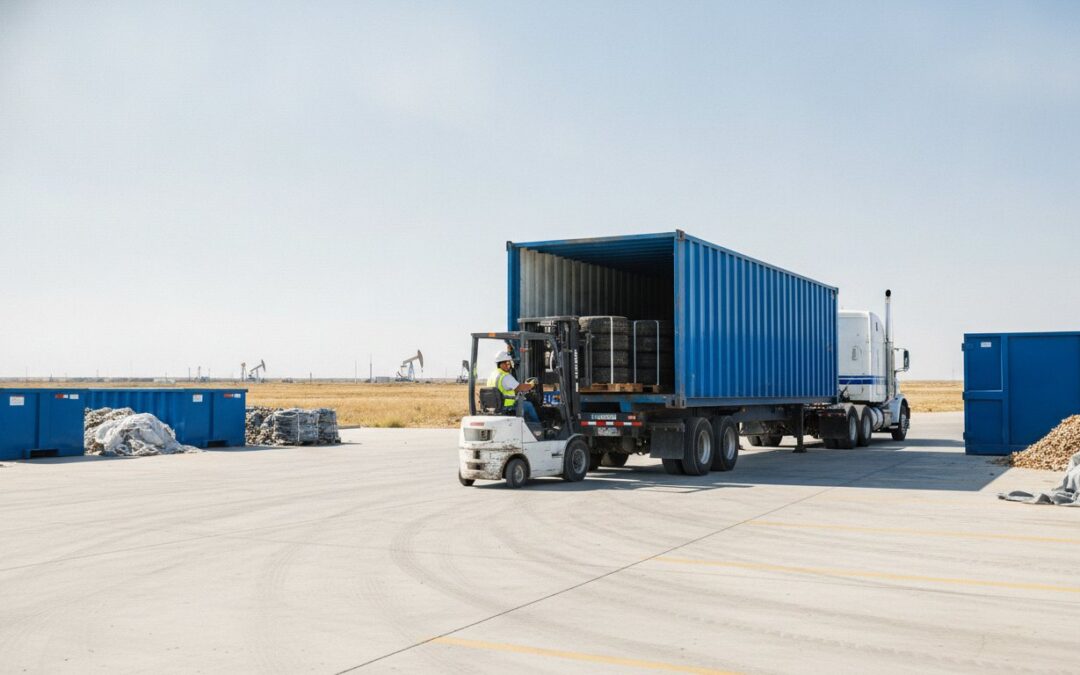
In the Permian Basin, the most expensive way to handle your waste isn’t paying for a pickup; it’s paying for a pickup you didn’t actually need or waiting so long that you’ve slipped out of TCEQ compliance. You’ve likely felt the frustration of watching a scrap pile grow into a fire hazard or a breeding ground for pests while trying to figure out if your current schedule makes financial sense. It’s a common struggle for businesses in Midland and Odessa to keep up with fluctuating waste volumes without overspending on logistics.
This guide focuses on optimizing your scrap rubber collection frequency to help you balance operational costs with strict safety thresholds and space constraints. You’ll learn how to find the perfect pickup rhythm that keeps your facility clean and your budget predictable. We’ll examine the specific storage limits for 2026, the realities of “cradle-to-grave” liability, and how to manage manifest requirements for everything from OTR tires to industrial conveyor belts. By the end, you’ll have a clear strategy for maintaining a compliant, efficient facility without the constant headache of overflowing rubber waste.
Key Takeaways
- Understand the 2026 TCEQ storage limits to ensure your facility avoids penalties and remains manifest-compliant.
- Discover how optimizing your scrap rubber collection frequency reduces fire hazards and pest risks while keeping waste management costs predictable.
- Compare the financial impact of scheduled routing versus on-call pickups to determine which model best supports your bottom line.
- Follow a practical two-step audit process to accurately track your waste generation and reclaim valuable operational space.
- Learn how to tailor collection rhythms for specialized industrial materials, including OTR tires, conveyor belts, and scrap hoses.
Why Collection Frequency is the Key to Efficient Waste Management
Efficient waste management isn’t just about getting rid of junk. It’s about precision. Optimizing your scrap rubber collection frequency ensures your yard stays clear without draining your budget. Unlike standard municipal trash, rubber waste is dense, bulky, and heavily regulated. It requires a specific logic because it doesn’t decompose or compact easily. If your pickup schedule is too slow, you risk safety; if it’s too fast, you pay for empty air in a truck.
In West Texas, the logistics are vast. Random pickups increase fuel consumption and emissions. A planned route allows for a smaller carbon footprint by ensuring trucks move with maximum efficiency through cities like Midland and Odessa. Financially, waiting for an emergency overflow often results in higher service fees. Service providers can offer more predictable rates when they can plan their routing in advance. Consistency is the foundation of a professional waste strategy.
The Hidden Costs of Infrequent Pickups
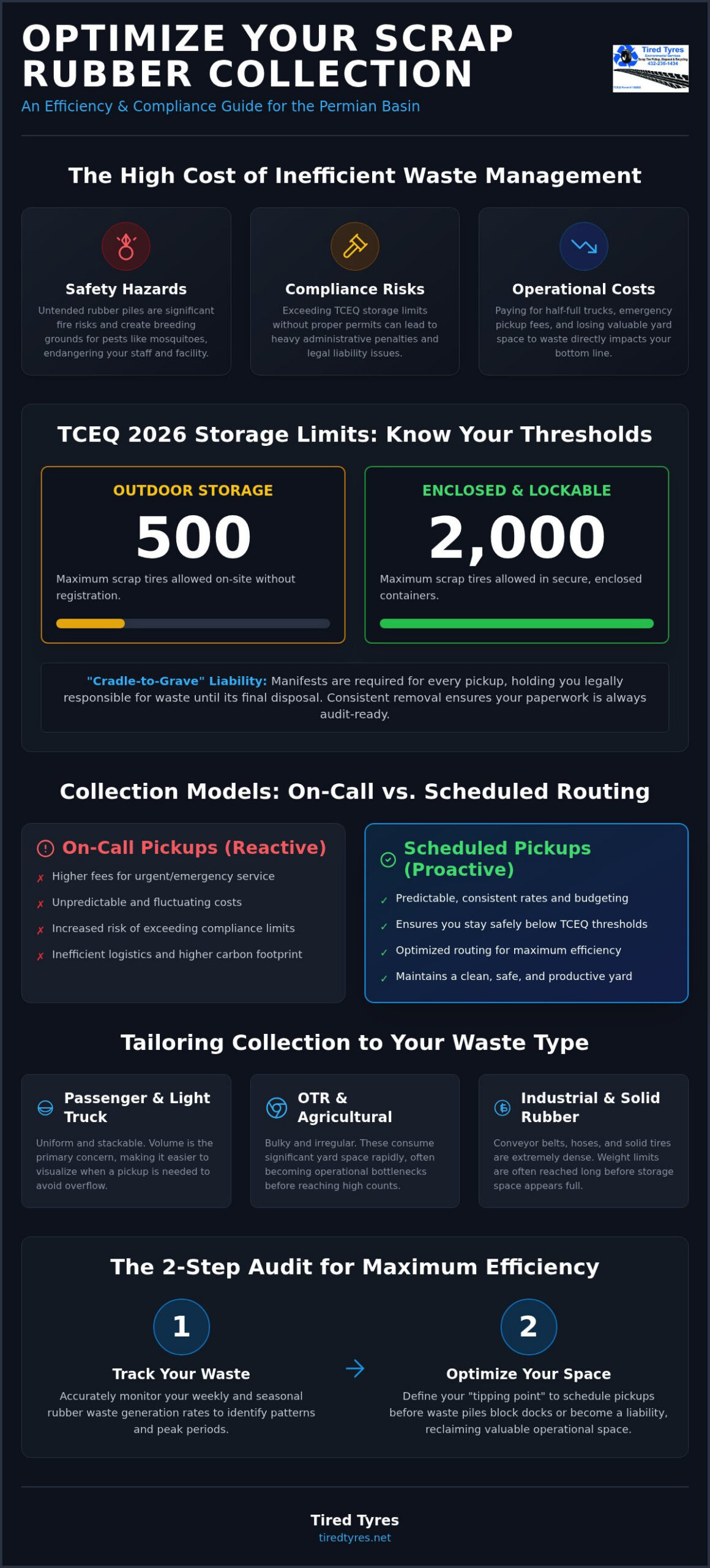
Texas heat is a major variable. Large rubber piles absorb thermal energy and create significant fire hazards during the summer months. Once a tire fire starts, it’s notoriously difficult to extinguish. Beyond fire risks, stagnant water inside tires is the perfect breeding ground for mosquitoes. This creates an unnecessary health risk for your staff. There’s also the operational bottleneck to consider. When OTR tires or semi-truck tire piles block loading docks, your daily workflow slows down. This yard space is better used for revenue-generating activities than for long-term waste storage.
Regulatory Compliance and Manifest Tracking
The TCEQ has clear rules for 2026. You can store up to 500 scrap tires on-site without a specific registration. If you use lockable, enclosed containers, that limit increases to 2,000 tires. Exceeding these numbers without proper permits leads to heavy administrative penalties. Consistent removal is the only way to stay safely below these thresholds. Every pickup must be documented with a manifest. This “cradle-to-grave” liability means you’re legally responsible for the waste until its final disposal. Understanding the Tire recycling process helps you see why these manifests are so critical for your legal protection. Optimizing your scrap rubber collection frequency ensures your paperwork is always current and ready for a potential state audit.
Determining Your Ideal Scrap Rubber Pickup Schedule
Finding the right cadence for your waste removal requires looking at your weekly output. Most West Texas businesses see a surge during specific seasonal cycles. For agricultural sectors, harvest and planting seasons increase the need for agricultural tire collection. In the Permian Basin, oilfield activity dictates the wear and tear on OTR and semi-truck tires. Optimizing your scrap rubber collection frequency means you aren’t paying for half-empty trucks during slow months or scrambling for emergency pickups when business peaks.
A truck is truly cost-effective when it reaches maximum load density. For passenger tires, this is easy to visualize. However, when you’re dealing with industrial rubber like scrap conveyor belts or hoses, the weight often hits the limit before the volume does. If you’re involved in paving or infrastructure, you might find the guidelines for using scrap tires in construction helpful for understanding how these materials are eventually repurposed. This information can influence how you sort and stage your materials for pickup.
Material Type and Volume Constraints
Different materials demand different storage logic. Passenger and light truck tires are uniform and stackable. OTR and agricultural tires are bulky and irregular, consuming yard space rapidly. If your business generates scrap solid tires or skid steer tracks, remember that these are significantly heavier than pneumatic tires. They don’t compress. This lack of “give” means your storage footprint fills up faster in terms of weight. You’ll often reach the structural limits of your storage containers or the weight limits of collection vehicles before the space looks full.
Storage Capacity and Site Safety
Your “tipping point” is the moment your storage becomes a liability. If you store tires outdoors in Midland or Odessa, you’re capped at 500 units by the TCEQ before registration is required. Indoor storage allows for up to 2,000 units but competes with your inventory space. Optimizing your scrap rubber collection frequency involves keeping your loading docks clear so collection vehicles can maneuver safely. If a driver can’t back in easily due to an overflow, the delay adds to your operational costs. You can schedule a site assessment to determine the exact volume your facility can safely handle before it impacts your daily workflow.
On-Call vs. Scheduled Collection: Which Saves More?
Choosing between a set calendar and an as-needed request is a major financial decision. For most high-volume sites in West Texas, a recurring schedule is the standard. It typically reduces the per-unit cost because the service provider can integrate your facility into a pre-planned route. Optimizing your scrap rubber collection frequency through a schedule ensures you aren’t hit with “emergency” surcharges when your yard suddenly hits capacity. Predictability is your best tool for keeping waste management costs under control.
When a hauler can plan their path through Midland, Odessa, and Lubbock, they save on fuel and time. These savings are passed to you. On-call models are reactive. They often result in higher “trip fees” because a truck has to be diverted from its main route to reach you. If you’re managing a busy facility, the last thing you want is to realize your pile is a fire hazard on a Friday afternoon only to find that every truck in the Permian Basin is already booked.
The Benefits of Predictable Routing
A scheduled service removes the administrative burden from your team. You don’t have to monitor the pile daily or assign staff to make phone calls. It also provides better budget forecasting. You’ll know exactly what your waste disposal costs will be every month. In regions like the Permian Basin, being on a route means you get priority service. During peak agricultural or construction seasons, on-call customers often face longer wait times because trucks are already committed to their scheduled stops. Consistency ensures your facility stays clean and compliant without constant oversight.
When to Choose On-Call Service
On-call service isn’t always the wrong choice. It works well for low-volume shops with significant indoor storage space. If you only generate a handful of tires every few months, a monthly stop is a waste of money. On-call is also the smarter choice for specific industrial projects. Consider these scenarios:
- Industrial demolition or site remediation where rubber waste is a one-time event.
- Site cleanups where old stockpiles of conveyor belts or hoses are being cleared.
- Low-volume auto shops that stay well below the 500-tire TCEQ outdoor storage limit.
Before choosing on-call, evaluate the impact of the trip fee. Haulers have fixed costs for sending a truck to your site. If your load is small, that fee makes the cost-per-tire much higher. Optimizing your scrap rubber collection frequency might involve a hybrid approach. You could maintain a baseline schedule for passenger tires but use on-call requests for heavy OTR or agricultural tire collection. This flexibility keeps your daily operations smooth while managing large-scale waste responsibly.
How to Audit Your Rubber Waste for Maximum Efficiency
You can’t manage what you don’t measure. To stop overpaying for pickups, you need a clear picture of your facility’s output. A waste audit is a strategic tool for cost reduction that identifies exactly how much material your business produces over a set period. By taking the time to look at the numbers, you’ll find the data needed for optimizing your scrap rubber collection frequency without guessing.
Start by identifying internal bottlenecks. If your technicians have to walk across a massive yard to drop off a scrap skid steer track, they’ll likely pile waste in unauthorized areas. This creates clutter and safety risks. Check your collection bins daily. If they’re only 60% full on your scheduled pickup day, you’re paying for the hauler’s time rather than the volume of waste removed. Conversely, if they’re overflowing two days before the truck arrives, you’re risking fines and creating a mess.
Conducting a 30-Day Scrap Audit
The first step is tracking every piece of rubber waste for a full month. Use a simple log to record the date and the type of material. Categorize these into passenger tires, semi-truck tires, and specialized items like scrap hoses or conveyor belts. This 30-day window helps you identify peak days. For example, many West Texas shops see a spike in agricultural tire waste during the spring planting season or fall harvest. Once you see these patterns, you can adjust your service level to match your busiest weeks while scaling back during the quiet months.
Maximizing Load Density
How your team stages the waste directly affects your bottom line. If tires are thrown into a pile at random, they create large air pockets. This makes the load look bigger than it actually is, leading to premature pickup requests. Use proper stacking techniques like lacing or “barrel stacking” to fit more units into the same footprint. For industrial rubber, prepare the materials for transport. Coiling scrap hoses and cutting conveyor belts into manageable sections allows the collection vehicle to reach its weight capacity before it runs out of physical space.
High load density means fewer trips for the hauler and lower costs for your business. If you aren’t sure how to organize your waste for the best rates, you can request a professional waste audit to see where your facility can improve its efficiency. This small investment in organization ensures your waste management remains a background process rather than a daily operational headache.
Custom Collection Solutions for West Texas Industries
West Texas industries operate on different cycles. A high-volume tire shop in Midland has different needs than a drilling site in the Permian Basin or a cotton farm near Lubbock. Optimizing your scrap rubber collection frequency isn’t a one-size-fits-all process. It requires a nuanced understanding of how different materials, from passenger tires to OTR rubber, accumulate in our specific climate and regulatory environment.
In the Permian Basin, oilfield operations generate a mix of heavy-duty waste. This includes OTR (Off-the-Road) tires, scrap conveyor belts, and industrial hoses. These materials are bulky and difficult to transport without specialized equipment. Agricultural operations in the Lubbock area often deal with massive tractor tires that only need removal once or twice a year. By tailoring the rhythm of these pickups, businesses can maintain a clean site without paying for unnecessary truck rolls during off-peak months.
Local Compliance: TCEQ and West Texas Standards
Staying legal in Texas means more than just moving tires. You must navigate complex Texas tire disposal regulations to protect your business from “cradle-to-grave” liability. Local knowledge of Midland and Odessa landfill rules is essential because specific regional ordinances can be stricter than state minimums. If a hauler dumps your waste illegally, the TCEQ holds you responsible. We ensure every load is manifest-compliant and headed to a permitted facility, providing you with the documentation needed for your annual reports.
Partnering with Tired Tyres for Optimization
We take a data-driven approach to reliable tire disposal. Instead of guessing, we use your 30-day audit data to build a custom pickup schedule that mirrors your actual generation rates. This precision is especially important for commercial tire disposal where volumes can fluctuate based on project timelines or seasonal demand. Optimizing your scrap rubber collection frequency with a local expert means your facility stays clear, your costs stay low, and your compliance is never in question. Contact us today to refine your waste management strategy and reclaim your yard space.
Reclaim Your Yard and Budget in 2026
Managing rubber waste doesn’t have to be a source of constant stress for your business. By optimizing your scrap rubber collection frequency, you move from reactive cleanup to a proactive, cost-saving strategy. We’ve explored how a 30-day audit and a clear understanding of load density can transform your facility’s efficiency. Staying ahead of TCEQ storage limits while keeping your yard clear of fire hazards isn’t just about safety; it’s about making your daily operations smoother and more predictable.
You don’t have to navigate these complex logistics alone. As a locally owned and operated partner in West Texas, we provide the specialized OTR and industrial rubber equipment needed for even the heaviest loads. We take the burden of TCEQ compliant manifesting off your shoulders so you can focus on your core business. Request a Tailored Collection Audit from Tired Tyres today to find the perfect pickup rhythm for your specific needs. A cleaner, more compliant facility is well within reach for your Permian Basin operations.
Frequently Asked Questions
How many scrap tires can I legally store in Texas without a permit?
You can legally store up to 500 scrap tires on your property without a TCEQ registration. If you use enclosed and lockable containers, this limit increases to 2,000 tires. Exceeding these specific thresholds requires you to register as a scrap tire storage site. Maintaining a steady flow and optimizing your scrap rubber collection frequency helps ensure you stay well below these legal limits and avoid administrative penalties.
Does pickup frequency affect the price of tire disposal in Midland?
Yes, the frequency of your pickups directly impacts your total costs. Scheduled routing allows us to integrate your Midland or Odessa facility into a predictable path, which reduces fuel expenses and logistical overhead. These savings are reflected in more stable rates compared to on-call services. On-call pickups often include higher trip fees because they require diverting a truck from its planned route to handle a reactive request.
What is the best way to store scrap rubber to prevent fire hazards?
The most effective way to prevent fire hazards is to store scrap rubber in neat, organized stacks rather than loose piles. Keep the material in a dry, shaded area if possible to prevent heat absorption from the West Texas sun. Limiting the size of each stack and maintaining clear fire lanes between them prevents a single ignition from spreading. Enclosed containers offer the best protection against both fire risks and pest breeding.
Can I change my collection frequency seasonally?
You can certainly adjust your schedule to match your business cycles. Many Lubbock area farms increase their agricultural tire collection needs during the spring and fall. Similarly, oilfield service companies in the Permian Basin may scale their frequency up or down based on active drilling projects. We work with you to analyze your generation data and adjust the rhythm of your pickups so you aren’t paying for empty truck space.
Do I need a different schedule for OTR tires versus passenger tires?
Most businesses benefit from separate schedules because OTR and passenger tires consume space differently. OTR tires are bulky and heavy; they hit transport weight limits much faster than standard tires. If you generate a high volume of passenger tires but only a few OTR units, a hybrid approach is best. This involves a consistent weekly or bi-weekly schedule for smaller tires and an as-needed or monthly stop for heavy equipment rubber.
How does Tired Tyres handle industrial rubber like conveyor belts?
We use specialized equipment designed to handle the weight and irregular shape of industrial rubber. For scrap conveyor belts and heavy-duty hoses, we recommend coiling the material or cutting it into manageable sections before the truck arrives. This preparation maximizes load density and ensures a faster, safer removal process. We provide full manifest documentation for these materials just as we do for standard tire collections to maintain your compliance.
What happens if my scrap pile grows faster than my scheduled pickup?
If your waste generation spikes unexpectedly, you should contact us immediately for an interim pickup. Letting a pile overflow creates safety hazards and risks TCEQ storage violations. Optimizing your scrap rubber collection frequency is an ongoing process. If your volume consistently exceeds your current schedule, we’ll help you audit your output and move you to a more frequent cadence to keep your facility clear and compliant.
Are there specific TCEQ manifests required for every rubber collection?
Yes, Texas law requires a multi-part manifest for every scrap tire shipment. This document tracks the waste from your site to the final permitted disposal facility. You must receive a completed copy within 60 days of the tires leaving your property and keep these records for at least three years. We handle the manifesting process for you, ensuring that every load is documented according to the latest 2026 regulatory standards.