
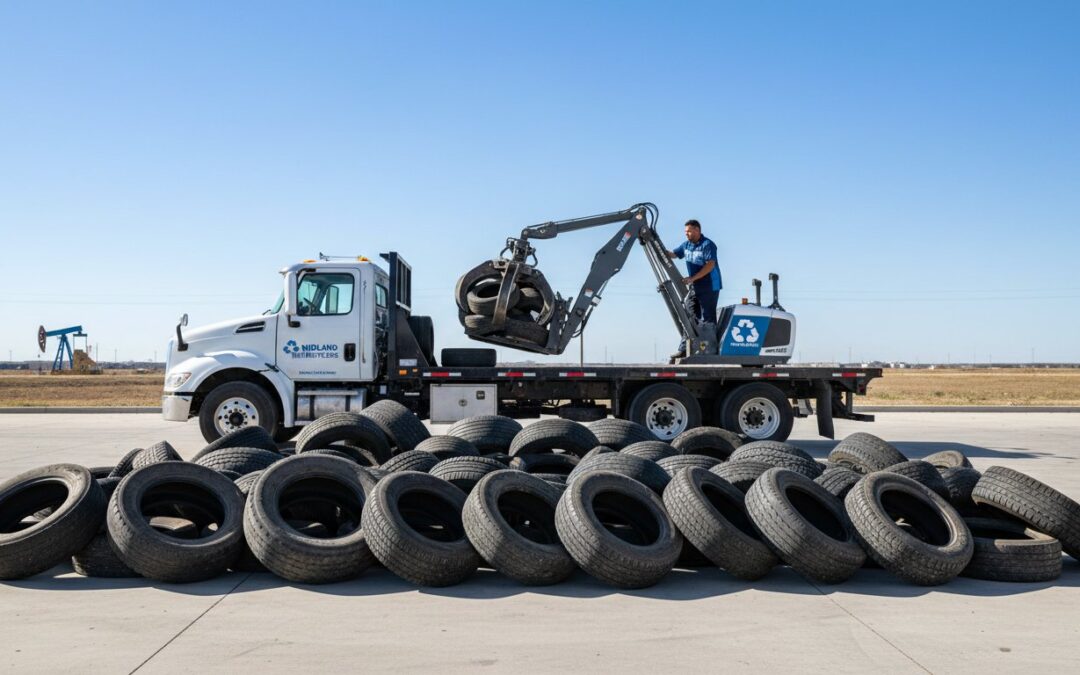
In 2025, Texas Commission on Environmental Quality (TCEQ) records highlighted that administrative penalties for improper scrap tire storage or manifest errors can reach $5,000 per day. It’s a steep price for a problem that often starts as a small pile behind your shop. You’ve likely noticed that managing these stockpiles is becoming more difficult as local regulations tighten and labor costs for manual hauling continue to climb. It’s frustrating to watch your team spend hours loading a trailer when they should be servicing vehicles and generating revenue.
This guide provides a transparent breakdown of the current tire disposal cost Midland businesses encounter in 2026. We’ll help you determine if DIY landfill trips are actually saving you money once you factor in fuel, staff time, and tipping fees. You’ll learn how to navigate strict manifest requirements and why professional collection is often the most cost-effective way to keep your premises safe from fire hazards and West Nile-carrying mosquitoes. We compare the City of Midland’s latest landfill rates against professional pickup services so you can make an informed, budget-friendly decision for your commercial property.
Key Takeaways
- Learn how tire size and volume dictate pricing, from standard passenger units to heavy-duty industrial rubber and OTR equipment.
- Compare landfill fees against professional services to calculate the true tire disposal cost Midland businesses pay when labor and transport are included.
- Protect your business from significant TCEQ fines by understanding the legal liabilities of tire generation and disposal compliance.
- Identify specialized removal options for commercial fleets and industrial waste, including skid steer tracks and hydraulic hoses.
- See how transparent pricing and local expertise provide a more predictable and cost-effective budget for waste management in the Permian Basin.
Factors Influencing Tire Disposal Costs in Midland (2026)
Understanding your total tire disposal cost Midland depends on several variables beyond the simple count of rubber units. In 2026, West Texas recycling facilities have tightened their intake protocols, making the physical condition and type of your tires the primary price drivers. You aren’t just paying for the space in a trailer; you’re paying for the specialized labor and energy required to process different rubber compounds.
Four main factors dictate your final invoice:
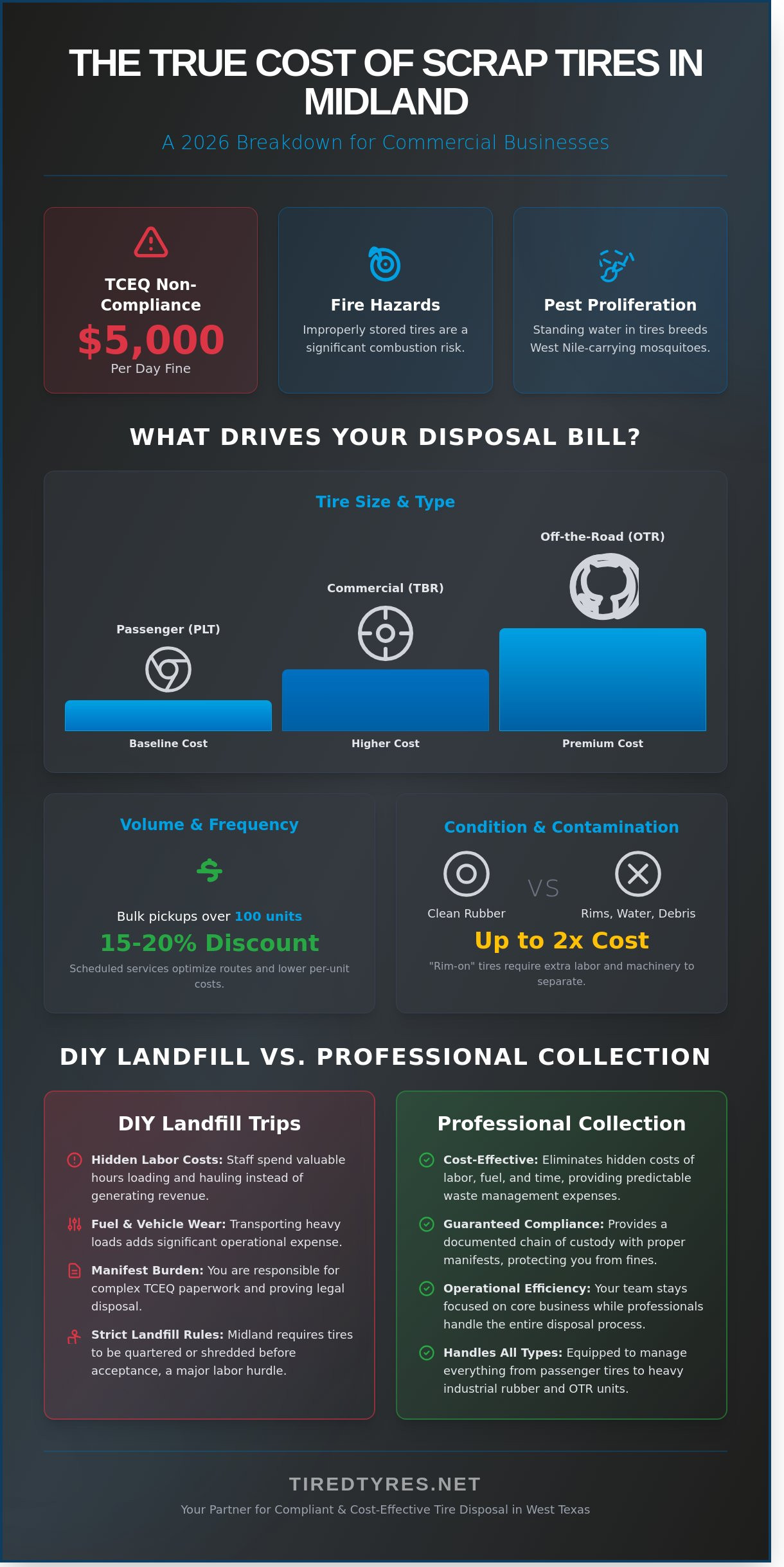
- Tire Size and Type: Standard passenger tires are the baseline for pricing. Commercial semi-truck tires (TBR) weigh significantly more and require more energy to shred. Off-the-road (OTR) units from oil field machinery often require heavy-duty cranes for handling, which spikes the service fee.
- Volume and Frequency: Large-scale cleanouts usually secure better per-unit rates. Many Midland logistics providers offer 15% to 20% discounts for bulk pickups exceeding 100 units because it optimizes the transport route.
- Geographic Location: Transporting scrap from Midland to regional processing hubs involves significant fuel expenditure. For example, moving a load 118 miles to Lubbock adds a logistical layer that isn’t present for local drop-offs.
- Contamination Levels: Processing plants require clean rubber. If your tires are filled with Midland caliche, stagnant water, or are still mounted on rims, expect additional handling fees. A “rim-on” tire often doubles the disposal cost because it requires mechanical separation before shredding.
Categorizing Scrap Tires by Disposal Tier
Passenger and Light Truck (PLT) tires remain the most common and affordable units to recycle. Commercial Semi-Truck (TBR) tires represent the middle tier; their high steel-to-rubber ratio increases processing time. Off-the-Road (OTR) and Agricultural tires sit at the top of the cost scale. These massive units often require on-site “beading” or cutting before they can even be loaded onto a standard flatbed.
The Role of the Permian Basin Economy
The tire disposal cost Midland businesses pay is directly tied to the local industrial climate. In 2026, high demand for recycled rubber in road construction projects across the Permian Basin helps offset some costs, but labor remains expensive. Because local tire technicians can often earn higher wages in the oil fields, disposal companies must offer competitive pay to retain staff. This labor competition, combined with fluctuating fuel surcharges for remote site pickups, keeps the West Texas market unique compared to coastal regions. When oil production reaches peak cycles, service availability often tightens, making scheduled bulk pickups a more cost-effective strategy than last-minute requests.
Comparing DIY Landfill Fees vs. Professional Collection Services
Calculating the true tire disposal cost Midland businesses face starts at the gate of the City of Midland Landfill. For 2026, the municipal tipping fees remain a primary baseline, but they only tell part of the story. While a single passenger tire might only cost a few dollars to drop off, the logistical hurdles for commercial entities or residents with high volumes quickly add up. Professional collection services aren’t just about moving rubber; they’re about eliminating the operational friction that kills productivity.
Efficiency matters in West Texas. When you choose a professional hauler, you’re paying for a documented chain of custody. This isn’t a luxury. State regulations require specific manifesting for tire transport to ensure environmental compliance. Handling this paperwork in-house takes time away from your core business. Professional services automate this administrative burden, providing you with a ready-to-file manifest that proves your scrap reached a licensed processor.
Landfill Realities in Midland and Odessa
The City of Midland Landfill and the Odessa Time-Machine Landfill have strict 2026 protocols you can’t ignore. Residents are often limited to four passenger tires per day. If you arrive with more, you’re redirected to commercial scales where rates fluctuate. Most importantly, Midland requires tires to be quartered or shredded before they’re accepted for landfilling. This adds a massive labor step to your DIY plan. You can see how these local rules compare to other regional hubs by checking our guide on tire disposal west texas options.
Total Cost of Ownership for DIY Disposal
Don’t fall into the trap of looking only at the tipping fee. To find the real tire disposal cost Midland operators pay, you have to run the numbers on your resources. Consider these factors:
- Labor Hours: If an employee earning $22 per hour spends three hours loading, driving, and waiting in landfill lines, that’s $66 in lost wages alone.
- Vehicle Wear: Tires are heavy and dirty. Hauling 50 scrap tires in a company pickup causes suspension stress and interior damage that isn’t cheap to fix.
- Fuel and Risk: Current fuel prices in the Permian Basin make every mile count. There’s also the risk of $500 fines if your load isn’t properly secured according to local transport ordinances.
Reclaiming your yard or warehouse space immediately has its own financial value. Stacking scrap tires creates a fire hazard and a breeding ground for pests, which can lead to code enforcement headaches. If you want to skip the landfill lines and the manual labor, it’s often more cost-effective to schedule a professional pickup and keep your team focused on their actual jobs. We handle the heavy lifting and the compliance paperwork so you don’t have to spend your Saturday at the dump.
The Hidden Costs of Illegal Dumping and TCEQ Non-Compliance
Choosing a cheap, unverified hauler to lower your tire disposal cost Midland might seem like a budget-friendly move. It’s actually a massive financial risk. The Texas Commission on Environmental Quality (TCEQ) maintains strict oversight of scrap tire movement. If your tires end up in a ditch or an unauthorized lot, the state doesn’t just go after the person who dropped them. They come after the business that generated them. Under Texas law, the generator holds “cradle-to-grave” responsibility. This means if a “fly-by-night” hauler dumps your inventory, you are legally liable for the cleanup costs and administrative penalties.
The financial consequences are steep. TCEQ administrative penalties can reach $25,000 per day per violation. Beyond government fines, illegal tire piles significantly damage your business reputation and property value. A visible pile of scrap tires can decrease neighboring property values by 10% to 15%. It signals neglect, attracts more illegal dumping, and deters potential investors or customers from entering your premises. In the Midland area, where professional image matters for oilfield service providers and retail shops alike, an unmanaged tire problem is a liability you can’t afford.
Manifest Requirements for Texas Businesses
Texas law requires every business that generates scrap tires to use a manifest system. A scrap tire manifest is a multi-part form that tracks the tires from your shop to a permitted processing facility. You must keep these records on file for at least 3 years to remain compliant during a TCEQ audit. Tired Tyres ensures full texas tire disposal regulations compliance by providing every client with accurate, stamped documentation. Using unpermitted haulers in Midland County is more than a bad idea; it is a Class A misdemeanor that can lead to jail time and permanent business closure.
Public Health and Safety Risks
The environmental stakes in the Permian Basin are unique. Tire fires in our arid climate are nearly impossible to extinguish. Because tires are made of 75% oil, they burn at temperatures exceeding 2,000 degrees Fahrenheit. Standard fire department equipment often can’t stop these blazes, which can burn for weeks and leach toxic runoff into the local groundwater.
- Disease Vectors: Scrap tires are the primary breeding ground for Culex mosquitoes in West Texas.
- West Nile Virus: These mosquitoes carry the West Nile virus, which remains a consistent seasonal threat in Midland County.
- Toxic Emissions: A single burning tire releases two gallons of oil into the soil and clouds of carcinogenic smoke into the air.
Vector control is the strategic management of environments to limit or eliminate insects and animals that transmit disease-causing pathogens to the human population. By managing your tire disposal cost Midland through professional channels, you directly contribute to the safety of our local community.
Bulk Disposal Pricing for Commercial and Industrial Rubber Waste
Fleet managers in the Permian Basin face unique logistics. Managing 50 or 100 vehicles means the tire disposal cost Midland businesses pay can fluctuate based on volume and frequency. Large dealerships often accumulate 300 or more casings in a single month. We provide structured pricing for these high-volume partners. This ensures your service bays stay clear and your business remains compliant with Texas Commission on Environmental Quality (TCEQ) rules. Scheduled pickups are always more cost-effective than waiting for a site to become overwhelmed.
Industrial Rubber Beyond the Tire
Standard municipal landfills in West Texas often reject heavy-duty items. Solid rubber tracks from skid steers or hydraulic hoses don’t compress. They take up too much air space and can damage expensive landfill liners. Processing high-tensile rubber requires heavy-duty shredders designed for steel-reinforced cores. We offer specific quotes for oil field site remediation. This covers the removal of miles of decommissioned hoses or industrial conveyor belts used in local sand mining. Removing these bulky items prevents fire hazards and avoids potential environmental penalties. We handle the heavy lifting and the specialized transport required for these dense materials.
Volume Discounts and Partnership Rates
Efficiency is the biggest factor in lowering your tire disposal cost Midland expenses. Setting up a recurring tire collection service Odessa operators rely on is cheaper than calling for a one-time emergency cleanup. Our “Clean Sweep” program helps businesses tackle legacy stockpiles that have sat for years. We offer lower rates for pre-sorted loads. If you separate passenger tires from OTR (Off-The-Road) tires and remove metal rims, the processing time drops. Data from 2024 industrial waste audits shows that pre-sorting reduces handling time by 25%. We reward that effort with better partnership rates for local shops.
- Fleet Pricing: Tailored for trucking companies and delivery services.
- Dealership Rates: Bulk removal for high-turnover service centers.
- Remediation Services: One-time clearing of industrial yards and oil sites.
- Pre-sorting Incentives: Lower fees for tires already removed from rims.
Managing commercial rubber waste doesn’t have to be a logistical headache. We focus on quick turnarounds so your team can focus on their actual work. Whether it’s a stack of 200 light truck tires or a massive industrial conveyor belt, we have the equipment to move it safely.
Need a bulk cleanup for your fleet? Contact Tired Tyres for a commercial quote today.
Why Tired Tyres is the Cost-Effective Choice for West Texas
Tired Tyres isn’t just another waste hauler. We’ve served Midland, Odessa, and Lubbock since our first day of operation in 2018. This local focus means we understand the specific environmental pressures and logistical hurdles of the Permian Basin. Many providers add hidden surcharges for TCEQ (Texas Commission on Environmental Quality) manifest documentation. We don’t. Our pricing stays transparent because we handle all the regulatory paperwork as a standard part of our service. This commitment ensures your business stays compliant with state law without unexpected hits to your budget. Managing your tire disposal cost Midland becomes much simpler when the quote you receive is the price you actually pay.
We specialize in the heavy-duty loads that smaller haulers often reject. Our fleet is equipped to handle the massive OTR (Off-the-Road) tires from mining sites and the heavy AG tires from local farms. We’ve invested in specialized trailers that can move up to 20 tons of scrap rubber in a single trip. Choosing a legal, registered recycler like us is the only way to protect the West Texas landscape from illegal dumping and the massive liability of tire fires. We take those “fáradt” (tired) abroncsok and ensure they’re processed through legitimate recycling channels.
Our Seamless Collection Process
We’ve streamlined our logistics to match the fast-moving pace of West Texas industry. Your experience starts with a clear, itemized quote and ends with the delivery of a completed scrap tire manifest for your records. Our professional equipment is designed specifically for the rugged terrain found on oilfield sites and rural properties. This ensures we arrive on time and complete the load-out safely; even in remote locations. For a deeper look at our regional operations, read our guide on reliable tire disposal. We focus on efficiency so you can focus on your core business operations.
Get a Custom Quote Today
Controlling your tire disposal cost Midland requires accurate data. To get the fastest estimate, provide a count categorized by tire type. We generally group these into passenger vehicle, commercial truck, or heavy equipment categories. For large-scale industrial sites or yards with over 500 units, we offer on-site assessment services to plan the most efficient removal strategy. This precision prevents overcharging and ensures we dispatch the right equipment for the job. Don’t let piles of scrap rubber create a safety hazard or a legal liability on your property. Getting a tire pickup quote Midland businesses trust is the first step toward clearing your site with confidence.
Streamline Your Waste Management in the Permian Basin
Managing rubber waste in West Texas requires more than just finding the lowest tire disposal cost Midland offers. It’s about maintaining strict compliance with TCEQ regulations to avoid the heavy fines associated with improper dumping. As we look toward 2026, the demand for industrial and OTR disposal continues to grow across the Permian Basin. Balancing landfill fees against the efficiency of professional collection saves your business time and reduces long-term liability. You need a partner who understands the local landscape and possesses the specialized equipment to handle heavy-duty industrial rubber safely.
Tired Tyres operates as a fully TCEQ Permitted Hauler, providing reliable service throughout the entire Permian Basin. We utilize specialized OTR and industrial rubber equipment to ensure every load is handled with professional precision. Whether you’re clearing out a small shop or managing a massive industrial site, we take the stress out of the process. Don’t let leftover rubber sit around and create a hazard for your operations.
Ready to clear your site? Get an Accurate Tire Disposal Quote for Your Midland Business today. We’re here to help you keep West Texas clean and your business running smoothly.
Frequently Asked Questions
How much does the Midland landfill charge for tires in 2026?
The City of Midland landfill charges $1.50 for each passenger tire and $5.00 for larger truck tires according to the 2026 fee schedule. These rates apply to residents who haul their own waste to the Smith Road facility. You’ll need a valid driver’s license to prove residency. If you’re looking to manage your tire disposal cost Midland residents often find these gate fees the most budget friendly option for single sets.
Can I dispose of tires with rims still on them in West Texas?
Most West Texas landfills, including the Midland and Odessa facilities, won’t accept tires with the rims still attached. You’ll need to separate the rubber from the metal before arrival. Local scrap yards often take the rims for free or pay a small scrap value for the aluminum. We handle the separation process for you if you choose our pickup service, saving you the labor and specialized tools.
Is there a limit to how many tires I can haul at once in Texas without a permit?
Texas law limits you to hauling 5 or fewer scrap tires at one time without a TCEQ transporter registration. Exceeding this number requires a formal permit and specific record keeping. This regulation helps prevent illegal dumping across the Permian Basin. We maintain all necessary state certifications so you don’t have to worry about transport legalities or paperwork. It’s the safest way to stay compliant with state environmental rules.
What is the cheapest way to get rid of 100+ scrap tires in Odessa?
Scheduling a bulk collection through a registered transporter is the most cost effective way to clear 100+ tires in Odessa. Hauling these yourself would require 20 separate trips to stay within the legal 5 tire limit. Our team provides volume based pricing for large cleanups. This eliminates the fuel costs and time spent waiting in line at the landfill, significantly lowering your total tire disposal cost Midland and Odessa rates included.
Does Tired Tyres provide the required TCEQ manifests for my business?
We provide full TCEQ manifests for every business pickup we complete. These documents are essential for your shop’s compliance during state inspections. We keep digital copies on file, but you’ll get a physical receipt the moment we load the tires. It’s the simplest way to prove your scrap rubber reached a licensed processing facility. You won’t have to spend hours tracking down paperwork when the inspectors arrive at your door.
Do you offer discounts for recurring tire pickups for auto shops?
We offer specialized pricing structures for auto shops and dealerships that schedule recurring monthly or bi weekly pickups. Regular service keeps your lot clear and reduces the risk of fire hazards or pest infestations. Since we’re already on a route near your location, we pass those efficiency savings on to you. Contact our office to set up a schedule that fits your shop’s volume and keeps your workspace organized.
What happens to the tires after Tired Tyres picks them up?
Your old tires are transported to licensed recycling facilities where they’re processed into rubber mulch or tire derived fuel. About 70% of scrap tires in Texas end up as fuel for cement kilns or paper mills. Others are shredded for use in road construction projects. We ensure nothing is dumped illegally, keeping the West Texas landscape clean and safe for everyone. It’s a sustainable solution for “tired” rubber.
Can you dispose of large OTR oil field tires in the Permian Basin?
We handle large Off the Road (OTR) tires from oil field equipment and heavy machinery across the Permian Basin. These massive tires require specialized loading equipment and dedicated transport trailers. Whether you have earthmover tires or tractor sets, we have the capacity to haul them. Dealing with these oversized items is a core part of our service to the local energy industry. We make sure your site stays clear and operational.