
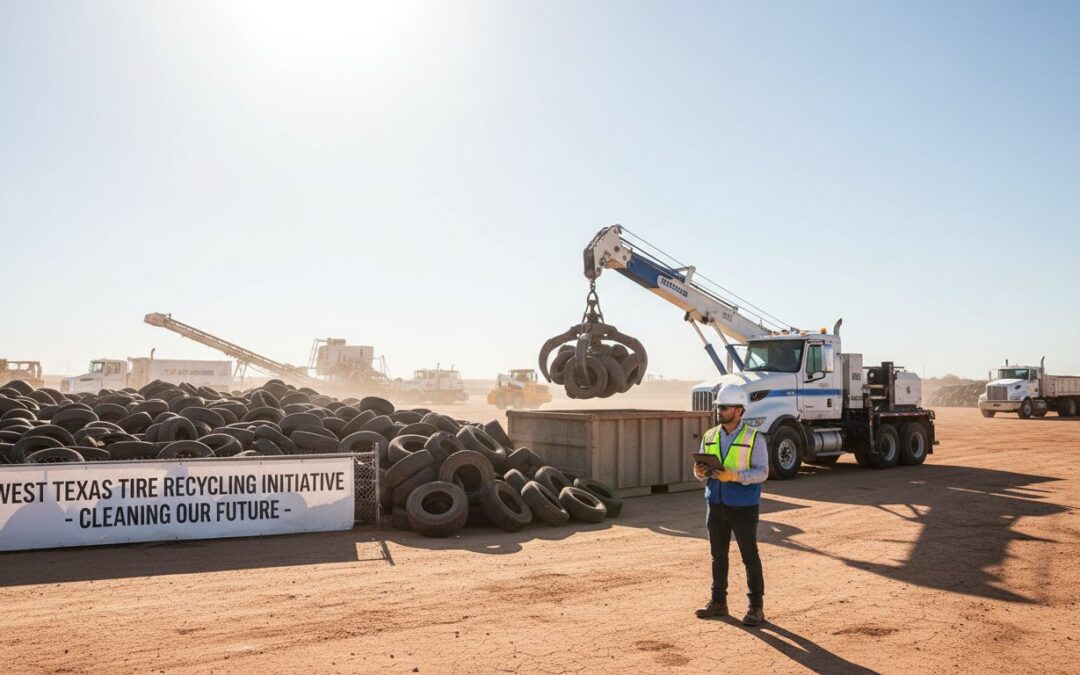
Did you know the Texas Commission on Environmental Quality (TCEQ) can issue administrative penalties of up to $25,000 per day for unauthorized scrap tire sites? For property owners in Midland, Odessa, or Lubbock, a growing pile of rubber isn’t just a nuisance; it’s a significant financial and legal liability. Managing a professional tire dump cleanup Texas project requires more than just a truck and some manual labor. It demands strict adherence to state environmental codes to avoid these heavy penalties and protect your investment.
We know that staring down thousands of “tired” tires feels like an overwhelming task. You’re likely concerned about the documented surge in mosquito-borne illness risks or the steep costs associated with specialized scrap hauling. This guide provides the clarity you need. You’ll discover the exact legal, safety, and logistical steps to remediating sites in West Texas while ensuring total TCEQ compliance. We will cover how to secure official transport manifests, mitigate fire hazards, and finalize the cleanup so your property is safe, clear, and legally documented.
Key Takeaways
- Identify the specific challenges of illegal tire accumulation in Midland, Odessa, and Lubbock to accurately assess your site’s remediation needs.
- Avoid severe TCEQ fines and catastrophic fire hazards by understanding the legal and safety risks of unauthorized scrap tire storage.
- Discover the professional logistics involved in a successful tire dump cleanup Texas project, including volume estimation and heavy equipment mobilization.
- Protect yourself from liability by learning the hidden dangers of unpermitted disposal and the risk of tires being illegally re-dumped in your name.
- Ensure 100% regulatory compliance and manifest transparency by partnering with experienced remediation experts in the Permian Basin.
The Challenge of Tire Dump Cleanup in West Texas
Illegal tire dumping remains a persistent issue across the South Plains and the Permian Basin. In cities like Midland, Odessa, and Lubbock, bulk rubber accumulation often exceeds local management capacity. This isn’t just a matter of a few stray tires on a curb. We’re talking about legacy sites where thousands of casings have gathered over decades. The challenge of tire recycling at this scale requires more than a pickup truck; it demands professional tire dump cleanup Texas landowners can rely on to clear their titles and restore their land.
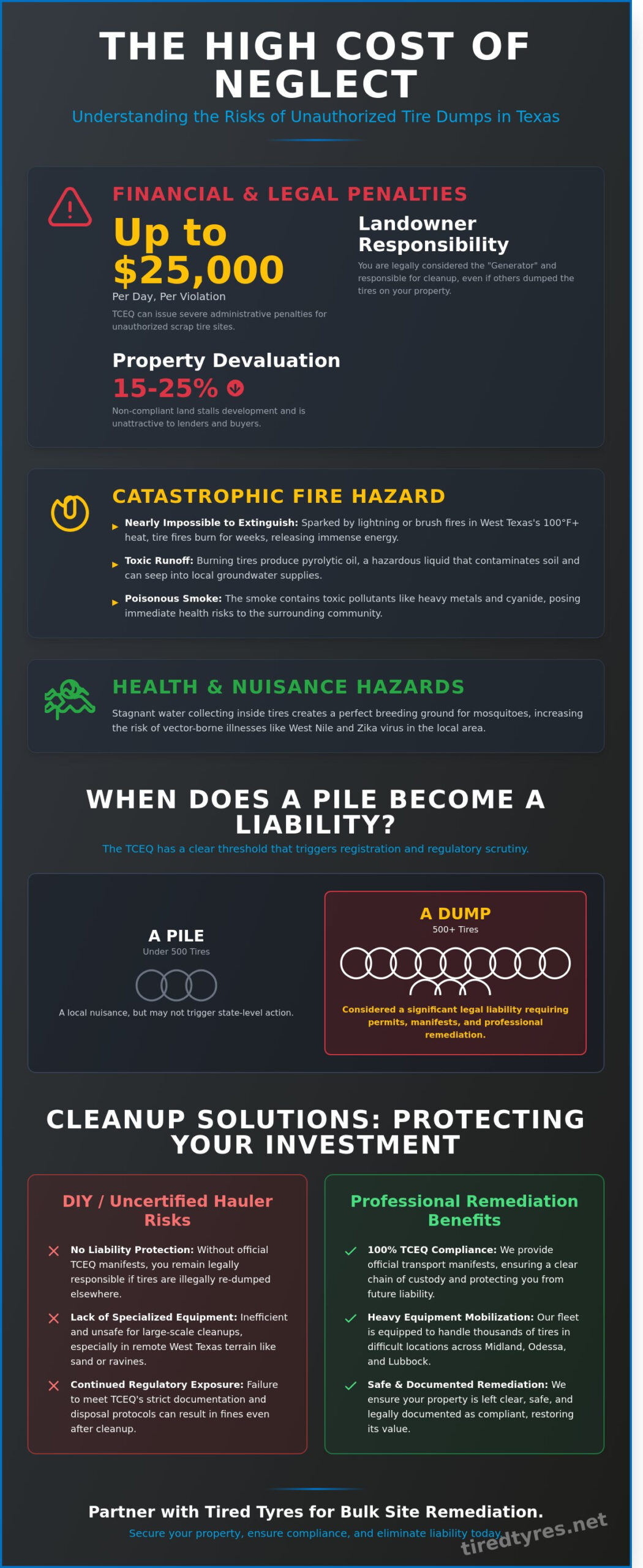
Routine scrap collection handles the weekly output of a tire shop. Full-site remediation is different. It involves heavy machinery, logistics for thousands of units, and strict adherence to environmental protocols. Abandoned stockpiles don’t just sit there. They devalue property by 15% to 25% in many rural Texas tracts. They also stall commercial development because lenders rarely finance projects on non-compliant land. If you’re looking to sell or build, those tires are a massive roadblock.
The Permian Basin Context
Oilfield operations in Ector and Midland counties generate unique industrial rubber waste. Large equipment tires and heavy-duty truck casings often end up in remote ravines or abandoned lots. Accessing these sites is difficult. The soft sand and remote locations of West Texas require specialized transport. Tired Tyres serves these specific regional needs. We understand the geography of the Basin. We provide the equipment necessary to reach sites that standard haulers avoid. Our team focuses on efficient removal to keep industrial projects moving forward without regulatory delays.
Identifying a “Dump” vs. a “Pile”
The Texas Commission on Environmental Quality (TCEQ) sets clear boundaries. A few tires in a backyard is a pile. Once a site exceeds 500 scrap tires, it often triggers registration requirements and higher scrutiny. If you’re over this limit without a permit, you face a significant legal liability. Landowners are often surprised to learn they’re responsible for cleanup costs even if the dumping was done by third parties. The urgency of tire dump cleanup Texas services increases as summer approaches. Stagnant water in tires breeds mosquitoes, and the risk of a tire fire is a permanent threat. Getting these sites cleared before a TCEQ inspector arrives saves property owners from heavy fines and potential litigation.
Understanding the Risks: Why Immediate Remediation is Vital
Abandoned tire piles aren’t just an eyesore; they’re a ticking time bomb for property owners. In the Permian Basin and South Plains, the combination of extreme heat and illegal dumping creates a high-stakes liability. Investing in professional tire dump cleanup Texas services is essential because the risks extend far beyond simple aesthetics. When you leave scrap tires to bake in the West Texas sun, you’re inviting legal, physical, and environmental disasters to your doorstep.
The most immediate threat is the risk of fire. West Texas summers frequently see temperatures climb above 100 degrees Fahrenheit. When large tire piles ignite, they’re nearly impossible to extinguish. A single spark from a brush fire or a lightning strike can turn a dump into an inferno. These fires produce pyrolytic oil, a toxic liquid that seeps into the ground. This runoff causes long-term soil contamination and can eventually reach local groundwater supplies. The smoke from these incidents contains heavy metals and cyanide, which creates immediate health and environmental concerns for everyone in the vicinity.
TCEQ Regulations and Landowner Responsibility
The Texas Commission on Environmental Quality (TCEQ) maintains strict oversight of scrap tire management. Under current law, if tires are found on your property, you’re often classified as the “Generator.” This means you’re legally responsible for their proper removal and disposal, even if you didn’t put them there yourself. Failing to address a site can lead to administrative penalties and daily fines that quickly exceed the cost of a professional tire dump cleanup Texas project.
It’s vital to follow the Texas tire disposal regulations to protect your business. You must use a permitted tire hauler to maintain a clear chain of custody. Without the proper manifest and documentation, you remain liable for where those tires end up. Using a certified service ensures that your liability ends the moment the tires leave your site.
Vector-Borne Diseases in Lubbock and Odessa
Public health is a major driver for rapid site remediation. Tires are designed to trap water, making them the perfect nursery for mosquitoes. In cities like Lubbock and Odessa, where West Nile virus is a recurring seasonal threat, a single tire can produce thousands of larvae every week. These pests don’t stay on your property; they migrate to neighboring homes and businesses.
Our detailed guide on scrap tire health hazards explains how these sites impact local communities. Removing these breeding grounds is a matter of public safety. Prompt action protects your neighbors and reduces the risk of local health departments issuing citations. If you’re dealing with an accumulation of old rubber, it’s best to schedule a professional assessment before the next rainy season begins.
The Anatomy of a Cleanup: Our Remediation Process
Executing a successful tire dump cleanup Texas project requires more than just a few trucks and a crew. It’s a calculated logistical operation that starts with a precise site assessment. We don’t guess at the numbers. Our team calculates the total tonnage by differentiating between standard passenger tires and massive Off-The-Road (OTR) units. A standard car tire weighs roughly 20 pounds, but a single earthmover tire can exceed 600 pounds. This data determines whether we deploy standard trailers or specialized heavy-haul equipment.
Once we establish the volume, we mobilize heavy equipment like grapple loaders and skid steers to the site. Efficiency is our priority. We coordinate with permitted scrap tire haulers to ensure a steady stream of transportation. These loads aren’t just dumped elsewhere. They’re hauled to authorized facilities where the rubber is processed for energy recovery or transformed into crumb rubber for new infrastructure projects. This systematic approach ensures that every scrap of rubber is accounted for from the moment it leaves your property.
Step 1: Sorting and Classification
We don’t treat all rubber waste the same. Sorting is the most critical phase for controlling labor costs and maximizing trailer space. Our crews separate passenger tires from heavy-duty agricultural and OTR models immediately. We also identify and isolate non-tire rubber waste, such as industrial conveyor belts or rubber tracks from skid steers. These materials often require different processing paths at the recycling plant. By organizing the site into distinct categories before the trucks arrive, we often reduce loading times by 25% or more. This preparation ensures that the loading phase remains fast and predictable.
Step 2: Tactical Removal and Manifesting
Moving thousands of tires from remote West Texas locations involves strict regulatory compliance. Every load that leaves the site must be accompanied by a TCEQ scrap tire manifest. This document is your legal shield. It proves that the waste was handled by a registered hauler and delivered to a licensed facility. We manage all the paperwork, ensuring that every trailer load moving down I-20 or Highway 385 is fully documented. After the final trailer is loaded, we perform a thorough ground sweep. We remove smaller debris and wire fragments to restore the land to its original condition, making it safe for livestock or future construction.
Comparing Cleanup Solutions: DIY vs. Professional Remediation
Choosing between a DIY approach and professional remediation often comes down to a choice between perceived savings and legal protection. For a tire dump cleanup in Texas, the stakes involve more than just physical labor. Handling 500 or 5,000 tires requires specialized loaders and transport permits that most property owners don’t have. Without this equipment, you’re looking at weeks of manual work that often results in back injuries or equipment damage.
Efficiency is the primary driver for professional services. A trained crew using specialized trailers can clear a site in 48 hours that would take an individual a month of weekend trips. Beyond speed, the biggest risk of DIY or “cheap” hauling is the lack of a paper trail. If your tires are re-dumped illegally on a neighboring West Texas ranch, you are the one the authorities will come looking for. Documentation is your only defense against illegal dumping charges. A professional manifest tracks every tire from your site to the end processor, providing the legal proof required by the Texas Commission on Environmental Quality (TCEQ).
The “Free Disposal” Myth
Unpermitted haulers often offer to take tires for a fraction of the market rate. This is a major red flag. These operators frequently dump the load in a ravine or an abandoned lot just a few miles away. If investigators find a single receipt or identifying mark in that pile, the original property owner remains legally liable. This is why unpermitted haulers are a major tire pile environmental risk. Tired Tyres eliminates this uncertainty with a transparent, flat-fee solution. We handle the licensing and the logistics, so you don’t have to worry about surprise fines or environmental audits.
Landfill Limitations in Midland and Lubbock
Landfills in Midland and Lubbock have strict protocols that make DIY disposal difficult. Most municipal sites refuse bulk loads of scrap rubber. Tires don’t compress well and they tend to “float” to the surface of landfill cells over time, which disrupts the landfill’s integrity. Professional recycling isn’t just a backup plan; it’s a necessity for meeting 2024 corporate sustainability goals. Recycling turns waste into tire-derived fuel or rubberized asphalt. This keeps your project compliant with local environmental standards and ensures the rubber stays out of the ground for good.
Protect your property and your reputation by choosing a partner who understands the legal landscape of a tire dump cleanup in Texas. Contact Tired Tyres for a professional remediation quote today.
Partner with Tired Tyres for Bulk Site Remediation
Large-scale tire dump cleanup Texas projects require more than just a truck and a trailer. They demand a partner who understands the logistics of the Permian Basin. We’ve spent years clearing massive rubber accumulations from remote sites where standard haulers won’t go. Our team manages the entire process from the first site assessment to the final TCEQ manifest. We don’t leave until the job is done and your land is restored to its original state.
Compliance is our top priority. We maintain 100% TCEQ compliance on every project. This means we provide full manifest transparency for every load we haul. You’ll receive documented proof that every tire was transported and processed according to Texas environmental laws. This paper trail is your best defense against potential fines or legal liabilities associated with illegal dumping on your property.
Our specialized equipment is designed for the toughest industrial rubber. Standard equipment often fails when faced with Off-the-Road (OTR) tires or heavy industrial casings. We use heavy-duty loaders and high-capacity trailers specifically rated for these loads. Whether you’re dealing with 400-pound mining tires or thousands of passenger tires buried in the brush, we have the machinery to move them quickly.
Serving Midland, Odessa, and Beyond
West Texas terrain presents unique challenges for remediation teams. We know the caliche roads and the industrial requirements of the Midland and Odessa areas. Since 2018, we’ve built a proven track record with commercial oilfield operators and local agricultural clients. We understand that your operations can’t stop just because a site needs cleaning. We work around your schedule to minimize disruption. Contact us today for a reliable tire disposal quote that covers your specific location in Lubbock or the surrounding counties.
The Tired Tyres Advantage
We pride ourselves on direct communication. When you call us, you’re talking to the people who will be on your property. We provide “boots-on-the-ground” service that ensures your land is safe, clean, and legally compliant. We don’t hide behind automated phone systems or complex contracts. Our goal is to solve your tire problem so you can focus on your business.
- Direct access to project managers for real-time updates.
- Full documentation for environmental audits and land sales.
- Rapid mobilization for time-sensitive remediation needs.
Tired Tyres provides the gold standard for West Texas landowners seeking professional remediation in 2026.
Starting the process is simple. We offer comprehensive site assessments in Midland, Odessa, and Lubbock to determine the scope of your tire dump cleanup Texas project. We’ll walk the property with you, estimate the tonnage, and provide a clear timeline for removal. Don’t let a tire stockpile devalue your property or create a fire hazard. Reach out to our team to schedule your assessment and get your land back in compliance.
Restore Your Property with Expert Remediation
Scrap tire piles are more than an eyesore; they represent significant fire risks and mosquito breeding grounds that threaten local health. Managing a tire dump cleanup Texas project requires a partner who follows strict state guidelines to avoid legal complications. Tired Tyres is a TCEQ-permitted tire hauler equipped with specialized OTR and industrial rubber machinery designed for the toughest jobs. We serve the entire Permian Basin and South Plains, ensuring your site meets environmental standards without the hassle of DIY attempts. You don’t have to manage the logistics of bulk rubber removal alone. Our professional team provides the documentation and efficiency needed to clear your land and protect your investment. Let’s get your site back to a clean, safe, and productive state today.
Get a Professional Quote for Your Site Remediation
We’re ready to help you clear the way for a safer future on your land.
Frequently Asked Questions
Is it illegal to have a tire pile on my property in Texas?
Yes, it’s illegal to store more than 500 scrap tires on your property without a specific permit from the Texas Commission on Environmental Quality (TCEQ). Under Texas Health and Safety Code Chapter 361, these piles are classified as public nuisances because they create fire hazards and breeding grounds for mosquitoes. Even if you’ve fewer than 500 tires, you must ensure they’re stored to prevent water accumulation and pest infestation.
How much does it cost to clean up a tire dump in Midland?
Costs for a tire dump cleanup in Texas depend on the total number of Passenger Tire Equivalents (PTEs) and the distance to a permitted recycling facility. While we provide custom quotes based on site surveys, the TCEQ reports that state-funded cleanups have historically cost millions of dollars for large-scale sites. Proactive remediation is always more affordable than facing civil penalties, which can reach $25,000 per day of violation.
What is a scrap tire manifest and why do I need one?
A scrap tire manifest is a mandatory TCEQ tracking document, specifically Form TCEQ-10304, that records the movement of tires from your site to a processing facility. You need this document to prove you disposed of the waste legally and to protect yourself from environmental liability. We handle all the necessary paperwork to ensure your records show the tires reached a registered end-user or recycler safely.
Can I bury old tires on my ranch in West Texas?
No, you cannot bury whole tires on your ranch because Texas law prohibits the land disposal of scrap tires under 30 TAC §328.63. Buried tires often float back to the surface over time, which damages soil stability and can ruin expensive ranching equipment. To stay compliant, you must have the tires hauled away by a registered transporter to a legitimate recycling or energy recovery facility.
How do I report illegal tire dumping in Lubbock County?
You should report illegal dumping to the TCEQ Region 2 office in Lubbock at 806-796-7092 or through the Environmental Complaint Hotline at 1-888-777-3186. Provide the exact location and the estimated number of tires if possible. Reporting helps prevent environmental damage and ensures that property owners or illegal haulers are held accountable for the necessary tire dump cleanup Texas residents deserve.
What happens to the tires after Tired Tyres removes them?
We transport all collected rubber to registered processing facilities where they’re recycled into new products or used for energy. Approximately 45 percent of scrap tires in the U.S. become tire-derived fuel, while others are ground into crumb rubber for roads or playground surfaces. Our process ensures that your tired tyres are repurposed sustainably rather than sitting in a dangerous pile on your land.
How long does a typical site remediation take?
A typical site remediation for a small to mid-sized tire dump takes between one and three business days. Larger sites with over 10,000 tires require more coordination and can take two weeks or longer to clear completely. We provide a specific timeline after our initial assessment so you can plan your land use accordingly. Every tire dump cleanup Texas project we handle prioritizes speed and site safety.
Does Tired Tyres handle OTR and industrial rubber waste during cleanups?
Yes, we specialize in removing Off-The-Road (OTR) tires, including those from mining, agricultural, and construction equipment. These oversized tires require specialized loading equipment and heavy-duty transport due to their weight and massive dimensions. Whether you have tractor tires or heavy industrial rubber waste, we’ve the expertise to clear your West Texas property efficiently. We ensure even the largest industrial tires reach the proper recycling channels.