
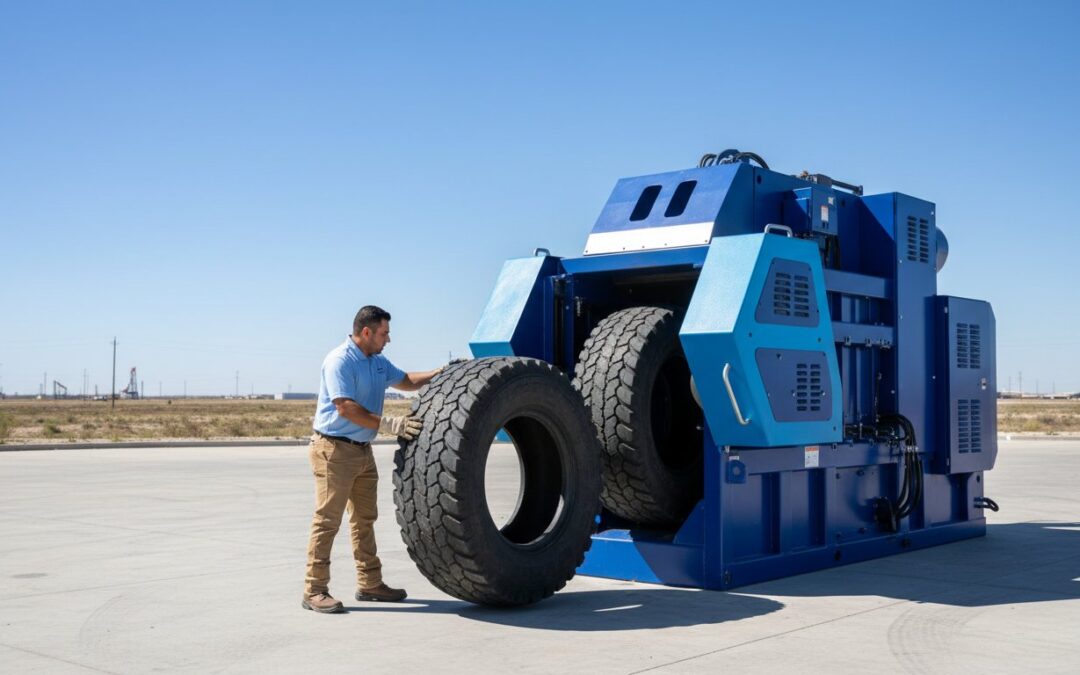
Storing a pile of scrap semi-truck tires in your yard isn’t just a space problem; it’s a liability that can trigger thousands of dollars in TCEQ fines. Many business owners in Midland and Odessa find that local landfills now enforce strict daily limits or refuse heavy OTR tires entirely. If you’ve been searching for “tire recycling near me” only to find closed gates or high disposal fees, you aren’t alone. We understand the physical strain of moving 200-pound casings and the stress of keeping your shop compliant with Texas environmental laws.
You deserve a disposal process that’s as efficient as your daily operations. This 2026 guide provides the exact steps to recycle scrap tires across West Texas, from Lubbock down to the Permian Basin, without the heavy lifting. We’ll cover how to secure a reliable pickup service that handles the hauling and ensures you meet all state mandates. By the end of this article, you’ll know how to clear your space, stay legal, and protect your business from environmental risks.
Key Takeaways
- Understand the unique environmental risks scrap tires pose in the West Texas climate and why professional disposal is a safety priority.
- Learn how the recycling process converts waste into reusable crumb rubber through efficient collection and shredding techniques.
- Compare the convenience and actual costs of municipal landfills versus finding the best professional tire recycling near me.
- Ensure your business stays compliant with Texas Commission on Environmental Quality (TCEQ) regulations by using authorized scrap tire haulers.
- Discover tailored collection solutions for all tire types, including passenger vehicles and massive OTR equipment, throughout the South Plains.
Why Tire Recycling Matters in Midland, Odessa, and Lubbock
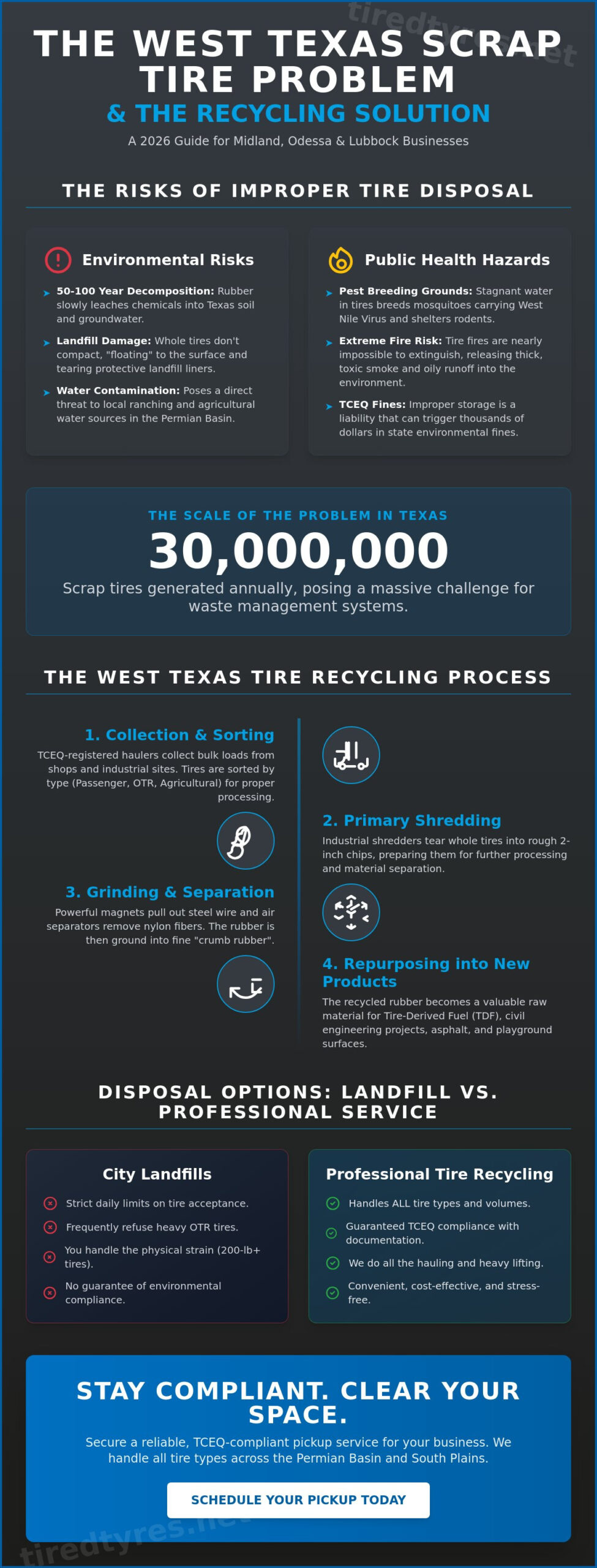
Tire recycling is the specific technical process of converting scrap tires into usable materials. It’s not just about clearing clutter from your shop or backyard. When you search for tire recycling near me in the Permian Basin, you’re participating in a critical environmental effort. Proper disposal ensures that old rubber doesn’t end up as a permanent blight on the Texas landscape. Landfills in Midland and Lubbock are increasingly restrictive about accepting whole tires because they don’t compact well and often “float” to the surface over time, damaging landfill liners.
Texas generates roughly 30 million scrap tires every year. In a region like West Texas, where the sun is intense and the wind is constant, abandoned tires pose unique risks. Professional recycling centers take these “faded” tires and shred them for civil engineering projects or ground rubber applications. This keeps our local communities cleaner and preserves the integrity of our regional waste management systems.
The Environmental Impact on West Texas Landscapes
Rubber is incredibly durable, which is great for driving but terrible for the environment. It takes 50 to 100 years for a tire to decompose in the Texas soil. During this century-long breakdown, chemicals can leach into the ground. In the Permian Basin, this creates a direct risk of groundwater contamination, potentially affecting local ranching and agricultural water sources. The tire recycling process prevents this by diverting rubber into secondary markets. Tire-derived fuel is a common recycling outcome where rubber is used as a high-energy heat source for cement kilns or paper mills. Using these alternatives reduces the need for raw fossil fuels while safely disposing of the waste.
Health Hazards of Scrap Tire Stockpiles
Scrap tire piles are more than an eyesore; they are a public health threat. In Odessa, even a small amount of rainfall can pool inside a tire casing, creating the perfect stagnant breeding ground for mosquitoes. These insects are primary carriers of the West Nile virus, which remains a consistent concern for Ector and Midland counties. Rodents also find these piles to be ideal nesting sites, leading to localized infestations near residential areas.
Fire is the other major danger. In our arid climate, a single spark can ignite a tire stockpile. Once a rubber fire starts in dry brush areas, it’s nearly impossible to extinguish. These fires release thick, toxic black smoke and oily runoff that can saturate the soil. You can learn more about these specific regional challenges in our guide on Waste Tire Problems in Midland, Odessa, and Lubbock. Choosing a legitimate tire recycling near me service is the most effective way to eliminate these hazards from our neighborhoods.
The West Texas Tire Recycling Process: From Pickup to Repurposing
Recycling a tire in West Texas involves more than just dropping it off at a collection point. It’s a precise industrial cycle that turns environmental hazards into valuable raw materials. When you search for tire recycling near me, you’re looking for a gateway into this specialized supply chain. The process begins with logistics and ends with high-performance products used across the South Plains. Proper handling ensures that scrap rubber stays out of our canyons and contributes to the local economy instead.
Collection and Sorting in the Permian Basin
Logistics in the Midland and Odessa areas require heavy-duty coordination. Permitted haulers use flatbeds and specialized trailers to collect bulk loads from auto shops, industrial sites, and fleet yards. Sorting happens immediately because passenger tires and Off-the-Road (OTR) tires require different shredding equipment. Heavy agricultural tires from Lubbock farms often need hydraulic cutters before they even reach the primary shredder. This initial sorting ensures that each material stream stays pure. Using a TCEQ-registered hauler is vital here. These professionals use a manifest system to track every tire from the point of origin to the final processing plant. This documentation prevents illegal dumping in our desert landscape and ensures compliance with state environmental laws.
From Scrap Rubber to New Products
Once at the facility, tires enter a multi-stage mechanical shredding process. Primary shredders break the rubber into two-inch chips. Secondary grinders then reduce these chips into crumb rubber, a fine material used in various industries. During this phase, powerful magnets pull out the steel wire, and air separators remove the fabric fiber. Data from the U.S. Tire Manufacturers Association indicates that nearly 100% of a tire’s weight is recyclable when processed correctly. This efficiency creates several local benefits:
- Tire-Derived Aggregate (TDA): Used in Texas civil engineering for lightweight fill in road embankments and vibration damping.
- Crumb Rubber: Found in playground mulch and synthetic turf fields in Midland and Lubbock schools.
- Rubberized Asphalt: Provides a quieter, more durable driving surface for West Texas highways that resists cracking in extreme heat.
The steel recovered from these tires often returns to the manufacturing sector to become new rebar or industrial components. If you’re managing a fleet or just finished a seasonal swap, it’s a good idea to check your tread depth before sending your old sets to the shredder. Proper maintenance extends the life of your rubber, but when they finally wear out, this recycling process ensures they don’t end up in a landfill.
City Landfills vs. Professional Tire Collection in West Texas
Many West Texas drivers and business owners assume the local dump is the simplest solution for old rubber. It isn’t. When you search for tire recycling near me, municipal landfills often appear first, but they come with significant hurdles. Hauling tires yourself requires time, a capable vehicle, and an understanding of complex local ordinances. For a single set of passenger tires, a landfill might work. For anything larger, it’s often a logistical headache.
The common “free tire disposal” claim is usually a myth for anyone with more than a few items. Most cities in the Permian Basin charge a per-tire fee once you exceed a very small residential limit. Additionally, city facilities are rarely equipped to handle specialized inventory. If you’re dealing with semi-truck casings or massive OTR (Off-The-Road) tires from an oil field site, the landfill will likely turn you away. They lack the industrial shredders required to process these heavy-duty materials.
Landfill Rules in Midland and Lubbock
In cities like Lubbock and Midland, daily limits are the standard. Residents are typically restricted to disposing of four to five tires per day. Most municipal sites refuse whole tires because they trap methane gas and eventually “float” to the surface, damaging the landfill liner. You’re often required to quarter or shred the tires before arrival. For specific local mandates, see the Tire Disposal in Midland, TX Guide. These rules make DIY disposal nearly impossible for high-volume users.
The Benefits of Professional Scrap Tire Pickup
Professional collection services offer a streamlined alternative that protects your bottom line. When you choose a professional partner for tire recycling near me, you move from manual labor to scheduled efficiency. This is vital for West Texas businesses that can’t afford to have technicians hauling waste instead of servicing customers.
- Liability Protection: Professional recyclers provide official waste manifests. This documentation is your legal proof of proper disposal, which is essential if environmental inspectors visit your site.
- Hazard Mitigation: Tires stored outdoors collect rainwater, creating breeding grounds for mosquitoes. Regular pickups eliminate these health risks and keep your property looking professional.
- Fleet Support: Professional services handle all sizes, including heavy equipment and tractor-trailer tires that city dumps won’t touch.
Outsourcing your tire scrap management ensures your business stays compliant with Texas Commission on Environmental Quality (TCEQ) standards. It’s a practical choice that trades the frustration of landfill lines for a reliable, documented pickup schedule. Instead of managing the mess yourself, you can focus on your core operations while experts handle the heavy lifting.
Navigating Texas Scrap Tire Regulations (TCEQ) for Businesses
The Texas Commission on Environmental Quality (TCEQ) manages every scrap tire generated in Midland, Odessa, and Lubbock. Under Texas Administrative Code Title 30, businesses that produce scrap tires are legally classified as “generators.” You can’t simply hand off these tires to anyone with a trailer. The state requires a closed-loop system to prevent illegal dumping, which remains a persistent issue across West Texas. When searching for tire recycling near me, business owners must prioritize compliance over convenience.
TCEQ utilizes a strict manifest system to track the lifecycle of every tire. This document serves as your proof of legal disposal. If a state inspector visits your shop, they’ll ask for these records immediately. Without them, you lack proof that your waste didn’t end up in a desert ravine or an unauthorized site. This tracking system ensures that the 20 million scrap tires generated in Texas annually are processed at authorized facilities.
Compliance for Auto Shops and Fleet Managers
Auto shops and fleet managers must use TCEQ Form 10311 to document the chain of custody. This form records the number of tires, the date of collection, and the signatures of both the generator and the hauler. Texas law mandates that businesses retain these disposal records for a minimum of three years. Keeping a clean filing system isn’t just about organization; it’s your primary defense during a TCEQ audit. For a deeper dive into local requirements, read our Texas Tire Disposal Regulations guide.
Identifying a Permitted Tire Hauler
Checking credentials takes five minutes but saves thousands in potential legal fees. Every legitimate hauler must possess a TCEQ registration number. You can verify this through the TCEQ Central Registry database before signing any contracts. Look for the official TCEQ “Scrap Tire Hauler” decal on the vehicle’s side. It must be current for the 2026 calendar year. If you hire an unpermitted hauler, the legal liability for any illegal dumping stays with you, the generator. Texas Health and Safety Code Chapter 361 allows for fines up to $10,000 per day for violations. Finding legitimate tire recycling near me means ensuring the person hauling the load is fully registered with the state.
Reliable Tire Collection Services for Midland, Odessa, and Lubbock
Tired Tyres serves as the primary expert for Permian Basin rubber waste management. We understand that finding reliable tire recycling near me involves more than just a quick search; it requires a partner who understands the industrial scale of West Texas. Our team manages the entire lifecycle of rubber waste, ensuring that every “tired” tyre is processed according to environmental standards. We handle a diverse range of materials, including standard passenger car tires, light truck tires, and massive OTR (Off-the-Road) equipment used in heavy industry.
Beyond standard vehicle tires, we offer specialized services for industrial rubber waste. This includes the removal and recycling of worn-out conveyor belts and high-pressure hoses commonly found in oil field operations. Scheduling a pickup is straightforward. You simply provide your location and the approximate volume of waste, and our team provides a transparent quote based on current logistics and processing requirements. We prioritize efficiency to ensure your job site remains clear of debris.
OTR and Agricultural Tire Solutions
Oil field sites and large-scale farms face unique challenges with rubber disposal. We have the specialized equipment necessary to transport and process large-scale tires from loaders, earthmovers, and graders. Our services extend to the removal of scrap skid steer tracks and solid rubber tires that standard haulers often refuse. For more information on high-volume needs, see our guide on Commercial Tire Disposal in West Texas. We ensure these massive components don’t end up in unauthorized landfills, protecting your business from potential compliance issues.
Serving the Entire West Texas Region
Our service area spans the heart of the region. We provide consistent coverage for Midland, Odessa, Lubbock, and the surrounding counties. If you are searching for tire recycling near me in Ector County or the Lubbock area, our logistics network is designed to reach you quickly. We are committed to keeping the West Texas environment clean and compliant with state regulations. Proper disposal prevents fire hazards and eliminates breeding grounds for pests, contributing to a safer community for everyone. Get your scrap tire pickup quote from Tired Tyres today and let our professionals handle the heavy lifting.
Streamline Your West Texas Scrap Tire Management
Managing scrap tires in the Permian Basin and South Plains doesn’t have to be a logistical headache. As 2026 approaches, staying compliant with Texas Commission on Environmental Quality (TCEQ) regulations is the most effective way to protect your business from unnecessary liabilities. While local landfills often impose strict daily limits on rubber disposal, professional collection offers a seamless alternative for high-volume needs. Our team operates as a TCEQ Permitted Hauler, bringing specialized OTR and industrial rubber equipment directly to your site in Midland, Odessa, or Lubbock. This ensures that even the most massive tires are handled with professional precision and care. If you’ve been searching for reliable tire recycling near me, you’ve found a partner committed to keeping West Texas clean and productive. We take the weight off your shoulders by providing transparent, efficient service that fits your specific schedule. Let’s work together to clear your lot and keep your operations running smoothly. Schedule your professional tire pickup in West Texas today. You’ll rest easy knowing your scrap rubber is in expert hands.
Frequently Asked Questions
Is there free tire recycling near me in Midland or Odessa?
Free tire recycling near me in Midland or Odessa is typically limited to specific municipal collection events. The City of Midland holds annual community cleanup days where residents can drop off up to four passenger tires without a fee. Outside these events, local drop-off sites usually charge a small handling fee to cover transportation and processing costs.
How many tires can I take to the Lubbock landfill?
Residents can take up to four passenger tires per visit to the Lubbock landfill at the Caliche Canyon site. This limit applies to individual households and requires a valid utility bill as proof of residency. If you have more than four tires or commercial-grade rubber, you’ll need to schedule a professional pickup to comply with 2026 city disposal ordinances.
What is a scrap tire manifest and do I need one?
A scrap tire manifest is a legal document required by the Texas Commission on Environmental Quality (TCEQ) to track the movement of tires. You need one if you’re transporting more than five scrap tires at once. It ensures that every tire reaches a registered processing facility rather than ending up in a roadside dump or an unauthorized site.
Can you recycle OTR tires from oil field equipment?
You can recycle OTR tires from oil field equipment, but they require specialized heavy-duty hauling. These massive tires from loaders and earthmovers are processed into rubber mulch or used in civil engineering projects. Tired Tyres manages the logistics for these oversized items, ensuring oil field operators stay compliant with current environmental standards.
What happens to tires after they are picked up for recycling?
Tires are processed into various raw materials after they’re picked up for recycling. Most are shredded into crumb rubber for turf fields or used as Tire-Derived Fuel (TDF) in industrial kilns. About 25 percent of recycled tires in Texas are repurposed for civil engineering projects like road sub-base and embankment fill.
Does Tired Tyres pick up industrial rubber like conveyor belts?
Tired Tyres picks up industrial rubber including worn conveyor belts and dock bumpers. We provide specialized containers for West Texas industrial sites to collect these materials efficiently. This service helps local businesses clear space and maintain a professional, hazard-free work environment while ensuring all industrial waste is documented correctly.
How much does tire disposal cost in West Texas?
Tire disposal costs in West Texas vary based on the tire size and quantity. According to 2024 regional landfill data, passenger tires typically cost between 3 and 8 dollars each at drop-off points. When searching for tire recycling near me, you’ll find that commercial truck tires often range from 15 to 35 dollars per unit due to their weight and steel content.
Are there fines for storing too many tires on my property in Texas?
Texas law allows for significant fines if you store more than 500 scrap tires without a permit. Under the Texas Health and Safety Code, illegal dumping or improper storage can result in administrative penalties of up to 10,000 dollars per day. Keeping tires on your property also creates fire hazards and breeding grounds for mosquitoes, which triggers local code enforcement actions.