
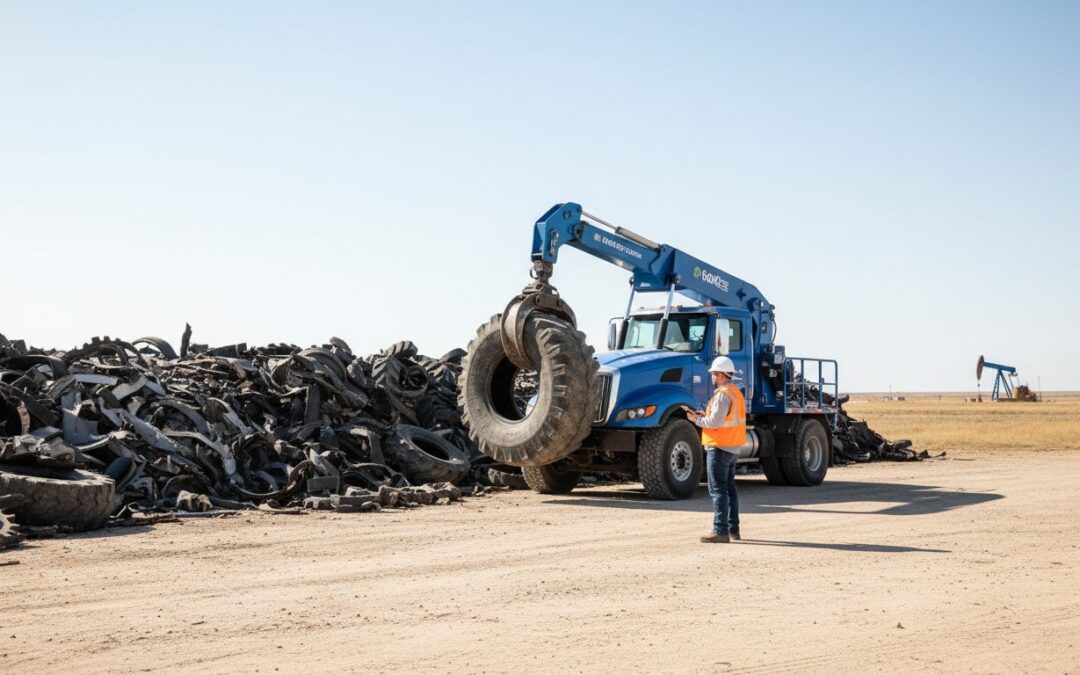
Could a single pile of neglected tires really cost your operation $25,000 per day in TCEQ fines? In West Texas, the answer is a definitive yes, especially since the state managed 39.7 million scrap tires in 2024. Finding professional Permian Basin rubber disposal services isn’t just about cleaning up your yard; it’s about protecting your bottom line from aggressive environmental enforcement. You’re likely tired of general waste haulers refusing oversized OTR tires or leaving you to handle complex manifest paperwork on your own.
It’s frustrating to watch industrial rubber accumulate while the December 31, 2025, annual reporting deadline approaches. This guide provides the tools to streamline your disposal process, ensuring every scrap hose and agricultural tire is tracked from your site to a verified facility. You’ll learn the exact 2026 pricing for bulk removal and how to maintain compliance with storage thresholds so you can focus on operations instead of audits.
Key Takeaways
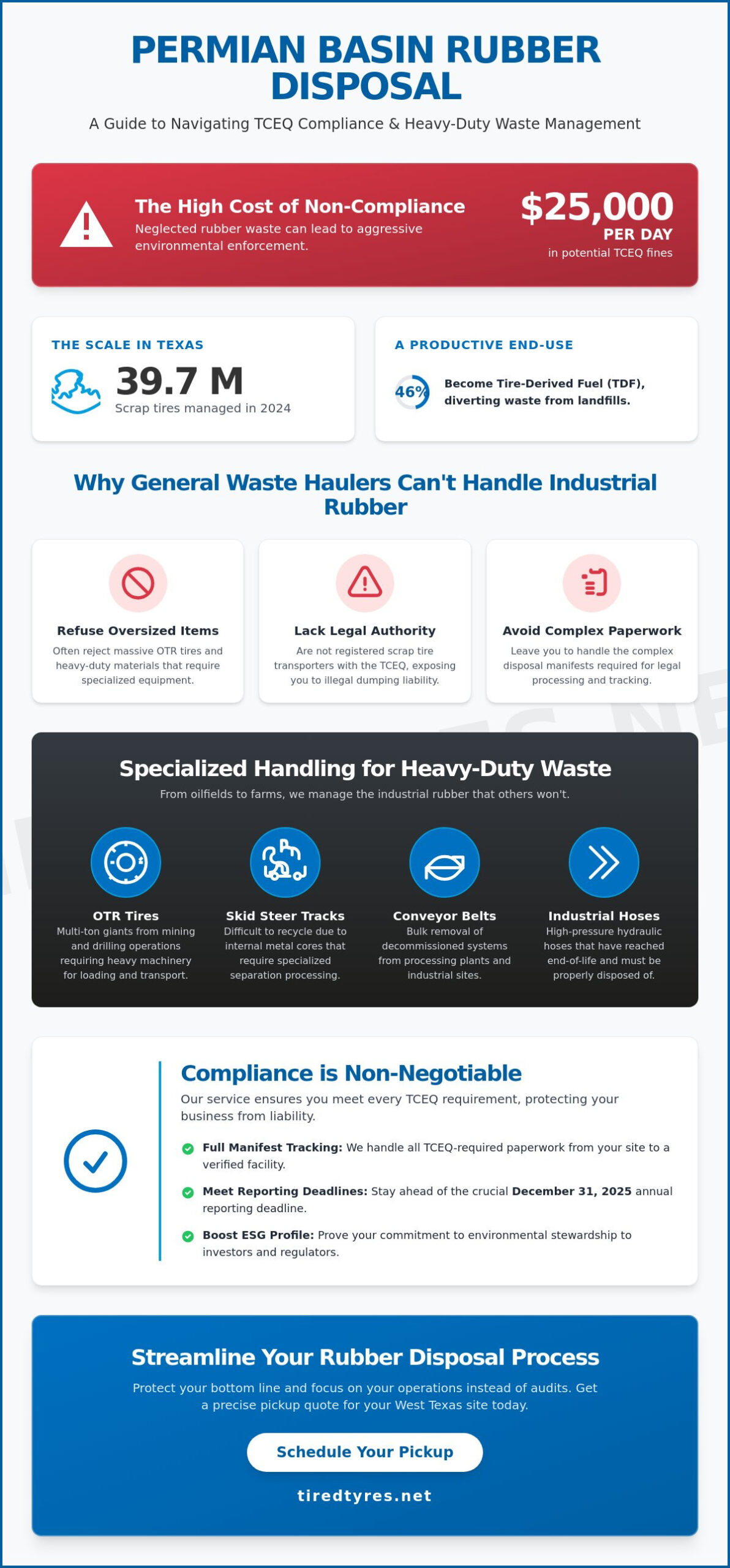
- Ensure full compliance with the latest TCEQ manifest requirements to protect your business from illegal dumping liability and potential $25,000 daily fines.
- Identify the specific challenges of managing heavy-duty OTR tires and metal-core skid steer tracks that general waste haulers often refuse to collect.
- Optimize your operational efficiency by utilizing specialized Permian Basin rubber disposal services designed for the unique needs of the oil, gas, and agricultural sectors.
- Learn how to accurately assess your rubber waste volume to receive a precise pickup quote and prepare your West Texas site for seamless heavy-duty collection.
What are Permian Basin Rubber Disposal Services?
Permian Basin rubber disposal services provide the specialized collection, transport, and processing of scrap tires and industrial rubber products. These services are essential for oil and gas exploration, commercial trucking, and large-scale agricultural operations. In 2026, professional rubber disposal is a critical ESG component for West Texas businesses seeking to prove environmental stewardship to investors and regulators. The scope of these services covers everything from standard passenger tires to massive OTR (Off-the-Road) units and industrial hoses. Because industrial rubber doesn’t break down like organic waste, it requires a dedicated logistics chain to move it from the field to a registered processing facility.
The Scale of Rubber Waste in West Texas
The Permian Basin generates unique waste streams that you won’t find in other regions. While a typical city handles mostly passenger tires, West Texas deals with massive volumes of heavy-duty materials. In 2024, Texas managed approximately 39.7 million scrap tires, with a significant portion originating from industrial hubs like Midland and Odessa. Local industries are shifting from old-fashioned stockpiling to active remediation to meet modern safety standards. This means clearing out old conveyor belts, rubber skid steer tracks, and hydraulic hoses that have sat on-site for years. These items represent a significant fire hazard and a liability for any site manager. Modern Permian Basin rubber disposal services ensure these materials are diverted toward productive end-uses, such as tire-derived fuel (TDF), which accounted for 46% of managed tires in 2024.
Why General Waste Haulers Often Decline Rubber
Most general waste haulers aren’t equipped for the realities of industrial rubber. Standard roll-off containers have strict weight and volume constraints that make them unsuitable for dense, heavy items like solid tires or OTR units. Transporting a single OTR tire requires specialized loading equipment and trailers; it’s not a job for a standard garbage truck. Additionally, Texas landfill restrictions prevent the disposal of whole tires or bulk rubber products in many municipal facilities. If a hauler isn’t a registered scrap tire transporter with the TCEQ, they risk massive fines. Businesses often find that general haulers simply refuse to touch oversized rubber items because they lack the proper disposal manifests required for legal processing. Using professional Permian Basin rubber disposal services ensures that these complex materials are handled correctly from the moment they leave your site, protecting you from the liability of illegal dumping.
Managing Heavy-Duty Industrial Rubber Waste
Heavy-duty industrial rubber waste presents a unique logistical challenge that standard trash services simply can’t handle. In the West Texas heat, leaving massive piles of rubber to degrade isn’t just an eyesore; it’s a significant environmental and fire risk. When industrial rubber sits in the sun, it can leach chemicals into the soil or become a breeding ground for pests. Mining and drilling operations often accumulate massive volumes of scrap that require more than a standard flatbed. To maintain a clean and safe job site, operators rely on professional Permian Basin rubber disposal services to handle the logistics of heavy, awkward materials. This includes everything from decommissioned conveyor systems to high-pressure hydraulic hoses that have reached the end of their service life.
The OTR Tire Disposal Challenge
Off-the-Road (OTR) tires are the giants of the industry. A 63-inch tire can weigh several tons, making it impossible for standard crews to move without heavy machinery. Loading and securing these oversized loads requires strict safety protocols to prevent accidents during transport. If you’re storing these on-site, you’re essentially sitting on a massive liability. Many businesses find that the cost-benefit of professional OTR collection far outweighs the risks of on-site storage, which can lead to TCEQ violations. Proper disposal feeds into sustainable tire recycling markets, where the rubber is repurposed rather than left to rot. Choosing specialized Permian Basin rubber disposal services prevents these materials from becoming permanent eyesores on your property.
Conveyor Belts and Industrial Hoses
Processing plants in the region often struggle with decommissioned conveyor belts and scrap skid steer tracks. Skid steer tracks are particularly difficult because they contain internal metal cores. You can’t just toss them into a standard shredder; they require specialized processing to separate the rubber from the steel. Bulk removal of conveyor systems also requires a strategic approach to manage the sheer volume of material. Oilfield service companies also produce miles of high-pressure scrap hoses that need a dedicated disposal route. At Tired Tyres, we use specialized equipment designed specifically for heavy industrial rubber removal. We ensure that even the most difficult materials, like solid tires and reinforced hoses, are cleared from your site efficiently. This proactive management keeps your facility compliant and operational without the clutter of industrial waste.
TCEQ Compliance and Texas Tire Disposal Regulations
Compliance in the West Texas oilfield isn’t just about checking a box; it’s about protecting your company from massive financial liability. The Texas Commission on Environmental Quality (TCEQ) maintains strict oversight on how scrap tires and industrial rubber are moved and stored. If you’re managing a site in Midland or Lubbock, you’re likely aware that improperly disposing of tires can result in fines of up to $25,000 per day. Professional Permian Basin rubber disposal services act as your first line of defense against these penalties. By following the state’s rigorous scrap tire rules, you ensure that your waste doesn’t become a legal nightmare. These regulations exist to prevent fire hazards and public health risks, but they also place the burden of proof squarely on the business owner.
A key part of this process is verifying that you’re working with a permitted tire hauler in Texas. TCEQ registration is mandatory for any site storing more than 500 tires on the ground or 2,000 in enclosed containers. If those thresholds are exceeded without registration, or if tires are handed off to an unpermitted hauler, the original generator faces the consequences. It doesn’t matter if the tires left your property weeks ago; if they’re found in a ditch or an unauthorized site, the manifest is the only thing that proves you did your part. Reliable Permian Basin rubber disposal services provide this documentation as a standard part of every pickup, ensuring you stay within the law.
The Legal Paper Trail: Manifests and Records
The Scrap Tire Manifest is a multi-part document that tracks rubber from the point of generation to its final destination. When a hauler picks up your scrap, you receive a copy of this manifest. Once the rubber reaches a permitted processing or recycling facility, the final signed copy is returned to you. You must retain these records for state audits to prove that every pound of rubber was handled legally. It’s a hard truth of Texas law: the generator remains liable for the waste until the rubber reaches a permitted facility. Keeping an organized file of these manifests is the only way to survive a TCEQ inspection without heavy penalties.
Avoiding the “Solar Cowboy” Haulers
In the Permian Basin, you’ll often encounter “solar cowboy” haulers who offer low-cost or cash-only pickups with no paperwork. These are major red flags that should never be ignored. If a hauler can’t provide a current TCEQ registration number or refuses to sign a manifest, they aren’t a legitimate service. There’s a high risk that these tires will end up in an illegal dump site, and when investigators find them, they’ll trace them back to your operation. Tired Tyres eliminates this risk by ensuring 100% regulatory compliance for every load we carry. We handle the paperwork, provide the necessary manifests, and give you the peace of mind that your disposal process is audit-ready and professional.
Logistics: Scheduling Rubber Pickup in Midland, Odessa, and Lubbock
Logistics in West Texas require more than just a truck and a trailer. Managing rubber waste across the vast distances of the oilfield takes precise coordination and local expertise. Whether you’re clearing out a drilling site or managing a commercial fleet, the first step is always a volume assessment. You need to know exactly what you’re moving to get an accurate tire pickup quote in Midland. Counting standard passenger tires is straightforward, but estimating the weight of scrap conveyor belts or reinforced skid steer tracks requires a more technical approach. Professional Permian Basin rubber disposal services help you categorize these materials so the right equipment arrives on day one. This prevents multiple trips and keeps your project on schedule.
Every operation has different needs when it comes to removal frequency. Some sites require a one-time remediation to clear years of accumulated industrial waste before a property transfer or inspection. Others, like high-volume service centers, benefit from a scheduled tire pickup for Odessa auto shops. This ensures that fire hazards never have the chance to build up. For companies managing multiple locations across Midland, Odessa, and Lubbock, we coordinate logistics to synchronize pickups. This centralized approach reduces the administrative burden on your site managers and ensures that every load is tracked under a single, compliant system. Efficiency isn’t just about moving rubber; it’s about moving it without disrupting your daily operations.
Site Preparation for Bulk Collection
Preparing your site is the best way to reduce labor costs and speed up the collection process. Staging your rubber waste in a centralized location allows our crews to load the vehicle quickly. If you’re dealing with OTR tires, ensure there’s enough safety clearance for forklift or crane operations. Semi-trucks and trailers need firm, level ground and plenty of room to maneuver, especially in tight oilfield environments. Clearing a path and removing debris from the staging area prevents equipment damage and keeps our team safe. When the site is ready, Permian Basin rubber disposal services can move tons of material in a single afternoon, leaving you with a clean, compliant yard.
Regional Service Nuances
The type of rubber waste we see often depends on the specific zip code. In the Midland and Odessa area, the focus is almost entirely on high-volume oilfield rubber disposal, including heavy OTR tires and industrial hoses. Lubbock operations tend to center more on agricultural and commercial trucking tire collection. Because we operate across the entire basin, we optimize our routes to keep costs competitive for our clients. We don’t just drive from point A to point B; we strategically plan loads to maximize efficiency. If you’re ready to clear your site, contact Tired Tyres today to schedule a professional assessment of your industrial rubber waste.
Tired Tyres: Your Permian Basin Rubber Disposal Partner
Choosing the right partner for industrial waste management is a decision that impacts your site safety and your regulatory standing. While general waste haulers manage everything from cardboard to food scrap, Tired Tyres maintains a specialized focus on rubber. This specialization makes our Permian Basin rubber disposal services significantly more efficient than standard trash collection. We understand the specific density of solid tires and the structural challenges of metal-core tracks. Our teams don’t show up with the wrong equipment; we arrive with the specialized trailers and loading tools required to clear your yard quickly. We’ve built our reputation on being the “boots on the ground” experts who handle the heavy lifting that others refuse to touch.
Our service list is built to match the diverse needs of West Texas industry. We provide comprehensive collection for a wide range of materials, including:
- Passenger and light truck tire collection
- Semi-truck and agricultural tire collection
- Heavy-duty OTR (Off-the-Road) tire collection
- Scrap skid steer track and solid tire collection
- Scrap hose and conveyor belt collection
- General scrap rubber and industrial rubber waste collection
The Tired Tyres Advantage
We’re a locally owned and operated business. We know the geography of the Permian Basin and the specific demands of the oilfield because we live and work here. This local expertise allows us to offer transparent pricing without the hidden “heavy load” surcharges or fuel adjustments that national corporations often tack onto their invoices. When you work with us, you get a straightforward quote and a professional crew trained in industrial site safety protocols. We respect your operational boundaries and ensure our collection process causes minimal disruption to your daily workflow. Join the hundreds of Permian operators who trust Tired Tyres to keep their sites clean and compliant.
Beyond Disposal: Supporting West Texas ESG
Environmental, Social, and Governance (ESG) goals are becoming a standard requirement for operators in the region. Choosing a permitted recycler for your rubber waste is a direct way to improve your company’s environmental footprint. By diverting tires from illegal dumps and landfills, you contribute to a more sustainable industrial ecosystem. We’re committed to active waste tire problem remediation, ensuring that old stockpiles are cleared and processed correctly. Supporting a West Texas-based service provider also keeps your disposal spend within the local economy, strengthening the community we all share. It’s a professional approach to a difficult waste stream that benefits both your business and the environment.
Don’t let industrial rubber become a permanent liability on your property. Our Permian Basin rubber disposal services are designed to take the burden of compliance and logistics off your shoulders. Whether you have a single OTR unit or a warehouse full of decommissioned conveyor belts, we have the capacity to handle it. Contact our Midland or Odessa teams today to develop a customized disposal plan that fits your specific volume and schedule.
Secure Your Site and Compliance Today
Managing industrial waste in West Texas shouldn’t be a constant source of stress for your operations team. By prioritizing professional Permian Basin rubber disposal services, you eliminate the risk of $25,000 daily TCEQ fines and clear hazardous stockpiles from your property. You’ve seen how a verified manifest protects your liability and why specialized equipment is necessary for heavy OTR tires and metal-core tracks. Professional handling ensures that these materials are processed correctly rather than becoming a permanent eyesore on your job site.
Tired Tyres has served Midland, Odessa, and Lubbock as a TCEQ Permitted Hauler since 2026. We bring specialized OTR loading equipment to every industrial job, ensuring your site stays clean without operational delays. It’s time to stop letting scrap rubber clutter your facility and start working with a partner who understands the local landscape. Request a Bulk Rubber Disposal Quote for Your Permian Basin Site today. Your site’s safety and regulatory compliance are just one professional pickup away.
Frequently Asked Questions
Can I legally dispose of whole tires in a Midland or Odessa landfill?
You cannot legally dispose of whole tires in municipal landfills across Midland or Odessa due to Texas state regulations. Whole tires are banned from these facilities because they trap methane gases and tend to “float” to the surface, which can breach landfill liners. Most Texas facilities require tires to be split, quartered, or shredded before they can be accepted for final disposal. Professional Permian Basin rubber disposal services ensure your scrap is processed at a permitted facility that meets these environmental standards.
What is a TCEQ scrap tire manifest and why do I need one?
A TCEQ scrap tire manifest is a mandatory tracking document that records the movement of waste tires from your site to a processing facility. You need this document because it serves as your only legal proof of compliance during a state audit. Without a signed manifest, your business remains legally liable for the tires even after they leave your property. If those tires are found in an illegal dump site, the lack of a manifest could result in your company facing significant cleanup costs and penalties.
How much does OTR tire disposal cost in the Permian Basin?
OTR and machinery tire disposal costs are calculated based on weight and dimensions due to the specialized equipment required for transport. As of May 2026, standard farm, ranch, and machinery tires are priced at $0.20 per pound. For oversized units, the rate is $45.00 plus the $0.20 per pound fee. These rates reflect the logistical complexity of moving tires that often weigh several thousand pounds and require heavy-duty loading machinery to handle safely.
Do you provide collection services for scrap conveyor belts and hoses?
Yes, Tired Tyres provides dedicated collection for decommissioned conveyor belts and high-pressure scrap hoses from industrial sites. These items are frequently rejected by general waste haulers because their length and weight make them difficult to manage in standard containers. We use specialized trailers to remove these bulky materials directly from your processing plant or oilfield location. This service prevents the accumulation of fire hazards and keeps your yard organized and ready for inspections.
How quickly can Tired Tyres schedule a bulk rubber pickup in Lubbock?
We typically schedule bulk rubber pickups in Lubbock within 48 hours of your service request. Our regional routing efficiency allows us to coordinate pickups across the basin to ensure a fast response for our clients. For large-scale site remediations involving hundreds of tires, we recommend calling at least three days in advance to secure the necessary heavy-duty trailers. Fast scheduling helps you clear your site before the December 31, 2025, TCEQ reporting deadline.
What happens if I use an unpermitted tire hauler in Texas?
Using an unpermitted hauler exposes your business to state-issued fines of up to $25,000 per day. If an unlicensed individual illegally dumps your waste, the TCEQ will trace those tires back to your operation using serial numbers or site records. Since an unpermitted hauler cannot provide a valid manifest, you’ll be held responsible for the entire cleanup cost. It’s a risk that can easily bankrupt a small operation or severely damage a major corporation’s reputation.
Do you offer recurring pickup services for commercial trucking fleets?
Yes, we offer scheduled Permian Basin rubber disposal services tailored for commercial trucking fleets and maintenance centers. Regular pickups ensure your shop never exceeds the TCEQ storage threshold of 500 tires on the ground. We establish a weekly or monthly rotation based on your specific volume to keep your facility clear of clutter. This proactive approach ensures you’re always audit-ready and that your workspace remains safe for your mechanics and drivers.
Are there specific requirements for disposing of skid steer tracks with metal cores?
Skid steer tracks with metal cores require specialized disposal because they cannot be processed by standard rubber shredding equipment. The internal steel reinforcement must be separated from the rubber at a dedicated processing facility. We collect these tracks and transport them to specialized recyclers who can reclaim both the metal and the rubber. This specialized handling prevents you from being turned away at standard recycling centers and ensures your tracks are managed according to state law.