
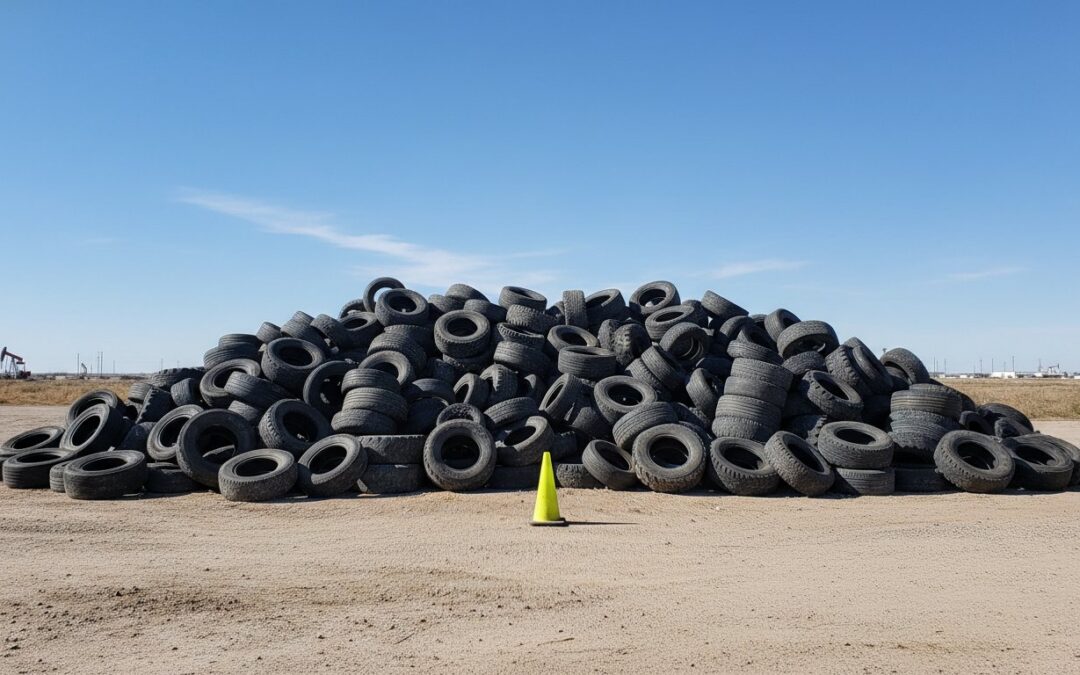
In Texas, a single week of non-compliance fines can cost your business more than a decade of professional tire collection services. If you’re currently asking what are the fines for improper tire storage in Texas, you’re likely aware that the Texas Commission on Environmental Quality (TCEQ) doesn’t take storage violations lightly. State-level administrative penalties can reach $25,000 per violation, per day. You probably started your business to provide a valuable service, not to spend your nights worrying about registration thresholds or the looming March 1 reporting deadline.
This 2026 guide will help you understand exactly where the legal line is drawn. You’ll learn the specific numbers that trigger registration requirements, such as the 500-tire limit for ground storage, and the difference between civil and criminal penalties. We’ll also cover the manifest system requirements and show you how to clear your site legally and efficiently. By the end of this article, you’ll have a clear roadmap to keep your operations compliant and your bank account protected from avoidable state and local fines.
Key Takeaways
- Differentiate between open-air storage and enclosed container limits to stay below mandatory TCEQ registration requirements.
- Review the full structure of what are the fines for improper tire storage in Texas, including the difference between daily civil and administrative penalties.
- Understand the health and safety risks, from fire hazards to mosquito breeding, that make tire piles a high-priority target for Texas inspections.
- Secure your business against liability by mastering the TCEQ manifest system and maintaining “cradle-to-grave” documentation for every haul.
- Explore how professional scrap rubber and tire collection services provide the necessary paperwork to clear your site legally and efficiently.
Texas Scrap Tire Storage Laws: Understanding the 500-Tire Threshold
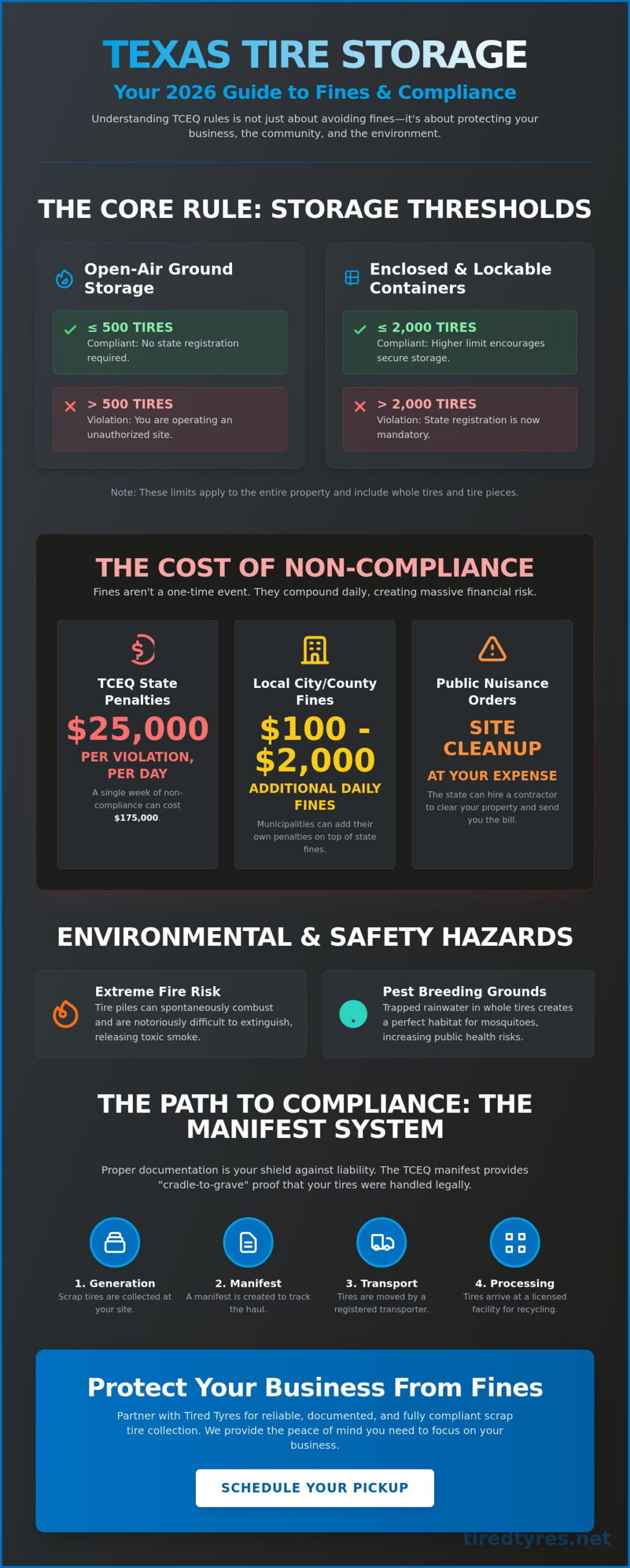
Texas law is very specific about when a pile of rubber becomes a legal liability. The Texas Commission on Environmental Quality (TCEQ) enforces what’s commonly known as the “500 Rule.” If you have 500 or fewer used or scrap tires stored on the ground, you don’t need a state registration. However, storing 501 tires without a permit is an immediate violation. This threshold includes whole tires, tire pieces, or any combination of the two. It’s a hard limit that applies to the entire property, not just a single pile.
There’s a significant exception for businesses that use enclosed and lockable containers, such as trailers or sea-cans. In these cases, you can store up to 2,000 tires before a state registration is required. This higher limit is designed to encourage secure storage that prevents the environmental hazards of scrap tires, such as pest infestations and spontaneous combustion. If you’re wondering what are the fines for improper tire storage in Texas, remember that exceeding these limits without the proper paperwork is the most common way businesses face penalties. Even if you’re one tire over the limit, you’re technically operating an unauthorized storage site.
For long-term storage, Texas requires tires to be processed. This means they must be shredded, split, or quartered. Whole tires trap water and air, which creates a breeding ground for mosquitoes and increases fire risks. Agricultural operations have some leeway when using tires for silage covers or bumpers, but they aren’t exempt from the rules if the tires are simply being stockpiled. Once a tire is no longer serving a specific agricultural purpose, it’s classified as scrap and falls under the standard storage limits.
The TCEQ Registration Process
If your West Texas business needs to store more than the allowed limits, you must register as a scrap tire storage site. This registration is valid for 60 months. While there’s no fee to apply, the process is often burdensome for smaller shops in Midland or Lubbock. You’re required to provide financial assurance, which usually means a closure cost bond. This ensures the state isn’t left with a cleanup bill if your business closes. Because of these complex requirements, many owners find it’s more cost-effective to schedule regular collections rather than maintaining a registered site.
Used Tires vs. Scrap Tires
Not every tire on your lot is considered waste. Texas law distinguishes between resalable used tires and scrap tires. To be classified as a used tire, it must pass a “good condition” test. This means it has a minimum tread depth and no visible sidewall damage or exposed cords. You should clearly label and separate your used inventory from your scrap pile. If an inspector finds a “used” tire that’s bald or damaged, they’ll count it toward your 500-tire limit, which can quickly lead to an unexpected violation and costly fines.
Fines and Legal Penalties for Improper Tire Storage in Texas
If you exceed the storage limits discussed in the previous section, you’re entering a high-stakes financial game. The state doesn’t just issue a one-time ticket. Instead, the Texas Commission on Environmental Quality (TCEQ) can assess administrative penalties of up to $25,000 per violation, per day. This means a single week of non-compliance could theoretically cost your business $175,000. When business owners ask what are the fines for improper tire storage in Texas, they often underestimate the “daily accrual” trap. The clock doesn’t stop ticking until the site is cleared and documented.
Beyond state-level action, local municipalities in the Permian Basin and South Plains often enforce their own specific ordinances. While state law sets the ceiling, local codes in cities like Midland or Lubbock allow for additional daily fines that range from $100 to $2,000 per violation. Under the Texas Health and Safety Code § 361.112, the state also has the authority to declare your property a public nuisance. This allows the government to clear the site at your expense, adding massive abatement fees on top of your existing fines.
Civil vs. Administrative Penalties
The TCEQ uses a penalty matrix to calculate fines based on “gravity.” They look at the size of the pile, its proximity to water sources, and your history of non-compliance. Administrative penalties are issued directly by the agency without going to court, making them much faster to process. Inspectors in Lubbock and Midland counties have increased site visits recently to ensure commercial yards aren’t becoming fire hazards. If you’ve had past warnings, the “good faith” credits that usually lower a fine will disappear, leading to the maximum possible penalty.
The Cost of Illegal Dumping
There’s a legal distinction between “improper storage” and “illegal dumping.” If tires are moved to an unauthorized site or left on a roadside, you face criminal charges. In Texas, sentencing for illegal dumping is often weight-based. If the scrap tires exceed five pounds, it’s a Class C misdemeanor; however, commercial-scale dumping can quickly escalate to a state jail felony. You can read more about these distinctions in our guide to Texas Tire Disposal Regulations. To avoid these risks, many businesses find that regular scrap rubber collection is the most predictable way to manage costs.
Environmental Hazards: Why Texas Cracks Down on Scrap Tire Piles
Texas regulators don’t just focus on the number of tires on your lot because of paperwork. They care about the catastrophic risks those piles represent to the community. In the arid environment of West Texas, a scrap tire pile is essentially a massive fuel source waiting for a spark. Tire fires are notoriously difficult to extinguish because the hollow shape of the tire traps oxygen, while the rubber itself acts as a high-energy fuel. These fires can burn for weeks, releasing toxic black smoke and oily runoff that is nearly impossible to contain once it hits the soil.
When you consider what are the fines for improper tire storage in Texas, it’s helpful to view those penalties as a preventative measure against these disasters. Beyond the fire risk, chemical leaching is a quiet but serious threat. As rubber decomposes under the intense Texas sun, it can release heavy metals and hydrocarbons. In the Permian Basin, where groundwater protection is a top priority, a poorly managed tire pile can lead to long-term soil contamination that requires expensive professional remediation. If a city deems your property a public health hazard, they can use the “Nuisance Abatement” law to clear the site without your consent. They will then bill you for the entire operation, which often costs significantly more than a scheduled collection service.
The Permian Basin Climate Factor
Extreme heat in Midland and Odessa accelerates the degradation of rubber, making older piles more volatile. During drought seasons, local enforcement priorities shift heavily toward fire prevention. Inspectors are often more aggressive when they see large, uncovered piles in high-heat zones. You can find more specific information on these regional challenges in our guide on Waste Tire Problems in West Texas. Staying compliant during the summer months is critical for avoiding emergency inspections.
Public Health Liabilities
Mosquito-borne illnesses are the primary reason local health departments in Lubbock and Midland trigger TCEQ investigations. Even a small amount of stagnant water trapped inside a tire can host thousands of larvae. This creates a breeding ground for vectors of West Nile and Zika viruses right next to commercial areas. Health departments don’t wait for a fire to take action; they often report standing water violations to state regulators immediately. The resulting fines and the cost of mandatory vector control treatments can quickly become a major financial burden for your business.
The Manifest System: How to Prove Your Business is Compliant
The manifest is your only legal defense when a TCEQ inspector arrives at your shop. In Texas, the scrap tire manifest, specifically Form 00103, acts as a tracking document that follows the rubber from your property to a permitted disposal or recycling facility. You might have cleared your lot, but if you can’t produce the paperwork to prove where those tires went, you’re still at risk. This is often how businesses discover exactly what are the fines for improper tire storage in Texas the hard way; without a manifest, the state assumes the tires were disposed of illegally or are still part of your storage count.
Texas operates under a “cradle-to-grave” liability system. This means you remain legally responsible for those tires until they reach their final, authorized destination. If you hire a “guy with a trailer” because he’s cheap, and he dumps those tires in a Lubbock alleyway, the TCEQ will trace them back to you. You’ll be the one facing the daily accrual fines and potential criminal charges. A professional passenger and light truck tire collection service eliminates this risk by providing the required state documentation at the point of pickup.
State law requires you to keep these records for at least three years. These documents must be readily available for inspection at your place of business. If an inspector finds 600 tires on your lot but you have manifests showing a recent pickup of 2,000 tires, you can prove you’re actively managing your inventory. Without that paper trail, you’re simply a business operating an unauthorized storage site.
The Three-Part Manifest Process
The manifest process consists of three critical stages. First, as the generator, you must sign the manifest and keep the initial copy before the truck leaves your property. Second, you must verify that your hauler has a valid TCEQ transporter registration number clearly listed. Finally, you should receive a “return copy” from the disposal facility within 60 days. This final copy confirms the tires reached a legal site, effectively ending your “cradle-to-grave” liability for that specific load.
Common Paperwork Mistakes
Many West Texas businesses fail audits because of simple data entry errors. Incomplete destination addresses or missing transporter signatures can invalidate the entire document in the eyes of the TCEQ. Remember that standard invoices or credit card receipts are not legal substitutes for a state-mandated manifest. You can learn more about maintaining a clean audit trail in our Commercial Tire Disposal Guide. Accurate record-keeping is the most effective way to ensure a routine inspection doesn’t turn into a financial disaster.
How Tired Tyres Protects Your West Texas Business from Storage Fines
Understanding what are the fines for improper tire storage in Texas is the first step toward protecting your business. The second step is implementing a removal schedule that keeps your inventory well below the 500-tire threshold. Tired Tyres provides professional collection services across Midland, Odessa, and Lubbock, ensuring your commercial site stays compliant without the stress of constant self-monitoring. We don’t just haul rubber; we provide the professional documentation you need to survive a state audit. By maintaining a clean yard, you eliminate the fire risks and health hazards that draw the attention of local inspectors.
Our team handles a wide range of scrap materials that often clutter industrial and automotive yards. This includes passenger and light truck tire collection, semi-truck tires, and specialized agricultural tire collection. We also manage heavy OTR tire collection and scrap solid tires. For industrial sites, we offer scrap skid steer track collection along with scrap conveyor belt, scrap hose, and scrap rubber collection. Centralizing your rubber waste management with a single permitted hauler simplifies your record-keeping and reduces the risk of paperwork errors that lead to administrative penalties.
Our Permitted Hauling Service
Using a registered transporter is your primary defense against the “cradle-to-grave” liability discussed earlier. Our TCEQ registration number is included on every manifest we sign, providing a clear trail for inspectors to follow. We establish reliable pickup schedules for auto shops and industrial yards to prevent bulk build-ups from ever reaching the 501-tire violation mark. You can learn more about our process in our guide to Reliable Tire Disposal. Consistent service means you never have to worry about an unexpected site visit turning into a financial disaster.
Clearing Out Bulk Accumulations
If your property is already facing a code enforcement deadline, we provide rapid site remediation to bring you back into compliance. We have the equipment to handle large-scale industrial rubber waste removal, including heavy agricultural and OTR units that standard haulers often refuse. Clearing these piles quickly is the only way to stop the daily accrual of civil penalties. Don’t let a legacy pile become a permanent financial burden on your operations. Get a quote for legal tire disposal in Midland or Odessa today and secure your business’s future with professional, manifest-backed collection.
Secure Your Business Against Texas Storage Penalties
Operating a commercial yard in West Texas requires constant vigilance. Staying under the 500-tire threshold and maintaining a rigorous manifest system aren’t just suggestions; they’re essential for your survival. Now that you know what are the fines for improper tire storage in Texas, it’s clear that the risk of a $25,000 daily penalty far outweighs the cost of professional removal. Keeping your site clear of scrap rubber prevents fire hazards and stops health department investigations before they start.
Tired Tyres is a fully permitted TCEQ tire hauler serving the Permian Basin and South Plains. We provide the comprehensive manifest documentation you need to prove 100% compliance during any audit. Whether you have a small pile of passenger tires or a massive accumulation of OTR and agricultural rubber, we have the equipment to clear your land legally and efficiently. Protect your business. Schedule a legal tire pickup today. You’ve worked hard to build your business, so don’t let a pile of scrap rubber put it all at risk.
Frequently Asked Questions
What is the maximum number of scrap tires I can store in Texas without a permit?
You can store up to 500 scrap tires on the ground or 2,000 tires in enclosed, lockable containers without a TCEQ registration. Once you exceed these limits, you’re legally required to register as a storage site. This rule applies to whole tires, tire pieces, or any combination found on your property.
How much are the fines for illegal tire storage in Texas?
When calculating what are the fines for improper tire storage in Texas, the TCEQ can assess administrative penalties up to $25,000 per day for each violation. Local cities also impose their own costs. For example, some municipalities in West Texas charge $50 per tire or up to $2,000 for every day the violation remains uncorrected.
Can I be jailed for improper tire storage or dumping?
Yes, criminal penalties are possible if improper storage is classified as illegal dumping. Commercial-scale dumping is often prosecuted as a state jail felony under the Texas Health and Safety Code. Sentencing is usually based on the weight of the tires involved in the violation.
Does the TCEQ inspect small businesses for tire compliance?
Small businesses in Midland and Lubbock are subject to routine inspections, especially those located near residential areas or water sources. Inspectors check for both physical storage limits and the presence of valid manifest records. If you generate scrap tires as part of your daily operations, you are a regulated entity and must be prepared for a site visit.
What paperwork do I need to prove my tires were disposed of legally?
You must maintain a TCEQ Scrap Tire Manifest (Form 00103) for every load that leaves your property. This document tracks the tires from your site to the final disposal facility. Texas law requires you to keep these records for at least three years to prove compliance during an audit.
Are there different storage rules for tires kept inside a warehouse?
Tires kept in enclosed, lockable containers or warehouses have a higher storage threshold of 2,000 units. This is significantly more than the 500-tire limit for open-air ground storage. The state allows this because enclosed storage reduces environmental risks like water accumulation and spontaneous combustion.
Does a “used tire” count toward the 500-tire storage limit?
A used tire counts toward your storage limit if it doesn’t meet specific safety standards for resale. To avoid fines, your used inventory must have adequate tread depth and no sidewall damage. Inspectors will count any tire that doesn’t pass the “good condition” test as a scrap tire.
How do I check if a tire hauler is registered with the state of Texas?
You can verify a transporter’s status by asking for their TCEQ registration number and checking it against the state’s Central Registry database. All legitimate haulers must have this number to legally sign your manifests. Using an unregistered hauler can leave your business liable for any illegal dumping that occurs after the tires leave your property.